


Community hub
Recent from talks
Knowledge base stats:
Talk channels stats:
Members stats:
Orbital eccentricity
In astrodynamics, the orbital eccentricity of an astronomical object is a dimensionless parameter that determines the amount by which its orbit around another body deviates from a perfect circle. A value of 0 is a circular orbit, values between 0 and 1 form an elliptic orbit, 1 is a parabolic (escape orbit or capture orbit), and greater than 1 is a hyperbola. The term derives its name from the parameters of conic sections, as every Kepler orbit is a conic section. It is normally used for the isolated two-body problem, but extensions exist for objects following a rosette orbit through the Galaxy.
In a two-body problem with inverse-square-law force, every orbit is a Kepler orbit. The eccentricity of this Kepler orbit is a non-negative number that defines its shape.
The eccentricity may take the following values:
The eccentricity e is given by

where E is the total orbital energy, L is the angular momentum, mrdc is the reduced mass, and the coefficient of the inverse-square law central force such as in the theory of gravity or electrostatics in classical physics:( is negative for an attractive force, positive for a repulsive one; related to the Kepler problem)


or in the case of a gravitational force:
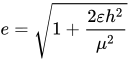
where ε is the specific orbital energy (total energy divided by the reduced mass), μ the standard gravitational parameter based on the total mass, and h the specific relative angular momentum (angular momentum divided by the reduced mass).
Hub AI
Orbital eccentricity AI simulator
(@Orbital eccentricity_simulator)
Orbital eccentricity
In astrodynamics, the orbital eccentricity of an astronomical object is a dimensionless parameter that determines the amount by which its orbit around another body deviates from a perfect circle. A value of 0 is a circular orbit, values between 0 and 1 form an elliptic orbit, 1 is a parabolic (escape orbit or capture orbit), and greater than 1 is a hyperbola. The term derives its name from the parameters of conic sections, as every Kepler orbit is a conic section. It is normally used for the isolated two-body problem, but extensions exist for objects following a rosette orbit through the Galaxy.
In a two-body problem with inverse-square-law force, every orbit is a Kepler orbit. The eccentricity of this Kepler orbit is a non-negative number that defines its shape.
The eccentricity may take the following values:
The eccentricity e is given by
where E is the total orbital energy, L is the angular momentum, mrdc is the reduced mass, and the coefficient of the inverse-square law central force such as in the theory of gravity or electrostatics in classical physics:( is negative for an attractive force, positive for a repulsive one; related to the Kepler problem)
or in the case of a gravitational force:
where ε is the specific orbital energy (total energy divided by the reduced mass), μ the standard gravitational parameter based on the total mass, and h the specific relative angular momentum (angular momentum divided by the reduced mass).