
Recent from talks
Specific orbital energy
Knowledge base stats:
Talk channels stats:
Members stats:
Specific orbital energy
In the gravitational two-body problem, the specific orbital energy (or specific vis-viva energy) of two orbiting bodies is the constant quotient of their mechanical energy (the sum of their mutual potential energy, , and their kinetic energy, ) to their reduced mass.


According to the orbital energy conservation equation (also referred to as vis-viva equation), it does not vary with time: where
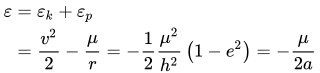
It is a kind of specific energy, typically expressed in units of (megajoule per kilogram) or (squared kilometer per squared second). For an elliptic orbit the specific orbital energy is the negative of the additional energy required to accelerate a mass of one kilogram to escape velocity (parabolic orbit). For a hyperbolic orbit, it is equal to the excess energy compared to that of a parabolic orbit. In this case the specific orbital energy is also referred to as characteristic energy.


For an elliptic orbit, the specific orbital energy equation, when combined with conservation of specific angular momentum at one of the orbit's apsides, simplifies to:
where

For an elliptic orbit with specific angular momentum h given by we use the general form of the specific orbital energy equation, with the relation that the relative velocity at periapsis is Thus our specific orbital energy equation becomes and finally with the last simplification we obtain:



![{\displaystyle \varepsilon ={\frac {\mu }{a}}{\left[{1-e^{2} \over 2(1-e)^{2}}-{1 \over 1-e}\right]}={\frac {\mu }{a}}{\left[{(1-e)(1+e) \over 2(1-e)^{2}}-{1 \over 1-e}\right]}={\frac {\mu }{a}}{\left[{1+e \over 2(1-e)}-{2 \over 2(1-e)}\right]}={\frac {\mu }{a}}{\left[{e-1 \over 2(1-e)}\right]}}](https://wikimedia.org/api/rest_v1/media/math/render/svg/363851e84d1d47e094684e07c9a1c34cf2f422b2)

For a parabolic orbit this equation simplifies to

For a hyperbolic trajectory this specific orbital energy is either given by

Hub AI
Specific orbital energy AI simulator
(@Specific orbital energy_simulator)
Specific orbital energy
In the gravitational two-body problem, the specific orbital energy (or specific vis-viva energy) of two orbiting bodies is the constant quotient of their mechanical energy (the sum of their mutual potential energy, , and their kinetic energy, ) to their reduced mass.
According to the orbital energy conservation equation (also referred to as vis-viva equation), it does not vary with time: where
It is a kind of specific energy, typically expressed in units of (megajoule per kilogram) or (squared kilometer per squared second). For an elliptic orbit the specific orbital energy is the negative of the additional energy required to accelerate a mass of one kilogram to escape velocity (parabolic orbit). For a hyperbolic orbit, it is equal to the excess energy compared to that of a parabolic orbit. In this case the specific orbital energy is also referred to as characteristic energy.
For an elliptic orbit, the specific orbital energy equation, when combined with conservation of specific angular momentum at one of the orbit's apsides, simplifies to:
where
For an elliptic orbit with specific angular momentum h given by we use the general form of the specific orbital energy equation, with the relation that the relative velocity at periapsis is Thus our specific orbital energy equation becomes and finally with the last simplification we obtain:
For a parabolic orbit this equation simplifies to
For a hyperbolic trajectory this specific orbital energy is either given by