Hubbry Logo
Edmond HallEdmond HallMain
Open search
Edmond Hall
Community hub
Edmond Hall
logo
8 pages, 0 posts
0 subscribers
Be the first to start a discussion here.
Edmond Hall
Edmond Hall
from Wikipedia

Key Information

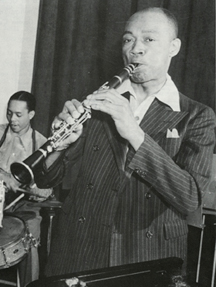
Edmond Hall (May 15, 1901 – February 11, 1967)[1] was an American jazz clarinetist and bandleader. Over his career, Hall worked extensively with many leading performers as both a sideman and bandleader and is possibly best known for the 1941 chamber jazz song "Profoundly Blue".

Biography

[edit]

Early life

[edit]

Born in Reserve, Louisiana, United States, about 40 miles west of New Orleans on the Mississippi River, Hall and his siblings were born into a musical family. His father, Edward Blainey Hall, and mother, Caroline Duhe, had eight children, Priscilla (1893), Moretta (1895), Viola (1897), Robert (1899), Edmond (1901), Clarence (1903), Edward (1905) and Herbert (1907).[1]

His father, Edward, played the clarinet in the Onward Brass Band,[1] joined by Edmond's maternal uncles, Jules Duhe on trombone, Lawrence Duhe on clarinet, and Edmond Duhe on guitar. The Hall brothers, Robert, Edmond, and Herbert, all became clarinetists,[1] but Edmond was first taught guitar by his uncle Edmond. When Hall picked up the clarinet, "he could play it within a week. He started Monday and played it Saturday," his brother Herb recalled in an interview with Manfred Selchow, who wrote a biography of Hall titled Profoundly Blue (1988).[2]

Hall worked as a farmhand, but by 1919 he had become tired of the hard work, and despite his parents' worries of him finding a decent job as a musician, he left for New Orleans. The first New Orleans band he played with was that of Bud Rousell (Bud Russell). He also played with Jack Carey (trombone) and blues cornetist Chris Kelley.

Music career

[edit]

In 1920, he went to a dance at Economy Hall in New Orleans where Buddy Petit was playing. Petit needed a replacement on clarinet, and he hired Hall.[1] After two years, he moved to Pensacola, Florida, and joined Lee Collins's band, followed by Mack Thomas, and the Pensacola Jazzers.[1] He met trumpeter Cootie Williams and, with Williams, he joined the Alonzo Ross DeLuxe Syncopators.[3]

Hall moved to New York City in 1928, and was a member of the Claude Hopkins orchestra until 1935.[4] Hall had been featured on alto and baritone saxophone since 1922. When he joined Billy Hicks's band, the Sizzling Six, he had a position as a full-time clarinetist. On June 15, 1937, he had his first recording session with Billie Holiday, accompanied by Lester Young on tenor saxophone.

At the Café Society, from left: Joe Williams, Andy Kirk, Edmond Hall, and John Hammond

In 1940, Henry "Red" Allen arrived at the Café Society, and Hall became the band's clarinetist.[4] Hall spent nine years at the Café Society, playing and recording in between jobs with many of his contemporaries, such as Sid Catlett, Charlie Christian, Ida Cox, Wild Bill Davison, Sidney De Paris, Vic Dickenson, Roy Eldridge, Bud Freeman, Coleman Hawkins, Eddie Heywood, J. C. Higginbotham, Meade Lux Lewis, Lucky Millinder, Hot Lips Page, Zutty Singleton, Joe Sullivan, Art Tatum, Jack Teagarden, Big Joe Turner, Helen Ward, and Josh White. He recorded for the first time as a leader in February 1941.

Late in 1941, Hall left Allen to join Teddy Wilson, who also played at the Café Society.[1] Around this time Hall's style changed. His admiration for Benny Goodman and Artie Shaw caused him to work on his technique. Hall tried a Boehm system clarinet, but that attempt was short-lived. He soon went back to his beloved Albert System clarinet, which he played until he died.

During this period, he made many recordings as Edmond Hall's Blue Note Jazzmen, the Edmond Hall Sextet, the Edmond Hall Celeste Quartet, Edmond Hall's Star Quintet, Ed Hall and the Big City Jazzmen, and Edmond Hall's Swingtet. The recording sessions always took place between the work hours of the Café Society and included many of the musicians who performed there. Hall was frequently invited to the Town Hall concerts led by Eddie Condon.[1]

In 1944, Teddy Wilson formed a trio, while the other band members remained at Café Society. Hall became a bandleader after being asked by Barney Josephson, owner of Café Society. He recorded for Blue Note and Commodore. In an Esquire magazine poll, he was voted the second-best clarinet player, behind the clarinetist he admired most, Benny Goodman.

With Louis Armstrong

[edit]

In the mid-1940s, Barney Josephson sought new musicians to play Café Society. In June 1947, Hall left the club. Early in 1947 Louis Armstrong's appearance at Carnegie Hall was announced. Hall and his small combo were picked to accompany Armstrong during half of the program. As a result of this concert, Armstrong would abandon his big band and switch a small combo, the All Stars.

In September 1947, Hall joined the All-Star Stompers with Wild Bill Davison, Ralph Sutton and Baby Dodds. Meanwhile, Barney Josephson again asked Hall to return to Uptown Café Society with a new band. Business worsened, however, and Josephson closed Uptown in December 1947. Hall took his men back to Downtown Café Society but, in June 1948, Hall's band was replaced with the Dave Martin Trio.

In late 1948, Hall took a job at Boston's Savoy Cafe, playing with members of Bob Wilber's band. He also promoted a concert with George Wein. Steve Connolly of the Savoy Cafe asked Hall to bring his own band and replace Bob Wilber. Hall's band, the Edmond Hall All-Stars, began playing the Savoy on April 4, 1949.

Hall left the Savoy in early March 1950 to return to New York. He played clubs and festivals, including one job in San Francisco. Eddie Condon called Hall in San Francisco, asking him to join his band at Eddie Condon's.[1] Hall stayed with Condon, playing other jobs as well, mostly with members from Condon's band. An example was the Annual Steamboat Ball in June 1951 and the frequent sessions for the Dr. Jazz broadcasts during 1952. Condon's band recorded many sessions during Hall's engagement.

In November 1952, Hall participated in a special concert, "Hot Versus Cool," which pitted New Orleans-style jazz against bop. The New Orleans-style musicians were Hall, Dick Cary, Vic Dickenson, Jack Lesberg, Jimmy McPartland, and George Wettling. On the opposite side were Ray Abrams, Don Elliott, Dizzy Gillespie, Al McKibbon, and Max Roach. The album received a top rating of five stars in DownBeat magazine. During 1954, Hall played with Ralph Sutton, Mel Powell, and Jack Teagarden.

At the end of 1955, Hall left Condon to appear as a guest musician on the Teddy Wilson show. He then replaced Barney Bigard in the Louis Armstrong band, which toured Europe and Sweden. Felix Blair of The New York Times wrote, "America's secret weapon is a blue note in a minor key. Right now its most effective ambassador is Louis Satchmo Armstrong."[citation needed] The quotation was used for the album Ambassador Satch.

Hall on a beach in Ghana, 1950

The band moved to Los Angeles to participate in the filming of High Society (1956) starring Grace Kelly and Bing Crosby. After tours in Australia and England, the band visited Ghana, Africa, where it played for its largest audience, 11,000 at the first concert.[citation needed] Back in the U.S., there was a performance with the New York Philharmonic under Leonard Bernstein. The evening's grand finale was Bernstein conducting the stadium symphony orchestra in an Alfredo Antonini arrangement of "Saint Louis Blues". The event was held at Lewisohn Stadium in New York, which drew a crowd of 21,000 people. The event was filmed as part of the documentary Satchmo the Great, produced and narrated by Edward R. Murrow, with film clips of the tours in Europe and Ghana.

The All Stars appeared on The Ed Sullivan Show before leaving for the midwest to play the Ravinia Festival near Chicago. They participated in a Norman Granz Benefit at Hollywood Bowl. In December 1956, they recorded the album Satchmo – A Musical Autobiography and supported it with a tour in the U.S. and South America. Hall became an honorary member of the Hot Club De Buenos Aires.

Tired of touring, Hall left the All-Stars and took a vacation in California. After his vacation, he performed with old friends Eddie Condon, Ralph Sutton, Teddy Wilson, Red Allen, and J. C. Higginbotham. Hall was invited to play with bands in Toronto, then returned to Chicago for an engagement at the Jazz, Ltd. club. At the end of 1958, he entered the studio to record Petit Fleur with his sextet, including friends from Cafe Society such as Vic Dickenson.

Hall returned to Ghana, having been impressed with its beauty, friendliness, and lack of racial prejudice. His goal was to settle there and start a music school. Hall and Winnie left New York for an exploratory trip, and when they returned they had decided to move to Ghana. Before moving, Hall was invited to the South Shore Jazz Festival in Milton, Massachusetts. He recorded Rumpus on Rampart Street with his orchestra, then left for Ghana. But his attempt at a music school failed. He was unable to get students to practice, and their lack of discipline and interest motivated his return to the U.S.

Hall flew to Copenhagen in 1961 to perform as a guest with Papa Bue's Viking Jazz Band. Returning home, he assembled the Hall American Jazz Stars and played at Condon's in New York City. During the early 1960s, he worked often, touring with Yves Montand and Chris Barber, and recording with Leonard Gaskin, Marlowe Morris, and the Dukes of Dixieland. In 1964, Hall and his wife settled in Cambridge, Massachusetts.

Last years

[edit]
Hall in Czechoslovakia, 1962

George Wein assembled a package of bands, and Hall was the featured star with the Dukes of Dixieland, who toured Japan in July 1964. He played at the Carnegie Hall Salute to Eddie Condon and appeared at jazz festivals, often with his friend Vic Dickenson.

For a few months, he played regularly at the Monticello restaurant, often in front of little or no audience as jazz was less popular. Hall would have played for as little as $50, but his wife did not let him unless the offer was at least $70–$75. By then Hall was semi-retired and would show up unexpectedly at a nearby pub where the local band, Tomasso and His Jewels of Dixieland, would play. According to Tomasso, they never knew when Hall would show up. Hall did that for an about six months for free, without any contract, for the pleasure of playing.

A break came in November 1966, when plans for a European tour were made. Hall was to play with Alan Elsdon's band during the tour, which began in England and extended to Germany, Denmark, and Sweden. Hall returned to Denmark to record for Storyville at the Rosenberg Studio in Copenhangen.

Hall was back home for Christmas. In January 1967, there was another important engagement, John Hammond's 30th Anniversary Concert – Spirituals to Swing at Carnegie Hall in New York. Hall was invited as he belonged the Café Society Band, which was featured at the concert. The next important concert was the Second Annual Boston Globe Jazz Festival on January 21, 1967. On February 3, 1967, Hall played at the Governor Dummer Academy with George Poor's band as a featured performer with Bobby Hackett. This was his last recording (JCD-233).

Hall died on February 12, 1967, at the age of 65.[5]

Private life

[edit]
Hall with his wife, Winnie, 1965

In April 1922, while playing in Buddy Petit's Band, Hall married 17-year-old girl Octavia Stewart. The marriage was prompted by the imminent arrival of their son, Elton Edmond Hall, who was born on July 20, 1922, but died as a child on December 3, 1934.

On May 12, 1938, he married his second wife, Winnifred Henry from Cambridge Massachusetts. He met her while he was a member of the Hopkins Band three years earlier at Ruggles Hall in Boston. The couple had no children. Hall was constantly practicing his clarinet even on his days off. Winnie sometimes was part of his travels. They had friends in England whom they visited frequently.

Throughout his career into the mid-1950s, Hall was confronted with race discrimination. In 1951, while playing at Condon's a film crew came in and wanted Hall to play the background track, but he was replaced with Pee Wee Russell for the actual shooting. Hall refused and called his union. Condon and the other musicians supported him. Losing a large audience in the south, if displaying a black man in the band was the company's reasoning. They did make two versions but in the end, the version with Hall was the only one released. Hall also recalled being talked to by police frequently, about the way he had parked his car, while others in the group were not bothered. On one occasion he and his wife were refused a hotel room and were forced to spend the night in their car.

In 1952, Hall, Buzzy Drootin and Ralph Sutton appeared as the Ralph Sutton Trio in Saint Louis, where they played the "Encore Lounge" for several weeks. They were the first mixed trio there.

Awards and honors

[edit]
  • Silver Award for clarinet, Esquire magazine, 1945[citation needed]
  • Certificate of nomination, one of outstanding jazz artists, Playboy magazine, 1961
  • Best Clarinetist, Melody Maker magazine, 1961

Discography

[edit]

As leader

[edit]
  • 1937–44 - The Chronological 1937–1944 (Classics, 1995)
  • 1941–44 - Profoundly Blue (Blue Note, 1998)
  • 1941–44 - Celestial Express (Blue Note, 1969)
  • 1943–44 - Jamming in Jazz (Blue Note, 1951) (& Sidney De Paris)
  • 1943 - Swing Session With Edmond Hall (Commodore, 1959)
  • 1944 - Rompin' in '44 (Circle, ?)
  • 1944–45 - The Chronological 1944–1945 (Classics, 1996)
  • 1949 - Jazz at the Savoy (Savoy, 1954)
  • 1958 - Petite Fleur (United Artists, 1959)
  • 1959 - Rumpus On Rampart St. (Mount Vernon Music, 1959)
  • 1966 - Edmond Hall with Alan Elsdon's Band (Jazzology, 1995)[6]
  • 1964–67 - Edmond Hall's Last Concert (Jazzology, 1996)

As sideman

[edit]
  • Louis Armstrong, European Concert by Ambassador Satch (Columbia, 1955)
  • Louis Armstrong & Eddie Condon, At Newport (Columbia, 1956)
  • Louis Armstrong, Louis and the Good Book (Decca, 1958)
  • Chris Barber, Chris Barber's American Jazz Band (Laurie, 1959)
  • Eddie Condon, Bixieland (Columbia, 1955)
  • Eddie Condon, Jammin' at Condon's (Columbia, 1955)
  • Wild Bill Davison, Ringside at Condon's Featuring Wild Bill Davison (Savoy, 1956)
  • Vic Dickenson, The Vic Dickenson Showcase (Vanguard, 1953)
  • Vic Dickenson & Urbie Green, Slidin' Swing (Jazztone, 1957)
  • Bud Freeman, Midnight at Eddie Condon's (Emarcy, 1955)
  • Leonard Gaskin, At the Jazz Band Ball (Prestige Swingville, 1962)
  • Marlowe Morris, Play the Thing (Columbia, 1962)
  • Jack Teagarden, Jazz Great (Bethlehem, 1956)

References

[edit]
[edit]
Revisions and contributorsEdit on WikipediaRead on Wikipedia
from Grokipedia
''Edmond Hall'' is an American jazz clarinetist known for his powerful, piercing tone, blues-inflected phrasing, and instantly recognizable sound that distinguished him among his contemporaries. Born on May 15, 1901, in Reserve, Louisiana, near New Orleans, Hall came from a musical family—his father Edward played clarinet in the Onward Brass Band, and several uncles and brothers were also musicians—and he initially learned guitar before switching to clarinet. He developed a distinctive voice relatively late, emerging strongly in the late 1930s after years of playing reeds in big bands, and became celebrated for bridging New Orleans traditional roots with swing-era innovation. Hall's early career took him through Southern bands and a recording debut with Alonzo Ross' De Luxe Syncopators in 1927, followed by a move to New York in 1928 and a long tenure with the Claude Hopkins Orchestra from 1929 to 1935. In the late 1930s and 1940s, he recorded extensively with Billie Holiday, Henry "Red" Allen, Teddy Wilson, and others, while leading sessions for Blue Note, including the influential 1941 Celeste Quartet with Meade Lux Lewis and Charlie Christian. His association with Eddie Condon began in the early 1940s, leading to residencies, Town Hall concerts, and broadcasts that showcased his extroverted, swinging frontline style. From 1955 to 1958, Hall achieved his highest visibility as a member of Louis Armstrong's All-Stars, replacing Barney Bigard and participating in global tours, major recordings, and filmed performances such as the 1957 "St. Louis Blues" with Leonard Bernstein. In later years, he freelanced with artists including Red Allen and Chris Barber, toured Europe extensively, and remained active in the New England jazz scene until his death from a heart attack on February 11, 1967, in Boston. Hall's legacy endures through his unique clarinet voice and his role in advancing small-group jazz during a transformative period.

Early life

Family background and childhood

Edmond Hall was born on May 15, 1901, in Reserve, Louisiana, a small town on the Mississippi River approximately forty miles west of New Orleans. He grew up in a Creole family deeply immersed in music, where relatives actively performed in local ensembles and brass bands typical of the region. His father, Edward Blainey Hall, played clarinet in the Onward Brass Band, exposing the household to regular musical activity. Hall's mother was Caroline Duhe, and her brothers—Lawrence Duhe, Jules Duhe, and Edmond Duhe—were also musicians who performed on clarinet, trombone, and guitar, respectively, contributing to the family's musical environment. Two of Hall's brothers, Herb Hall and Robert Hall, later pursued careers as clarinetists, reflecting the strong familial tradition in the instrument. Surrounded by this musical heritage from childhood, Hall experienced music as a constant presence in daily life and community gatherings near New Orleans. Until the age of 18, Hall worked as a manual laborer in various jobs while living in this musically rich but economically modest setting.

Early musical training and start in New Orleans

Edmond Hall's early musical training began on the guitar, which he learned from his uncle, Edmond Duhe. Although his family was deeply involved in music, with his father Edward Hall playing clarinet in the Onward Brass Band, Hall initially focused on guitar before transitioning to the clarinet around 1919. He reportedly mastered the basics of the clarinet quickly after the switch. In 1919, at the age of 18, Hall left behind farm work in Reserve, Louisiana, and moved to New Orleans despite his parents' concerns about the viability of a musical career. He soon secured early professional engagements in the city's vibrant jazz scene, beginning with Bud Roussell's band alongside trumpeter Lee Collins. He also played occasional jobs with trombonist Jack Carey and blues cornetist Chris Kelley during this initial period in New Orleans. These early experiences marked Hall's entry into professional music-making in the Crescent City before he pursued further opportunities outside the region.

Early career

Bands in New Orleans and the South (1919–1928)

Edmond Hall began his professional musical career in New Orleans after relocating there in 1919 at age 18, quickly securing positions with local bands. From 1921 to 1923, he played clarinet in the band of the influential but unrecorded cornetist Buddy Petit. In the mid-1920s, Hall moved to Pensacola, Florida, where he performed with several ensembles, including those led by Lee Collins and Mack Thomas, as well as the Pensacola Jazzers. His most significant engagement in the region came with Alonzo Ross’ DeLuxe Syncopators. In 1927, Hall made his recording debut with Alonzo Ross’ DeLuxe Syncopators, playing clarinet, soprano saxophone, alto saxophone, and baritone saxophone on eight sides. In 1928, he moved to New York City.

Claude Hopkins Orchestra in New York (1928–1935)

Edmond Hall relocated to New York City in 1928 after his time with bands in the South, initially arriving with Alonzo Ross's group. The following year he joined the Claude Hopkins Orchestra, where he remained a member until 1935. In the Claude Hopkins Orchestra, Hall functioned primarily as a section player within the reed section, one of three reed players in the ensemble. He focused on alto and baritone saxophone, doubling on baritone saxophone, while playing clarinet only occasionally. During this extended tenure, the orchestra made numerous recordings and performed regularly in New York venues, but Hall's contributions were largely supportive in the ensemble texture, with limited opportunities for solo exposure. Hall's clarinet playing in this period appeared only sporadically and did not yet display the distinctive, assertive style that would later define his reputation as a leading jazz clarinetist. This phase marked a continuation of his earlier multi-reed experience rather than the emergence of his personal clarinet voice.

Emergence as a leading clarinetist

Transition to clarinet specialist (1936–1940)

In 1937, Edmond Hall made the decisive shift to become a full-time clarinetist, abandoning saxophones completely at the age of 35–36 after years of doubling on reeds as a section player with the Claude Hopkins Orchestra. This change marked the true emergence of his personal voice on record, transforming him from a versatile sideman into a distinctive soloist. Hall's first significant recordings as a clarinet specialist came that year with Billy Hicks’ Sizzling Six, followed by sessions with Frankie Newton’s Uptown Serenaders and Henry “Red” Allen that highlighted his strong, original playing. Other accompaniment work from the late 1930s included sessions with Mildred Bailey and Midge Williams. During this transitional period, Hall developed a forceful clarinet sound characterized by strong vibrato and an intense, swinging delivery that set him apart in small-group jazz contexts.

Key recordings and collaborations (1941–1944)

In 1941, Edmond Hall made his debut as a leader on Blue Note Records with the Celeste Quartet, a chamber-style session that highlighted his emerging voice as a clarinet specialist. Recorded on February 5, 1941, at Reeves Sound Studios in New York City, the group featured Hall on clarinet alongside Meade Lux Lewis on celeste, Charlie Christian on acoustic guitar, and Israel Crosby on bass. The date produced several notable tracks, including "Jammin' in Four," "Edmond Hall Blues," "Profoundly Blue," "Profoundly Blue No. 2," and "Celestial Express," with "Profoundly Blue" standing out as a signature chamber jazz piece due to its introspective blues structure and the unusual, intimate instrumentation that allowed Hall's passionate tone to shine in a small-group context. Hall continued to record for Blue Note in 1943 with a heated Dixieland-oriented all-star session by his Blue Note Jazz Men. Held on November 29, 1943, at WOR Studios in New York City, the date included Sidney DeParis on trumpet, Vic Dickenson on trombone, James P. Johnson on piano, and other supporting players, capturing Hall in a vibrant traditional ensemble setting. During 1941–1944, Hall also collaborated on various recordings with artists such as Zutty Singleton, Joe Sullivan, Red Allen, Art Tatum, Lionel Hampton, Josh White, W.C. Handy, and Ida Cox, contributing his distinctive clarinet work to small-group and session dates across labels like Commodore. These projects further established his reputation in the evolving New York jazz scene.

New York jazz scene and Eddie Condon

Café Society residency and small groups (1940s)

Edmond Hall established a long residency at Café Society in New York City during the 1940s, a landmark integrated nightclub that provided a key platform for his clarinet work in small-group settings. He performed there with Henry “Red” Allen early in the decade before joining Teddy Wilson’s Sextet in late 1941, a group that held a regular engagement at the venue through 1944. The sextet featured Hall on clarinet alongside Wilson on piano and other swing musicians, offering him a prominent role in sophisticated small-band jazz during this period. In 1944, after Wilson's group shifted format, Hall transitioned to leading his own small band at Café Society, continuing his presence at the club throughout much of the decade. This residency allowed him to showcase his distinctive clarinet style in intimate performances, often as part of the venue's innovative interracial lineup. Concurrently, Hall pursued small-group recordings that highlighted his leadership, beginning with his debut as a leader for Blue Note in 1941 featuring the Edmond Hall Celeste Quartet with Charlie Christian on guitar and Meade Lux Lewis on celeste. These sessions and live appearances solidified his reputation in the New York jazz scene for blending New Orleans roots with swing-era sophistication.

Eddie Condon association (1943–1955)

In late 1943, Edmond Hall entered the world of Eddie Condon by substituting for clarinetist Pee Wee Russell in Condon's ensembles. He soon secured a regular role, appearing on Condon's famed Town Hall Concerts and contributing to the associated radio broadcasts that have since been reissued in full by Jazzology. In 1947, Hall assembled his own group to back Louis Armstrong for a concert at Carnegie Hall, an event whose success helped convince Armstrong to disband his big band and transition to a small-group format. Hall spent part of 1948–1949 in Boston, where he worked with Bob Wilber's combo at the Savoy Café. From 1950 to 1955, Hall performed nightly as part of the house band at Eddie Condon's club in New York, sometimes as the only African American musician on the bandstand. His consistent presence there exemplified his role in breaking color barriers in the New York Dixieland scene through his distinctive talent and sound. This period of close collaboration with Condon concluded in 1955 shortly before Hall joined Louis Armstrong's All-Stars.

Louis Armstrong All-Stars

Membership and major tours (1955–1958)

In 1955, Edmond Hall became a permanent member of Louis Armstrong's All-Stars, replacing clarinetist Barney Bigard. Armstrong recalled Hall's strong performance from their 1947 Carnegie Hall collaboration and welcomed his manager Joe Glaser's arrangement to bring Hall on board. Hall transitioned quickly, recording with the All-Stars just three days after finishing an album with Eddie Condon. From 1955 to 1958, Hall achieved the highest visibility of his career during the group's "Ambassador Satch" period, featuring extensive U.S. State Department-sponsored international tours. The All-Stars performed across Europe—including Scandinavia, Italy, Spain, France, and England—along with Australia, South America, and Africa, including a 1956 visit to Ghana where they played before huge crowds. Portions of this touring were captured in Edward R. Murrow's documentary Satchmo the Great. A notable highlight was the July 14, 1956, concert at Lewisohn Stadium, where Hall joined Armstrong's All-Stars with Leonard Bernstein and the New York Philharmonic for a performance of "St. Louis Blues." The demanding schedule of nonstop global travel ultimately exhausted Hall, who left the All-Stars in 1958 due to fatigue from constant touring and repetitive performances.

Recordings, performances, and media exposure

During his tenure with Louis Armstrong's All-Stars from 1955 to 1958, Edmond Hall contributed clarinet to several key recordings and participated in notable media appearances that showcased the group's performances. In 1957, Armstrong and the All-Stars, including Hall on clarinet, recorded Satchmo: A Musical Autobiography, a multi-disc project where Armstrong revisited his early repertoire with updated arrangements. Hall appeared with the All-Stars in the 1956 MGM film High Society, performing as part of Armstrong's band in musical sequences alongside Bing Crosby and Grace Kelly. He was featured in the 1957 documentary Satchmo the Great, directed by Edward R. Murrow, which included performance footage of the All-Stars and highlighted Hall's clarinet work during international tours. Additionally, Hall performed with Armstrong on the 1957 television special The Edsel Show, contributing clarinet to the rendition of "Now You Has Jazz." These appearances helped expose Hall's playing to broader audiences through film, television, and documentary formats during this period.

Later career

Freelance work and international activities (1958–1967)

After leaving Louis Armstrong's All-Stars in 1958, Edmond Hall took a brief non-playing vacation in California before returning to New York to resume a busy freelance career. He performed with Eddie Condon, Red Allen, Ralph Sutton, J.C. Higginbotham, Teddy Wilson, and others, and led a couple of his own albums during 1958–1959, including some selections featuring his brother Herb Hall on clarinet. In 1960, Hall and his wife Winnie returned to Ghana, where he attempted to establish a music school; the venture proved short-lived, and he soon resumed activities in New York. During the early 1960s, he recorded with British trombonist Chris Barber in the United States in November 1960 and joined Barber's band as a guest for a tour of England in November 1962, where he featured prominently in studio sessions and concerts alongside Barber, trumpeter Pat Halcox, and clarinetist Ian Wheeler. Hall also worked briefly with the Dukes of Dixieland in 1962 and joined them for a Japanese tour in 1964. In November 1966, he made his final European trip, performing with Alan Elsdon's band across England, Germany, Denmark, and Sweden, and recording in Copenhagen with Papa Bue’s Viking Jazz Band. In January 1967, Hall participated in John Hammond’s Spirituals to Swing concert at Carnegie Hall on January 15, performing "Swinging the Blues" with trumpeter Buck Clayton, tenor saxophonist Buddy Tate, and pianist Count Basie or Ray Bryant, and appearing on selections with vocalists Big Joe Turner and Big Mama Thornton. His last recording occurred on February 3, 1967, in a live set with cornetist Bobby Hackett. Hall remained active in performances and recordings until his death later that month.

Legacy and influence

Edmond Hall developed a distinctive powerful and blues-inflected clarinet tone in the mid-1930s after shifting to exclusive focus on the instrument, resulting in a piercing and instantly recognizable sound that set him apart from his contemporaries. His playing produced unmatched excitement and visceral impact, with no subsequent clarinetist replicating its unique quality or intensity. Hall played the Albert system clarinet throughout his career, valuing its rich, big tone—especially in the low register—for small-group Dixieland and traditional settings over the Boehm system's brighter sound. His approach remained rooted in the New Orleans clarinet tradition while incorporating swing elements influenced by Benny Goodman, allowing him to maintain a personal style amid evolving jazz trends. He gained significant recognition in jazz polls, placing second to Benny Goodman in Esquire magazine's clarinet category in 1943. As a prolific sideman and occasional leader across Dixieland and swing traditions, Hall's legacy endures through his forceful, authoritative approach and the enduring excitement of his playing.

Personal life

Marriages and family

Edmond Hall was married twice. His first marriage was to Octavia Stewart in April 1922 in Reserve, Louisiana. The marriage was prompted by the imminent birth of their son, Elton Edmond Hall, who was born on July 20, 1922. Elton died as a child on December 3, 1934. On May 12, 1938, Hall married his second wife, Winnifred (Winnie) Henry from Cambridge, Massachusetts. The couple had no children. Winnie occasionally accompanied Hall on his travels, including during his time in Ghana in 1960.

Death

Edmond Hall died of a heart attack on February 11, 1967, at the age of 65. He suffered the attack while shoveling snow in front of his home in Boston, Massachusetts. Some sources place the location in Cambridge, Massachusetts, where he resided at the time. The sudden death came shortly after his performances in the Boston area.

References

Add your contribution
Related Hubs
User Avatar
No comments yet.