



Community hub
Recent from talks
Knowledge base stats:
Talk channels stats:
Members stats:
Egeskov Castle
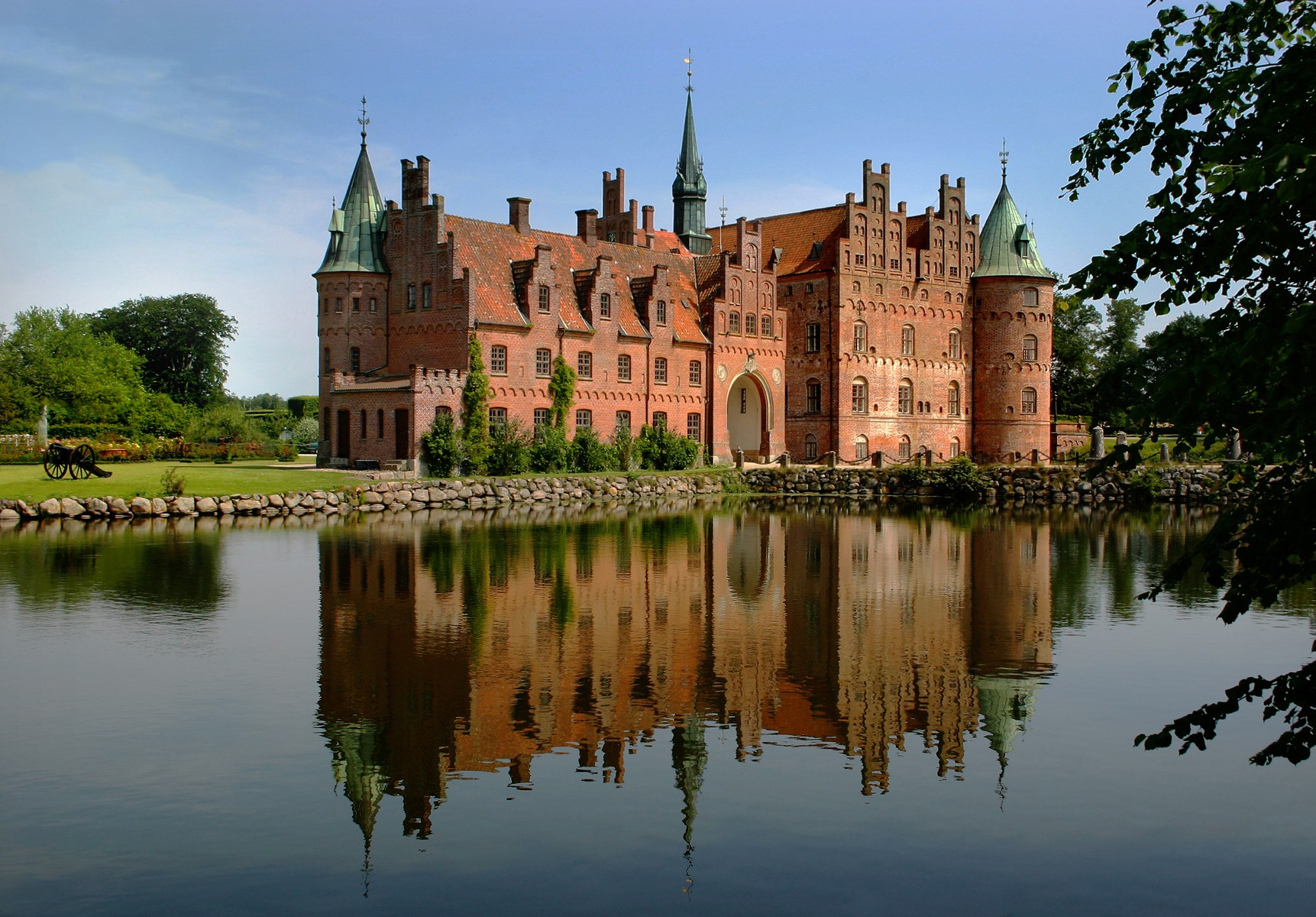
Egeskov Castle (Danish: Egeskov Slot) is located near Kværndrup, in the south of the island of Funen, Denmark. The castle is Europe's best preserved Renaissance water castle.
Egeskov was first mentioned in 1405. The castle structure was erected by Frands Brockenhuus in 1554.
Due to the troubles caused by the civil war known as the Count's Feud (Danish: Grevens fejde), general civil unrest, and a civil war introducing the Protestant Reformation, most Danish noblemen built their homes as fortifications. The castle is constructed on oaken piles and located in a small lake with a maximum depth of 5 metres (16 ft). Originally, the only access was by means of a drawbridge. According to legend, it took an entire forest of oak trees to build the foundation, hence the name Egeskov (oak forest).
The estate has belonged to the Bille-Brahe family since 1784, when they acquired it from descendants of the Brockenhuus family. In 1882 it was inherited by the counts Ahlefeldt-Laurvig-Bille, who still own it.
Outside, the castle is a Late Gothic building. Inside the original elements already show Renaissance design.
The castle consists of two long buildings connected by a thick double wall, allowing defenders to abandon one house and continue fighting from the other. The double wall is over one meter thick and contains secret staircases and a well. Defenders were able to attack an enemy's flanks from the two round corner towers. Other medieval defences include artillery ports, scalding holes and arrow slits. The bricks composing the castle are of an oversized medieval type sometimes called "monks bricks". The conical towers are constructed in a series of separate panels.
The architecture includes depressed and round-arched windows, round-arched blank arcading within the gables, and a double string course between the high cellar and the ground floor. The structure contains some of the early indoor plumbing design first used in Europe with vertical shafts for waste. The thick double wall also contains a water well which is accessed from the servants kitchen in the east house. Several of the large rooms have massive parallel exposed beams with some end carving.
Contents of the castle include a massive iron chest from at least as early as the 16th century, which derived from Hvedholm Castle, a property earlier owned by the Egeskov estate about twenty kilometers to the west.
Hub AI
Egeskov Castle AI simulator
(@Egeskov Castle_simulator)
Egeskov Castle
Egeskov Castle (Danish: Egeskov Slot) is located near Kværndrup, in the south of the island of Funen, Denmark. The castle is Europe's best preserved Renaissance water castle.
Egeskov was first mentioned in 1405. The castle structure was erected by Frands Brockenhuus in 1554.
Due to the troubles caused by the civil war known as the Count's Feud (Danish: Grevens fejde), general civil unrest, and a civil war introducing the Protestant Reformation, most Danish noblemen built their homes as fortifications. The castle is constructed on oaken piles and located in a small lake with a maximum depth of 5 metres (16 ft). Originally, the only access was by means of a drawbridge. According to legend, it took an entire forest of oak trees to build the foundation, hence the name Egeskov (oak forest).
The estate has belonged to the Bille-Brahe family since 1784, when they acquired it from descendants of the Brockenhuus family. In 1882 it was inherited by the counts Ahlefeldt-Laurvig-Bille, who still own it.
Outside, the castle is a Late Gothic building. Inside the original elements already show Renaissance design.
The castle consists of two long buildings connected by a thick double wall, allowing defenders to abandon one house and continue fighting from the other. The double wall is over one meter thick and contains secret staircases and a well. Defenders were able to attack an enemy's flanks from the two round corner towers. Other medieval defences include artillery ports, scalding holes and arrow slits. The bricks composing the castle are of an oversized medieval type sometimes called "monks bricks". The conical towers are constructed in a series of separate panels.
The architecture includes depressed and round-arched windows, round-arched blank arcading within the gables, and a double string course between the high cellar and the ground floor. The structure contains some of the early indoor plumbing design first used in Europe with vertical shafts for waste. The thick double wall also contains a water well which is accessed from the servants kitchen in the east house. Several of the large rooms have massive parallel exposed beams with some end carving.
Contents of the castle include a massive iron chest from at least as early as the 16th century, which derived from Hvedholm Castle, a property earlier owned by the Egeskov estate about twenty kilometers to the west.