Hubbry Logo
MachicolationMachicolationMain
Open search
Machicolation
Community hub
Machicolation
logo
8 pages, 0 posts
0 subscribers
Be the first to start a discussion here.
Machicolation
Machicolation
from Wikipedia

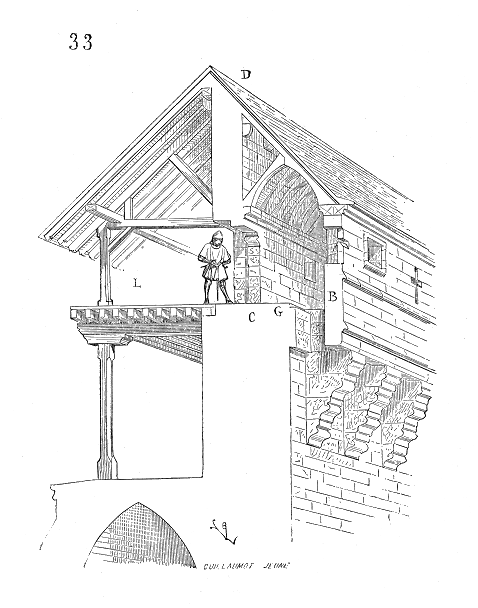
In architecture, a machicolation (French: mâchicoulis) is an opening between the supporting corbels of a battlement through which defenders could target attackers who had reached the base of the defensive wall. A smaller related structure that only protects key points of a fortification are referred to as Bretèche. Machicolation, hoarding, bretèche, and murder holes are all similar defensive features serving the same purpose, that is to enable defenders atop a defensive structure to target attackers below. The primary benefit of the design allowed defenders to remain behind cover rather than being exposed when leaning over the parapet. They were common in defensive fortifications until the widespread adoption of gunpowder weapons made them obsolete.

Key Information

Etymology

[edit]

The word machicolation derives from Old French machecol, mentioned in Medieval Latin as machecollum, probably from Old French machier 'crush', 'wound' and col 'neck'.[1] The verb Machicolate is first recorded in English in the 18th century, but machicollāre is attested in Anglo-Latin.[2][page needed]

Origins and Regional Prevalence

[edit]
15th-century machicolations of Craigmillar Castle in Scotland

The oldest known buildings with machicolation are Ancient Roman fortifications of the Limes Arabicus, such as Qasr Bshir and Qasr al-Hallabat, dating from the 4th century AD.[3] The design was brought to Europe from the Levant following the crusades and became especially prevalent in Southern Europe.

Machicolations were more common in French castles than English, where they are usually restricted to the gateway, as in the 13th-century Conwy Castle.[4] Within France, machicolation is more common on southern castles. One of the oldest extant examples of machicolation in northern France is at Château de Farcheville which was built from 1290 to 1304.[5]

Annotated sketch of an Italian battlement

See also

[edit]

References

[edit]
[edit]
Revisions and contributorsEdit on WikipediaRead on Wikipedia
from Grokipedia
A machicolation is a defensive architectural element in medieval fortifications, consisting of a projecting gallery or parapet supported by corbels with openings in the floor through which boiling oil, molten lead, stones, or other missiles could be dropped on attackers below. Also known as a "murder hole," it allowed defenders to target assailants at the base of walls or gates while providing a vantage for observation and counterattacks. The feature originated in ancient Egypt around 3000 BCE but saw significant revival and refinement in the Islamic world during the Umayyad period (8th century CE), with early stone examples appearing in structures across Iraq, Spain, and Syria by the 8th to 12th centuries. European adoption occurred primarily through Crusaders in the 12th century, as seen in advanced forms like slot and box machicolations at Syrian sites such as Crac des Chevaliers, where they protected wall bases and integrated with arrow slits for enhanced defense. These designs influenced Western castles, evolving from temporary wooden hoardings—used initially to douse fires set by besiegers—into permanent stone galleries by the late 12th and 13th centuries, often positioned over doorways, towers, and corners to exploit structural vulnerabilities. Prominent examples include the gallery machicolations at Crac des Chevaliers (late 12th century) and Château Gaillard in (1197–1198 CE), which demonstrated the feature's role in concentric castle layouts and its adaptation from Eastern models. By the late medieval period, machicolations transitioned from purely functional defenses to decorative motifs in , appearing in non-military buildings as ornamental projections.

Definition and Features

Architectural Description

Machicolations are overhanging architectural features in fortifications, consisting of a projecting or platform supported by or arches, with deliberate openings in the to facilitate defensive actions. These structures typically form part of the atop walls or towers, extending outward to cover the base of the structure below. The , often triangular or bracket-shaped projections, are arranged in series to bear of the overhanging section, creating a stable cantilevered platform that integrates seamlessly with the surrounding . Several types of machicolations exist, distinguished by their form and enclosure. The open type features simple overhanging slots formed by corbelled stones, leaving the space beneath exposed for direct vertical access. In contrast, the boxed type comprises an enclosed gallery or , providing defenders with greater while maintaining floor openings; these are often supported on multiple corbels and may include side walls or arrowslits for lateral defense. Semicircular variants curve outward in a rounded projection, enhancing coverage over corners or through their arched profile. Additionally, slot machicoulis represent narrower, linear openings integrated directly into walls, while bretèches form localized overhanging turrets. Murder holes, distinct from machicolations, are vertical openings typically in ceilings rather than projecting structures. Construction materials for machicolations were predominantly stone, such as or , for durability in permanent installations, though was used in regions with abundant clay resources, and timber occasionally for temporary or lighter elements like wooden hoardings, which served as precursors. Corbels were precisely cut and placed at regular intervals, with the overhanging platform extending beyond the wall face to optimize projection without compromising structural integrity. Floor openings were narrow and elongated to span multiple corbels, ensuring efficient passage of projectiles while limiting upward visibility for attackers. In design, machicolations integrated closely with battlements, often positioned between merlons to align with crenels, and served as a stone evolution of earlier wooden hoardings. They were embedded within the wall's thickness or added as projections on towers and gatehouses, enhancing overall defensive layering without altering the primary wall structure. This configuration allowed for the dropping of projectiles through the openings, providing vertical enfilade fire.

Defensive Functions

Machicolations served as a critical component of medieval fortifications, primarily enabling defenders to assail attackers positioned at the base of walls or gates without exposing themselves to return fire. This was achieved by allowing the vertical projection of projectiles such as stones, substances like or pitch, or even arrows through the overhanging openings, directly targeting assailants attempting to undermine structures or breach entrances. In addition to their offensive capabilities, machicolations facilitated secondary roles in and coordination during sieges. Defenders could observe enemy movements below the walls, identifying sappers or scaling parties, while the apertures also supported communication between upper levels of the fortress and ground forces, aiding in the of tactical instructions. These features often integrated with adjacent defensive elements, such as arrow slits for horizontal enfilade fire or murder holes—similar vertical openings in ceilings—for layered protection within gatehouses and passages. The tactical advantages of machicolations were particularly pronounced in addressing vulnerabilities inherent to vertical fortifications, such as dead angles at the wall bases where traditional parapets offered no coverage. By projecting outward, they enabled enfilade-style attacks on clustered attackers, effectively covering approaches to and towers while minimizing defender casualties. This enhanced overall resistance, especially in gatehouses where concentrated assaults were common, turning potential weak points into fortified kill zones. Despite these benefits, machicolations had notable limitations that could compromise their effectiveness in prolonged engagements. They were susceptible to damage from siege engines, such as trebuchets or , which could target the protruding corbels and disrupt the structure. Furthermore, in scenarios involving operations, attackers could counter by tunneling beneath the walls, rendering overhead drops ineffective if the machicolations did not align with the undermined sections. Their construction also demanded significant resources, restricting deployment to key defensive nodes rather than comprehensive wall coverage.

Historical Development

Origins in Medieval Europe

Machicolations first appeared in European fortifications during the 12th century within Crusader castles in the , where they were incorporated into the defensive architecture of structures built by military orders such as the Knights Hospitaller. These features, consisting of overhanging stone galleries or slots that allowed defenders to drop projectiles or boiling substances on attackers below, were particularly evident in northern Syrian fortresses like , which underwent significant expansion starting in 1142. The design likely drew influences from pre-existing Byzantine and Islamic architectural traditions, where similar overhanging elements had been used in fortifications since the Umayyad period (8th–12th centuries) to enhance base-of-wall defenses against sappers and escaladers. The adoption of machicolations by Crusaders reflected adaptations of Eastern defensive techniques encountered during the ongoing conflicts of the , a period marked by intensified warfare as both Christian and Muslim forces employed advanced engines like trebuchets and operations. This innovation addressed vulnerabilities at the foot of walls, providing a more permanent and effective alternative to temporary wooden hoardings used in earlier Norman castles. Returning Crusaders introduced machicolations to around 1190–1200, with one of the earliest documented examples appearing in at , constructed between 1196 and 1198 under King , who had direct experience from the Third Crusade. This castle featured slot machicolations akin to those at , marking a shift from predominantly wooden defenses to stone-integrated systems in response to the escalating threats of cross-Channel conflicts and royal ambitions. In , initial adoption followed suit in the early , as seen in fortifications influenced by Richard's campaigns, though stone machicolations remained rare until later refinements. The spread was driven by the practical lessons of Levantine sieges, where such features proved vital for repelling assaults without exposing defenders.

Evolution and Peak Usage

The transition to permanent stone machicolations in the marked a significant advancement in European design, replacing earlier temporary wooden hoardings that had been vulnerable to and damage. These stone structures, corbelled out from walls and featuring floor openings for dropping projectiles or boiling substances, were integrated directly into the of towers and gatehouses, enhancing durability and defensive efficiency. In , this shift accelerated after the civil unrest of the early , with royal initiatives promoting more robust stone fortifications in response to baronial conflicts. Machicolations reached their peak integration during the 14th century within Gothic-style concentric fortifications, where they complemented layered defenses such as inner and outer walls to create kill zones for attackers. This era saw their widespread use in sophisticated designs, exemplified by King Edward I's Welsh castles built in the late 13th and early 14th centuries, which represented the zenith of medieval military architecture through innovative combinations of machicolations with arrow slits and battlements. These features allowed for overlapping fields of fire and close-range assaults, optimizing defense against infantry assaults in an age of prolonged sieges. By the , the advent of began rendering machicolations obsolete, as the protruding stone galleries proved fragile against the horizontal battering forces of cannons and bombards, which could shatter corbels and expose walls. The fall of in demonstrated the vulnerability of traditional high-walled defenses, prompting a shift toward low, sloped bastions and earthworks in early fortifications, though isolated uses persisted in transitional forts until the widespread adoption of trace italienne designs. Machicolations were increasingly combined with barbicans—fortified outer enclosures—and posterns—secondary sally ports—to extend defensive coverage over approach routes, forming integrated gateway complexes that funneled enemies into trapped positions.

Regional and Cultural Variations

Prevalence in Western Europe

Machicolations became a dominant defensive feature in French medieval architecture during the 12th and 13th centuries, particularly in royal and seigneurial castles where they were integrated extensively along walls and gatehouses for enhanced protection against sieges. Elaborate examples appear in the chateaus, such as the Château de Sully-sur-Loire, where machicolations crown the walls, allowing defenders to target attackers below while maintaining structural integrity. In , adoption was more limited and later, often confined to gateways during 13th-century updates to existing fortresses, as seen in built by Edward I, reflecting a cautious integration influenced by French designs but adapted to insular warfare needs. Variations emerged in the , where machicolations in German castles like Marksburg featured more angular, protruding forms to suit rugged terrain and frequent border conflicts, emphasizing verticality over extensive horizontal coverage. On the , machicolations were prominently incorporated into fortifications during the , as in the walls of and the castle at Granadilla, blending Christian defensive innovations with Islamic influences to counter prolonged sieges by Muslim forces. These regional differences highlight how local building materials and strategic priorities shaped the feature's form, with stone corbels in and contrasting the hybrid brick-and-stone constructions in Iberia. Royal patronage significantly drove adoption rates, exemplified by Philip II of France's standardization of castle fortifications in the late 12th and early 13th centuries to consolidate power amid . Regional warfare, such as the Hundred Years' War's early phases and the Reconquista's ongoing campaigns, further accelerated their proliferation, as lords upgraded keeps to withstand and scaling attacks. By around 1300, machicolations were near-universal in major European , providing a tactical edge in urban and frontier strongholds, though rarer in rural keeps where simpler hoardings sufficed due to lower threat levels and resource constraints.

Adaptations in Non-European Contexts

In the , machicolation-like features, often referred to as "shooting holes" or overhanging openings for dropping projectiles, appeared in Islamic fortress architecture prior to or concurrent with Crusader influences, serving as integral defensive elements in urban citadels. The exemplifies this, where the Ayyubid-era () entrance complex incorporates projecting salients equipped with machicolations to allow defenders to target attackers below the walls, highlighting the sophistication of medieval Arab military design at the peak of its dominance. These structures drew from earlier Islamic traditions, emphasizing elevated fortifications that integrated natural terrain for enhanced protection, distinct from later European adaptations. In and , Mughal rulers incorporated corbel-supported projections inspired by machicolation concepts, adapting them with wooden elements to suit humid tropical environments where stone alone might degrade. For instance, the in features jharokhas—overhanging balconies braced by wooden or stone corbels—that blend aesthetic and ceremonial roles in fortress-palaces, with conceptual similarities to machicolations in providing elevated overlooks. This modification reflected a fusion of Persian-Islamic influences with local climatic needs, using lighter materials to create ventilated, projecting galleries for surveillance. Colonial expansions transferred machicolation designs directly to the , where Spanish engineers integrated them into fortifications during the 16th to 18th centuries to counter indigenous resistance and pirate raids. In , structures like the presidios around employed stone machicolations in bastioned walls to enable downward fire on assailants, adapting European trace italienne principles to terrains with coral rag and local . Independent parallels to machicolation emerged in East Asian defensive architecture, though lacking true corbelled overhangs; the utilized crenellated parapets with strategic overhangs in sections like the Jiayuguan Overhanging Great Wall, where the structure itself projects over cliffs to create natural drop points for defense. These features, built from and brick during the (14th-17th centuries), prioritized sloped walls and barrier projections for repelling climbers, offering conceptual similarities in overhead assault prevention without the articulated stone galleries of Western or Islamic designs.

Notable Examples and Legacy

Iconic Structures

The Château de Pierrefonds in , constructed primarily in the late 14th century under Louis d'Orléans, exemplifies the use of boxed machicolations as a key defensive element, particularly over its main gates and along the upper levels of its towers and curtain walls. These protruding stone galleries featured floor openings through which defenders could drop stones, boiling liquids, or other projectiles onto attackers below the walls, enhancing vertical defense without exposing personnel. The castle's machicolations were part of a comprehensive system, including a massive keep and double moats, designed to withstand sieges during the era. Following its partial destruction in the , the Château de Pierrefonds underwent extensive restoration from 1857 to 1885 under architect Eugène Viollet-le-Duc, who reconstructed the machicolations to faithfully replicate medieval designs while incorporating 19th-century interpretations of Gothic military . This work preserved the boxed form over the gates, making them prominent visual and functional features today. Archaeological insights from the restoration reveal that original 14th-century elements, such as supports for the machicolations, were integrated into the rebuilt structure, providing evidence of evolving defensive priorities in late medieval . The site remains well-preserved as a French historical , open to the public and maintained by the state since 1867. Caernarfon Castle in Wales, built from 1283 to 1330 under King Edward I as part of his campaign to conquer Wales, incorporates open machicolations integrated into its concentric walls, allowing for enfilading fire—cross-coverage of approach paths—to deter assaults on the outer defenses. These features are especially evident in the King's Gatehouse, a multi-towered structure with multiple portcullises and murder holes (a variant of machicolations) in the ceilings above passageways, enabling defenders to target enemies trapped in chicanes below. The design supported broader defensive tactics like coordinated arrow fire from wall-walks, making the castle a formidable symbol of English dominion. Recent archaeological excavations at , including a 2019–2020 dig by the , have uncovered foundational elements near the walls but confirm the machicolations' intact integration through non-invasive surveys, highlighting their role in the castle's incomplete yet robust 13th-century layout. As a World Heritage Site since 1986, the castle enjoys excellent preservation through minimal-intervention conservation, with ongoing management plans ensuring the authenticity of its defensive architecture. Krak des Chevaliers in , fortified by the Knights Hospitaller from 1142 to 1271 and later adapted by Mamluks in the late 13th century, showcases early Crusader-era machicolations in its outer walls, including complex box machicolations—enclosed projections with downward-facing slits—for protecting the perimeter against advances. These were strategically placed along the inner and outer circuits of the concentric layout, complementing arrow slits and hoardings to create layered defenses in the volatile frontier. The outer walls' machicolations reflect influences from Byzantine and Islamic fortifications, adapted for Crusader needs. Archaeological studies, including French Mandate-era surveys and post-2006 documentation, have revealed that the box machicolations at Krak were more elaborate than contemporaries like , with preserved corbels indicating reinforcements during the 13th century to counter siege engines. The castle's exceptional state of conservation, as one of the best-preserved Crusader fortresses, stems from limited modern alterations and clearance of overlying debris, though it faced minor damage from airstrikes during the (2011–present) and the 2023 earthquake; some sections have undergone restoration as of 2025, with ongoing efforts to fully repair war and seismic damage under Syrian law and oversight since 2006. Comparatively, these structures illustrate machicolations' evolution from open forms in 12th-century Crusader outposts like to integrated boxed variants in 13th–14th-century European designs at and Pierrefonds, with preservation varying by intervention: Krak's minimal restoration yields authentic Crusader insights, Caernarfon's oversight maintains structural integrity, and Pierrefonds' 19th-century rebuild offers a romanticized yet archaeologically informed view of medieval defenses. Archaeological work across sites underscores machicolations' role in enfilade tactics, providing tangible evidence of adaptive without exhaustive numerical analysis of their dimensions.

Influence on Later Architecture

During the 19th-century Romantic Gothic Revival, machicolations were revived as key elements in restorations and new designs to evoke medieval defensive grandeur. Architect prominently featured them in his work on French châteaus, restoring machicolations at the Narbonnaise gate and tower hoardings of the Cité of Carcassonne to reconstruct the site's military functionality while harmonizing form with historical purpose. These additions emphasized the machicolation's role in layered defense, such as enabling enfilading fire and dropping projectiles, thereby infusing the structures with a sense of national heritage and aesthetic vigor. Viollet-le-Duc's theoretical writings further elevated machicolations within architectural discourse, portraying them as exemplars of rational design where utility enhances beauty. In his Dictionnaire raisonné de l'architecture française du XIe au XVIe siècle, he detailed their structural integration in medieval fortifications, advocating for restorations that preserved this defensive logic rather than mere ornamentation. Similarly, in Discourses on Architecture, he described an immense machicolation at the Château de la Ferté-Milon gateway, adorned with a bas-relief of the Virgin's crowning, to illustrate how such features united practical defense with sculptural elegance in feudal architecture. The machicolation's legacy persisted symbolically in later styles, such as the of the 19th and early 20th centuries, where decorative machicolations adorned luxury homes and estates to convey baronial prestige without active defense needs. This ornamental adoption extended the form's influence into neo-medieval revivals, prioritizing evocative silhouettes over functionality in residential and public buildings. In 20th-century contexts, the overhanging principle inspired concrete projections in military bunkers, adapting the medieval enfilade to while retaining the core concept of elevated protection.

References

Add your contribution
Related Hubs
User Avatar
No comments yet.