Hubbry Logo
Egghead SoftwareEgghead SoftwareMain
Open search
Egghead Software
Community hub
Egghead Software
logo
8 pages, 0 posts
0 subscribers
Be the first to start a discussion here.
Contribute something
Egghead Software
Egghead Software
from Wikipedia
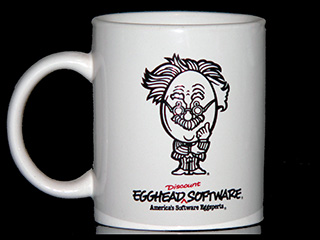
Employee coffee cup, c. 1988

Key Information

Egghead Software was an American computer software retailer. Founded in 1984, it filed for bankruptcy in 2001 and its domain name was acquired by Amazon.com.

History

[edit]

The company was founded by Victor D. Alhadeff in 1984, as a single store in Bellevue, Washington.[1]

Customers were able to sign up for a "CUE" card ("Customer Updates and 'Eggs' tras") that would provide discounts.[2]

By June 1987, when Alhadeff was 40 years old, the company had 50 stores on the West Coast of the United States.[3]

In June 1988, the company became a public company via an initial public offering. Within a year, the stock price dropped from $17 per share to $11 per share and top executives, including the founder, were sued for fraud for failing to disclose material facts about the true condition of the company's inventory systems and finances.[4]

By December 1989, the company had 206 stores, but closed 20 of them due to losses and inventory issues and theft.[5]

In June 1993, the company released its first software product, Egghead Express, which allowed customers to place and manage orders.[6]

In 1995, the company moved its headquarters from Issaquah, Washington, east of Seattle, to Spokane. At that time, it had 2,500 employees and operated retail stores in 30 states.[7]

Also in 1995, when the development manager of Windows 95 wanted to test compatibility, he bought a copy of every program for sale at an Egghead store.[8]

In 1996, George Orban became chairman and in January 1997, he became CEO. In May 1996, Egghead sold its Corporate, Government & Education division to Software Spectrum for $45 million.[9][10][11] At that time, the stock price was $6 per share and there was speculation of a takeover of the company.[12]

In February 1997, the company announced it would close 77 of its 156 stores and reported additional losses. In May 1997, the company acquired competitor Surplus Software Inc. for $31.5 million.[13]

In January 1998, the company reported a loss and announced it would close all 80 of its remaining stores, lay off 600 of its 800 employees, and sell only through its website, Egghead.com. Its stock price fell 18% on the news.[14][7][1]

In July 1998, during the dot-com bubble, shares soared 175% in a couple weeks.[15]

In 1999, the company merged with OnSale.com in a $375 million all-stock transaction. The company kept the Egghead.com name and the CEO of Onsale, Jerry Kaplan, became CEO of the combined company.[16][17]

In December 2000, right before Christmas, the company's servers were compromised, and it feared that the credit card data of over 3.7 million people was stolen.[18][19] The company first publicly denied that there was a problem, then notified Visa Inc., which notified banks, who notified consumers, causing the breach to escalate into a full-blown scandal.[20][21] Many credit cards were cancelled.[22] The company later discovered that credit card information was not obtained.[23]

In August 2001, the company filed bankruptcy and worked out a deal to be acquired by Fry's Electronics.[24] However, the deal fell apart after Fry's accused Egghead of failing to provide financial documents, and in December 2001, the company sold its domain name to Amazon.com.[25]

References

[edit]
Revisions and contributorsEdit on WikipediaRead on Wikipedia
from Grokipedia
Egghead Software was an American computer software retailer founded in 1984 by Victor D. Alhadeff in , initially operating as a chain of customer-friendly stores that emphasized low prices, knowledgeable staff, and trial periods for software products to appeal to non-technical consumers. The company rapidly expanded in the late 1980s, going public in 1988 and growing to over 100 stores nationwide by offering a wide selection of PC software and peripherals in an era when personal computing was emerging. It later diversified into mail-order catalogs and, in the mid-1990s, began experimenting with larger "superstore" formats and an electronics unit called Elekom to compete with big-box retailers like . By 1997, Egghead acquired Surplus Software to bolster its discount offerings and launched multiple websites, marking its pivot toward amid intensifying price competition and declining retail margins. Facing significant financial losses in the late due to aggressive pricing wars and the rise of online competitors, Egghead closed all 85 of its physical stores in 1998 to focus exclusively on its business as egghead.com. The company encountered further setbacks, including a major security breach on December 22, 2000, that exposed information of approximately 3.5 million customers. In 1999, it merged with Onsale Inc., an site, to strengthen its digital marketplace, but these efforts proved insufficient against the dot-com bust and ongoing operational challenges. Ultimately, Egghead filed for Chapter 11 bankruptcy on August 18, 2001, ceasing operations shortly thereafter, with its domain name acquired by Amazon.com later that year.

Overview

Founding

Egghead Software was founded in 1984 in , by entrepreneur Victor D. Alhadeff. Alhadeff, who had previously built a multimillion-dollar oil and gas tax shelter business called ENI Corp. that collapsed in the early 1980s due to falling energy prices, sought a new venture after facing personal challenges in purchasing software for his son's Apple computer in 1983. This experience highlighted the intimidating and customer-unfriendly nature of existing computer stores for non-technical buyers, motivating him to create a more approachable retail model focused on simplified software sales. The company launched with an initial investment of $50,000 from Alhadeff's personal funds and $1 million raised from local limited partners, including co-founder . The initial operations centered on the opening of Egghead's first retail store in Bellevue, which emphasized accessibility and trust-building features to differentiate from traditional computer retailers. The store stocked over 1,300 software titles sourced directly from publishers like and Lotus, offering discounts of up to 40% off list prices through volume purchasing. To further ease customer concerns, Egghead implemented a generous 30-day no-questions-asked return policy, allowing buyers to test software at home, alongside in-store demonstrations on up to four computers. These elements, combined with trained staff and a friendly mascot named Professor Egghead, aimed to demystify software purchasing for everyday consumers. By 1985, Egghead had begun rapid expansion within the , opening additional outlets to capitalize on growing demand for personal computing software while maintaining its core focus on customer-friendly retailing. This early growth laid the foundation for broader regional penetration, supported by a developing direct-sales force targeting corporate clients such as and .

Business Model

Egghead Software's business model centered on providing accessible software solutions to a growing market of users in the , focusing exclusively on software and peripherals while avoiding hardware sales initially. The company emphasized PC-compatible titles from major publishers such as and Lotus, stocking a wide selection of up to 1,300 titles in stores with additional inventory available from warehouses. This product focus catered to the emerging demand for user-friendly applications in an era when personal computing was still novel for many. The company's and service strategies were designed to build trust and accessibility for non-expert consumers and small businesses navigating the PC market. Egghead operated on a low-margin model that enabled competitive , such as offering 5 for $39.99 compared to its $99.95 list price, making software more affordable. To further support customers, it provided 30-day trial periods, employed knowledgeable staff trained to offer consultations and simplify complex software explanations, and fostered a no-pressure sales environment with in-store demonstrations on dedicated computers. Distribution channels centered on physical retail presence to reach a broad audience. Egghead's mall-based stores, averaging 1,500 square feet, served as primary touchpoints for hands-on experiences. This approach targeted non-expert users and small businesses seeking straightforward software solutions without the intimidation of specialized outlets.

History

Early Growth

Following its founding in 1984 with a single store in Bellevue, Washington, Egghead Software experienced rapid organic expansion during the mid-1980s, capitalizing on the burgeoning personal computer market ignited by the IBM PC's launch in 1981. The company positioned itself as a specialized retailer of software, distinguishing from general electronics chains like RadioShack by offering expert advice and a curated selection of PC-compatible titles, which appealed to the growing wave of home and business users navigating the PC boom. This focus enabled Egghead to build foot traffic through in-store demonstrations and a complementary mail-order catalog, driving early customer loyalty amid rising demand for applications like word processors and spreadsheets. By 1987, Egghead had grown to nearly 60 stores, concentrated primarily on the U.S. West Coast and Midwest, reflecting a strategic push into high-population areas with strong PC adoption rates. reached $77.5 million that fiscal year, nearly doubling from 1986 levels, fueled by increased store visits and catalog orders that accounted for a significant portion of . Profits stood at $2 million, underscoring the viability of its discount model in a market where software prices were dropping due to and volume . As expansion accelerated into early 1988, Egghead operated 107 stores across 13 cities, maintaining a $40 million software to meet surging demand. Amid this growth, founder Victor Alhadeff began planning management enhancements in the late 1980s to sustain momentum, culminating in the appointment of Stuart M. Sloan as president and CEO in February 1989 to guide further scaling. Sloan's role as an early investor positioned him to refine operations ahead of broader national rollout.

Expansion and Public Offering

Egghead Software went public on June 7, 1988, through an on the exchange, raising approximately $24 million. The proceeds were allocated primarily to support aggressive retail expansion and provide , allowing the company—which had already reached 107 stores across 13 cities by early 1988—to open approximately 100 additional stores in the following period. Building on this momentum, Egghead accelerated its growth throughout the late and early , reaching a total of 205 stores in 20 U.S. states by the end of 1991. This expansion capitalized on the rising demand for software, propelling annual sales to a peak of $665 million in fiscal 1991. The company's strategy emphasized strategic placement in high-traffic areas to serve the growing base of PC users. To adapt to evolving consumer needs, the company introduced larger superstore formats in 1995, with locations exceeding 10,000 square feet designed to stock not only software but also hardware and peripherals. These bigger outlets aimed to enhance the experience amid intensifying in the retail sector.

Acquisitions and Diversification

In the mid-1990s, Egghead Software sought to broaden its product offerings beyond software to counter intensifying from larger chains and online sellers. By 1996, the company had begun stocking computer peripherals such as printers and monitors, along with limited hardware selections like entry-level PCs, in select stores to appeal to a wider base seeking one-stop for needs. This shift marked an early diversification strategy, as Egghead's traditional focus on software titles—up to 1,300 in-store and 1,000 in warehouse stock—faced margin pressures from discounters and direct downloads. A pivotal move came in May 1997 when Egghead acquired Surplus Software Inc., a direct marketer of discounted and overstocked computer products, for approximately $31.5 million in stock, including the assumption of $5.6 million in debt. The acquisition enabled Egghead to enter the surplus market, reselling outdated but functional hardware, software, and accessories through catalogs and the newly launched website surplusdirect.com, which specialized in bargain inventory. This venture complemented Egghead's core operations by providing a channel for liquidating excess stock and attracting price-sensitive buyers, ultimately expanding to include an auction site, surplusauction.com, by late 1997. Parallel to these efforts, Egghead developed internal capabilities through its Elekom, established in late 1995 in partnership with Lotus Development Corporation to build online transaction tools. In November 1997, the company spun off Elekom as an independent entity focused on electronic commerce applications, while retaining a 25% ownership stake to leverage its technology for Egghead's growing digital sales. This partial divestiture allowed Egghead to monetize its innovations without full operational burden, positioning it for future online expansion. Overseeing these initiatives was George Orban, who assumed the role of CEO in January 1997 after serving as chairman since mid-1996. Orban, a former retail executive, directed the strategic pivots, including the Surplus acquisition and Elekom spin-off, as part of a broader effort to streamline operations amid declining physical retail viability. Under his leadership, Egghead tested alternative sales formats, such as automated kiosks in non-traditional locations like airports and office buildings, to extend reach beyond mall-based stores without full retail overhead. These moves reflected Egghead's proactive adaptation to the evolving tech retail landscape in the late 1990s.

Transition to E-Commerce

Store Closures

In January 1998, Egghead Software announced the closure of its remaining 80 physical stores as part of a strategic pivot to an , aiming to reduce costs in response to persistent operating losses and declining profit margins. The decision followed a challenging quarter ending December 1997, during which the company's sales fell 12.5% to $99.1 million, resulting in a $6.6 million net loss. The closures were driven primarily by intense competition from larger big-box retailers such as and , which offered broader product selections including hardware at competitive prices, eroding Egghead's in software . Egghead's smaller-format stores struggled to match the scale and pricing power of these superstores, exacerbating financial pressures amid years of revenue declines and unprofitable operations. The shutdown led to the layoff of approximately 800 employees, representing about 80% of the workforce, with the company taking a $42 million charge to cover closure costs, including the shuttering of its Sacramento distribution center. Inventory was liquidated through accelerated online sales and existing distribution channels to minimize losses during the transition. By February 1998, all physical stores had been closed, marking the complete end of Egghead's brick-and-mortar retail presence and a full shift of operations to e-commerce.

Online Rebranding and Merger

In 1998, Egghead Software underwent a significant rebranding to egghead.com, transitioning fully to an online-only retailer after announcing the closure of its 80 physical stores in January and completing it by February of that year. This shift positioned the company as a dedicated e-commerce platform for computer software and hardware, capitalizing on the growing internet market. As part of its online expansion, egghead.com launched or integrated specialized sites including surplusauction.com for auctions of refurbished and technology products and surplusdirect.com as an web warehouse for discounted goods. These platforms complemented the core egghead.com site, which focused on direct sales of software and hardware, and were built on acquisitions like Surplus Software in May 1997. Egghead.com's early online strategies emphasized software and hardware bundles to appeal to both and customers, drawing on prior catalog sales expertise for efficient web-based and . The company formed key partnerships, such as becoming the premier computer and software merchant on Yahoo! in February 1998, which helped drive initial traffic growth. By 1999, egghead.com had achieved substantial early performance, attracting over 7 million monthly customer visits and demonstrating rapid scaling in online engagement. However, the transition brought challenges in logistics scaling, contributing to operational losses from investments in and amid expanding demand. In November 1999, egghead.com merged with Onsale Inc. in a transaction, with Egghead shareholders receiving 0.565 shares of Onsale per Egghead share. The combined entity adopted the egghead.com name and relocated its headquarters to , while integrating Onsale's auction capabilities to enhance the surplus sites. This merger aimed to consolidate strengths in online retail and auctions, creating a broader platform for sales.

Decline and Closure

Financial Challenges

Egghead Software, rebranded as Egghead.com following its pivot to an online-only model in , encountered severe financial strain as it navigated the dot-com bubble's volatility. The company reported a net loss of $50.2 million in fiscal , driven primarily by substantial investments in and infrastructure to support the abrupt closure of its 85 retail stores and the shift to e-commerce operations. This transition, while aimed at —dropping costs from $100 million to about $14 million—exacerbated short-term profitability issues amid declining overall sales of $207.8 million for the year. In fiscal 1999, following its merger with Onsale Inc. in November, losses narrowed slightly to $34.4 million but remained burdensome, attributable to elevated expenditures, write-downs on outdated stock, and intensifying competitive dynamics in the online retail space. The competitive landscape during this period amplified Egghead.com's economic pressures, as the bursting dot-com bubble eroded market share for niche software retailers. Emerging giants like Amazon.com and eBay dominated online consumer electronics and software sales, offering broader selections and aggressive pricing that Egghead.com struggled to match, particularly in surplus and discounted categories. Additionally, mass-market retailers such as Best Buy and Circuit City undercut Egghead.com's pricing through economies of scale, further squeezing margins in a sector already reeling from the 2000-2001 economic downturn and reduced technology spending. These pressures contributed to a 2000 net loss of approximately $62 million, despite efforts to streamline operations post-merger. Operational challenges compounded these financial woes, particularly in online fulfillment and inventory management during the e-commerce ramp-up. The company's reliance on a surplus inventory model—acquired through the 1997 purchase of Surplus Software—led to overexpansion, resulting in substantial unsold stock and ongoing write-downs that strained cash flows by 2000. disruptions, including inefficiencies in transitioning from retail distribution to web-based , hindered and increased costs, as Egghead.com grappled with integrating auction-style sales from the Onsale merger into its core operations. These issues manifested in persistent inventory overhang and logistical bottlenecks, undermining the anticipated efficiencies of the online pivot. In response to escalating cash flow crises, Egghead.com implemented drastic workforce reductions in early 2001, ultimately cutting two-thirds of its staff—approximately 400 employees across multiple rounds—to preserve liquidity. This included a 29% reduction of 178 positions announced in 2001, targeting overhead in areas like operations and corporate functions, as the company sought to align expenses with declining revenues amid the broader tech sector contraction. Despite a $20 million from to stabilize operations, these measures proved insufficient to reverse the trajectory of mounting losses.

Bankruptcy and Asset Sales

On August 16, 2001, Egghead.com Inc. filed for Chapter 11 bankruptcy protection in the U.S. Bankruptcy Court for the Northern District of California, following unsuccessful attempts at cost-cutting measures that included laying off approximately 185 employees, or 59% of its workforce. The filing aimed to facilitate an orderly wind-down of operations, with the company's website remaining operational under court supervision to fulfill existing orders and manage inventory during the initial phase. This step came amid ongoing financial losses that had persisted from prior years. As part of the bankruptcy proceedings, Egghead agreed to sell substantially all of its assets to Fry's Electronics for $10 million, a deal announced concurrently with the filing and intended to transfer inventory, customer lists, and intellectual property to the California-based retailer. However, the agreement collapsed in early October 2001 when Fry's canceled the purchase after deciding to acquire Egghead's competitor, Cyberian Outpost, instead. The cancellation led Egghead to cease website operations on October 29, 2001, effectively halting all sales activities. In late November 2001, Amazon.com acquired Egghead's remaining assets—including its , trademarks, , and inventory—for $6.1 million through the court, allowing Amazon to relaunch the Egghead brand as a software-focused section of its own platform. The transaction marked the primary disposition of Egghead's core assets, with full of the estate completed by 2002 through court-supervised sales of any residual holdings. Egghead's case concluded in February 2003, with the final distribution of approximately $10.5 million in remaining cash to creditors, signifying the complete cessation of all operations. The brand name had been included in the Amazon acquisition as a distinct element of the transfer.

Legacy

Cultural Impact

Egghead Software occupies a cherished spot in the collective memory of and computer enthusiasts, evoking for the tactile experience of software retail in an era before widespread digital downloads. Tech communities often recall the chain's stores as informal hubs where young programmers and gamers spent weekends browsing aisles filled with boxed software on floppy disks and CDs, discovering titles through hands-on interaction rather than previews. This physical engagement made Egghead a gateway for non-experts to explore , with affordable bundles and productivity tools like upgrades priced at around $40, far below full retail costs. The stores' demo stations were particularly memorable, allowing customers to test games and applications in real time, fostering early attachments to software like Sierra adventure titles and LucasArts' Rebel Assault, which cost $40–$60 at the time. These setups turned into an entertaining rite for tech-curious youth, with employees occasionally rewarding frequent visitors—such as gifting a to a immersed in a demo—to encourage . Egghead's role extended to popularizing early PC gaming and , providing an accessible entry point amid the excitement of titles that defined the period's computing boom. In media and retrospective discussions, Egghead has been highlighted in technology articles as a pioneer of software retailing, with coverage in outlets like noting its dominance in merchandise during the decade. The chain's legacy resurfaced prominently in , marking the 24th anniversary of its 2001 bankruptcy, when tech enthusiasts shared stories online and in news features about its influence on PC culture. Documentaries and histories of retail evolution occasionally reference Egghead as emblematic of the pre-internet model. Symbolically, Egghead represents the pre-digital retail era, where software acquisition involved physical visits to strip-mall locations—peaking at around 200 U.S. stores—that contrasted sharply with today's instant downloads and app stores. This shift underscores the company's role in democratizing technology access, turning software shopping into a community experience that many view as a hallmark of analog computing's golden age.

Influence on Retail

Egghead Software pioneered the model of specialist software retail in the by establishing dedicated stores focused exclusively on computer software and peripherals, offering an extensive inventory of up to 1,300 titles at discounts of up to 40 percent off list prices. This approach included innovative customer trial policies, such as 30-day home trials and in-store demonstrations on up to four computers per location, which differentiated it from general retailers and built consumer trust in a nascent market. By , these strategies enabled Egghead to capture approximately 10 percent of U.S. software sales through 107 stores, setting a benchmark for specialized retail that influenced emerging chains like Babbage's and Software Etc., the latter of which evolved into . The company's aggressive pivot to in 1998, which involved closing all 85 remaining physical stores to focus solely on online sales, provided critical lessons for the sector by underscoring the perils of prematurely abandoning brick-and-mortar assets amid uncertain digital infrastructure. This multi-channel misstep, driven by declining retail margins and the allure of growth, resulted in operational challenges like high —90 minutes daily, over twice that of competitors—and ultimately contributed to Egghead's 2001 , highlighting the need for hybrid models that retain physical inventory advantages. These experiences informed subsequent strategies, such as Amazon's emphasis on diversified inventory management post-acquisition, avoiding over-reliance on pure digital channels during the dot-com era. Egghead's trajectory accelerated the broader industry shift in the from specialty software stores to online and mass-market distribution models, as software commoditization allowed big-box retailers like to undercut prices and capture share. Purchases from specialty stores for fell from 38 percent in 1994 to 18 percent by 2000, reflecting the rise of bundled PC sales and early online platforms that eroded the viability of niche chains. Egghead's expansion to over 200 stores and $500 million in sales by exemplified the peak of this model before competitive pressures forced adaptation. Following its closure, Amazon's 2001 acquisition of Egghead's domain and for $6.1 million enabled the integration of its software and inventory into Amazon's platform, bolstering the retailer's category and facilitating expanded through the early until digital downloads diminished physical sales in the . This asset transfer supported Amazon's growth in software offerings without the burdens of Egghead's failed pivot, contributing to a more resilient online retail ecosystem.

References

Add your contribution
Related Hubs
Contribute something
User Avatar
No comments yet.