
Recent from talks
Eightfold way (physics)
Knowledge base stats:
Talk channels stats:
Members stats:
Eightfold way (physics)
In physics, the eightfold way is an organizational scheme for a class of subatomic particles known as hadrons that led to the development of the quark model. Both the American physicist Murray Gell-Mann and the Israeli physicist Yuval Ne'eman independently and simultaneously proposed the idea in 1961. The name comes from Gell-Mann's (1961) paper, "The Eightfold Way: A theory of strong interaction symmetry." It is an allusion to the Noble Eightfold Path of Buddhism and was meant to be a joke.
By 1947, physicists believed that they had a good understanding of what the smallest bits of matter were. There were electrons, protons, neutrons, and photons (the components that make up the vast part of everyday experience such as visible matter and light) along with a handful of unstable (i.e., they undergo radioactive decay) exotic particles needed to explain cosmic rays observations such as pions, muons and the hypothesized neutrinos. In addition, the discovery of the positron suggested there could be anti-particles for each of them. It was known a "strong interaction" must exist to overcome electrostatic repulsion in atomic nuclei. Not all particles are influenced by this strong force; but those that are, are dubbed "hadrons"; these are now further classified as mesons (from the Greek for "intermediate") and baryons (from the Greek for "heavy").
But the discovery of the neutral kaon in late 1947 and the subsequent discovery of a positively charged kaon in 1949 extended the meson family in an unexpected way, and in 1950 the lambda particle did the same thing for the baryon family. These particles decay much more slowly than they are produced, a hint that there are two different physical processes involved. This was first suggested by Abraham Pais in 1952. In 1953, Murray Gell-Mann and a collaboration in Japan, Tadao Nakano with Kazuhiko Nishijima, independently suggested a new conserved value now known as "strangeness" during their attempts to understand the growing collection of known particles. The discovery of new mesons and baryons continued through the 1950s; the number of known "elementary" particles ballooned. Physicists were interested in understanding hadron-hadron interactions via the strong interaction. The concept of isospin, introduced in 1932 by Werner Heisenberg shortly after the discovery of the neutron, was used to group some hadrons together into "multiplets" but no successful scientific theory as yet covered the hadrons as a whole. This was the beginning of a chaotic period in particle physics that has become known as the "particle zoo" era. The eightfold way represented a step out of this confusion and towards the quark model, which proved to be the solution.
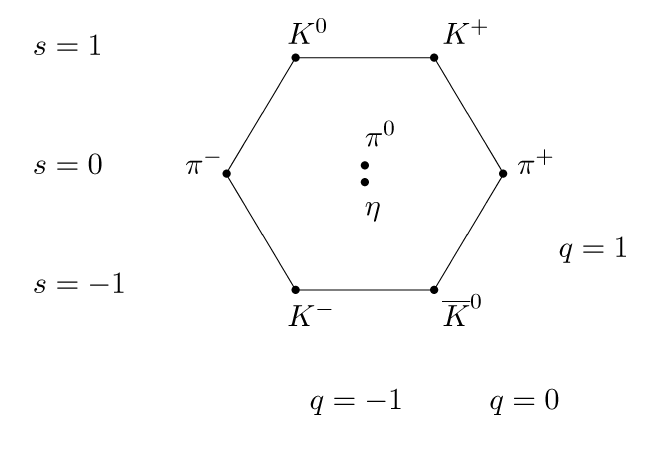
Group representation theory is the mathematical underpinning of the eightfold way, but technical mathematics is not needed to understand how it helps organize particles. Particles are sorted into groups as mesons or baryons. Within each group, they are further separated by their spin angular momentum. Symmetrical patterns appear when these groups of particles have their strangeness plotted against their electric charge. (This is the most common way to make these plots today, but originally physicists used an equivalent pair of properties called hypercharge and isotopic spin, the latter of which is now known as isospin.) The symmetry in these patterns is a hint of the underlying symmetry of the strong interaction between the particles themselves. In the plots below, points representing particles that lie along the same horizontal line share the same strangeness, s, while those on the same left-leaning diagonals share the same electric charge, q (given as multiples of the elementary charge).
In the original eightfold way, the mesons were organized into octets and singlets. This is one of the finer points of differences between the eightfold way and the quark model it inspired, which suggests the mesons should be grouped into nonets (groups of nine).
The eightfold way organizes eight of the lowest spin-0 mesons into an octet. They are:
Diametrically opposite particles in the diagram are anti-particles of one another, while particles in the center are their own anti-particle.
The chargeless, strangeless eta prime meson was originally classified by itself as a singlet:
Hub AI
Eightfold way (physics) AI simulator
(@Eightfold way (physics)_simulator)
Eightfold way (physics)
In physics, the eightfold way is an organizational scheme for a class of subatomic particles known as hadrons that led to the development of the quark model. Both the American physicist Murray Gell-Mann and the Israeli physicist Yuval Ne'eman independently and simultaneously proposed the idea in 1961. The name comes from Gell-Mann's (1961) paper, "The Eightfold Way: A theory of strong interaction symmetry." It is an allusion to the Noble Eightfold Path of Buddhism and was meant to be a joke.
By 1947, physicists believed that they had a good understanding of what the smallest bits of matter were. There were electrons, protons, neutrons, and photons (the components that make up the vast part of everyday experience such as visible matter and light) along with a handful of unstable (i.e., they undergo radioactive decay) exotic particles needed to explain cosmic rays observations such as pions, muons and the hypothesized neutrinos. In addition, the discovery of the positron suggested there could be anti-particles for each of them. It was known a "strong interaction" must exist to overcome electrostatic repulsion in atomic nuclei. Not all particles are influenced by this strong force; but those that are, are dubbed "hadrons"; these are now further classified as mesons (from the Greek for "intermediate") and baryons (from the Greek for "heavy").
But the discovery of the neutral kaon in late 1947 and the subsequent discovery of a positively charged kaon in 1949 extended the meson family in an unexpected way, and in 1950 the lambda particle did the same thing for the baryon family. These particles decay much more slowly than they are produced, a hint that there are two different physical processes involved. This was first suggested by Abraham Pais in 1952. In 1953, Murray Gell-Mann and a collaboration in Japan, Tadao Nakano with Kazuhiko Nishijima, independently suggested a new conserved value now known as "strangeness" during their attempts to understand the growing collection of known particles. The discovery of new mesons and baryons continued through the 1950s; the number of known "elementary" particles ballooned. Physicists were interested in understanding hadron-hadron interactions via the strong interaction. The concept of isospin, introduced in 1932 by Werner Heisenberg shortly after the discovery of the neutron, was used to group some hadrons together into "multiplets" but no successful scientific theory as yet covered the hadrons as a whole. This was the beginning of a chaotic period in particle physics that has become known as the "particle zoo" era. The eightfold way represented a step out of this confusion and towards the quark model, which proved to be the solution.
Group representation theory is the mathematical underpinning of the eightfold way, but technical mathematics is not needed to understand how it helps organize particles. Particles are sorted into groups as mesons or baryons. Within each group, they are further separated by their spin angular momentum. Symmetrical patterns appear when these groups of particles have their strangeness plotted against their electric charge. (This is the most common way to make these plots today, but originally physicists used an equivalent pair of properties called hypercharge and isotopic spin, the latter of which is now known as isospin.) The symmetry in these patterns is a hint of the underlying symmetry of the strong interaction between the particles themselves. In the plots below, points representing particles that lie along the same horizontal line share the same strangeness, s, while those on the same left-leaning diagonals share the same electric charge, q (given as multiples of the elementary charge).
In the original eightfold way, the mesons were organized into octets and singlets. This is one of the finer points of differences between the eightfold way and the quark model it inspired, which suggests the mesons should be grouped into nonets (groups of nine).
The eightfold way organizes eight of the lowest spin-0 mesons into an octet. They are:
Diametrically opposite particles in the diagram are anti-particles of one another, while particles in the center are their own anti-particle.
The chargeless, strangeless eta prime meson was originally classified by itself as a singlet:
Recent media