Hubbry Logo
Electric BraeElectric BraeMain
Open search
Electric Brae
Community hub
Electric Brae
logo
8 pages, 0 posts
0 subscribers
Be the first to start a discussion here.
Electric Brae
Electric Brae
from Wikipedia

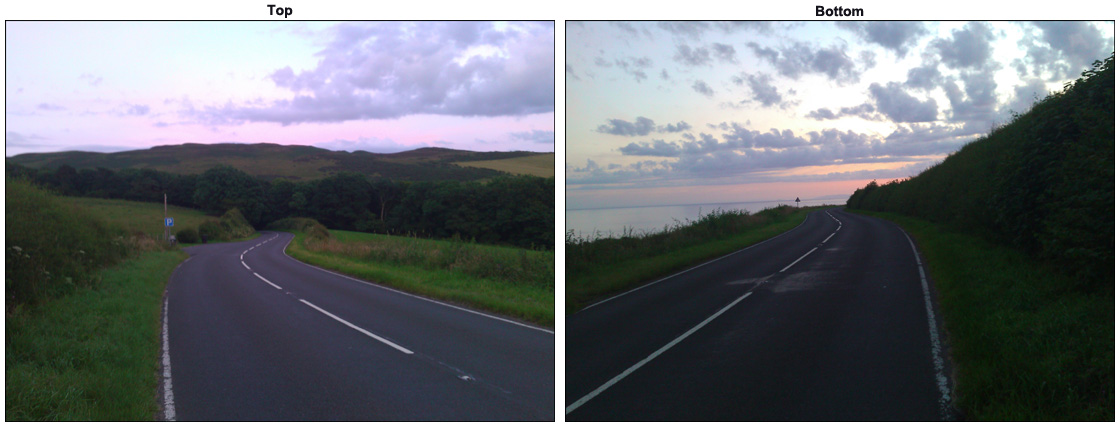
The road that appears to be running downhill is actually running uphill, and vice versa. Photographs taken from the middle of the brae.

The Electric Brae is a gravity hill in South Ayrshire, Scotland, where a freewheeling vehicle will appear to be drawn uphill by some mysterious attraction. The phenomenon is an optical illusion.

Etymology

[edit]

The term "Electric" dates from a time when it was incorrectly thought to be a phenomenon caused by electric or magnetic attraction within the Brae. The Lowland Scots word brae means a hill-slope or brow (with which it is cognate). The name has also been applied to other slopes in Scotland.

Location

[edit]

There is more than one stretch of road known as the Electric Brae. The most famous is on the A719, south of Dunure, not far from Ayr, between Drumshrang and Knoweside.[1] Metal road signs that used to mark the location have tended to be taken by visitors, and have been replaced by a stone inscribed with an explanation of the phenomenon.[a]

Explanation

[edit]

Although the road appears to be running uphill, a suitably free-running vehicle will slowly move off from a standstill. It was widely believed that vehicles were being propelled uphill by a mysterious magnetic force, but the road's apparently uphill slope is an optical illusion.[1] This runs the quarter of a mile from the bend overlooking Croy railway viaduct in the west (286 feet Above Ordnance Datum) to the wooded Craigencroy Glen (303 feet A.O.D.) to the east. Whilst there is this slope of 1 in 86 upwards from the bend to the Glen, the configuration of the land on either side of the road provides an optical illusion making it look as if the slope is going the other way. Therefore, a stationary car on the road with the brakes off will appear to move slowly uphill.

There are hundreds of gravity hills around the world. The explanation often given for the phenomenon is that of a visual illusion, similar to the well-known Ames room, in which balls can appear to roll against gravity.

World War II visitors

[edit]

During the Second World War General Dwight D Eisenhower had a flat at nearby Culzean Castle. Eisenhower took visitors to see the phenomenon. Many other American personnel from the air-base at Prestwick also visited.

See also

[edit]

References

[edit]
[edit]
Revisions and contributorsEdit on WikipediaRead on Wikipedia
from Grokipedia
Electric Brae is a in , , where an causes freewheeling vehicles to appear to roll uphill on a quarter-mile stretch of the A719 road between Dunure and Croy Shore. This phenomenon, known locally as Croy Brae, spans from a bend overlooking the Croy railway viaduct to Craigencroy Glen, where the actual terrain slopes upward at a of 1 in 86, but the surrounding landscape contours create the deceptive downhill appearance. The name "Electric Brae" originated in the from a widespread misconception that an electric or magnetic force—possibly linked to the nearby island of Arran—was drawing objects uphill, leading to explanations involving supernatural or electromagnetic attractions. By the early , the illusion was recognized as a scientific curiosity, with a stone marker erected by the local council to inform visitors and dispel myths; the marker describes the slope and effect, noting that a stationary car with its brakes off will seem to move "uphill." Electric Brae gained further prominence during when American General , headquartered at nearby , reportedly brought guests to experience the baffling sight. Today, it remains one of the United Kingdom's most famous gravity hills, drawing tourists to a designated layby for safe demonstrations, and serves as a classic example of how visual cues from the horizon and surrounding hills can override perceptions of .

Physical Description

Location

Electric Brae is situated in , , at precise coordinates of 55°22.85′N 4°45.4167′W. This positioning places it along the scenic southwest coastal route, accessible via the A719 road, which winds through the region's undulating terrain. The site lies south of the village of Dunure, specifically between the localities of Drumshrang and Knoweside, making it a notable feature on this stretch of roadway. It is proximate to key landmarks, including the Croy railway to the west, with the adjacent road bend at 286 feet above , and the wooded Craigencroy Glen to the east, with the adjacent road end at 303 feet above . These nearby elevations highlight the area's varied , with the offering a prominent visual reference point from the road. The Electric Brae segment itself spans a quarter-mile along the A719, aligning parallel to the southwest coast and featuring a subtle 17-foot incline from the coastal (western) end to the inland (eastern) end, resulting in an overall gradient of approximately 1 in 86. This alignment integrates the site into the broader coastal landscape, where the road's path enhances its accessibility for travelers heading toward or from Dunure.

Road and Landscape Features

The Electric Brae is a winding, narrow stretch of the A719 road in , , characterized by its cliffside positioning along the coastal route south of . This segment, approximately a quarter-mile long, follows the contours of the terrain, creating a series of gentle curves that hug the edge of the shoreline. The road itself ascends with a subtle overall of 1 in 86, rising from an elevation of 286 feet above at the western bend overlooking the Croy railway viaduct to 303 feet at the eastern end near the wooded Craigencroy Glen. The surrounding landscape amplifies the site's dramatic setting, featuring undulating hills that roll inland from the coast and steep cliffs that drop toward the . These cliffs provide unobstructed vistas across the water to the Isle of Arran and , with the island's prominent outline often visible on clear days, enhancing the scenic coastal drive. The interplay of these elevation changes and the rolling topography contributes to the area's visual complexity, where the road appears to weave through a deceptive incline amid the broader countryside. A prominent stone marker stands adjacent to a small parking area along the route, inscribed with explanatory text about the site's features. The inscription reads: "The ELECTRIC BRAE, known locally as 'CROY BRAE'. This runs the quarter mile from the bend overlooking in the west (286 feet Above ) to the wooded Craigencroy Glen (303 feet A.O.D.) to the east. Whilst there is this slope of 1 in 86 upwards from the bend to the Glen, the undulations of the road and the surroundings create the illusion that when the car is out of gear it is drawn uphill by some mysterious force." This durable stone serves as the primary on-site indicator, designed to inform visitors of the physical layout.

The Optical Illusion

Observed Phenomenon

At Electric Brae, a quarter-mile stretch of the A719 road in , , visitors observe vehicles in neutral gear or with handbrakes released appearing to defy by rolling uphill. The road visually presents a downward slope toward the , yet parked cars, bicycles, and even loose objects move steadily in the opposite direction, creating a striking and counterintuitive motion. This phenomenon is most pronounced near the Croy Railway Viaduct, where the effect draws vehicles from a standstill over the initial portion of the brae before tapering off along the full length. The sensory experience is disorienting, as the surrounding coastal landscape and undulating terrain enhance the of reversed motion, leaving observers baffled by the apparent upward pull. Despite the road's actual uphill gradient of approximately 1 in 86 from the viaduct to the inland end, the visual cues dominate, making the site a popular spot for testing with personal vehicles. Safety considerations are prominent due to the narrow, winding nature of the road and the illusion's potential to distract drivers. advise slow traffic, and a dedicated layby provided by Council allows visitors to safely park and observe the effect without impeding through traffic.

Scientific Explanation

The Electric Brae is a classic example of a , where the actual topography of the road is inverted in due to misleading environmental cues. The stretch of road in question slopes gently uphill from the coastal end to the inland end, rising approximately 17 feet over a quarter-mile distance, equivalent to a of 1 in 86. However, the surrounding landscape—characterized by undulating hills and a raised formed by distant inland elevations—creates a false visual reference that makes the downhill direction (toward the ) appear as an uphill incline. This misperception arises because the human relies on contextual cues like the horizon to gauge slope and depth; here, the tilted , known as the surface-referenced (SREL), biases the away from the true gravity-referenced (GREL), leading observers to underestimate the actual slant and reverse the apparent direction of gravity. From a standpoint, this exploits the brain's tendency to integrate relative heights and in the environment to construct a stable sense of orientation. At Electric Brae, the higher inland areas provide a deceptive downward reference point, causing the road's true uphill toward the interior to be perceived as downhill, while the coastal direction seems elevated. Experimental recreations, including tabletop models and field measurements at similar sites, demonstrate that slopes as shallow as 1.5% can appear horizontal or reversed when flanked by steeper contextual inclines, confirming the effect's dependence on these visual distortions rather than any physical anomaly. As a result, vehicles placed in neutral roll toward the coast—the actual downhill direction—but this motion is interpreted as defying gravity by ascending what appears to be an uphill path. This phenomenon is analogous to other well-documented illusions, such as the , where converging lines and depth cues distort perceived size and slant, or artificial gravity hills like those at mystery spots, where tilted surroundings override topographic reality. Unlike the , which primarily affects size perception through trapezoidal distortion, Electric Brae's effect hinges on horizon misalignment to fool slope estimation, a process rooted in the visual system's adaptation to natural terrains. Importantly, scientific analysis unequivocally attributes the illusion to these optical and psychological factors, with no evidence of , magnetic, or anti-gravity forces involved; laboratory simulations replicate the effect purely through visual manipulation.

History

Etymology and Early Naming

The term "brae" derives from Lowland Scots, referring to a hillside, , or steep , and is commonly incorporated into Scottish place names to denote such geographical features. This linguistic element reflects the region's , where undulating terrain often shapes local . The prefix "Electric" was added in the during the late , when the site's was popularly attributed to mysterious electromagnetic forces exerting an upward pull on vehicles, evoking the era's fascination with as an unseen power. These beliefs in magnetic attraction from nearby features, such as the Isle of Arran, contributed to the name's adoption as a descriptor of the perceived unnatural phenomenon. Prior to this renaming, the site was known locally as Croy Brae, a designation tied to its proximity to Croy Shore and the surrounding landscape. The name Electric Brae first emerged in 19th-century travel accounts, marking the location as a curiosity for visitors intrigued by its anomalous properties.

Pre-20th Century Beliefs

During the , the unusual phenomenon at what is now known as Electric Brae was attributed to a mysterious magnetic or electric force emanating from the nearby , which locals believed pulled vehicles and objects "uphill" against gravity. This theory emerged amid the era's burgeoning interest in , following discoveries like Michael Faraday's work on induction in the 1830s, though the concept was often misconstrued in popular imagination to explain natural anomalies. The name "Electric Brae" itself reflects this pseudoscientific interpretation, replacing the earlier local designation "Croy Brae" and evoking the era's fascination with electricity as a near-mystical power. Folklore surrounding the site portrayed it as a "magic hill" that defied Isaac Newton's laws of motion, with tales of carriages and carts inexplicably accelerating in the apparent uphill direction, drawing curious early tourists to the coast even before widespread automobile use. These stories aligned with broader 19th-century British interest in optical anomalies as portals to the or unexplained forces, often blending empirical observation with in a time when thrived alongside scientific progress. Visitors, including those traveling by horse-drawn conveyance along the A719 road, contributed to the site's growing reputation as a local wonder, where the prompted speculation about hidden energies in the landscape. This cultural context of s as evidence of pseudoscientific phenomena mirrored wider Victorian trends, such as the popularity of magic lanterns and spectral apparitions that blurred the line between reality and deception, fueling public intrigue with sites like Electric Brae. By the early , as automotive travel increased and surveying techniques improved, the magnetic myths were dispelled with the recognition that the effect was purely an caused by the surrounding terrain's visual cues.

World War II Visitors

During , Electric Brae served as a notable diversion for American military personnel stationed in , particularly those at the nearby airbase, which functioned as a crucial hub for the North Atlantic Ferry Command transporting aircraft and supplies across the ocean. Troops seeking brief respite from the rigors of wartime duties would travel to the site to witness the , where vehicles appeared to defy by rolling uphill, providing a momentary amid the era's tensions. This recreational outing highlighted the Brae's role as a simple yet captivating morale booster for service members far from home. General , serving as in , visited Electric Brae during the war while in the area, drawn by reports of the perplexing phenomenon. He reportedly brought dignitaries and allies to experience the illusion firsthand, using it as an amusing demonstration of nature's deceptive tricks. These visits underscored the site's novelty as a lighthearted interlude, even for high-ranking officers navigating the strategic demands of the conflict. The proximity of Electric Brae to , located just a few miles away along the coast, further facilitated such excursions, though Eisenhower's primary wartime presence in the region centered on operational bases like . Accounts from the period emphasize how the illusion's entertainment value offered a rare, apolitical escape, fostering camaraderie among Allied forces in .

Cultural and Modern Significance

Tourism and Visitor Experience

Electric Brae serves as a popular stop for road trippers exploring the scenic Ayrshire coast route in , , drawing visitors intrigued by its alongside attractions like . It receives consistent attention in travel resources, with over 100 reviews on averaging 4.2 out of 5 stars, highlighting its appeal as a quick, free diversion. Visitors are advised to experience the illusion safely by pulling into the designated lay-by on the A719 road, where vehicles in neutral appear to roll uphill; testing it mid-road is discouraged due to traffic risks. The site is accessible year-round, though the surrounding coastal landscape enhances the views during daylight hours, particularly on clear days along the route toward Dunure. The short visit typically lasts just a few minutes. By 2025, articles described it as a "mind-bending adventure," boosting its profile as an offbeat destination on lists. As part of South Ayrshire's landscape, Electric Brae contributes to the local economy, which ranked in the top quartile for tourism employment reliance in as of 2021, supporting nearby businesses through visitor traffic to coastal sites like . Electric Brae has been featured in early media as a captivating curiosity, notably in a 1971 BBC Nationwide report that highlighted the optical illusion drawing vehicles uphill, portraying it as a local phenomenon in Ayrshire. In modern coverage, Electric Brae gained prominence through Atlas Obscura's 2012 profile and a 2020 video demonstration, which explored the gravity hill's disorienting pull on objects. YouTube uploads continued this trend, including a 2025 video showcasing a car rolling "uphill" in neutral to illustrate the illusion. News outlets amplified its allure, with a 2023 Daily Record article describing the road's baffling effect on freewheeling vehicles, and 2025 pieces in Travel and Tour World emphasizing its role as one of Scotland's strangest drives. The site appears in cultural references as a symbol of Scotland's quirky landscapes, frequently listed among the UK's weirdest roads; for instance, a 2025 Ayr Advertiser report ranked it for its mind-bending optical trick that defies driver expectations, and in October 2025, named it the second weirdest road in Britain. Electric Brae's online presence includes demonstrations, such as a November 2024 Facebook video showcasing the effect.

References

Add your contribution
Related Hubs
User Avatar
No comments yet.