Hubbry Logo
Elmer LachElmer LachMain
Open search
Elmer Lach
Community hub
Elmer Lach
logo
8 pages, 0 posts
0 subscribers
Be the first to start a discussion here.
Elmer Lach
Elmer Lach
from Wikipedia

Elmer James Lach (/ˈlɑːk/ LAHK, January 22, 1918 – April 4, 2015) was a Canadian professional ice hockey player who played 14 seasons for the Montreal Canadiens in the National Hockey League (NHL). A centre, he was a member of the Punch line, along with Maurice Richard and Toe Blake. Lach led the NHL in scoring twice and was awarded the Hart Trophy in 1945 as the league's most valuable player.

Key Information

He won three Stanley Cups with Montreal. When Lach retired in 1954, he was the league's all-time leading scorer and was inducted into the Hockey Hall of Fame twelve years later. His number 16 was retired on December 4, 2009, during the Montreal Canadiens centennial celebrations. In 2017 Lach was named one of the '100 Greatest NHL Players' in history.[1]

Early life

[edit]

Lach was born in Nokomis, Saskatchewan, a small town 133 kilometres (83 mi) north of Regina. Elmer was the youngest of two boys and four girls born to William and Mary-Ann Lach, who arrived in Canada from Eastern Europe in 1910. Lach's father was at first a farmer, then took a job as the head of public works for Nokomis, population 550.[2] Lach played ice hockey for his school team, starting at age 12. Against the wishes of his Baptist parents, Elmer would sneak away to play ice hockey on a local pond instead of attending church on Saturday mornings.[2]

Lach began playing junior ice hockey with the Regina Abbotts in the 1935–36 season, arranged by a Nokomis doctor with contacts in Regina.[2] In Regina, Lach would work at the team's owner's pool hall, racking balls for 25 cents per day.[2] He played the two following seasons with the senior Weyburn Beavers of the Saskatchewan Senior Hockey League (SSHL). He moved again in 1938 to star for two seasons for the senior Moose Jaw Millers,[3] playing hockey in the winter for $75 a month and baseball in the summer, where he would be paid $2.50 per game behind the plate.[2] In his first season with the Millers, he led them in assists, with 20, and was the leading playoff scorer. He also scored 17 regular-season goals. The next season, he scored 15 goals and 29 assists and led in playoff scoring again. Lach was also noted for his defensive contributions.[4]

In 1937, Lach, along with future Hockey Hall of Fame member Doug Bentley attended the Toronto Maple Leafs training camp; both were rejected as too small for the National Hockey League.[5] According to Lach, Conn Smythe, manager of the Leafs, saw Lach and Bentley and said "They were sending me big guys from the West, but instead they’ve sent me peanuts."[6]

It was during his time in Moose Jaw that Lach met his future wife, Kay Fletcher. Lach had a job reading meters for the National Light & Power Co., and one day he met Kay in her home. They married in 1941.[2] That same year, Lach's mother died and his father moved to Vancouver, beginning a lifelong estrangement from his son.[2] In 1945, Elmer and Kay celebrated the birth of their only child, son Ron. Ron was born while Elmer was on the road with the Canadiens. According to Montreal Gazette columnist Dave Stubbs, Elmer wired Kay the message "Nice going, honey."[6]

Career

[edit]
The Punch line: Maurice Richard (bottom left), Elmer Lach (centre), and Toe Blake (bottom right)
The Broken Bone line: Maurice Richard, Elmer Lach and Tony Demers in 1942

Rejecting the Maple Leafs' assessment, the Montreal Canadiens signed Lach as a free agent on October 24, 1940. With the arrangement of Moose Jaw's owner Cliff Henderson, Montreal player-scout Paul Haynes paid Lach $100 for his rights, "more money than I'd had in my pocket in my life.".[2] He came to the Canadiens' training camp with only an overnight bag, not expecting to be offered a contract. Henderson had encouraged Lach to go, expecting him to return in time for the Millers' training camp, and be in better shape for it, but Lach never returned to the Millers.[6]

In his first NHL season, Lach played 43 games, scoring seven goals and adding 14 assists. He was limited to only one game the following season, after crashing into the boards in the first game, dislocating his shoulder, fracturing his wrist, and injuring his elbow.[6] He returned the following season to score 58 points in 45 games. A highlight of the 1942–43 season came when he set a still-standing Canadiens record of six assists in one game on February 6, 1943.[4]

In the 1943–44 season, Montreal head coach Dick Irvin tried a line combination of Lach at centre, Maurice Richard on the right wing, and Toe Blake at left. This line became known as the Punch line and dominated the NHL for four seasons. In the first season of the Punch line, Lach played 48 games, scoring on average an assist per game; he also added 24 goals. After the season, Lach was named to the Second All-Star Team. Montreal won the Stanley Cup, his first with the team, sweeping the Chicago Black Hawks in the Stanley Cup Finals series.[3][4]

In the 1944–45 season, Lach played in all 50 games, picking up a league-leading 80 points, of which 26 were goals and 54 were assists. That season, linemate Maurice Richard became the first player in the NHL to score 50 goals in 50 games. The Punch line amassed 220 points in total for the season, an NHL record until the 1960s. Lach won the Hart Trophy as the league's most valuable player and was named to the First All-Star Team.

In the 1945–46 season, Lach led all players with 34 regular season assists, and was named once more to the Second All-Star Team. The Canadiens won the Stanley Cup for the second time in Lach's career, defeating the Boston Bruins in five games.

In the 1947–48 season, Lach became the first recipient of the Art Ross Trophy, after leading the league in points, with 61. The Punch line era ended when Blake retired due to injury at the end of the season. At the end of the 1948–49 season, Lach announced his retirement while recovering from a fractured jaw, but returned for the following season.[7] Lach led the league in assists for the last time in the 1951–52 season, with 50.

In the 1952–53 season, Lach won his third and final Stanley Cup in a memorable finish. In the 1953 Stanley Cup Finals against the Boston Bruins, Lach scored the cup-winning goal at 1:22 of overtime in the fifth game of the series. In the on-ice celebration immediately after the goal, Maurice Richard accidentally broke Lach's nose with his stick.[3][4] In 1953–54, Lach was again held back by injuries and his place was taken by another great, Jean Béliveau, whom he tutored in faceoffs. When the playoffs began, Lach was no longer a full-time player, but he was inserted into the lineup in the 1954 Stanley Cup Finals when Montreal fell behind in the series. Montreal extended the series to seven games but ultimately lost.

Lach received numerous injuries during his career. His nose was broken seven times; his jaw (later permanently wired) was broken three times, officially only twice as he did not tell Irvin of one fracture because he did not want to come out of a game; a fractured skull that at first was treated as a "slight concussion". In one incident Lach suffered two severed veins in his foot from the slash of a skate blade. He played on until a teammate saw the blood.[6] According to Ted Reeve, curator of the Hockey Hall of Fame in the 1950s, any pictorial record of the 1940s NHL would have to include prints of Lach's X-rays.[6] Lach was injured so many times that he was offered $17,000 (enough for a house at the time) by his health insurance company to retire from hockey.[8]

Lach was known for his skills at passing and speed in skating. Beliveau spoke glowingly of Lach's passing ability in his biography. He was also known for his competitiveness and willingness to fight in the corners to get the puck. According to writer Trent Frayne, "To some, [Elmer Lach] is hockey’s greatest competitor; to others, ‘the nastiest so-and-so in the league‘, in a 1950 article in the Saturday Evening Post.[8][9]

Later life

[edit]
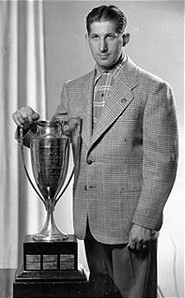
Lach in 1945

Lach retired after the 1953–54 NHL season as the league's all-time leading scorer, having played 664 regular season games, scoring 215 goals and 408 assists for 623 points, as well as 76 playoff games, in which he scored 19 goals and 45 assists for 64 points. He retired to accept an offer to coach the Montreal Junior Canadiens. He also coached the Montreal Royals for two seasons, before pursuing business interests. He worked for Maislin Transport for 30 years[10] in sales and public relations,[6] retiring in the 1980s.[8]

He was elected into the Hockey Hall of Fame in 1966.[3] In 1998, he was ranked number 68 on The Hockey News' list of the 100 Greatest Hockey Players.[4] On December 4, 2009, coinciding with the Canadiens centennial celebration, his jersey number, 16, was retired a second time to honour Lach (along with Emile Bouchard's No. 3; No. 16 had been retired previously for Henri Richard).[11]

Lach was married to Kay until she died in 1985.[2] He married his second wife, Lise Desjardins, years later.[2] The two lived together in Pointe Claire, Quebec.[12] Lise Lach died October 13, 2014, at age 87 from leukemia.[13]

Golf was a favourite pastime of Lach's. He played it into his 90s and for a while could match his age in his score.[6] He met his second wife, Lise, while golfing. Part of his job entertaining clients with Maislin was taking them golfing.[6] His son Ron was the manager of the Beaconsfield Golf Club.[14]

On March 28, 2015, Lach suffered a stroke at a long-term care facility in Beaconsfield, Quebec, where he had moved after Lise's death.[6] He never regained consciousness and on April 4, 2015, died at the West Island Palliative Care Residence in Kirkland, Quebec.[6] He had been the oldest living former Canadiens player.[15] Lach's final public appearance was at the funeral of Jean Béliveau on December 10, 2014.[6]

Career statistics

[edit]
    Regular season   Playoffs
Season Team League GP G A Pts PIM GP G A Pts PIM
1935–36 Regina Abbotts S-SJHL 2 0 1 1 2 4 3 0 3 6
1936–37 Weyburn Beavers S-SSHL 23 16 6 22 27 3 0 1 1 4
1937–38 Weyburn Beavers S-SSHL 23 12 12 24 44 3 2 1 3 0
1938–39 Moose Jaw Millers S-SSHL 29 17 20 37 23 10 6 4 10 8
1939–40 Moose Jaw Millers S-SSHL 30 15 29 44 20 8 5 9 14 12
1939–40 Moose Jaw Millers AC 3 1 1 2 4
1940–41 Montreal Canadiens NHL 43 7 14 21 16 3 1 0 1 0
1941–42 Montreal Canadiens NHL 1 0 1 1 0
1942–43 Montreal Canadiens NHL 45 18 40 58 14 5 2 4 6 6
1943–44 Montreal Canadiens NHL 48 24 48 72 23 9 2 11 13 4
1944–45 Montreal Canadiens NHL 50 26 54 80 37 6 4 4 8 2
1945–46 Montreal Canadiens NHL 50 13 34 47 34 9 5 12 17 4
1946–47 Montreal Canadiens NHL 31 14 16 30 22
1947–48 Montreal Canadiens NHL 60 30 31 61 72
1948–49 Montreal Canadiens NHL 36 11 18 29 59 1 0 0 0 4
1949–50 Montreal Canadiens NHL 64 15 33 48 33 5 1 2 3 4
1950–51 Montreal Canadiens NHL 65 21 24 45 48 11 2 2 4 2
1951–52 Montreal Canadiens NHL 70 15 50 65 36 11 1 2 3 4
1952–53 Montreal Canadiens NHL 53 16 25 41 56 12 1 6 7 6
1953–54 Montreal Canadiens NHL 48 5 20 25 28 4 0 2 2 0
NHL totals 664 215 408 623 478 76 19 45 64 36

Sources: HHOF,[16] SIHR.[17]

Awards

[edit]
  • Art Ross Trophy (1948; also led the league in scoring in 1945).
  • Hart Trophy (1945)
  • NHL First All-Star Team centre (1945, 1948, 1952)
  • NHL Second All-Star Team centre (1944, 1946)
  • Hockey Hall of Fame (1966)
  • Saskatchewan Sports Hall of Fame (1967)
  • In January 2017, Lach was part of the first group of players to be named one of the '100 Greatest NHL Players' in history.[1]

Source: Hockey Hall of Fame,[16] Saskatchewan Sports Hall of Fame.[18]

References

[edit]
[edit]
Revisions and contributorsEdit on WikipediaRead on Wikipedia
from Grokipedia
Elmer Lach (January 22, 1918 – April 4, 2015) was a Canadian professional ice hockey centre who played his entire 14-season National Hockey League (NHL) career with the from 1940 to 1954. Born in , , Lach was renowned for his exceptional playmaking skills, amassing 623 points (215 goals and 408 assists) in 664 regular-season games despite frequent injuries, including seven broken noses and multiple jaw fractures. He was a pivotal member of the Canadiens' famed forward line with wingers and from 1943 to 1948, which powered the team to two victories in 1944 and 1946, and helped secure a third Cup in 1953. Lach's individual accolades underscored his dominance as one of the NHL's premier centres during the . In the 1944–45 season, he captured the as the league's most valuable player after leading the NHL with 80 points, including a league-high 54 assists, while earning a spot on the NHL First All-Star Team. Three years later, in 1947–48, he won the as the top scorer with 61 points and again made the First All-Star Team; he was also selected to the Second All-Star Team in 1944 and 1946, and to the First All-Star Team in 1952. Nicknamed "Elegant Elmer" for his graceful style, Lach set a Canadiens record with six assists in a single game on February 6, 1943, and scored the overtime winner in Game 5 of the 1953 Final against the . His resilience was evident as he missed only about 150 games due to injuries over his career, often returning quickly to contribute offensively. Following his retirement in 1954, Lach briefly coached the Montreal Royals in the Quebec Hockey League and later worked in sales and for Maislin Transport, a Montreal-based trucking company. He was inducted into the in 1966 and the Saskatchewan Sports Hall of Fame in 1967, and the Canadiens retired his number 16 jersey in 2009, and he was named one of the in 2017, in recognition of his legacy as a trailblazing playmaker and three-time champion.

Early life

Family and upbringing

Elmer James Lach was born on January 22, 1918, in the small rural community of , , as the youngest of six children to William Lach and Nathalie Marie Lach, Polish immigrants who had settled in the area after arriving from Russian Poland around 1910. His siblings included Edith and Lydia, born in Russian Poland, and Helen, Margaret Adella, Erick, and himself, all born in . The family resided on a in the Last Mountain Valley region, where William worked as a farmer, relying on the challenging prairie agriculture for their livelihood. The Lach family's farming life was marked by the economic hardships prevalent across during the of , a period known as the "Dirty Thirties," characterized by severe droughts, infestations, hailstorms, and plummeting prices that devastated millions of acres and led to widespread rural poverty. These conditions forced many prairie families, including those like the Lachs, to endure financial strain, food shortages, and labor-intensive survival efforts, fostering a sense of perseverance amid adversity. By the 1931 census, the family still operated their own farm, with young Elmer contributing to daily chores typical of rural immigrant households. Lach attended local schools in , part of the district established in 1907, where enrollment had grown significantly by the to support the community's children; at age 13, he was recorded as a balancing with farm duties. Beyond academics, he gained early exposure to community sports in , a town active in recreational activities like through leagues such as the 1915 League and , with its first held in 1907, providing outlets for youth amid the harsh rural environment.

Introduction to hockey

Elmer Lach's affinity for hockey developed during his childhood in the small rural community of , , where he spent time skating and playing on local outdoor rinks and ponds. His family's support for his athletic interests helped foster this early passion, despite the modest circumstances of small-town life in the 1920s and early 1930s. Lach's first foray into organized hockey came at age 17, when he joined the Regina Abbots of the for the 1935–36 season, appearing in a handful of games that marked his transition from casual play to structured competition. This brief junior stint showcased his emerging talent as a speedy and skilled , earning him notice in 's hockey circles and setting the stage for further development. By age 18, Lach advanced to senior amateur play, signing with the Beavers of the Saskatchewan Senior Hockey League before moving to the Millers, where he spent several seasons refining his playmaking abilities and offensive prowess. His performances with the Millers, including strong scoring outputs that helped the team claim a league championship in his final year there, drew the attention of professional scouts seeking promising talent from the western leagues. It was during his time in that Lach met Kathleen "Kay" Fletcher; the two married in 1941, shortly before his entry into professional hockey.

Professional career

Junior and minor league beginnings

Lach's early promise in junior hockey emerged with the Regina Abbots of the in 1935-36, where he appeared in two regular-season games and contributed three points in the playoffs. Transitioning to senior competition, he joined the Weyburn Beavers of the Senior Hockey League for the 1936-37 and 1937-38 seasons, amassing 28 goals and 18 assists over 45 games while developing his endurance through physical, demanding play in the rough Western leagues. In 1938, Lach relocated to , , to play for of the same league, balancing shifts at a sponsoring flour mill with on-ice duties; over two seasons (1938-39 and 1939-40), he recorded 32 goals and 49 assists in 59 regular-season games, highlighting his emerging playmaking ability with high assist totals. These standout performances in Saskatchewan's senior circuits drew attention from Montreal Canadiens scout Paul Haynes, who arranged for the Millers' owner to release Lach, culminating in his signing as a free agent with the Canadiens organization on October 24, 1940, for a $4,000 salary plus a $1,000 bonus. The outbreak of World War II in 1939 disrupted minor and senior league operations across Canada and the U.S., with reduced schedules, travel restrictions, and enlistments delaying full professional transitions for many players like Lach until the 1940-41 season.

NHL debut and early success

Elmer Lach made his NHL debut with the during the 1940-41 season, a time when was causing significant roster shortages across the league as many players enlisted in the military. Signed to a $4,000 plus a $1,000 bonus after starring for the senior , the 22-year-old center appeared in 43 games, recording 7 goals and 14 assists for 21 points while accumulating 16 penalty minutes. His debut season showcased his potential amid the Canadiens' rebuilding efforts, as wartime conditions opened opportunities for young talent like Lach to fill gaps left by departed veterans. The following 1941-42 season proved challenging, as Lach played just one game before suffering a severe injury against the Detroit Red Wings, shattering his elbow, fracturing his wrist, and dislocating his shoulder, which sidelined him for the remainder of the year. Returning healthier in 1942-43, he secured a full-time role, playing 45 games and tallying 18 goals and 40 assists for 58 points, finishing tied for fifth in league scoring. This breakout performance highlighted his adaptation from minor and senior leagues, where his playmaking skills had been honed. Lach quickly established himself as a premier playmaking known for his exceptional vision and precise passing, often creating scoring chances through clever lane-clearing and feeds to wingers. His rising prominence culminated in his first NHL selection at the end of the 1943-44 season, earning Second Team honors after leading the Canadiens with 24 goals and 48 assists for 72 points in 48 games. Key moments included multi-point outings against rivals, such as his contributions in high-stakes games versus the , where his assists helped drive offensive surges.

The Punch Line era

The Punch Line, one of the most potent forward lines in NHL history, was fully assembled during the 1943–44 season when Maurice "Rocket" Richard returned from injury to join Elmer Lach at center and on left wing for the . This trio's chemistry stemmed from Lach's tireless playmaking and ability to clear lanes for his linemates, Blake's positional reliability as the anchor, and Richard's explosive finishing, allowing them to dominate offensively while complementing each other's strengths on the ice. The line earned its nickname from Montreal newspapers for its , captivating fans with high-scoring performances that solidified their status as local heroes amid the wartime-era league. In the 1943–44 season, Lach led the NHL with 48 assists in 48 games, setting the stage for the Canadiens' Stanley Cup triumph, where the Punch Line combined for 10 of Montreal's 16 goals in the four-game sweep of the Chicago Black Hawks in the finals—following a hard-fought semifinal victory over the Toronto Maple Leafs. The following year, 1944–45, Lach elevated his game further, topping the league in assists again with a record 54 while accumulating 80 points (26 goals, 54 assists) in 50 games, earning him the Hart Memorial Trophy as the NHL's most valuable player and helping the Punch Line finish 1-2-3 in league scoring. His playmaking prowess was exemplified earlier in his career by a Canadiens record of six assists in a single game against the Boston Bruins on February 6, 1943, a feat that underscored his vision and speed in feeding teammates during the line's formative years. The Punch Line's dominance continued into the 1945–46 season, contributing 19 of Montreal's 45 playoff goals en route to another , clinched in a five-game final series against the , where intense rivalry fueled their performances—Richard scoring the Cup-winning goal in Game 5. Throughout this era, the line's synergy not only overwhelmed opponents but also intensified Montreal's storied feud with Boston, drawing fervent adoration from Canadiens fans who packed the Forum to witness their offensive fireworks. Lach later reflected on the trio as simply "a line" that meshed naturally, their unselfish play driving two championships and establishing a benchmark for forward line excellence in the Original Six era.

Later seasons and retirement

Following his severe skull fracture sustained on January 30, 1947, against the , Elmer Lach remarkably returned to the lineup the following season. The injury, caused by a hit from Gus Mortson that left Lach unconscious and required extensive recovery, had initially threatened to end his career. Despite lingering effects that reduced his skating speed, Lach led the NHL in scoring during the 1947–48 season with 61 points (30 goals and 31 assists) in 60 games, earning the inaugural as the league's top point producer. As the 1950s progressed, Lach's production declined amid mounting injuries and the Canadiens' transitional phase toward a roster rebuild. In the 1952–53 season, he recorded 16 goals and 25 assists for 41 points in 53 games, a noticeable drop from his peak years, though he still contributed six game-winning goals. The team's focus on younger talent and Lach's accumulating physical toll limited his role, reflecting the end of the Punch Line's dominance. Lach's career concluded abruptly in the 1953–54 season after a fractured that severely impaired his mobility, prompting his at age 36. Playing in 48 games that year, he tallied 5 goals and 20 assists for 25 points before the injury sidelined him permanently. The Canadiens honored his 14-season tenure with an emotional send-off, recognizing his resilience and contributions to three championships, a legacy bolstered by his earlier exploits.

Achievements and legacy

Individual awards and records

Elmer Lach's exceptional playmaking ability earned him the as the National Hockey League's most valuable player for the 1944–45 season, during which he led the league with 54 assists and 80 points. He became the inaugural recipient of the in 1947–48 as the league's leading scorer with 61 points, highlighting his consistent offensive dominance. Lach was recognized as one of the NHL's top centers multiple times through All-Star selections, earning First Team honors in 1945, 1948, and 1952, as well as Second Team nods in 1944 and 1946. His record-setting 54 assists in 1944–45 marked the first time any player reached 50 in a season, a milestone that underscored his era-defining distribution skills. He led the league in assists on three occasions—1944–45 with 54, 1945–46 with 34, and 1951–52 with 50—further cementing his reputation as a premier setup man. In terms of single-game feats, Lach set a record on February 6, 1943, by recording six assists in an 8–3 victory over the , with five of those coming on goals by teammate Ray Getliffe. Over his career, he amassed 408 assists in 664 games, a total that ranked among the highest for his position in the Original Six era, reflecting his pivotal role in the Canadiens' offensive schemes.

Team contributions and posthumous honors

Elmer Lach played a pivotal role in the ' victories in 1944, 1946, and 1953, serving as the playmaking center of the famed alongside and . In the 1944 playoffs, Lach recorded 11 assists, tying for the league lead and providing crucial setup plays that helped defeat the Chicago Black Hawks in the Finals. His vision and passing ability were instrumental in fueling the team's offensive surge during that championship run. During the 1946 playoffs, Lach emerged as the undisputed leader for the Canadiens, amassing 17 points on 12 assists—a new NHL postseason record at the time—and earning recognition as the series MVP in their triumph over the . This performance underscored his ability to elevate teammates like and Blake under pressure, solidifying the Punch Line's dominance. In 1953, at age 35 and in his final season, Lach delivered the overtime goal in Game 5 of against , clinching the Cup and marking a fitting capstone to his contributions amid a lineup featuring emerging stars. His win in 1945 further illustrated how his individual excellence directly bolstered Montreal's team success. Lach's enduring legacy extended beyond his playing days, with induction into the Hockey Hall of Fame in 1966 as a player, honoring his role in revitalizing the Canadiens during a transformative era. He was also enshrined in the Saskatchewan Sports Hall of Fame in 1967, recognizing his roots and impact on Canadian hockey. As the last surviving member of the Punch Line following the deaths of Blake in 1995 and Richard in 2000, Lach became a living symbol of Montreal's golden age. In 2017, he was named one of the NHL's 100 Greatest Players as part of the league's centennial celebration, affirming his foundational influence on future playmakers like Jean Béliveau, whom he mentored in face-offs and team play. Lach's tenure helped lay the groundwork for Montreal's dynasty of the late 1950s, emphasizing skilled, intelligent hockey that influenced subsequent generations of Canadiens forwards. Until his death in 2015 at age 97, he held the distinction of the oldest living NHL player, outlasting contemporaries by over four decades.

Later life and death

Post-retirement activities

After retiring from the NHL following the 1953–54 season due to cumulative injuries, Lach transitioned into coaching roles within Montreal's hockey community. He served as head coach of the Montreal Junior Canadiens in the Quebec Junior Hockey League during the 1954-55 season, where the team finished with a 16–17–1 record. Lach then moved to the senior level, coaching the Montreal Royals of the Quebec Hockey League for two seasons from 1955 to 1957, guiding the team to records of 34–23–7 in 1955-56 and 28–34–6 in 1956-57. Following his coaching tenure, Lach entered the , joining Maislin Transport, one of Canada's largest trucking companies at the time, where he worked in sales, , and promotions for over three decades until the company's in 1983. In this role, he leveraged his celebrity status to build client relationships, often through outings and networking events. Lach maintained ties to the Montreal Canadiens organization through occasional involvement in alumni activities, including attending games and participating in centennial celebrations in 2009, where he greeted fellow legends and . He also spoke at public events, such as a 2009 presentation at City Hall alongside broadcaster on Canadiens history. In his later years, Lach embraced a quiet lifestyle in the area of , residing in and largely avoiding the public spotlight while enjoying simple pleasures like meals with friends at local establishments.

Personal life and passing

Elmer Lach married Kathleen "Kay" Fletcher on May 24, 1941, in , , where they had met while she worked at a local plant and he read meters for the utility company. Their marriage lasted 44 years until Kay's death from cancer in 1985. The couple had one son, Ron, born in 1945, who went on to become general manager of the Beaconsfield Golf and Country Club near and predeceased his father in 2012. Lach was also a great-uncle to entrepreneur through Kay's family connections. Following Kay's passing, Lach married Lise Desjardins Morel in 1985, sharing 30 years together until her death in October 2014. He was survived by stepdaughters Michèle Morel of Atlanta, Georgia, and Denise Morel, as well as grandchildren including Trevor James Lach and Marc Morel. Lach spent his post-retirement years residing in the suburbs of , including areas like Kirkland and , where he lived a quiet, low-profile life away from the spotlight of his hockey fame. In the , Lach's health began to decline, particularly after the successive losses of his wives, leading him to spend time in a convalescent before entering . At age 97, he held the distinction of being the NHL's oldest living former player. Lach died of natural causes on April 4, 2015, at the Residence in . In keeping with his humble nature, the family held no public funeral, instead organizing a private memorial service for close friends and relatives, which included prominent hockey figures. Donations in his memory were directed to the Lakeshore General Hospital Foundation in . Specific burial details were not disclosed.

Career statistics

Regular season performance

Elmer Lach's NHL regular season career spanned 14 seasons with the from 1940 to 1954, during which he appeared in 664 games, scoring 215 goals and recording 408 assists for a total of 623 points. This performance yielded an average of 0.94 , a strong output in an era characterized by physical play and limited scoring opportunities. Lach's production showed steady improvement in his early years, peaking during the 1944-45 season when he tallied 26 goals and a league-leading 54 assists for 80 points in just 50 games, earning him the as the NHL's . He repeated as the league's top assist producer in 1945-46 with 34 assists and again in 1951-52 with 50, accomplishments particularly notable in the NHL's era (1942-1967), where competition was intense among only six teams and seasons typically featured 50 to 70 games. Following a solid 1950-51 campaign with 45 points, Lach's output declined in his final seasons, dropping to 41 points in 1952-53 and 25 points in 1953-54 amid injuries and age, reflecting the physical toll of the era on aging players. Despite these later challenges, his career assist total ranked among the elite for the time, underscoring his role as a premier playmaker. The following table summarizes Lach's regular season statistics year by year:
SeasonGPGAPTS
1940-414371421
1941-421011
1942-4345184058
1943-4448244872
1944-4550265480
1945-4650133447
1946-4731141630
1947-4860303161
1948-4936111829
1949-5064153348
1950-5165212445
1951-5270155065
1952-5353162541
1953-544852025

Playoff contributions

Elmer Lach appeared in 74 NHL playoff games over his career with the , accumulating 19 goals and 45 assists for 64 points, averaging 0.86 points per game. His postseason production was instrumental in the team's three victories in 1944, 1946, and 1953, where he often facilitated scoring for linemates and as the center of the famed "." In the 1944 Stanley Cup playoffs, Lach recorded 13 points (2 goals, 11 assists) in 9 games, tying for the league lead in assists and contributing significantly to the Canadiens' championship run against the Chicago Black Hawks. His playmaking was pivotal in the finals, where the Punch Line accounted for a substantial portion of Montreal's offense in securing the Cup. Two years later, in the 1946 playoffs, Lach delivered a standout performance with 17 points (5 goals, 12 assists) in 9 games, leading all players in points and assists and setting a then-NHL playoff record for assists that underscored his role in high-stakes games, including key setups in the finals sweep of the Boston Bruins. Lach's final Stanley Cup in 1953 came at age 35, amid a career marked by numerous injuries including multiple broken jaws, a fractured skull, and other fractures that he frequently played through. In 12 playoff games that year, he tallied 7 points (1 goal, 6 assists), with his most memorable contribution being the overtime goal in Game 5 of the finals against the Bruins, clinching the championship for .
SeasonGPGAPtsPIM
1940-4111010
1942-4352466
1943-449211134
1944-4564482
1945-469512174
1948-4910004
1949-5051234
1950-51112242
1951-52111234
1952-53121676
1953-5440220
Total7419456436

References

Add your contribution
Related Hubs
User Avatar
No comments yet.