



Community hub
Recent from talks
Contribute something to knowledge base
Content stats: 0 posts, 0 articles, 1 media, 0 notes
Members stats: 0 subscribers, 0 contributors, 0 moderators, 0 supporters
Subscribers
Supporters
Contributors
Moderators
Hub AI
Endomembrane system AI simulator
(@Endomembrane system_simulator)
Hub AI
Endomembrane system AI simulator
(@Endomembrane system_simulator)
Endomembrane system
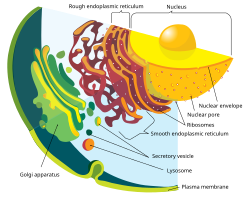
The endomembrane system is composed of the different membranes (endomembranes) that are suspended in the cytoplasm within a eukaryotic cell. These membranes divide the cell into functional and structural compartments, or organelles. In eukaryotes the organelles of the endomembrane system include: the nuclear membrane, the endoplasmic reticulum, the Golgi apparatus, lysosomes, vesicles, endosomes, and plasma (cell) membrane among others. The system is defined more accurately as the set of membranes that forms a single functional and developmental unit, either being connected directly, or exchanging material through vesicle transport. Importantly, the endomembrane system does not include the membranes of plastids or mitochondria, but might have evolved partially from the actions of the latter (see below).
The nuclear membrane contains a lipid bilayer that encompasses the contents of the nucleus. The endoplasmic reticulum (ER) is a synthesis and transport organelle that branches into the cytoplasm in plant and animal cells. The Golgi apparatus is a series of multiple compartments where molecules are packaged for delivery to other cell components or for secretion from the cell. Vacuoles, which are found in both plant and animal cells (though much bigger in plant cells), are responsible for maintaining the shape and structure of the cell as well as storing waste products. A vesicle is a relatively small, membrane-enclosed sac that stores or transports substances. The cell membrane is a protective barrier that regulates what enters and leaves the cell. There is also an organelle known as the Spitzenkörper that is only found in fungi, and is connected with hyphal tip growth.
In prokaryotes endomembranes are rare, although in many photosynthetic bacteria the plasma membrane is highly folded and most of the cell cytoplasm is filled with layers of light-gathering membrane. These light-gathering membranes may even form enclosed structures called chlorosomes in green sulfur bacteria. Another example is the complex "pepin" system of Thiomargarita species, especially T. magnifica.
The organelles of the endomembrane system are related through direct contact or by the transfer of membrane segments as vesicles. Despite these relationships, the various membranes are not identical in structure and function. The thickness, molecular composition, and metabolic behavior of a membrane are not fixed, they may be modified several times during the membrane's life. One unifying characteristic the membranes share is a lipid bilayer, with proteins attached to either side or traversing them.
Most lipids are synthesized in yeast either in the endoplasmic reticulum, lipid particles, or the mitochondrion, with little or no lipid synthesis occurring in the plasma membrane or nuclear membrane. Sphingolipid biosynthesis begins in the endoplasmic reticulum, but is completed in the Golgi apparatus. The situation is similar in mammals, with the exception of the first few steps in ether lipid biosynthesis, which occur in peroxisomes. The various membranes that enclose the other subcellular organelles must therefore be constructed by transfer of lipids from these sites of synthesis. However, although it is clear that lipid transport is a central process in organelle biogenesis, the mechanisms by which lipids are transported through cells remain poorly understood.
The first proposal that the membranes within cells form a single system that exchanges material between its components was by Morré and Mollenhauer in 1974. This proposal was made as a way of explaining how the various lipid membranes are assembled in the cell, with these membranes being assembled through lipid flow from the sites of lipid synthesis. The idea of lipid flow through a continuous system of membranes and vesicles was an alternative to the various membranes being independent entities that are formed from transport of free lipid components, such as fatty acids and sterols, through the cytosol. Importantly, the transport of lipids through the cytosol and lipid flow through a continuous endomembrane system are not mutually exclusive processes and both may occur in cells.
The nuclear envelope surrounds the nucleus, separating its contents from the cytoplasm. It has two membranes, each a lipid bilayer with associated proteins. The outer nuclear membrane is continuous with the rough endoplasmic reticulum membrane, and like that structure, features ribosomes attached to the surface. The outer membrane is also continuous with the inner nuclear membrane since the two layers are fused together at numerous tiny holes called nuclear pores that perforate the nuclear envelope. These pores are about 120 nm in diameter and regulate the passage of molecules between the nucleus and cytoplasm, permitting some to pass through the membrane, but not others. Since the nuclear pores are located in an area of high traffic, they play an important role in cell physiology. The space between the outer and inner membranes is called the perinuclear space and is joined with the lumen of the rough ER.
The nuclear envelope's structure is determined by a network of intermediate filaments (protein filaments). This network is organized into a mesh-like lining called the nuclear lamina, which binds to chromatin, integral membrane proteins, and other nuclear components along the inner surface of the nucleus. The nuclear lamina is thought to help materials inside the nucleus reach the nuclear pores and in the disintegration of the nuclear envelope during mitosis and its reassembly at the end of the process.
Endomembrane system
The endomembrane system is composed of the different membranes (endomembranes) that are suspended in the cytoplasm within a eukaryotic cell. These membranes divide the cell into functional and structural compartments, or organelles. In eukaryotes the organelles of the endomembrane system include: the nuclear membrane, the endoplasmic reticulum, the Golgi apparatus, lysosomes, vesicles, endosomes, and plasma (cell) membrane among others. The system is defined more accurately as the set of membranes that forms a single functional and developmental unit, either being connected directly, or exchanging material through vesicle transport. Importantly, the endomembrane system does not include the membranes of plastids or mitochondria, but might have evolved partially from the actions of the latter (see below).
The nuclear membrane contains a lipid bilayer that encompasses the contents of the nucleus. The endoplasmic reticulum (ER) is a synthesis and transport organelle that branches into the cytoplasm in plant and animal cells. The Golgi apparatus is a series of multiple compartments where molecules are packaged for delivery to other cell components or for secretion from the cell. Vacuoles, which are found in both plant and animal cells (though much bigger in plant cells), are responsible for maintaining the shape and structure of the cell as well as storing waste products. A vesicle is a relatively small, membrane-enclosed sac that stores or transports substances. The cell membrane is a protective barrier that regulates what enters and leaves the cell. There is also an organelle known as the Spitzenkörper that is only found in fungi, and is connected with hyphal tip growth.
In prokaryotes endomembranes are rare, although in many photosynthetic bacteria the plasma membrane is highly folded and most of the cell cytoplasm is filled with layers of light-gathering membrane. These light-gathering membranes may even form enclosed structures called chlorosomes in green sulfur bacteria. Another example is the complex "pepin" system of Thiomargarita species, especially T. magnifica.
The organelles of the endomembrane system are related through direct contact or by the transfer of membrane segments as vesicles. Despite these relationships, the various membranes are not identical in structure and function. The thickness, molecular composition, and metabolic behavior of a membrane are not fixed, they may be modified several times during the membrane's life. One unifying characteristic the membranes share is a lipid bilayer, with proteins attached to either side or traversing them.
Most lipids are synthesized in yeast either in the endoplasmic reticulum, lipid particles, or the mitochondrion, with little or no lipid synthesis occurring in the plasma membrane or nuclear membrane. Sphingolipid biosynthesis begins in the endoplasmic reticulum, but is completed in the Golgi apparatus. The situation is similar in mammals, with the exception of the first few steps in ether lipid biosynthesis, which occur in peroxisomes. The various membranes that enclose the other subcellular organelles must therefore be constructed by transfer of lipids from these sites of synthesis. However, although it is clear that lipid transport is a central process in organelle biogenesis, the mechanisms by which lipids are transported through cells remain poorly understood.
The first proposal that the membranes within cells form a single system that exchanges material between its components was by Morré and Mollenhauer in 1974. This proposal was made as a way of explaining how the various lipid membranes are assembled in the cell, with these membranes being assembled through lipid flow from the sites of lipid synthesis. The idea of lipid flow through a continuous system of membranes and vesicles was an alternative to the various membranes being independent entities that are formed from transport of free lipid components, such as fatty acids and sterols, through the cytosol. Importantly, the transport of lipids through the cytosol and lipid flow through a continuous endomembrane system are not mutually exclusive processes and both may occur in cells.
The nuclear envelope surrounds the nucleus, separating its contents from the cytoplasm. It has two membranes, each a lipid bilayer with associated proteins. The outer nuclear membrane is continuous with the rough endoplasmic reticulum membrane, and like that structure, features ribosomes attached to the surface. The outer membrane is also continuous with the inner nuclear membrane since the two layers are fused together at numerous tiny holes called nuclear pores that perforate the nuclear envelope. These pores are about 120 nm in diameter and regulate the passage of molecules between the nucleus and cytoplasm, permitting some to pass through the membrane, but not others. Since the nuclear pores are located in an area of high traffic, they play an important role in cell physiology. The space between the outer and inner membranes is called the perinuclear space and is joined with the lumen of the rough ER.
The nuclear envelope's structure is determined by a network of intermediate filaments (protein filaments). This network is organized into a mesh-like lining called the nuclear lamina, which binds to chromatin, integral membrane proteins, and other nuclear components along the inner surface of the nucleus. The nuclear lamina is thought to help materials inside the nucleus reach the nuclear pores and in the disintegration of the nuclear envelope during mitosis and its reassembly at the end of the process.
Recent media
Recent media