Hubbry Logo
Medial epicondyle of the humerusMedial epicondyle of the humerusMain
Open search
Medial epicondyle of the humerus
Community hub
Medial epicondyle of the humerus
logo
8 pages, 0 posts
0 subscribers
Be the first to start a discussion here.
Medial epicondyle of the humerus
from Wikipedia
Medial epicondyle of the humerus
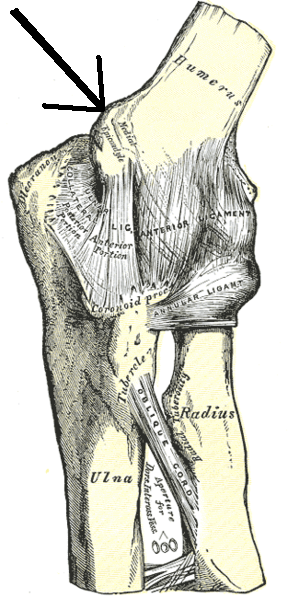
Left elbow-joint, showing anterior and ulnar collateral ligaments. (Medial epicondyle labeled at center top.)
Plan of ossification of the humerus. (Medial epicondyle labeled at lower left.)
Details
Identifiers
Latinepicondylus medialis humeri
TA98A02.4.04.027
TA21207
FMA23441
Anatomical terms of bone

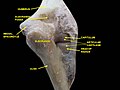
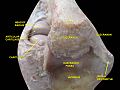
The medial epicondyle of the humerus is an epicondyle of the humerus bone of the upper arm in humans. It is larger and more prominent than the lateral epicondyle and is directed slightly more posteriorly in the anatomical position. In birds, where the arm is somewhat rotated compared to other tetrapods, it is called the ventral epicondyle of the humerus. In comparative anatomy, the more neutral term entepicondyle is used.

The medial epicondyle gives attachment to the ulnar collateral ligament of elbow joint, to the pronator teres, and to a common tendon of origin (the common flexor tendon) of some of the flexor muscles of the forearm: the flexor carpi radialis, the flexor carpi ulnaris, the flexor digitorum superficialis, and the palmaris longus. The medial epicondyle is located on the distal end of the humerus. Additionally, the medial epicondyle is inferior to the medial supracondylar ridge. It is also proximal to the olecranon fossa.

The medial epicondyle protects the ulnar nerve, which runs in a groove on the back of this epicondyle. The ulnar nerve is vulnerable because it passes close to the surface along the back of the bone. Striking the medial epicondyle causes a tingling sensation in the ulnar nerve. This response is known as striking the "funny bone".[1] The name funny bone could be from a play on the words humorous and humerus, the bone on which the medial epicondyle is located,[2] although according to the Oxford English Dictionary, it may refer to "the peculiar sensation experienced when it is struck".[3] Medial epicondyle fracture of the humerus are common when falling onto an outstretched hand.

Fractures

[edit]

Medial epicondyle fractures are common elbow injuries in children. There is considerable controversy about their treatment, with uncertainty about whether surgery to restore the natural position of the bone is better than healing in a cast.

Additional images

[edit]

References

[edit]
[edit]
Revisions and contributorsEdit on WikipediaRead on Wikipedia
from Grokipedia
The medial epicondyle of the is a prominent bony projection situated on the medial aspect of the distal , at the end of the medial supracondylar ridge. It is larger and more prominent than its lateral counterpart, serving as a key anatomical landmark palpable just above the medial . This structure primarily functions as the origin point for the , which includes the pronator teres, flexor carpi radialis, palmaris longus, flexor digitorum superficialis, and flexor carpi ulnaris muscles responsible for and flexion as well as forearm pronation. Additionally, the (also known as the ) attaches to its anterior inferior surface, providing essential stability against valgus forces at the elbow joint. The posterior aspect features a shallow groove through which the passes, forming part of the . In clinical contexts, the medial epicondyle is notable for its role in conditions such as medial epicondylitis (commonly called ), which involves inflammation of the flexor tendon origins due to repetitive stress, and avulsion fractures, particularly in adolescents where it represents the final that fuses around ages 14-17. These features underscore its importance in and injury susceptibility.

Anatomy

Location and structure

The medial epicondyle of the humerus is a large, palpable bony projection located on the medial aspect of the distal , positioned superior to the medial portion of the trochlea and approximately 1 cm proximal to the joint line. This structure arises at the distal end of the medial supracondylar ridge, contributing to the overall widening of the distal . Larger and more prominent than the lateral epicondyle, the medial epicondyle extends slightly more distally and serves as an apophysis—a secondary that develops from . Its gross structure consists of dense cortical with a rough, irregular surface adapted for attachments, lacking distinctive internal trabecular beyond typical compact composition. Ossification of the medial epicondyle begins as a separate center around 5 to 7 years of age. This center subsequently fuses to the humeral shaft around 14 to 17 years in females and 16 to 20 years in males, with variation by population.

Borders and relations

The medial epicondyle of the is a prominent bony projection located at the distal end of the bone, with its superior border seamlessly blending into the medial supracondylar , which extends proximally along the posterior aspect of the humeral shaft. The inferior border of the epicondyle is adjacent to the medial portion of the trochlea, forming part of the medial contour of the distal . The medial surface of the faces the , contributing to the palpable medial prominence of the elbow joint, while its lateral surface remains continuous with the shaft of the and is in close proximity to the medial condyle. Posteriorly, the epicondyle features a shallow groove, known as the ulnar groove, through which the passes immediately behind the structure within the , positioning the nerve in a relatively superficial and vulnerable location. Anteriorly, with no direct involvement of major nerves in this region. No major vascular structures are directly embedded within or immediately adjacent to the medial epicondyle itself, though the courses proximally and medially along the arm, branching into the ulnar collateral arteries that contribute to the periarticular vascular network near the .

Attachments

Muscular attachments

The medial epicondyle of the humerus serves as the primary origin site for the flexor-pronator muscle group of the anterior compartment via the , a shared tendinous structure that facilitates coordinated flexion and pronation of the and fingers. These muscles attach to roughened areas on the anterior and medial surfaces of the , with the pronator teres originating from the most medial aspect, providing the medialmost attachment point. The flexor carpi radialis attaches to the anterior surface, extending farther anteriorly than other superficial flexors. The palmaris longus, present in approximately 85% of individuals, originates centrally from the when developed. The flexor digitorum superficialis arises from a deeper layer beneath the superficial flexors, sharing the humeroulnar head origin at the epicondyle. Finally, the humeral head of the flexor carpi ulnaris attaches to the posterior aspect, beginning near the posterior ridge of the epicondyle. No extensor muscles originate from the medial epicondyle; all attachments belong exclusively to flexor and pronator muscles that act on the , fingers, and . These muscular origins share the epicondyle's surface with ligamentous attachments that contribute to stability.

Ligamentous attachments

The medial epicondyle of the humerus serves as the primary proximal attachment site for the (UCL), also known as the , which originates from its anteroinferior surface. This origin is located approximately 8.5 mm distal and 7.8 mm anterior to the tip of the epicondyle, providing a broad footprint for the ligament's proximal anchorage. The UCL comprises an anterior bundle and a posterior bundle, each with distinct distal insertions on the . The anterior bundle, the primary medial stabilizer against valgus forces, inserts onto the sublime tubercle of the coronoid process. The posterior bundle inserts onto the semilunar (trochlear) notch of the , contributing additional support to the medial aspect of the elbow joint. The medial provides minor contributions to the medial , with fibers blending into the capsular reinforcements surrounding the UCL, though without distinct direct attachments beyond these ligamentous overlaps. There is no direct ligamentous attachment to the pronator independent of the shared origin area with overlying flexor muscles. Anatomical variations include accessory bands of the UCL, observed in approximately 25% of cases, which may originate proximally from the posteromedial near the and insert onto the transverse bundle or coronoid process.

Function

Role in forearm movement

The medial epicondyle of the humerus serves as the primary proximal attachment site, or fixed anchor, for the flexor-pronator muscle group, collectively known as the common flexor origin. This positioning enables these muscles to generate contractile forces that drive key movements, including wrist flexion via the flexor carpi radialis and flexor carpi ulnaris, finger flexion through the flexor digitorum superficialis, and pronation primarily by the pronator teres. By providing a stable bony leverage point on the distal humerus, the epicondyle allows these muscles to pull effectively on their distal insertions at the , , and , facilitating coordinated motion essential for hand positioning. During elbow flexion, the medial epicondyle's anteromedial location optimizes the moment arms of the attached flexor-pronator muscles, enhancing torque production across the elbow and radioulnar joints. The pronator teres, originating here, is the dominant generator of pronation torque, accounting for approximately 79% of the total pronation force, with the remainder from the pronator quadratus. This biomechanical arrangement increases rotational efficiency, particularly as the elbow flexes from extension, allowing greater displacement of the force vector for pronation without requiring excessive muscle activation. The epicondyle's role thus supports efficient energy transfer in dynamic activities involving combined elbow flexion and forearm rotation. In compound movements such as gripping, the medial epicondyle facilitates the transmission of tensile forces from the through the flexor-pronator attachments to the forearm bones ( and ), enabling synergistic wrist and finger flexion without direct involvement in the elbow's articular surfaces. This indirect force relay stabilizes the during grasp formation, contributing to overall hand function in tasks like tool manipulation. However, the epicondyle's attachments limit its influence to medial-sided actions, with no contribution to forearm extension or supination, which rely on lateral and posterior structures.

Role in elbow stability

The medial epicondyle of the humerus serves as the primary proximal attachment site for the (UCL), which acts as the chief static stabilizer against valgus stress at the joint. This ligamentous connection resists outward forces on the medial aspect of the , such as those encountered during throwing motions, thereby preventing excessive abduction of the relative to the . In addition to its static role, the medial epicondyle contributes to dynamic elbow stability through the origin of the flexor-pronator muscle mass, which tenses during activity to supplement UCL restraint, particularly effective between 30° and 120° of elbow flexion where valgus loads peak. At full elbow extension, the epicondyle's alignment with the joint's flexion-extension axis positions the UCL to experience maximal tension while minimizing shear forces across the joint, providing approximately one-third of the total valgus stability in this posture. This stabilizing function is especially vital in overhead sports like pitching, where repetitive valgus stresses can lead to medial instability upon UCL or epicondylar compromise, without directly impairing flexion mechanics.

Clinical significance

Fractures

Fractures of the medial epicondyle of the are most common in children aged 7 to 14 years, typically presenting as avulsion injuries due to valgus stress on the , such as from falls on an outstretched hand or repetitive throwing motions in sports. These fractures account for 15-20% of all pediatric fractures and often involve the apophysis prior to its complete fusion with the , contributing to the region's vulnerability during growth. The Watson-Jones classification system categorizes these fractures into four types based on displacement and entrapment: Type I (non-displaced or minimal displacement less than 5 mm without rotation), Type II (displaced greater than 5 mm, often with rotation), Type III (incarcerated fragment without elbow ), and Type IV (incarcerated fragment with elbow ). Patients typically present with acute medial elbow pain, swelling, ecchymosis, and limited , particularly in flexion and pronation; is confirmed through anteroposterior, lateral, and oblique radiographs that reveal the avulsed fragment and its displacement. Management depends on fracture characteristics and stability. Non-displaced or minimally displaced s (Type I, displacement less than 5 mm) are treated non-operatively with immobilization in a long-arm cast at 90 degrees of flexion for 1 week, followed by active range-of-motion exercises; recent evidence supports casting even for some displaced s greater than 2 mm without inferior functional outcomes. Operative intervention, including open reduction and with screws, Kirschner wires, or sutures, is indicated for displaced s greater than 5 mm (Types II, III, and IV), involvement, or intra-articular entrapment (occurring in 5-18% of cases). Outcomes are generally excellent, with greater than 90% achieving good functional recovery and bony union, particularly with appropriate treatment; however, non-operative approaches may carry a higher risk of (up to 68%) without impacting long-term function.

Medial epicondylitis

Medial , also known as or medial epicondylopathy, is a degenerative condition arising from repetitive microtrauma to the origin at the medial epicondyle of the humerus. It commonly affects individuals engaged in activities requiring forceful gripping, flexion, and pronation, such as , racquet sports, , and manual labor including or . The involves tendinosis rather than acute , characterized by degenerative changes with angiofibroblastic , disorganized , and increased at the tendon-epicondyle interface. This degeneration primarily impacts the pronator teres and flexor carpi radialis tendons, which attach to the medial epicondyle and are susceptible to overload during repetitive motions. Symptoms typically develop insidiously and include medial pain that worsens with resisted flexion, pronation, or gripping activities, often radiating along the . Localized tenderness is noted approximately 5 mm distal to the medial epicondyle tip, accompanied by reduced , though instability is rare unless the condition becomes chronic. Diagnosis relies on clinical , including a positive response to resisted flexion and pronation tests, which elicit at the medial . or MRI may reveal thickening or hypoechoic changes to confirm the and rule out other pathologies, with demonstrating over 90% sensitivity. Treatment begins conservatively with rest, ice application, nonsteroidal anti-inflammatory drugs (NSAIDs), and counterforce bracing to alleviate symptoms, typically over 6-12 weeks. focusing on eccentric strengthening exercises for the flexor muscles is a cornerstone, promoting remodeling and improving function. For persistent cases, (PRP) injections offer an alternative, providing significant relief and functional gains comparable to in randomized trials. Surgical options, such as open or arthroscopic and reattachment of the common flexor origin, are reserved for cases after failed nonoperative management, occurring in approximately 5-12% of patients with success rates exceeding 80%.

Other conditions

Cubital tunnel syndrome involves compression of the in the , located posterior to the medial epicondyle of the humerus, leading to irritation or entrapment of the . This condition manifests as , numbness, and tingling primarily in the ring and little fingers, often exacerbated by flexion or prolonged bending. Risk factors include repetitive flexion activities, such as those in manual labor or , as well as direct trauma to the medial , commonly known as hitting the "funny bone." Diagnosis typically relies on clinical history, including , and electrodiagnostic tests like nerve conduction studies. Initial treatment focuses on conservative measures, such as exercises to improve mobility and night splinting to maintain extension, alongside nonsteroidal anti-inflammatory drugs for relief. In cases of persistent symptoms or , surgical intervention may be required, including decompression or transposition to relieve pressure at the . Ulnar collateral ligament (UCL) injuries, which originate from the medial epicondyle, are prevalent among overhead throwers, particularly pitchers, due to repetitive valgus stress during motions. These injuries range from partial tears to complete ruptures, resulting in medial , decreased , and valgus , where the excessively opens on the medial side under stress. involves the moving valgus stress test, which reproduces and laxity during dynamic flexion-extension, supplemented by to assess ligament integrity. Conservative management includes rest, ice, anti-inflammatory medications, and injections for partial tears, but athletes with significant often require surgical reconstruction. Tommy John surgery, involving tendon grafting to replace the damaged UCL, allows over 80% of professional pitchers to return to prior performance levels, though recovery typically spans 12-18 months. Medial epicondyle apophysitis, commonly termed little league elbow, represents a chronic stress injury to the apophysis of the medial in youth throwers, occurring before the ossification centers fuse around age 15. It arises from repetitive valgus loading during overhead throwing, such as in , leading to and microavulsion at the growth plate without acute . Symptoms include insidious medial pain that intensifies with throwing, accompanied by tenderness and reduced , affecting up to 30% of young pitchers with high-volume play. Radiographic evaluation may reveal physeal widening or irregularity, confirming the alongside clinical history of overuse. Management emphasizes rest from throwing for 4-6 weeks, ice application, and activity modification to prevent progression, with gradual structured return-to-throw programs over several months to ensure healing. Other rare pathologies affecting the medial epicondyle include and tumors, though involvement at this site is uncommon compared to the capitellum in the . typically presents as subchondral bone fragmentation due to vascular compromise, causing and mechanical symptoms, but medial epicondyle cases are exceptional and often require advanced imaging for detection. Tumors, such as osteoid osteomas or benign growths, may rarely originate or involve the , leading to localized relieved by nonsteroidal anti-inflammatory drugs, with diagnosis via computed tomography and treatment through excision if symptomatic.

References

Add your contribution
Related Hubs
User Avatar
No comments yet.