Hubbry Logo
Capitate boneCapitate boneMain
Open search
Capitate bone
Community hub
Capitate bone
logo
8 pages, 0 posts
0 subscribers
Be the first to start a discussion here.
Capitate bone
Capitate bone
from Wikipedia

Capitate bone
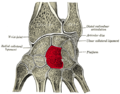
Left hand anterior view (palmar view). Capitate-bone shown in red.
The left capitate bone.
Left: ulnar surface (little-finger-side surface).
Right: radial surface (thumb-side surface)
Details
Pronunciation/ˈkæpɪtt/
Part ofCarpal bones of the hand
Identifiers
Latinos capitatum; os magnum
MeSHD051224
TA98A02.4.08.011
TA21258
FMA23727
Anatomical terms of bone

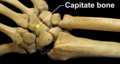
The capitate bone is a bone in the human wrist found in the center of the carpal bone region, located at the distal end of the radius and ulna bones. It articulates with the third metacarpal bone (the middle finger) and forms the third carpometacarpal joint. The capitate bone is the largest of the carpal bones in the human hand. It presents, above, a rounded portion or head, which is received into the concavity formed by the scaphoid and lunate bones; a constricted portion or neck; and below this, the body.[1] The bone is also found in many other mammals, and is homologous with the "third distal carpal" of reptiles and amphibians.

Structure

[edit]

The capitate is the largest carpal bone found within the hand.[2] The capitate is found within the distal row of carpal bones. The capitate lies directly adjacent to the metacarpal of the ring finger on its distal surface, has the hamate on its ulnar surface and trapezoid on its radial surface, and abuts the lunate and scaphoid proximally.[3] : 708–709 

Surfaces

[edit]

The proximal surface is round, smooth, and articulates with the lunate bone.[1]

The distal surface is divided by two ridges into three facets, for articulation with the second, third, and fourth metacarpal bones, that for the third being the largest.[1]

The dorsal surface is broad and rough.[1]

The palmar surface is narrow, rounded, and rough, for the attachment of ligaments and a part of the adductor pollicis muscle.[1]

The lateral surface articulates with the lesser multangular by a small facet at its anterior inferior angle, behind which is a rough depression for the attachment of an interosseous ligament. Above this is a deep, rough groove, forming part of the neck, and serving for the attachment of ligaments; it is bounded superiorly by a smooth, convex surface, for articulation with the scaphoid bone.[1]

The medial surface articulates with the hamate bone by a smooth, concave, oblong facet, which occupies its posterior and superior parts; it is rough in front, for the attachment of an interosseous ligament.[1]

Variation

[edit]

The capitate bone variably articulates with the metacarpal of the index finger. However, its normal articulation is with the middle finger.[2]

Development

[edit]

The ossification of capitate starts at 1 – 5 months.[4]

Function

[edit]

The carpal bones function as a unit to provide a bony superstructure for the hand.[3] : 708  They allow movements of the wrist from side to side (medial to lateral) as well as up and down (anterior to posterior). H. A. Harris wrote in the British Medical Journal in 1944 that "the strength of construction of the hand in a man is concentrated in the radius, thumb, and index and middle fingers." Therefore, the capitate is larger to support the strength and stress that the middle finger undergoes.

Clinical significance

[edit]

A capitate fracture accounts for 1.3% of all wrist fractures. Isolated fractures of the capitate comprise only 0.3% and are often non-displaced. This is since the capitate is at the centre of the carpal region and is therefore quite well protected. Capitate fractures occur together with fractures of another carpal bone, the scaphoid.[5]

Various mechanisms for fractures of the capitate have been postulated. Adler et al. described three mechanisms—the first is direct trauma to the dorsal surface of the bone, the second is fall on the palm with the wrist in forced extension and the third is fall on the forcefully flexed hand; the second being the most frequent and the third rarest.[5]

In the case of an acute capitate fracture where there is X-ray evidence of excellent alignment of the fracture fragments, the attending doctor will immobilise the wrist in a plaster or lightweight wrist brace. Once the cast has been removed, the patient begins physiotherapy to regain the range of movement of the wrist joint and strength in the muscles involved.

If X-rays show that the capitate fracture fragments are out of alignment, surgery is indicated. A surgeon can use small compression screws or K-wires to unite the two pieces of bone. The headless compression screw has advantage over the K-wire as it provides compression across the fracture site and allows early motion. It may be the case that the ligament between the сapitate and the scaphoid bone is also injured; if so, this would be repaired at the same time.[6]

Because the capitate has a poor blood supply there are sometimes complications with the healing process. This may manifest itself as a diffuse ache in the wrist upon activity, and can persist for many months. This is due to a breakdown of the capitate caused by the lack of blood supply and healing (avascular necrosis). Nonunion has been reported as the most common complication; 19.6% to 56% in isolated capitate fractures. Early diagnosis is key to preventing this.

Etymology

[edit]

The name of the bone derives from Latin: capitātus 'having a head', from Latin: capit- 'head'.[7]

Additional images

[edit]

See also

[edit]

References

[edit]

Sources

[edit]
  • Saladin, Kenneth S. "The Skeletal System." Anatomy and Physiology. 7th ed. New York: McGraw-Hill, 2015. N. pag. Print.
  • Harris, H. A. "Fractures Of The Carpal Bones." The British Medical Journal 2.4367 (1944): 381. JSTOR. Web. 28 Nov. 2016.
Revisions and contributorsEdit on WikipediaRead on Wikipedia
from Grokipedia
The capitate bone is the largest and most centrally positioned of the eight in the , situated in the distal row between the laterally and the hamate medially, where it functions as the "keystone" of the due to its extensive articulations and role in maintaining structural stability. Characterized by a rounded proximal head, a narrow , and a broader distal body, the capitate articulates proximally with the scaphoid and lunate bones of the proximal carpal row, distally with the bases of the second, third, and fourth , laterally with the , and medially with the hamate, forming seven surfaces in total that contribute to mobility and load transmission during grasping and manipulation. Its dorsal and palmar surfaces are rough for attachments, including those supporting the transverse carpal arch and , while the volar surface also provides origin for the oblique head of the . The capitate receives its blood supply primarily from dorsal intercarpal and basal metacarpal arterial arches with retrograde flow, supplemented by palmar and ulnar recurrent anastomoses, though it relies on a single dominant intraosseous vessel, predisposing it to following fractures. Innervation arises from the anterior interosseous branch of the , the posterior interosseous branch of the , and dorsal and deep branches of the , supporting sensory and proprioceptive functions in the . Clinically, capitate fractures are uncommon but often occur in high-energy trauma such as perilunate dislocations, with the proximal pole at particular risk for or osteonecrosis due to its retrograde vascularity, potentially leading to chronic and instability if untreated.

Structure

Location and articulations

The capitate bone is the largest and most central of the eight , situated in the distal row of the carpus within the . It occupies a pivotal position between the lunate bone proximally, the medially, the laterally, and the bases of the second, third, and fourth distally. Its articulations form multiple synovial that stabilize the . The rounded head of the capitate projects proximally into the concavity formed by the lunate and scaphoid bones, articulating directly with the lunate via the lunocapitate and with the scaphoid via the scaphocapitate . The distal surface articulates primarily with the base of the third metacarpal at the , with smaller facets connecting to the second and fourth metacarpals. Laterally, the capitate forms the trapeziocapitate with the , while medially, a ridge on its surface articulates with the hamate at the capitohamate , fitting into the hamate's configuration without direct involvement of the triquetral fossa. Positioned distally to the radius and ulna, the capitate serves as a key bridge in the carpal arch, linking the forearm's distal ends to the hand's metacarpals and facilitating the overall transmission of forces across the wrist.

Surfaces

The capitate bone exhibits a distinctive pyramidal shape, characterized by a rounded head proximally, a constricted waist-like neck in the midportion, and a broader body distally. This morphology positions it centrally within the distal row of carpal bones, facilitating its role as a key articulator in the wrist. The bone's surfaces are adapted for both articular and non-articular functions, with multiple facets for adjacent carpal and metacarpal bones, as well as roughened areas for ligamentous attachments. The proximal surface forms the rounded, convex head of the capitate, which articulates with the lunate and scaphoid bones; this surface is covered by to enable smooth motion. The distal surface is triangular in outline with a palmarly directed apex, presenting concave facets that articulate with the bases of the second, third, and fourth , thereby transmitting forces from the to the hand. A central ridge on this surface helps separate the articular areas for the second and third metacarpals, enhancing stability during grip activities. The medial surface is concave and features a large, smooth articular facet for the hamate bone, complemented by a roughened region that serves as the attachment site for the capitohamate interosseous ligament, which reinforces the intercarpal . Laterally, the surface transitions from a spherical proximal facet for the scaphoid to a concave distal strip articulating with the , separated by a shallow depression; this area also anchors the dorsal and palmar intercarpal ligaments for cohesion. The dorsal (posterior) surface is rough and generally concave, providing attachment points for dorsal intercarpal ligaments that contribute to posterior wrist stability. In contrast, the palmar (anterior) surface is slightly convex and roughened, offering origins for fibers of the oblique head of the and attachments for palmar intercarpal ligaments, including the radioscaphocapitate , which helps maintain carpal alignment.

Blood supply

The blood supply of the capitate bone primarily derives from the dorsal intercarpal arch, a branch of the that contributes the majority of dorsal vascularization; the dorsal basal metacarpal arch; the palmar intercarpal arch, formed by branches of the anterior interosseous artery; and recurrent branches of the from the . These extraosseous vessels form anastomotic networks that penetrate the bone through foramina predominantly located on the distal and palmar surfaces. Intraosseous occurs in a predominantly retrograde manner, with 2–4 dorsal vessels entering the concave distal aspect and traveling proximally to supply the head and body, while 1–3 palmar vessels directly perfuse the head region. Studies using micro-computed have identified dorsal and volar vascular systems without a clear predominance in supply, though anastomoses between these systems occur in approximately 30% of cases. Earlier anatomic investigations described three intraosseous vascular patterns—palmar-dominant, dorsal-dominant, and balanced—wherein the proximal pole consistently relies on retrograde flow across the , rendering it susceptible to ischemia in a watershed zone with relatively sparse direct vascular entry. However, up to 70% of capitates exhibit at least one direct volar vessel supplying the proximal pole, potentially mitigating risks in this region. The capitate bone lacks motor innervation but receives sensory innervation to its periosteum and surrounding ligaments from the anterior interosseous branch of the , the posterior interosseous branch of the , and the dorsal and deep branches of the . This vascular arrangement underscores the bone's vulnerability to ischemic compromise at the proximal pole due to its dependence on distal-to-proximal flow, particularly following disruptions in the nutrient foramina or waist region.

Development

The capitate bone originates from undifferentiated within the distal row of the developing carpal region during early embryogenesis. Chondrification begins around Carnegie 18, approximately 44 days post-fertilization (equivalent to 6 weeks ), with condensations of pre-chondrogenic forming the initial model. By 20 (about 50-51 days, or 7-8 weeks ), the capitate emerges as the first distinct precartilage structure in the , followed by full chondrification by 21. This process aligns with the broader formation of chondrification centers in the hand plate, where the capitate and hamate are among the earliest to develop in the distal carpal row. Ossification of the capitate occurs through a single primary , marking it as the first carpal bone to undergo , with no secondary centers present. The typically appears between 1 and 3 months postnatally, though radiographic detection may vary slightly due to individual differences in mineralization. initiates earlier in females, often at around 2 months, compared to 3 months in males, reflecting a general sex-based in skeletal maturation. The process completes gradually, with the bone achieving full and structural maturity by ages 12-14 years, coinciding with the overall stabilization of carpal growth. Postnatal growth of the capitate proceeds primarily through appositional formation on its surfaces, allowing expansion in and while maintaining its central role in the carpus. This growth is modulated by mechanical loading from movements, which stimulates periosteal deposition and adaptive remodeling to withstand functional stresses. The reaches its adult dimensions by late adolescence, typically around 16-18 years, after which further changes are minimal. Developmental variations in the capitate are uncommon but include rare accessory ossicles, such as those occasionally forming at the distal pole due to unfused secondary centers, with an overall incidence of accessory ossicles below 1%. Congenital fusions, or coalitions, involving the capitate occur infrequently, most notably with the hamate (capitohamate type) or , at rates less than 1% of the population and comprising about 15-20% of all carpal coalitions. These anomalies arise from incomplete separation of chondrification centers during embryogenesis and are usually unless associated with degenerative changes.

Function

Role in wrist kinematics

The capitate bone is integral to wrist flexion and extension, primarily through its articulation with the lunate at the midcarpal joint, where it glides relative to the proximal row to facilitate the typical 70–90° arc of motion. During these movements, the rounded head of the capitate functions as a fulcrum, serving as the approximate center of rotation for the distal carpal row and enabling coordinated flexion of approximately 80° and extension of 70° relative to the . This gliding action, combined with contributions from the scaphoid (flexing 70% of the capitate's amount) and lunate (46%), ensures smooth proximal-distal row interactions without excessive shear. In radial-ulnar deviation, the capitate translates laterally as part of the distal carpal row, which shifts palmarly during radial deviation and dorsally during ulnar deviation, with the overall range constrained by ligaments such as the radioscaphocapitate and triquetrocapitate to about 20–30°. This translation, rather than significant rotation, maintains carpal alignment, with midcarpal contributions accounting for 90% of radial deviation and 50% of ulnar deviation. The capitate's central position stabilizes this motion, preventing excessive lateral drift through its ligamentous tethers to adjacent bones. Circumduction of the , a composite motion integrating flexion-extension and radial-ulnar deviation, involves the capitate in a coupled where it undergoes minimal intrinsic rotation due to its pivotal, central location within the carpus. This limited rotation allows the distal row to follow a conical path around the capitate head, supporting fluid, multiplanar hand positioning without compromising stability. Beyond , the capitate facilitates load transmission across the , bearing 20–30% of the axial load to the second and third metacarpals during gripping tasks, thereby distributing compressive forces from the proximal row. This role underscores its importance in maintaining structural integrity under dynamic loads, with the distal row acting as a unified transmitter.

Biomechanical contributions

The capitate bone exhibits a composition dominated by trabecular bone within its central body, which facilitates shock absorption during compressive loading, while a surrounding cortical shell provides structural strength and resistance to tensile forces. This architecture is evident in micro-CT analyses of hominoid capitates, where trabecular bone volume fraction (BV/TV) is lowest in humans compared to other hominoids, with cortical thickness increasing distally to enhance load-bearing capacity. The cortical component has a Young's modulus of approximately 18 GPa, typical for carpal bones in finite element models, enabling elastic deformation under physiological stresses without fracture. In , the capitate serves as a primary conduit for transmission, channeling approximately 50% of compressive loads from the through the midcarpal joint to the index and middle metacarpals, as indicated by load distribution studies across the lunocapitate (29%) and scapho-capitate (19%) articulations. This central role positions the capitate within the wrist's load path, where shear forces concentrate at the narrow neck region, potentially leading to translational stresses during multi-planar motions like flexion-extension. Ligamentous attachments further bolster the capitate's stability against displacement. The radioscaphocapitate ligament, originating from the radial styloid and inserting on the palmar capitate, forms a sling that restrains volar of the proximal carpal row relative to the capitate. Complementarily, the dorsal intercarpal ligament, spanning from the triquetrum to the scaphoid and trapezoids, restricts excessive extension by limiting dorsal translation and maintaining alignment during radial-ulnar deviation. Evolutionarily, the capitate's trabecular architecture shows conserved patterns across hominoids, with anisotropic orientations proximally in humans and orangutans reflecting adaptations for manipulative behaviors, including tool use that imposes targeted compressive loads via the thumb and dart-thrower's motion. In contrast to the thicker cortices in apes like , human capitates exhibit relatively lower BV/TV and thinner distal shells, optimized for precision gripping rather than high-impact locomotion, as quantified in comparative micro-CT studies.

Clinical significance

Fractures and injuries

Capitate fractures represent a rare , accounting for 1-2% of all carpal bone fractures. In children, capitate fractures are the second most common carpal bone after the scaphoid. These fractures are often underdiagnosed due to their occult nature and the superimposition of on standard radiographs. They typically result from high-energy trauma and are frequently associated with other carpal injuries, particularly scaphoid fractures in the context of perilunate dislocations. The most common type of capitate fracture involves the waist or body, comprising the majority of cases and often occurring in high-energy falls onto an outstretched hand. Head and neck fractures account for a significant portion of reported cases and are commonly seen in conjunction with scaphoid waist fractures as part of transscaphoid-transcapitate perilunate fracture-dislocations. Chip avulsions, which involve small fragments at the dorsal or volar poles, are less frequent and usually arise from ligamentous avulsion forces. The primary mechanism of is hyperextension of the combined with ulnar deviation, transmitting axial loads through the capitate during falls on an outstretched hand. This pattern is prevalent in sports such as , where repetitive or acute dorsiflexion under load can precipitate the , as evidenced in case reports of adolescent athletes. Isolated capitate fractures are uncommon, with most cases linked to greater arc perilunate injuries involving the scaphoid. Diagnosis begins with clinical suspicion in patients presenting with dorsal wrist pain and swelling following trauma, though initial plain radiographs have low sensitivity, often missing up to 100% of fractures on posteroanterior views due to bone overlap. Lateral radiographs may reveal disruption of the normal colinearity between the , lunate, and capitate, but computed (CT) is essential for confirming fractures, providing 100% sensitivity and detailing fragment displacement. The overall incidence underscores the need for advanced in high-suspicion cases, as capitate injuries comprise only 1-2% of carpal fractures but carry risks of delayed . Management of nondisplaced capitate fractures involves immobilization in a short-arm thumb spica cast for 4-6 weeks to promote union, with serial to monitor progress. For displaced fractures, particularly those at the or body, open reduction and (ORIF) using Herbert screws is the standard approach, allowing stable compression and preserving vascularity. Early surgical intervention yields union rates of 80-90% in appropriately selected cases, reducing the risk of or displacement. Postoperative immobilization follows ORIF, typically for an additional 4 weeks, with emphasis on the retrograde supply that may complicate if not addressed promptly.

Avascular necrosis and complications

Avascular necrosis (AVN) of the capitate bone most commonly arises from disruption of its retrograde blood supply following trauma, such as fractures that interrupt vascular flow to the proximal pole, which is particularly vulnerable due to the intraosseous vessels entering distally and flowing proximally. Idiopathic AVN is rare, with the majority of cases linked to post-traumatic etiology, though associations with steroid use, gout, or Gaucher's disease have been noted in isolated reports. The true incidence remains unknown but is considered low overall, with AVN reported as a complication in untreated or delayed-diagnosis capitate fractures, where the tenuous proximal pole supply predisposes to ischemia. The condition progresses through stages adapted from the Ficat classification used for other osteonecrotic sites: stage I features normal radiographs but (MRI) evidence of bone marrow ; stage II shows sclerosis and cystic changes without collapse; stage III involves subchondral ; and stage IV demonstrates bone collapse with secondary degenerative changes. Patients typically present with chronic pain, stiffness, reduced , and occasional swelling, often delaying until advanced stages. Key complications include , occurring in 19% to 56% of isolated capitate fractures due to impaired and mechanical , as well as secondary affecting adjacent structures like the lunate and third metacarpal base from altered load distribution and degeneration. Advanced AVN can lead to carpal collapse patterns analogous to scaphoid nonunion advanced collapse, involving progressive joint space narrowing and between the scaphoid, capitate, and lunate. Treatment strategies depend on disease stage and aim to preserve joint function where possible. For early-stage AVN (pre-collapse), core decompression with or without addresses intraosseous hypertension and promotes , though evidence specific to the capitate is limited to case reports showing pain relief and delayed progression. In more advanced cases, partial capitate resection removes necrotic proximal pole tissue arthroscopically, providing pain relief and functional improvement in short-term follow-up without compromising overall stability. Vascularized bone grafts, often pedicled from the distal or second metacarpal base, are preferred for in stages I-III, with case series demonstrating union, pain reduction, and gains at 12-18 months post-surgery. Recent long-term evaluations of capitate-related interventions report satisfactory outcomes in approximately 80% of cases at 9-16 years, including maintained motion and minimal progression. Additionally, capitate shortening serves as an adjunctive procedure in (lunate AVN) to redistribute ulnar load and prevent further lunate collapse, yielding improved pain scores and lunate geometry in stage IIIA cases with neutral ulnar variance.

Etymology and nomenclature

Etymology

The term "capitate" derives from the Latin capitātus, meaning "having a head" or "formed like a head," which stems from caput, the Latin word for "head." This specifically alludes to the bone's rounded, head-like proximal articular surface, which articulates with the lunate bone and contributes to its distinctive morphology. The use of the term in anatomical literature emerged during the period of systematic dissection and naming. , in his seminal 1543 work De humani corporis fabrica, cataloged the numerically rather than descriptively, designating the capitate as the seventh in sequence from the scaphoid to the hamate. The specific name "capitatum" (Latin for capitate) was formalized later by anatomist Bernhard Siegfried Albinus in 1726, highlighting the bone's prominent, knob-like head as a key identifying feature in osteological descriptions. Linguistically, the capitate bone's name exemplifies the descriptive tradition in , where terms are drawn from classical languages to evoke morphological traits. While a direct Greek translation exists as κεφαλωτό οστό (kephalōtó ostó, literally "head-shaped bone"), derived from kephalē meaning "head," this equivalent is infrequently employed in contemporary anatomical texts, with the Latin form predominating due to historical conventions in Western medical .

Alternative names

The capitate bone, the largest of the , has historically been referred to by several alternative names reflecting its size and position. The Latin term os magnum, meaning "great bone," was commonly used in early anatomical descriptions owing to its prominence and size among the carpals; this name dates back to classical and medieval texts and persists in some older literature but is now considered obsolete. The English equivalent, "magnum bone," served as a direct and appeared frequently in 19th-century anatomical works, such as those describing structure in English-language treatises. In positional terms, it has been described as the "central carpal" in radiographic and surgical discussions to emphasize its location at the center of the distal carpal row. Similarly, "third carpal" denotes its sequential position in that row (following the trapezium and ) within certain clinical and anatomical contexts. Nomenclature for the evolved toward greater specificity with the establishment of standardized ; the Basle Nomina Anatomica of 1895 adopted os capitatum (leading to the "capitate"), replacing earlier descriptive terms like os magnum in favor of those highlighting its head-like proximal feature, though the shift was gradual in adoption across texts.

References

Add your contribution
Related Hubs
User Avatar
No comments yet.