Hubbry Logo
logo
Entire function
Community hub

Entire function

logo
0 subscribers
Read side by side
from Wikipedia

In complex analysis, an entire function, also called an integral function, is a complex-valued function that is holomorphic on the whole complex plane. Typical examples of entire functions are polynomials and the exponential function, and any finite sums, products and compositions of these, such as the trigonometric functions sine and cosine and their hyperbolic counterparts sinh and cosh, as well as derivatives and integrals of entire functions such as the error function. If an entire function has a root at , then , taking the limit value at , is an entire function. On the other hand, the natural logarithm, the reciprocal function, and the square root are all not entire functions, nor can they be continued analytically to an entire function.

A transcendental entire function is an entire function that is not a polynomial.

Just as meromorphic functions can be viewed as a generalization of rational fractions, entire functions can be viewed as a generalization of polynomials. In particular, if for meromorphic functions one can generalize the factorization into simple fractions (the Mittag-Leffler theorem on the decomposition of a meromorphic function), then for entire functions there is a generalization of the factorization — the Weierstrass theorem on entire functions.

Properties

[edit]

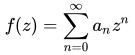
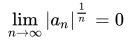
Every entire function can be represented as a single power series: that converges everywhere in the complex plane, hence uniformly on compact sets. The radius of convergence is infinite, which implies that or, equivalently,[a] Any power series satisfying this criterion will represent an entire function.
If (and only if) the coefficients of the power series are all real then the function evidently takes real values for real arguments, and the value of the function at the complex conjugate of will be the complex conjugate of the value at Such functions are sometimes called self-conjugate (the conjugate function, being given by ).[1]

If the real part of an entire function is known in a (complex) neighborhood of a point then both the real and imaginary parts are known for the whole complex plane, up to an imaginary constant. For instance, if the real part is known in a neighborhood of zero, then we can find the coefficients for from the following derivatives with respect to a real variable :

(Likewise, if the imaginary part is known in such a neighborhood then the function is determined up to a real constant.) In fact, if the real part is known just on an arc of a circle, then the function is determined up to an imaginary constant.[b]} Note however that an entire function is not necessarily determined by its real part on some other curves. In particular, if the real part is given on any curve in the complex plane where the real part of some other entire function is zero, then any multiple of that function can be added to the function we are trying to determine. For example, if the curve where the real part is known is the real line, then we can add times any self-conjugate function. If the curve forms a loop, then it is determined by the real part of the function on the loop since the only functions whose real part is zero on the curve are those that are everywhere equal to some imaginary number.

The Weierstrass factorization theorem asserts that any entire function can be represented by a product involving its zeroes (or "roots").

The entire functions on the complex plane form an integral domain (in fact a Prüfer domain). They also form a commutative unital associative algebra over the complex numbers.

Liouville's theorem states that any bounded entire function must be constant.[c]

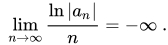
As a consequence of Liouville's theorem, any function that is entire on the whole Riemann sphere[d] is constant. Thus any non-constant entire function must have a singularity at the complex point at infinity, either a pole for a polynomial or an essential singularity for a transcendental entire function. Specifically, by the Casorati–Weierstrass theorem, for any transcendental entire function and any complex there is a sequence such that

Picard's little theorem is a much stronger result: Any non-constant entire function takes on every complex number as value, possibly with a single exception. When an exception exists, it is called a lacunary value of the function. The possibility of a lacunary value is illustrated by the exponential function, which never takes on the value . One can take a suitable branch of the logarithm of an entire function that never hits , so that this will also be an entire function (according to the Weierstrass factorization theorem). The logarithm hits every complex number except possibly one number, which implies that the first function will hit any value other than an infinite number of times. Similarly, a non-constant, entire function that does not hit a particular value will hit every other value an infinite number of times.

Liouville's theorem is a special case of the following statement:

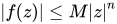
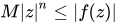
TheoremAssume are positive constants and is a non-negative integer. An entire function satisfying the inequality for all with is necessarily a polynomial, of degree at most [e] Similarly, an entire function satisfying the inequality for all with is necessarily a polynomial, of degree at least .

Growth

[edit]

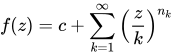
Entire functions may grow as fast as any increasing function: for any increasing function there exists an entire function such that for all real . Such a function may be easily found of the form:

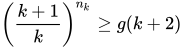
for a constant and a strictly increasing sequence of positive integers . Any such sequence defines an entire function , and if the powers are chosen appropriately we may satisfy the inequality for all real . (For instance, it certainly holds if one chooses and, for any integer one chooses an even exponent such that ).

Order and type

[edit]

The order (at infinity) of an entire function is defined using the limit superior as:
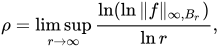
where is the disk of radius and denotes the supremum norm of on . The order is a non-negative real number or infinity (except when for all ). In other words, the order of is the infimum of all such that:

The example of shows that this does not mean if is of order .

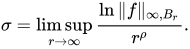
If one can also define the type:

If the order is 1 and the type is , the function is said to be "of exponential type ". If it is of order less than 1 it is said to be of exponential type 0.

If then the order and type can be found by the formulas
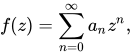
Let denote the -th derivative of . Then we may restate these formulas in terms of the derivatives at any arbitrary point :

The type may be infinite, as in the case of the reciprocal gamma function, or zero (see example below under § Order 1).

Another way to find out the order and type is Matsaev's theorem.

Examples

[edit]

Here are some examples of functions of various orders:

Order ρ

[edit]

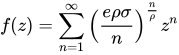
For arbitrary positive numbers and one can construct an example of an entire function of order and type using:

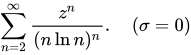
Order 0

[edit]
  • Non-zero polynomials

Order 1/4

[edit]

where

Order 1/3

[edit]

where

Order 1/2

[edit]

with (for which the type is given by )

Order 1

[edit]
  • with ()
  • the Bessel functions and spherical Bessel functions for integer values of [2]
  • the reciprocal gamma function ( is infinite)

Order 3/2

[edit]

Order 2

[edit]
  • with ()
  • The Barnes G-function ( is infinite).

Order infinity

[edit]

Genus

[edit]

Entire functions of finite order have Hadamard's canonical representation (Hadamard factorization theorem):

where are those roots of that are not zero (), is the order of the zero of at (the case being taken to mean ), a polynomial (whose degree we shall call ), and is the smallest non-negative integer such that the series

converges. The non-negative integer is called the genus of the entire function .

If the order is not an integer, then is the integer part of . If the order is a positive integer, then there are two possibilities: or .

For example, , and are entire functions of genus .

Other examples

[edit]

According to J. E. Littlewood, the Weierstrass sigma function is a 'typical' entire function. This statement can be made precise in the theory of random entire functions: the asymptotic behavior of almost all entire functions is similar to that of the sigma function. Other examples include the Fresnel integrals, the Jacobi theta function, and the reciprocal Gamma function. The exponential function and the error function are special cases of the Mittag-Leffler function. According to the fundamental theorem of Paley and Wiener, Fourier transforms of functions (or distributions) with bounded support are entire functions of order and finite type.

Other examples are solutions of linear differential equations with polynomial coefficients. If the coefficient at the highest derivative is constant, then all solutions of such equations are entire functions. For example, the exponential function, sine, cosine, Airy functions and Parabolic cylinder functions arise in this way. The class of entire functions is closed with respect to compositions. This makes it possible to study dynamics of entire functions.

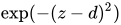
An entire function of the square root of a complex number is entire if the original function is even, for example .

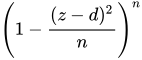
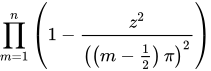
If a sequence of polynomials all of whose roots are real converges in a neighborhood of the origin to a limit which is not identically equal to zero, then this limit is an entire function. Such entire functions form the Laguerre–Pólya class, which can also be characterized in terms of the Hadamard product, namely, belongs to this class if and only if in the Hadamard representation all are real, , and , where and are real, and . For example, the sequence of polynomials

converges, as increases, to . The polynomials

have all real roots, and converge to . The polynomials

also converge to , showing the buildup of the Hadamard product for cosine.

See also

[edit]

Notes

[edit]

References

[edit]

Sources

[edit]
  • Boas, Ralph P. (1954). Entire Functions. Academic Press. ISBN 9780080873138. OCLC 847696. {{cite book}}: ISBN / Date incompatibility (help)
  • Levin, B. Ya. (1980) [1964]. Distribution of Zeros of Entire Functions. American Mathematical Society. ISBN 978-0-8218-4505-9.
  • Levin, B. Ya. (1996). Lectures on Entire Functions. American Mathematical Society. ISBN 978-0-8218-0897-9.
Revisions and contributorsEdit on WikipediaRead on Wikipedia
from Grokipedia
In complex analysis, an entire function is a function f:CCf: \mathbb{C} \to \mathbb{C} that is holomorphic (complex differentiable) at every point in the entire complex plane C\mathbb{C}.[1] This means it has no singularities or points of non-differentiability anywhere in the finite plane, distinguishing it from more general holomorphic functions that may be defined only on restricted domains.[2] Entire functions possess several fundamental properties that arise from their global holomorphy. Every entire function can be expressed as a power series n=0anzn\sum_{n=0}^\infty a_n z^n with infinite radius of convergence, allowing uniform representation across the plane.[3] Classic examples include polynomials of any degree, the exponential function eze^z, and the trigonometric functions sinz\sin z and cosz\cos z, all of which extend the familiar real-variable counterparts to the complex domain without introducing singularities.[1] More advanced examples, such as ez2e^{z^2} or the error function erf(z)=2π0zet2dt\operatorname{erf}(z) = \frac{2}{\sqrt{\pi}} \int_0^z e^{-t^2} \, dt, also qualify as entire due to composition or integral representations preserving holomorphy everywhere.[4] Key theorems highlight the richness and constraints of entire functions. Liouville's theorem states that if an entire function is bounded (i.e., f(z)M|f(z)| \leq M for some constant M>0M > 0 and all zCz \in \mathbb{C}), then it must be constant, implying that non-constant entire functions grow without bound as z|z| \to \infty.[5] The Little Picard theorem further asserts that a non-constant entire function omits at most one complex value, meaning its range is either all of C\mathbb{C} or C\mathbb{C} minus a single point, underscoring their tendency to be highly "surjective" despite analytic constraints.[6] These results, along with classifications by order (measuring growth rate, e.g., polynomials have order 0, exponentials order 1) and connections to dynamics and value distribution, form the cornerstone of the theory of entire functions in complex analysis.[7]

Fundamentals

Definition

In complex analysis, an entire function is a complex-valued function f:CCf: \mathbb{C} \to \mathbb{C} that is holomorphic at every point in the complex plane C\mathbb{C}.[1] Holomorphicity at a point z0Cz_0 \in \mathbb{C} requires that ff is complex differentiable in some open neighborhood of z0z_0, meaning the limit
f(z0)=limzz0f(z)f(z0)zz0 f'(z_0) = \lim_{z \to z_0} \frac{f(z) - f(z_0)}{z - z_0}
exists as a complex number.[1] If f(z)=u(x,y)+iv(x,y)f(z) = u(x,y) + iv(x,y) where z=x+iyz = x + iy and u,v:R2Ru, v: \mathbb{R}^2 \to \mathbb{R}, then ff satisfies the Cauchy-Riemann equations
ux=vy,uy=vx \frac{\partial u}{\partial x} = \frac{\partial v}{\partial y}, \quad \frac{\partial u}{\partial y} = -\frac{\partial v}{\partial x}
at every point in C\mathbb{C}, along with the continuity of these partial derivatives.[1] Unlike meromorphic functions, which are holomorphic in C\mathbb{C} except at isolated poles (points where the function tends to infinity in a specific Laurent series manner), entire functions have no such poles in the finite complex plane.[8] Meromorphic functions thus allow for singularities at countably many points, whereas the absence of any singularities distinguishes entire functions as analytic everywhere without exception.[8] A characterizing property of entire functions is their representation via power series: for any z0Cz_0 \in \mathbb{C}, there exist complex coefficients ana_n such that
f(z)=n=0an(zz0)n f(z) = \sum_{n=0}^{\infty} a_n (z - z_0)^n
for all zCz \in \mathbb{C}, with the series having an infinite radius of convergence.[1] This expansion holds globally due to the lack of singularities, enabling ff to be expressed as an infinite-degree polynomial in a formal sense, though non-polynomial examples like the exponential function eze^z illustrate the breadth of this class.[1]

Basic properties

An entire function ff is holomorphic on the entire complex plane C\mathbb{C}, and thus admits a Taylor series expansion about any point z0Cz_0 \in \mathbb{C} given by
f(z)=n=0an(zz0)n, f(z) = \sum_{n=0}^{\infty} a_n (z - z_0)^n,
where an=f(n)(z0)/n!a_n = f^{(n)}(z_0)/n!, and this series converges to f(z)f(z) for all zCz \in \mathbb{C}.[9] The derivative f(z)f'(z) of an entire function ff is also entire, as differentiation preserves holomorphicity on C\mathbb{C}.[9] Moreover, if ff and gg are entire functions, then their sum f+gf + g and product fgf \cdot g are also entire, provided the relevant series or operations converge on C\mathbb{C}.[10] Entire functions are defined and holomorphic on the whole complex plane, so they represent their own unique analytic continuations to C\mathbb{C}; in particular, they possess no natural boundaries within the finite plane.[10] The Weierstrass factorization theorem states that any entire function ff with zeros at points ana_n (counted with multiplicity) can be expressed as
f(z)=zmeg(z)n=1Epn(zan), f(z) = z^m e^{g(z)} \prod_{n=1}^{\infty} E_{p_n}\left(\frac{z}{a_n}\right),
where m0m \geq 0 is the order of the zero at z=0z=0 (or m=0m=0 if no zero there), g(z)g(z) is entire, and the EpnE_{p_n} are Weierstrass elementary factors ensuring convergence.[9] Since entire functions have no singularities in the finite complex plane, the Casorati-Weierstrass theorem does not apply there; however, at infinity, an entire function may exhibit a pole (if polynomial), a removable singularity (if constant), or an essential singularity (if transcendental).[11]

Growth Analysis

Boundedness and Liouville's theorem

A bounded entire function is one for which there exists a constant $ M > 0 $ such that $ |f(z)| \leq M $ for all $ z \in \mathbb{C} $. Liouville's theorem states that every such function must be constant.[12][13] To prove this, consider the derivative $ f'(z) $ at any point $ z \in \mathbb{C} $. By Cauchy's integral formula applied over a circle $ | \zeta - z | = r $ of radius $ r > 0 $,
f(z)=12πiζz=rf(ζ)(ζz)2dζ. f'(z) = \frac{1}{2\pi i} \oint_{|\zeta - z| = r} \frac{f(\zeta)}{(\zeta - z)^2} \, d\zeta.
Taking absolute values yields
f(z)12π2πrMr2=Mr. |f'(z)| \leq \frac{1}{2\pi} \cdot 2\pi r \cdot \frac{M}{r^2} = \frac{M}{r}.
Letting $ r \to \infty $ gives $ |f'(z)| \leq 0 $, so $ f'(z) = 0 $ everywhere, implying $ f $ is constant.[12][13] The maximum modulus principle provides another perspective: for a non-constant holomorphic function on a bounded domain, the maximum of $ |f| $ occurs on the boundary. For an entire function bounded by $ M $, this principle extends to the plane, forcing $ |f(z)| $ to attain its maximum everywhere only if $ f $ is constant.[12] As a corollary, every non-constant entire function is unbounded and thus exhibits growth in some sense. An important extension is Picard's little theorem, which asserts that a non-constant entire function can omit at most one complex value from its range.[6]

Asymptotic growth

For entire functions, the maximum modulus function $ M(r) = \max_{|z|=r} |f(z)| $ plays a central role in analyzing asymptotic behavior as $ |z| \to \infty $. By the maximum modulus principle, since $ f $ is holomorphic everywhere, $ M(r) $ is non-decreasing in $ r $; that is, $ M(r_1) \leq M(r_2) $ for $ 0 \leq r_1 < r_2 < \infty $.[12] If $ f $ is non-constant, this function tends to infinity as $ r \to \infty $, except in the bounded case where Liouville's theorem implies constancy.[12] A key growth indicator for entire functions is the quantity $ \lim_{r \to \infty} \frac{\log \log M(r)}{\log r} $, which informally characterizes the order of growth by capturing how rapidly $ M(r) $ increases with $ r $.[12] This limit provides a qualitative sense of the function's expansion at infinity, distinguishing polynomial-like behaviors (finite order) from those of infinite order without specifying the precise order parameter. For example, entire functions like $ e^z $ exhibit rapid growth along the positive real axis, where this indicator approaches 1. The Nevanlinna characteristic $ T(r, f) $ offers another measure of asymptotic growth for entire functions, integrating information about the function's values and zeros up to radius $ r $. It combines a proximity term averaging $ |f| $ on the circle $ |z| = r $ with a counting term for zeros inside $ |z| < r $, providing a logarithmic scale for overall expansion that aligns asymptotically with $ \log M(r, f) $ for large $ r $.[14] The Phragmén-Lindelöf principle extends growth control to unbounded sectors of the plane, applicable to entire functions by considering angular regions. If $ f $ is entire and bounded by 1 on the boundary rays of a sector of angle $ \alpha < \pi $, and satisfies $ |f(z)| \leq \exp(c |z|^\beta) $ for some $ c > 0 $ and $ 0 < \beta < \pi / \alpha $ in the sector, then $ |f(z)| \leq 1 $ throughout the sector.[15] This bounds growth in specific directions, preventing excessive expansion without implying global boundedness.

Order and Type

Definition of order

The order ρ\rho of an entire function ff is defined as
ρ=lim suprloglogM(r,f)logr, \rho = \limsup_{r \to \infty} \frac{\log \log M(r, f)}{\log r},
where M(r,f)=maxz=rf(z)M(r, f) = \max_{|z| = r} |f(z)| denotes the maximum modulus of ff on the circle of radius rr centered at the origin. This quantity provides a precise measure of the growth rate of ff as z|z| tends to infinity, capturing the exponential character of the function's expansion.[16] An equivalent formulation of the order can be obtained from the Taylor series coefficients of ff. If f(z)=n=0anznf(z) = \sum_{n=0}^\infty a_n z^n, then
ρ=lim supnnlognlogan. \rho = \limsup_{n \to \infty} \frac{n \log n}{-\log |a_n|}.
This alternative definition links the growth order directly to the decay rate of the coefficients, facilitating computations for functions with known series expansions.[16] A key property of the order is its invariance under certain transformations. Specifically, if gg is an entire function of order strictly less than ρ\rho, then the product f(z)exp(g(z))f(z) \exp(g(z)) has the same order ρ\rho as ff. This reflects the dominant growth behavior of ff overpowering the slower growth contributed by exp(g(z))\exp(g(z)). For concrete cases, polynomials of any degree have order ρ=0\rho = 0, as their maximum modulus grows like a power of rr. In contrast, the exponential function exp(z)\exp(z) has order ρ=1\rho = 1, illustrating linear exponential growth.

Definition of type

For an entire function ff of finite order ρ>0\rho > 0, the type σ=σ(f)\sigma = \sigma(f) provides a finer measure of growth beyond the order itself. It is defined as
σ=lim suprlogM(r,f)rρ, \sigma = \limsup_{r \to \infty} \frac{\log M(r, f)}{r^\rho},
where M(r,f)=maxz=rf(z)M(r, f) = \max_{|z| = r} |f(z)| is the maximum modulus function of ff.[16][17] This quantity σ\sigma characterizes the exponential rate of growth along the directions where ff achieves its maximum modulus for large rr. The function ff is said to be of finite type if σ<\sigma < \infty, and of infinite type if σ=\sigma = \infty. When the limit superior is actually a limit (i.e., the limit exists), the type is referred to as the mean type.[16] Representative examples illustrate these concepts for order ρ=1\rho = 1. The exponential function f(z)=exp(z)f(z) = \exp(z) has type σ=1\sigma = 1, since M(r,f)=erM(r, f) = e^r and thus logM(r,f)/r=1\log M(r, f)/r = 1. Similarly, the hyperbolic cosine f(z)=cosh(z)f(z) = \cosh(z) has type σ=1\sigma = 1, as its maximum modulus satisfies M(r,f)12erM(r, f) \sim \frac{1}{2} e^r for large rr, yielding lim suprlogM(r,f)/r=1\limsup_{r \to \infty} \log M(r, f)/r = 1.[16]

Finite vs. infinite order

Entire functions are classified by the order of their growth, denoted ρ\rho, which is defined as ρ=lim suprloglogM(r)logr\rho = \limsup_{r \to \infty} \frac{\log \log M(r)}{\log r}, where M(r)=maxz=rf(z)M(r) = \max_{|z|=r} |f(z)|. An entire function has finite order if ρ<\rho < \infty, meaning its growth is bounded above by exp(rρ+ϵ)\exp(r^{\rho + \epsilon}) for any ϵ>0\epsilon > 0 and sufficiently large rr. In contrast, a function has infinite order if ρ=\rho = \infty, which occurs when loglogM(r)\log \log M(r) grows faster than any multiple of logr\log r, i.e., for every K>0K > 0, there exists r0r_0 such that loglogM(r)>Klogr\log \log M(r) > K \log r for all r>r0r > r_0.[16] For entire functions of finite order, the Weierstrass-Hadamard factorization theorem provides a canonical representation as f(z)=zmeP(z)n=1Eq(z/an)f(z) = z^m e^{P(z)} \prod_{n=1}^\infty E_q(z/a_n), where mm is a non-negative integer, P(z)P(z) is a polynomial of degree at most qq, the ana_n are the non-zero zeros of ff (repeated according to multiplicity), and EqE_q are the Weierstrass primary factors of genus qq. Here, the genus qq satisfies qρq \leq \rho (often q=ρq = \lfloor \rho \rfloor), ensuring convergence of the infinite product via the condition 1/anq+1<\sum 1/|a_n|^{q+1} < \infty. This structure reflects the "regular" growth of finite-order functions, where the zeros have a finite exponent of convergence τρ\tau \leq \rho.[18][16] Entire functions of infinite order, however, admit no such finite-genus factorization, as no integer qq can bound the necessary primary factors for convergence, leading to more complex representations without a polynomial exponential factor of finite degree. A classic example is f(z)=exp(exp(z))f(z) = \exp(\exp(z)), which exhibits infinite order because its maximum modulus grows as exp(er)\exp(e^r) along the positive real axis, outpacing any exp(rμ)\exp(r^\mu) for finite μ\mu. Such functions display wildly irregular growth, manifesting as essential singularities at infinity with behavior that defies polynomial control in their factorization.[16]

Classification by Order

Orders less than 1

Entire functions of order less than 1 exhibit growth slower than exponential, with the maximum modulus satisfying loglogM(r,f)=o(logr)\log \log M(r, f) = o(\log r) as rr \to \infty, implying M(r,f)<exp(rϵ)M(r, f) < \exp(r^\epsilon) for any ϵ>0\epsilon > 0 and sufficiently large rr.[16] This subexponential growth distinguishes them from functions of order 1 or higher, such as exp(z)\exp(z), and for polynomial-like behavior, M(r)rkM(r) \sim r^k for some nonnegative integer kk when the function is a polynomial.[16] From implications of Jensen's formula, which relates the logarithmic average of f|f| on circles to the zeros via
12π02πlogf(reiθ)dθ=logf(0)+log(ran), \frac{1}{2\pi} \int_0^{2\pi} \log |f(re^{i\theta})| \, d\theta = \log |f(0)| + \sum \log \left( \frac{r}{|a_n|} \right),
where ana_n are the zeros, entire functions of order ρ<1\rho < 1 have sparse zeros, with the counting function n(r)n(r) satisfying n(r)=O(rρ+ϵ)n(r) = O(r^{\rho + \epsilon}) for any ϵ>0\epsilon > 0.[16] Polynomials, which have order 0, possess finitely many zeros (counting multiplicity), and are the only entire functions of order less than 1 with finitely many zeros unless the function is constant (order undefined or 0). Transcendental examples have infinitely many zeros, but these are sufficiently sparse that 1/an<\sum 1/|a_n| < \infty, allowing the Weierstrass canonical product to converge without exponential factors.[19] Polynomials provide the primary examples of order 0, such as f(z)=zk+f(z) = z^k + \cdots, where the order is exactly 0 for k1k \geq 1. For order 1/21/2, a classic transcendental example is f(z)=cos(z)f(z) = \cos(\sqrt{z}), expressible as
cos(z)=12(eiz+eiz), \cos(\sqrt{z}) = \frac{1}{2} \left( e^{i \sqrt{z}} + e^{-i \sqrt{z}} \right),
with the order inherited from exp(z)\exp(\sqrt{z}), which has order 1/21/2 since logM(r,exp(z))r\log M(r, \exp(\sqrt{z})) \sim \sqrt{r} implies loglogM(r)(1/2)logr\log \log M(r) \sim (1/2) \log r. Another example of order 1/21/2 is f(z)=sin(z)zf(z) = \frac{\sin(\sqrt{z})}{\sqrt{z}}, which is bounded on the positive real axis and arises in applications of Hadamard factorization for genus 0.[16]

Order 1 functions

Entire functions of order exactly 1 display exponential growth of the form M(r)eσrM(r) \sim e^{\sigma r} asymptotically, where σ>0\sigma > 0 is the type, distinguishing them from slower-growing functions of order less than 1. These functions may possess infinitely many zeros, with the linear density of zeros—measured by lim suprn(r)/r\limsup_{r \to \infty} n(r)/r, where n(r)n(r) counts the zeros inside the disk of radius rr—bounded above by a constant times σ\sigma, reflecting how the type governs the distribution and accumulation of zeros.[16] Prominent examples include the exponential function exp(z)\exp(z), which has order 1 and type σ=1\sigma = 1, as its maximum modulus satisfies logM(r)r\log M(r) \sim r. The trigonometric functions sin(z)\sin(z) and cos(z)\cos(z) also achieve order 1 with type σ=1\sigma = 1, derived from their series expansions and growth estimates along the imaginary axis, where sin(iy)12ey|\sin(iy)| \sim \frac{1}{2} e^{|y|}. The Mittag-Leffler function E1(z)=k=0zkk!=exp(z)E_1(z) = \sum_{k=0}^\infty \frac{z^k}{k!} = \exp(z) similarly exhibits order 1 and type 1.[16][16][16] Hadamard's factorization theorem provides the canonical representation for such functions: if ff is an entire function of order 1 with zeros {zn}\{z_n\} (counting multiplicity, excluding possibly z=0z=0) and exponent of convergence 1, then
f(z)=zmeaz+bn=1(1zzn)exp(zzn), f(z) = z^m e^{a z + b} \prod_{n=1}^\infty \left(1 - \frac{z}{z_n}\right) \exp\left(\frac{z}{z_n}\right),
where m0m \geq 0 is the multiplicity at 0, a,bCa, b \in \mathbb{C}, and the infinite product is the genus-1 canonical product ensuring convergence. This form captures the linear exponential factor eaze^{a z} alongside the zero contributions, with the type σ\sigma influencing both the polynomial degree in the exponential and the zero density. For instance, the function sin(πz)πz\frac{\sin(\pi z)}{\pi z} admits the genus-1 product form
sin(πz)πz=n0(1zn)exp(zn), \frac{\sin(\pi z)}{\pi z} = \prod_{n \neq 0} \left(1 - \frac{z}{n}\right) \exp\left(\frac{z}{n}\right),
where the exponential terms effectively cancel in pairs due to symmetry, yielding order ρ=1\rho = 1 and type σ=π\sigma = \pi.[18][18][16]

Orders greater than 1

Entire functions of order ρ>1\rho > 1 exhibit very rapid growth, surpassing the exponential growth typical of order 1 functions, as their maximum modulus M(r)M(r) satisfies loglogM(r)ρlogr\log \log M(r) \sim \rho \log r for large rr, leading to logM(r)rρ\log M(r) \sim r^\rho. This rapid growth implies that such functions can have a higher density of zeros compared to those of lower order, with the number of zeros n(r)n(r) inside the disk of radius rr bounded by n(r)Crρ+ϵn(r) \leq C r^{\rho + \epsilon} for any ϵ>0\epsilon > 0 and sufficiently large rr, allowing for potentially dense distributions in the sense of increased asymptotic counting function.[20][18] In the Hadamard factorization theorem, entire functions of finite order ρ>1\rho > 1 admit a canonical product representation f(z)=eP(z)zmn=1Eq(zan)f(z) = e^{P(z)} z^m \prod_{n=1}^\infty E_q\left(\frac{z}{a_n}\right), where {an}\{a_n\} are the non-zero zeros counted with multiplicity, mm is the order of the zero at z=0z=0, P(z)P(z) is a polynomial of degree at most qq, and q=ρq = \lfloor \rho \rfloor is the genus, which is at least 1 for ρ>1\rho > 1. The higher genus qq necessitates primary factors EqE_q of higher degree and allows the exponential factor to include polynomials up to degree qq, reflecting the function's accelerated growth and the sparseness condition 1/anq+1<\sum 1/|a_n|^{q+1} < \infty. This structure distinguishes them from lower-order cases by incorporating more complex convergence exponents in the Weierstrass factors.[20][18] Prominent examples include exp(zk)\exp(z^k) for integers k>1k > 1, which has order exactly ρ=k>1\rho = k > 1 and no zeros, simplifying the factorization to f(z)=eP(z)f(z) = e^{P(z)} with P(z)=zkP(z) = z^k. Specifically, for f(z)=exp(z2)f(z) = \exp(z^2), the order is ρ=2\rho = 2, the type is σ=1\sigma = 1, and the growth is given by logM(r)r2\log M(r) \sim r^2. Another example is the Airy function of the first kind Ai(z)\operatorname{Ai}(z), an entire function of order ρ=3/2>1\rho = 3/2 > 1 with infinitely many real negative zeros, illustrating transcendental growth and zero distribution characteristic of this regime.[18][20]

Genus of entire functions

In the theory of entire functions, the genus qq is defined as the smallest non-negative integer such that the series n=11znq+1\sum_{n=1}^\infty \frac{1}{|z_n|^{q+1}} converges, where {zn}\{z_n\} denotes the sequence of zeros of the entire function ff, counted with multiplicity and excluding the origin if applicable.[21] This integer qq characterizes the distribution of zeros in a way that ensures convergence of the associated infinite product representation.[20] The genus plays a central role in the Weierstrass-Hadamard factorization theorem for entire functions of finite order ρ\rho, where the minimal genus satisfies qρ<q+1q \leq \rho < q+1.[20] Specifically, such a function ff can be expressed in the canonical form
f(z)=zmexp(Q(z))n=1E(zzn,q), f(z) = z^m \exp(Q(z)) \prod_{n=1}^\infty E\left(\frac{z}{z_n}, q\right),
where m0m \geq 0 is the order of the zero at the origin, Q(z)Q(z) is a polynomial of degree at most qq, and E(u,p)E(u, p) is the Weierstrass canonical factor defined by
E(u,p)=(1u)exp(k=1pukk). E(u, p) = (1 - u) \exp\left( \sum_{k=1}^p \frac{u^k}{k} \right).
[18] The infinite product n=1E(z/zn,q)\prod_{n=1}^\infty E(z/z_n, q) is known as the canonical product of genus qq, which converges uniformly on compact sets due to the convergence of the defining series.[21] If the degree of Q(z)Q(z) exceeds qq, the genus of ff is taken as max{q,degQ}\max\{q, \deg Q\}; however, for the minimal genus in the Hadamard representation, degQq\deg Q \leq q holds, ensuring the factorization aligns with the order constraint.[7] This structure provides a complete decomposition of ff into its principal part (the exponential polynomial), the factor accounting for the zero at the origin, and the product over non-zero zeros, all governed by the genus.[18]

Characteristic function

The Nevanlinna characteristic function provides a fundamental measure for analyzing the growth and value distribution of entire functions, extending classical tools like the maximum modulus principle to quantify both the average size and the distribution of zeros. For an entire function ff, the characteristic is defined as
T(r,f)=m(r,f)+N(r,f), T(r, f) = m(r, f) + N(r, f),
where the proximity function m(r,f)m(r, f) captures the average growth on the circle z=r|z| = r,
m(r,f)=12π02πlog+f(reiθ)dθ, m(r, f) = \frac{1}{2\pi} \int_0^{2\pi} \log^+ |f(r e^{i\theta})| \, d\theta,
with log+\log^+ denoting the positive part of the logarithm, and the counting function N(r,f)N(r, f) accounts for the zeros of ff inside the disk z<r|z| < r,
N(r,f)=0rn(t,f)tdt. N(r, f) = \int_0^r \frac{n(t, f)}{t} \, dt.
Here, n(t,f)n(t, f) is the number of zeros of ff (counted with multiplicity) in zt|z| \leq t, assuming f(0)0f(0) \neq 0 for simplicity; adjustments for zeros at the origin are standard. This decomposition allows T(r,f)T(r, f) to reflect both the function's magnitude on the boundary and its internal zero structure, making it invariant under finite value shifts by the First Main Theorem.[22] The First Main Theorem states that for any entire function ff and any aCa \in \mathbb{C},
T(r,fa)=T(r,f)+O(1) T(r, f - a) = T(r, f) + O(1)
as rr \to \infty. This invariance implies that the characteristic T(r,f)T(r, f) is essentially independent of the specific value aa, highlighting the balanced role of proximity to aa and the counting of solutions to f(z)=af(z) = a. For entire functions, which lack poles, this theorem underscores the theory's focus on value distribution without the complications of singularities at infinity. The result originates from Nevanlinna's foundational work on meromorphic functions, adapted seamlessly to the entire case.[22][23] In relation to growth, the Nevanlinna characteristic T(r,f)T(r, f) is asymptotically equivalent to the logarithm of the maximum modulus M(r,f)=maxz=rf(z)M(r, f) = \max_{|z|=r} |f(z)|, satisfying T(r,f)logM(r,f)T(r, f) \sim \log M(r, f) in the sense that their ratio approaches a positive constant or they share the same order of magnitude for functions of finite order. More precisely, logM(r,f)T(r,f)+O(1)\log M(r, f) \leq T(r, f) + O(1), with the reverse inequality holding up to lower-order terms, ensuring T(r,f)T(r, f) serves as a reliable proxy for overall growth. A canonical example is the exponential function f(z)=ezf(z) = e^z, which has no zeros (N(r,ez)=0N(r, e^z) = 0) and yields
T(r,ez)=m(r,ez)rπ, T(r, e^z) = m(r, e^z) \sim \frac{r}{\pi},
since ereiθ=ercosθ|e^{r e^{i\theta}}| = e^{r \cos \theta} and the integral over the positive part simplifies to rπ\frac{r}{\pi}. This asymptotic matches the order of logM(r,ez)=r\log M(r, e^z) = r, illustrating how T(r,f)T(r, f) scales linearly for order-one entire functions.[24][23]

Examples

Polynomial entire functions

Polynomial entire functions are the simplest class of entire functions, consisting of finite sums of powers of zz with complex coefficients. A polynomial f(z)=k=0nakzkf(z) = \sum_{k=0}^n a_k z^k, where an0a_n \neq 0 and nn is the degree, is holomorphic everywhere in the complex plane due to its finite Taylor series expansion around any point, making it entire. Examples include constant functions (degree 0), linear functions like f(z)=z+1f(z) = z + 1 (degree 1), and higher-degree cases such as f(z)=z2+2z+1=(z+1)2f(z) = z^2 + 2z + 1 = (z+1)^2 (degree 2). These functions exhibit polynomial growth, distinguishing them from transcendental entire functions with faster asymptotic behavior. A key property of non-constant polynomials is that they have exactly nn roots in the complex plane, counting multiplicities, as guaranteed by the fundamental theorem of algebra. This theorem, first proved by Gauss in 1799, implies that any polynomial factors completely as f(z)=anj=1n(zrj)f(z) = a_n \prod_{j=1}^n (z - r_j), where the rjr_j are the roots (possibly complex and repeated). At infinity, polynomials behave like rational functions with a pole of order nn, but their entire nature in the finite plane ensures no singularities there. Regarding growth, the maximum modulus M(r)=maxz=rf(z)M(r) = \max_{|z|=r} |f(z)| satisfies M(r)anrnM(r) \sim |a_n| r^n as rr \to \infty, reflecting their order 0 classification among entire functions. This bounded growth rate by powers of rr underscores their role in approximation theory, where polynomials approximate other holomorphic functions on compact sets via theorems like Runge's.

Transcendental entire functions

A transcendental entire function is an entire function that is not a polynomial. Unlike polynomials, which have finite Taylor series expansions around any point, transcendental entire functions possess infinite Taylor series with infinitely many non-zero terms, reflecting their more complex analytic structure. Furthermore, when viewed on the Riemann sphere, they exhibit an essential singularity at infinity, as their growth exceeds that of any polynomial.[12] Transcendental entire functions generally have infinitely many zeros in the complex plane, counting multiplicities, unless they are of the form $ e^{g(z)} $ where $ g(z) $ is another entire function, in which case they have no zeros at all. This follows from the fact that if an entire function never vanishes, it can be expressed exponentially after taking logarithms in suitable domains. By Picard's great theorem, in any neighborhood of the essential singularity at infinity, a transcendental entire function assumes every complex value, with at most one possible exception, infinitely often. This underscores their dense range behavior near infinity, contrasting with the removable or pole singularities of polynomials at that point.[12][12] Prominent examples include the exponential function $ e^z $, which has no zeros and omits the value 0, and the sine function $ \sin z $, which has zeros at integer multiples of $ \pi $ and assumes all complex values. Other transcendental entire functions arise in integral representations, such as certain special functions constructed via contour integrals. The Weierstrass factorization theorem guarantees the existence of transcendental entire functions with prescribed zeros $ a_n $ (a sequence with no limit point in the finite plane), expressed in the canonical form
f(z)=zmeg(z)n=1Ep(zan), f(z) = z^m e^{g(z)} \prod_{n=1}^\infty E_p\left( \frac{z}{a_n} \right),
where $ m \geq 0 $ is the order of the zero at 0 (or 0 if none), $ g(z) $ is entire, $ p $ is the genus (a non-negative integer depending on the growth of the zeros), and the primary factors are
Ep(u)=(1u)exp(u+u22++upp). E_p(u) = (1 - u) \exp\left( u + \frac{u^2}{2} + \cdots + \frac{u^p}{p} \right).
This product converges uniformly on compact sets, enabling the construction of entire functions beyond polynomials.[12][12][12]

Specific order examples

The exponential function $ f(z) = \exp(z) $ is an entire function of order $ \rho = 1 $ and type $ \sigma = 1 $, as its maximum modulus satisfies $ M(r) \sim \exp(r) $ for large $ r $, yielding $ \rho = \lim_{r \to \infty} \frac{\log \log M(r)}{\log r} = 1 $ and $ \sigma = \lim_{r \to \infty} \frac{\log M(r)}{r^\rho} = 1 $.[16] The sine and cosine functions, $ f(z) = \sin(z) $ and $ f(z) = \cos(z) $, are entire functions of order $ \rho = 1 $ and type $ \sigma = 1 $, with growth bounded by $ |\sin(z)| \leq \exp(|z|) $ and similarly for cosine, confirming the order via the maximum modulus principle; their infinite product representations, $ \sin(z) = z \prod_{n=1}^\infty \left(1 - \frac{z^2}{n^2 \pi^2}\right) $ and $ \cos(z) = \prod_{n=0}^\infty \left(1 - \frac{4z^2}{(2n+1)^2 \pi^2}\right) $, further align with this finite order and type.[16][16] The function $ f(z) = \exp(z^2) $ is an entire function of order $ \rho = 2 $ and type $ \sigma = 1 $, since $ M(r) = \exp(r^2) $ implies $ \rho = \lim_{r \to \infty} \frac{\log \log M(r)}{\log r} = 2 $ and $ \sigma = \lim_{r \to \infty} \frac{\log M(r)}{r^2} = 1 $.[16][7] An example of an entire function of order $ \rho = 1/2 $ is $ f(z) = \cos(\sqrt{z}) $, which can be expressed via its power series expansion and exhibits growth such that the order is $ 1/2 $, with finite type $ \sigma < \infty $.[16] The iterated exponential $ f(z) = \exp(\exp(z)) $ is an entire function of infinite order $ \rho = \infty $, as $ M(r) = \exp(\exp(r)) $ leads to $ \rho = \lim_{r \to \infty} \frac{\log \log M(r)}{\log r} = \infty $.[16][7] The reciprocal gamma function $ f(z) = 1/\Gamma(z) $ is an entire function of order $ \rho = 1 $ and infinite type $ \sigma = \infty $, determined by the convergence exponent of its zeros at the non-positive integers and asymptotic growth analysis.[16]
User Avatar
No comments yet.