Hubbry Logo
Solution conceptSolution conceptMain
Open search
Solution concept
Community hub
Solution concept
logo
8 pages, 0 posts
0 subscribers
Be the first to start a discussion here.
Solution concept
Solution concept
from Wikipedia
Selected equilibrium refinements in game theory. Arrows point from a refinement to the more general concept (i.e., ESS Proper).

In game theory, a solution concept is a formal rule for predicting how a game will be played. These predictions are called "solutions", and describe which strategies will be adopted by players and, therefore, the result of the game. The most commonly used solution concepts are equilibrium concepts, most famously Nash equilibrium.

Many solution concepts, for many games, will result in more than one solution. This puts any one of the solutions in doubt, so a game theorist may apply a refinement to narrow down the solutions. Each successive solution concept presented in the following improves on its predecessor by eliminating implausible equilibria in richer games.

Formal definition

[edit]

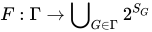
Let be the class of all games and, for each game , let be the set of strategy profiles of . A solution concept is an element of the direct product i.e., a function such that for all

Rationalizability and iterated dominance

[edit]

In this solution concept, players are assumed to be rational and so strictly dominated strategies are eliminated from the set of strategies that might feasibly be played. A strategy is strictly dominated when there is some other strategy available to the player that always has a higher payoff, regardless of the strategies that the other players choose. (Strictly dominated strategies are also important in minimax game-tree search.) For example, in the (single period) prisoners' dilemma (shown below), cooperate is strictly dominated by defect for both players because either player is always better off playing defect, regardless of what his opponent does.

Prisoner 2 Cooperate Prisoner 2 Defect
Prisoner 1 Cooperate −0.5, −0.5 −10, 0
Prisoner 1 Defect 0, −10 −2, −2

Nash equilibrium

[edit]

A Nash equilibrium is a strategy profile (a strategy profile specifies a strategy for every player, e.g. in the above prisoners' dilemma game (cooperate, defect) specifies that prisoner 1 plays cooperate and prisoner 2 plays defect) in which every strategy played by every agent (agent i) is a best response to every other strategy played by all the other opponents (agents j for every j≠i) . A strategy by a player is a best response to another player's strategy if there is no other strategy that could be played that would yield a higher pay-off in any situation in which the other player's strategy is played.

Backward induction

[edit]

In some games, there are multiple Nash equilibria, but not all of them are realistic. In dynamic games, backward induction can be used to eliminate unrealistic Nash equilibria. Backward induction assumes that players are rational and will make the best decisions based on their future expectations. This eliminates noncredible threats, which are threats that a player would not carry out if they were ever called upon to do so.

For example, consider a dynamic game with an incumbent firm and a potential entrant to the industry. The incumbent has a monopoly and wants to maintain its market share. If the entrant enters, the incumbent can either fight or accommodate the entrant. If the incumbent accommodates, the entrant will enter and gain profit. If the incumbent fights, it will lower its prices, run the entrant out of business (incurring exit costs), and damage its own profits.

The best response for the incumbent if the entrant enters is to accommodate, and the best response for the entrant if the incumbent accommodates is to enter. This results in a Nash equilibrium. However, if the incumbent chooses to fight, the best response for the entrant is to not enter. If the entrant does not enter, it does not matter what the incumbent chooses to do. Hence, fight can be considered a best response for the incumbent if the entrant does not enter, resulting in another Nash equilibrium.

However, this second Nash equilibrium can be eliminated by backward induction because it relies on a noncredible threat from the incumbent. By the time the incumbent reaches the decision node where it can choose to fight, it would be irrational to do so because the entrant has already entered. Therefore, backward induction eliminates this unrealistic Nash equilibrium.

See also:

Subgame perfect Nash equilibrium

[edit]

A generalization of backward induction is subgame perfection. Backward induction assumes that all future play will be rational. In subgame perfect equilibria, play in every subgame is rational (specifically a Nash equilibrium). Backward induction can only be used in terminating (finite) games of definite length and cannot be applied to games with imperfect information. In these cases, subgame perfection can be used. The eliminated Nash equilibrium described above is subgame imperfect because it is not a Nash equilibrium of the subgame that starts at the node reached once the entrant has entered.

Perfect Bayesian equilibrium

[edit]

Sometimes subgame perfection does not impose a large enough restriction on unreasonable outcomes. For example, since subgames cannot cut through information sets, a game of imperfect information may have only one subgame – itself – and hence subgame perfection cannot be used to eliminate any Nash equilibria. A perfect Bayesian equilibrium (PBE) is a specification of players' strategies and beliefs about which node in the information set has been reached by the play of the game. A belief about a decision node is the probability that a particular player thinks that node is or will be in play (on the equilibrium path). In particular, the intuition of PBE is that it specifies player strategies that are rational given the player beliefs it specifies and the beliefs it specifies are consistent with the strategies it specifies.

In a Bayesian game a strategy determines what a player plays at every information set controlled by that player. The requirement that beliefs are consistent with strategies is something not specified by subgame perfection. Hence, PBE is a consistency condition on players' beliefs. Just as in a Nash equilibrium no player's strategy is strictly dominated, in a PBE, for any information set no player's strategy is strictly dominated beginning at that information set. That is, for every belief that the player could hold at that information set there is no strategy that yields a greater expected payoff for that player. Unlike the above solution concepts, no player's strategy is strictly dominated beginning at any information set even if it is off the equilibrium path. Thus in PBE, players cannot threaten to play strategies that are strictly dominated beginning at any information set off the equilibrium path.

The Bayesian in the name of this solution concept alludes to the fact that players update their beliefs according to Bayes' theorem. They calculate probabilities given what has already taken place in the game.

Forward induction

[edit]

Forward induction is so called because just as backward induction assumes future play will be rational, forward induction assumes past play was rational. Where a player does not know what type another player is (i.e. there is imperfect and asymmetric information), that player may form a belief of what type that player is by observing that player's past actions. Hence the belief formed by that player of what the probability of the opponent being a certain type is based on the past play of that opponent being rational. A player may elect to signal his type through his actions.

Kohlberg and Mertens (1986) introduced the solution concept of Stable equilibrium, a refinement that satisfies forward induction. A counter-example was found where such a stable equilibrium did not satisfy backward induction. To resolve the problem Jean-François Mertens introduced what game theorists now call Mertens-stable equilibrium concept, probably the first solution concept satisfying both forward and backward induction.

Forward induction yields a unique solution for the burning money game.

See also

[edit]

References

[edit]
Revisions and contributorsEdit on WikipediaRead on Wikipedia
from Grokipedia
In game theory, a solution concept is a formal rule or model for predicting how rational players will choose strategies in a strategic interaction, resulting in stable outcomes known as solutions or equilibria that no player has an incentive to deviate from unilaterally. These concepts provide prescriptive guidance on optimal play, assuming players aim to maximize their own payoffs while anticipating others' . Solution concepts are central to analyzing both normal-form games (simultaneous moves) and extensive-form games (sequential moves), applying to settings ranging from zero-sum conflicts, where payoffs sum to zero, to general-sum scenarios with variable utilities. They emerged from foundational work in the early 20th century, with John von Neumann's 1928 establishing mixed strategies for securing payoffs in two-player zero-sum games, where the value equals the maximum of minima or minimum of maxima. Later developments, including John Nash's 1950 proof of equilibrium existence in finite games, expanded these ideas to non-zero-sum contexts, influencing fields like , , and . Among the most prominent solution concepts is the , a strategy profile where each player's choice is a best response to the others', ensuring stability through mutual unprofitability of deviation; it always exists in finite games via mixed strategies (probability distributions over actions). Dominant strategy equilibrium occurs when all players select strictly dominant strategies that outperform alternatives regardless of opponents' actions, as in the where mutual defection prevails despite collective inefficiency. Other key variants include , introduced by , which allows coordination via external signals (e.g., a mediator) to achieve higher joint payoffs than pure Nash outcomes, and for sequential games, refining Nash by requiring optimality in every subgame. Additional refinements, such as rationalizability (strategies surviving iterated deletion of dominated actions), and Stackelberg equilibrium (leader-follower commitment), address limitations like multiple equilibria, enabling predictions in complex real-world applications from auctions to international negotiations.

Overview and Foundations

Formal Definition

In , a solution concept is a function (or correspondence) that associates outcomes, or sets of outcomes, with , where an outcome is typically identified with the payoffs that players receive or the strategy profiles leading to those payoffs. This formal rule predicts the results of strategic interactions by selecting strategy profiles or outcomes that satisfy specific criteria of stability or , applicable to both normal-form and extensive-form . Formally, consider a game Γ=(N,S,u)\Gamma = (N, S, u), where NN is the of players, S=iNSiS = \prod_{i \in N} S_i is the set of strategy profiles with SiS_i denoting player ii's set, and u=(ui)iNu = (u_i)_{i \in N} is the vector of payoff functions ui:SRu_i: S \to \mathbb{R}. A solution concept σ\sigma maps the game to a nonempty of strategy profiles: σ(Γ)S\sigma(\Gamma) \subseteq S. Desirable solution concepts often possess properties such as existence in finite games and invariance under equivalent representations of the game, such as affine transformations of payoffs. The framework for solution concepts as tools to identify reasonable outcomes in strategic settings beyond individual optimization was introduced by Luce and Raiffa in their seminal 1957 text Games and Decisions. A prominent example is the .

Role in Game Theory

Solution concepts serve a fundamental purpose in by resolving the multiplicity of possible equilibria in strategic interactions, thereby selecting plausible predictions of player behavior under rationality assumptions. In non-cooperative settings, they identify self-enforcing outcomes where no player can improve their payoff through unilateral deviation, providing a foundation for analyzing adversarial interactions without binding commitments. In contrast, cooperative solution concepts focus on stable allocations of payoffs among coalitions, assuming enforceable agreements that distinguish these frameworks from non-cooperative ones. This distinction enables to model diverse social phenomena, from individual competition to . These concepts find wide applications across disciplines. In economics, they inform analyses of market competition, such as oligopolistic pricing and cartel formation, where equilibria predict firm strategies under interdependence. In political science, solution concepts elucidate voting mechanisms and coalition governments, revealing strategic incentives in legislative bargaining and electoral systems. In biology, evolutionary game theory employs them to assess strategy stability in populations, modeling traits like aggression in animal conflicts. For instance, in the Prisoner's Dilemma, non-cooperative Nash equilibrium yields mutual defection as the prediction, whereas evolutionary stable strategies in repeated interactions can sustain cooperation through reputation effects, highlighting how different concepts produce varying behavioral forecasts. Despite their utility, solution concepts face inherent limitations. No universal concept exists that consistently selects a unique equilibrium across all games, as many exhibit multiple stable outcomes without a clear rationale for preference. The Gibbard-Satterthwaite theorem underscores this by proving that, for voting games with at least three alternatives, no non-dictatorial social choice function is strategy-proof on all preference profiles, implying unavoidable manipulation risks and the absence of fully incentive-compatible mechanisms in social choice. Furthermore, predictions are sensitive to the game's representational form, such as normal-form versus extensive-form, which can alter equilibrium sets and interpretations. The evolution of solution concepts reflects a progression from ad hoc selections in early to rigorous axiomatic frameworks. Initial developments, like von Neumann's for zero-sum games in the 1920s and 1940s, addressed simple competitive scenarios through intuitive optimality criteria. Nash's 1950 equilibrium concept extended this to general non-cooperative games, establishing existence via fixed-point theorems and shifting focus toward self-enforcing predictions. By the and , refinements incorporated incomplete , as in Harsanyi's Bayesian approach, enabling analysis of . The 1980s marked axiomatic maturation, with refinements like subgame perfection and evolutionary stability integrating dynamic and biological perspectives into foundational models.

Solution Concepts in Normal-Form Games

Rationalizability and Iterated Dominance

In normal-form games, a sis_i for player ii is strictly dominated by another sis_i' if sis_i' yields a strictly higher payoff to player ii regardless of the strategies chosen by the other players, that is, ui(si,si)>ui(si,si)u_i(s_i', s_{-i}) > u_i(s_i, s_{-i}) for all strategy profiles sis_{-i} of the opponents. This definition captures strategies that a rational player would never choose, as there is always a better alternative. The iterated elimination of strictly dominated strategies (IESDS) is a refinement process that begins by removing all strictly dominated strategies from each player's set and repeats this elimination on the reduced until no further strictly dominated strategies remain. This iterative procedure relies on the assumption that rational players avoid dominated strategies and anticipate that others do the same. In dominance-solvable games, IESDS converges to a unique profile, providing a clear of play under . Rationalizability offers an epistemic justification for the outcomes of IESDS, characterizing strategies that survive under of . A strategy profile is rationalizable if each player's strategy is a best response to some about the opponents' strategies, where those beliefs themselves arise from higher-order mutual of best responses. Formally, the best-response correspondence for player ii is BRi(ui,μ)={siSisiargmaxsiSiSiui(si,si)dμ(si)},BR_i(u_i, \mu) = \{ s_i \in S_i \mid s_i \in \arg\max_{s_i' \in S_i} \int_{S_{-i}} u_i(s_i', s_{-i}) \, d\mu(s_{-i}) \}, where μ\mu is a () over the opponents' strategy set SiS_{-i}. The set of rationalizable strategies is the largest fixed point of this correspondence across all players, obtained through infinite iterations of best-response restrictions. A key result is that the rationalizable strategies exactly coincide with those that survive IESDS. This equivalence holds because IESDS implicitly enforces the of : a strategy survives if it is a best response to beliefs supported on other surviving strategies, . The epistemic foundation of rationalizability rests on of mutual best responses, meaning players not only play best responses but know that others do, know that others know, and so on indefinitely. Without this common knowledge assumption, weaker forms of may allow additional strategies. For illustration, consider the game, a where one player wins if two coins match and the other wins if they mismatch, with payoffs of 1 and -1 accordingly. Here, no pure or mixed strategy is strictly dominated, so IESDS eliminates nothing, and the set of rationalizable strategies is the full strategy space—all probability distributions over heads and tails for both players. In contrast, dominance-solvable games reduce via IESDS to a singleton set of rationalizable strategies. The set of rationalizable profiles always includes all Nash equilibria but is typically broader, as Nash requires mutual best responses to exact strategies rather than to beliefs.

Nash Equilibrium

The Nash equilibrium, introduced by John Nash in his 1950 doctoral thesis and subsequent 1951 publication, is a fundamental solution concept in that identifies stable profiles in normal-form games. Formally, for a game with player set II, strategy sets SiS_i for each iIi \in I, and utility functions ui:SRu_i: S \to \mathbb{R}, a strategy profile s=(si,si)Ss^* = (s_i^*, s_{-i}^*) \in S is a if, for every player ii, siargmaxsiSiui(si,si)s_i^* \in \arg\max_{s_i \in S_i} u_i(s_i, s_{-i}^*). This means no player can strictly improve their payoff by unilaterally deviating from sis_i^* while others adhere to their strategies. Nash's formulation addressed limitations in earlier concepts like von Neumann's , which applied mainly to zero-sum games, by extending stability to general-sum interactions. The concept extends naturally to mixed strategies, where players randomize over pure strategies. A mixed strategy profile σ=(σi,σi)\sigma^* = (\sigma_i^*, \sigma_{-i}^*), with σi\sigma_i^* a probability distribution over SiS_i, constitutes a mixed Nash equilibrium if, for each ii, E[ui(σi,σi)]E[ui(σi,σi)]\mathbb{E}[u_i(\sigma_i^*, \sigma_{-i}^*)] \geq \mathbb{E}[u_i(\sigma_i, \sigma_{-i}^*)] for all σiΔ(Si)\sigma_i \in \Delta(S_i), where Δ(Si)\Delta(S_i) is the simplex of distributions over SiS_i and expectations are taken with respect to the joint distribution induced by σ\sigma^*. Pure strategy equilibria are special cases where σi\sigma_i^* assigns probability 1 to a single sis_i^*. Nash proved the existence of at least one mixed-strategy Nash equilibrium in finite games using Brouwer's fixed-point theorem, by mapping best-response correspondences to a continuous function on the compact, convex strategy simplex and showing a fixed point corresponds to an equilibrium. Nash equilibria exhibit key properties that highlight their role in modeling strategic stability, though they do not always align with social optimality. In the , a canonical two-player game with symmetric payoffs where mutual defection yields a unique , this outcome is Pareto inefficient because mutual cooperation would improve both players' utilities without harming either. Conversely, coordination games like the battle of the sexes often feature multiple pure equilibria, each representing a mutually beneficial but self-reinforcing outcome, such as both players choosing the same activity despite differing preferences. 's contributions earned him the 1994 Nobel Memorial Prize in Economic Sciences, shared with and , for pioneering analyses of equilibria in non-cooperative games. Computing equilibria, especially in mixed strategies, involves methods like best-response dynamics, where players iteratively update to a best response against the current profile, potentially converging to an equilibrium under certain conditions such as potential . Equivalently, finite can be reformulated as linear complementarity problems (LCPs), solvable via algorithms like Lemke-Howson, which exploit the fixed-point structure for two-player cases. All equilibria are contained within the set of rationalizable strategies, linking the concept to iterative dominance elimination.

Solution Concepts in Extensive-Form Games

Backward Induction

is a method for solving finite extensive-form games of by reasoning from the end of the game tree toward the beginning, determining optimal actions at each decision node under the assumption that all players will act in subsequent . This approach ensures sequential rationality, where strategies are optimal not only overall but also conditional on reaching any . It was first applied by in 1913 to analyze the game of chess, proving that in such deterministic, finite two-player zero-sum games, one player can force a win, force a draw, or the opponent can force a win, depending on the position. The formal process begins at the terminal nodes of the game tree, where payoffs are known, and proceeds backward through each decision node hh. At node hh, the player to move selects an action ahargmaxau(τ(ah))a_h \in \arg\max_a u(\tau(a|h)), where uu is the player's payoff function and τ(ah)\tau(a|h) denotes the continuation following action aa from hh, assuming optimal play thereafter. This value is then assigned to node hh, and the process iterates upward until the root node, suboptimal branches at each step. The outcome of is a -perfect strategy profile, where strategies form a equilibrium in every of the original game; in finite perfect-information games without payoff ties, this profile is unique. The resulting strategies refine normal-form equilibria by eliminating non-credible threats or promises that would not be executed off the equilibrium path. A representative example is the , where player 1 proposes a division of a fixed sum (e.g., $10) and player 2 accepts or rejects. starts at player 2's decision node: rational play implies acceptance of any positive offer, as rejection yields zero for both. Anticipating this, player 1 offers the minimal positive amount (e.g., $1 to player 2, keeping $9), yielding payoffs of (9, 1) in the subgame-perfect equilibrium and eliminating the of rejection for fairness. Backward induction relies on assumptions of common knowledge of payoffs, perfect information (singleton information sets), perfect recall, and rationality at every node, even counterfactual ones. It applies only to finite-horizon games; limitations arise in infinite-horizon settings, where convergence may fail, or with incomplete information, requiring extensions like perfect Bayesian equilibrium.

Subgame Perfect Nash Equilibrium

A subgame perfect (SPNE) is a refinement of the for extensive-form games, requiring that the strategy profile induces a not only in the entire game but also in every . Formally, a strategy profile σ* is an SPNE if, for every Γ_h originating at a history h, the restriction of σ* to Γ_h constitutes a of that . This concept, introduced by , addresses limitations in standard Nash equilibria by ensuring sequential rationality throughout the game tree. In finite of , SPNE coincides with the outcome of , where strategies are determined by recursively solving subgames starting from terminal nodes. However, SPNE extends this logic to with imperfect information, where subgames may not be fully revealing, allowing for mixed strategies in equilibria. Key properties of SPNE include its ability to eliminate non-credible threats or promises that would not be optimal if reached, thereby selecting equilibria robust to deviations off the equilibrium path. Existence of SPNE in finite extensive-form is guaranteed by applying Kakutani's to the compact, of mixed behavioral strategies, analogous to the proof for Nash equilibria. A classic illustration is the chain-store paradox, where an monopolist faces sequential entry attempts by potential competitors across multiple markets. A naive might involve the incumbent aggressively fighting all entrants to deter future entries via reputation, but this fails subgame perfection because, in later s after prior fights, the incumbent would rationally accommodate entry to minimize losses, rendering early aggression non-credible. The unique SPNE has the incumbent always accommodating, as unravels the deterrence strategy from the final period. SPNE can be computed through sequential , recursively finding equilibria in subgames and combining them, or via formulations that enforce conditions across all subgames, particularly efficient for zero-sum or structured games. Despite its strengths, SPNE does not address incomplete information about types or payoffs, nor does it specify out-of-equilibrium beliefs, potentially allowing multiple equilibria in such settings.

Perfect Bayesian Equilibrium

A perfect Bayesian equilibrium (PBE) is a solution concept for extensive-form with incomplete information, consisting of a strategy profile σ\sigma and a μ\mu such that σ\sigma is perfect and, at every information set II, the action σ(I)\sigma(I) maximizes the expected of the player to move given beliefs μ(I)\mu(I), with beliefs updated according to Bayes' rule whenever possible on the equilibrium path. This equilibrium refines by requiring sequential off the equilibrium path, where beliefs about unobserved types or actions guide behavior in situations not reached under σ\sigma. The concept evolved from Reinhard Selten's in the , extending it to handle incomplete by incorporating explicit beliefs, and was formally defined for multi-stage games with observed actions. Key components include sequentially rational strategies, which ensure optimal play conditional on reaching any information set, and beliefs that resolve uncertainty about opponents' types or past moves, particularly pinning down out-of-equilibrium behavior where Bayes' rule does not apply due to zero-probability events. In finite games of perfect recall, a PBE always exists, as the set of PBEs includes all limits of trembling-hand perfect equilibria, though the concept's looseness leads to multiple equilibria supported by arbitrary off-path beliefs. A classic example is the beer-quiche signaling game, where a strong-type sender prefers beer for breakfast but must signal toughness to deter a receiver's challenge; pooling equilibria where both strong and weak types choose quiche can be sustained as PBEs if the receiver holds pessimistic beliefs (assigning positive probability to the weak type) upon observing beer off the path. Such multiplicity arises from freedom in specifying off-equilibrium beliefs, allowing implausible equilibria; refinements like universal divinity restrict these beliefs by eliminating responses that some types would never rationally deviate to, even under favorable belief updates, thereby selecting intuitive outcomes in signaling games. PBEs find applications in entry deterrence models, where incumbents signal low costs through aggressive pricing to convince potential entrants of unprofitability, and in auctions with sequential bidding, where bidders update beliefs about rivals' valuations based on observed bids to form optimal strategies. In finite-horizon settings, is assured via sequential equilibria, which impose consistency through trembling-hand perturbations, ensuring robustness to small mistakes in play.

Refinements and Advanced Concepts

Forward Induction

Forward induction is a refinement in extensive-form games that guides players' beliefs following observed deviations from equilibrium paths, interpreting such deviations as informative signals about the deviator's type or future intentions. Specifically, if a deviation is more likely to occur under "strong" types (those committed to aggressive or coordinated play) than under "weak" types (those inclined toward passive or conflicting actions), rational players should update their beliefs to place higher probability on strong types after observing the deviation. This , introduced as part of strategic stability analysis, emphasizes that past actions provide "preplay communication" that influences play, preventing the treatment of subgames as isolated from prior history. Formally, forward induction restricts beliefs in perfect Bayesian equilibria (PBE) by requiring that off-equilibrium-path deviations—those improbable under the candidate equilibrium—signal commitment or strength, thereby eliminating equilibria where such deviations lead to beliefs favoring implausible types. It builds on PBE by imposing forward-looking inference, ensuring that only outcomes robust to rational interpretations of deviations survive refinement. A representative example is the battle of the sexes game augmented with an entry stage, where one player first chooses whether to enter a coordination (with payoffs favoring joint or joint attendance) or take an outside option. Off-path cheap talk, such as a pre-entry announcement favoring one coordination outcome, can induce efficient play if forward induction leads the second player to believe the entrant is committed to that outcome, as deviation from the outside option would otherwise be irrational for uncommitted types; experimental evidence shows partial support for this coordination via such beliefs. As a refinement, forward induction is stronger than standard PBE, which permits arbitrary off-path beliefs, by mandating inference from deviation incentives. It aligns with the stable sets of equilibria proposed in strategic stability frameworks but can conflict with certain divine equilibria, where belief restrictions prioritize equilibrium dominance over deviation likelihood in signaling contexts. Forward induction finds applications in resolving equilibrium multiplicity within signaling games, where it selects separating outcomes by interpreting costly signals as evidence of high types, and in bargaining settings, where deviations signal resolve to prevent concessions. However, critiques arise in games with multiple possible motives for deviation, as the principle may over-refine by assuming a single dominant interpretation, potentially excluding plausible equilibria. Historically, forward induction emerged in the 1980s amid debates on equilibrium stability, with Eric van Damme's work integrating it with intuitive criteria to bridge logical inference from deviations and broader stability requirements in extensive-form games.

Trembling-Hand Perfection

Trembling-hand perfection is a refinement of introduced by to address the robustness of equilibria to small implementation errors or "trembles" in players' actions. In extensive-form games, it ensures that strategies remain optimal even if players occasionally deviate from their intended actions with small probability, thereby eliminating equilibria that rely on implausible off-equilibrium-path behavior. This concept builds on subgame perfect by adding stability to minor perturbations, making it a stricter criterion for rational play. Formally, a strategy profile σ\sigma is trembling-hand perfect if, for every ϵ>0\epsilon > 0, there exists a fully mixed strategy profile σϵ\sigma^\epsilon that is a in the ϵ\epsilon-perturbed game—where each player randomizes over all actions with minimum probability ϵ\epsilon for non-intended actions and distributes the remaining probability 1ϵ1 - \epsilon according to σ\sigma—and σ=limϵ0σϵ\sigma = \lim_{\epsilon \to 0} \sigma^\epsilon. The perturbed game modifies payoffs to reflect these small randomization probabilities, capturing the idea that players' hands might "tremble," leading to unintended moves. Selten proved that every finite has at least one trembling-hand perfect equilibrium, often in mixed strategies. Trembling-hand perfect equilibria exhibit several key properties. They imply sequential rationality, as strategies must be optimal responses at every information set, even those reached only with small tremble probabilities. This refinement eliminates non-credible threats by requiring that no player benefits from deviating in response to low-probability errors, ensuring equilibria are supported by sensible off the equilibrium path. Additionally, every trembling-hand perfect equilibrium is perfect, though the converse does not hold, as subgame perfection alone may permit equilibria unstable to trembles. A classic example illustrating trembling-hand perfection is the chain-store game, where an firm faces sequential entry by potential competitors in multiple markets. In the without perturbations, the incumbent fights entry aggressively in every market to deter future entrants, despite the high cost of repeated fights. However, trembling-hand perfection resolves this by introducing small probabilities of accidental accommodation; if the incumbent ever trembles and accommodates once, subsequent entrants infer weakness, making aggressive threats non-credible and leading to the equilibrium where the incumbent accommodates entry immediately. This outcome aligns with intuitive reputation-building limits in finite horizons. In normal-form games, trembling-hand perfect equilibria are equivalent to proper equilibria, a concept defined by as a further refinement where more costly mistakes are less likely than less costly ones. Thus, trembling-hand perfection refines perfect by ensuring robustness to errors, providing a bridge between extensive- and normal-form analyses. Despite its strengths, trembling-hand perfection has limitations. It does not always select a unique outcome; multiple such equilibria can exist in the same game, requiring additional criteria for selection. Computationally, verifying whether a given pure-strategy is trembling-hand perfect is NP-hard, even for three-player games with integer payoffs, making it challenging for large-scale applications. Historically, Selten's 1975 paper laid the foundation for this refinement amid efforts to strengthen against implausible assumptions. The concept also links to , where trembling-hand perfect equilibria correspond to evolutionarily stable strategies under small mutation rates, as random perturbations mimic evolutionary noise in .

References

Add your contribution
Related Hubs
User Avatar
No comments yet.