Hubbry Logo
Ernest MarsdenErnest MarsdenMain
Open search
Ernest Marsden
Community hub
Ernest Marsden
logo
8 pages, 0 posts
0 subscribers
Be the first to start a discussion here.
Ernest Marsden
Ernest Marsden
from Wikipedia

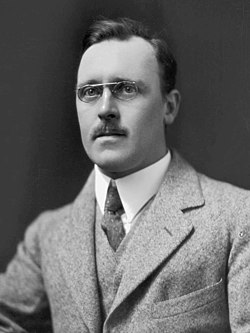
Sir Ernest Marsden CMG CBE MC FRS (19 February 1889 – 15 December 1970) was an English-New Zealand physicist. He is recognised internationally for his contributions to science while working under Ernest Rutherford, which led to the discovery of new theories on the structure of the atom. In Marsden's later work in New Zealand, he became a significant member of the scientific community, while maintaining close links to the United Kingdom.

Key Information

Education

[edit]

Born in Manchester, the son of Thomas Marsden and Phoebe Holden, Marsden lived in Rishton and attended Queen Elizabeth's Grammar School, Blackburn, where an inter-house trophy rewarding academic excellence ('The Marsden Merit Trophy') bears his name.[2]

In 1909, as a 20-year-old student at the University of Manchester, he met and began work under Ernest Rutherford.[3] While still an undergraduate he conducted the famous Geiger–Marsden experiment, also called the gold foil experiment, together with Hans Geiger under Rutherford's supervision. This experiment led to Rutherford's new theory for the structure of the atom, with a centralised concentration of mass and positive charge surrounded by empty space and a sea of orbiting negatively charged electrons.[4] Rutherford later described this as "almost as incredible as if you fired a 15-inch shell at a piece of tissue paper and it came back to hit you".[5]

The apparatus used in the experiment was an early version of what was to become the Geiger counter.[6]

In 1915 he moved to Victoria University College in Wellington, New Zealand, to replace Thomas Laby as Professor of Physics; Rutherford recommended his appointment there.

Career

[edit]

Marsden served in France during World War I as a Royal Engineer in a special sound-ranging section and was awarded the Military Cross in the 1919 King's Birthday Honours.

In 1922 Marsden turned from his research and position as Professor of Physics to bureaucracy. He was appointed Assistant Director of Education before accepting the position of Secretary of New Zealand's new Department of Scientific and Industrial Research (DSIR) in 1926. The new Department's focus was on assisting primary industries, and Marsden worked to organise research particularly in the area of agriculture.[3]

Marsden initiated a number of projects that kept New Zealand in touch with international developments in the field of radiation and nuclear sciences. In 1939 he pioneered the non-medical use of radioisotopes in New Zealand, and conducted a series of experiments to determine the role of cobalt in animal metabolism.[4]

With the outbreak of World War II Marsden was given the title of Director of Scientific Developments, and was charged with mobilizing New Zealand's scientific manpower.[7] During the War he worked on radar research, setting up a team to develop the radar equipment for use in the Pacific. Marsden also used his scientific connections to form a team of young New Zealand scientists who would participate in the American Manhattan Project developing the nuclear bomb, and initiated the search for uranium, the raw material needed for nuclear projects, in New Zealand.[8]

Marsden had a post-war vision of a nuclear New Zealand, with scientists working on research using local nuclear reactors, and developing connections with the British nuclear energy and weapons program. While this vision was not fully realised, in 1946 he established a team of scientists to carry out research into atomic energy and the application of nuclear science to problems in agriculture, health, and industry. Ties between Marsden and the scientific community in Britain remained strong, and in 1947 he became the DSIR's scientific liaison officer in London.[8]

Marsden retired in 1954 and returned to Wellington, where he continued to work and travel extensively, serving on a number of committees and conducting research into environmental radioactivity. As his studies turned to the impact of fallout from radioactive bombs, Marsden came to oppose testing and the development of nuclear weapons.[4] While Marsden had a significant role in establishing and encouraging nuclear science in New Zealand, this role of speaking out against nuclear weapons development and testing - which he only did after the British nuclear testing program was complete - is less known.

In 1966, the same year France began testing nuclear bombs in the Pacific, Marsden suffered a stroke after which he used a wheelchair. He later died at his home in Lowry Bay, Lower Hutt on the shores of Wellington Harbour in 1970.

Family life

[edit]

Marsden married Margaret Sutcliffe, a school teacher, in 1913. They had two children together, a son and a daughter. After Marsden's final retirement to New Zealand, Maggie (who had been suffering from heart disease) died on 7 November 1956. Two years later, on 26 June 1958, Marsden married Joyce Winifred Chote, who was 30 years his junior. She assisted him in his remaining years, joining him on his travels and supporting him during his research.[2]

Honours and awards

[edit]

Marsden's career recognitions included fellowship in the Royal Society[1] of London in 1946, president of the Royal Society of New Zealand in 1947 and the Rutherford Memorial Lecture in 1948. In 1961 he chaired the Rutherford Jubilee Conference in Manchester, which celebrated 50 years since Rutherford's discovery of the atomic nucleus.

In 1935, he was awarded the King George V Silver Jubilee Medal[9] and appointed a Commander of the Order of the British Empire in the Silver Jubilee and King's Birthday Honours.[10] He was appointed a Companion of the Order of St Michael and St George in the 1946 New Year Honours.[11] In 1953, Marsden was awarded the Queen Elizabeth II Coronation Medal,[12] and he was made a Knight Bachelor in the 1958 New Year Honours, for services to science.[13]

Honorific eponyms

[edit]

The Marsden Fund for basic research in New Zealand was set up in 1994.

Massey University has named a major lecture theatre after him.[14]

References

[edit]
[edit]
Revisions and contributorsEdit on WikipediaRead on Wikipedia
from Grokipedia

Sir Ernest Marsden OM CMG CBE MC FRS (19 February 1889 – 15 December 1970) was an English-born physicist who emigrated to New Zealand and became a pivotal figure in the country's scientific development, best known for his early experimental work demonstrating the scattering of alpha particles, which supported Ernest Rutherford's model of the nuclear atom.
Born in Rishton, Lancashire, Marsden studied at the University of Manchester, where he earned his BSc in 1909 and DSc in 1914, collaborating with Rutherford and Hans Geiger on radioactivity research. In 1909, as a research student, he conducted experiments firing alpha particles at thin metal foils, observing large-angle deflections that indicated the atom's positive charge was concentrated in a dense nucleus rather than diffusely distributed, as per the prevailing plum pudding model./18:_Measuring_the_Very_Small/18.03:_The_Geiger-Marsden_Experiment)/04:_Atomic_Structure/4.14:_Gold_Foil_Experiment) These Geiger-Marsden experiments, published between 1909 and 1913, provided empirical evidence pivotal to Rutherford's 1911 planetary atomic model./18:_Measuring_the_Very_Small/18.03:_The_Geiger-Marsden_Experiment)
After serving in World War I with the Royal Engineers, earning the Military Cross, Marsden moved to New Zealand in 1914, becoming professor of physics at Victoria University College in Wellington from 1915 to 1922. He later headed the Department of Scientific and Industrial Research (DSIR) from 1926 to 1947, fostering applied science, including wartime radar development that supported Allied operations in the Pacific and laid groundwork for post-war industry. Knighted in 1958 and elected a Fellow of the Royal Society in 1946, Marsden's administrative roles advanced New Zealand's scientific infrastructure, emphasizing practical applications over theoretical pursuits alone.

Early Life and Education

Childhood and Family Background

Ernest Marsden was born on 19 February 1889 at 68 Hermitage Street in Rishton, , , into a working-class family. His father, Thomas Marsden, worked as a cotton weaver, a common occupation in the textile-heavy region, and later transitioned to operating as a draper and hardware dealer. His mother was Phoebe Holden. Marsden was the second of five children born to his parents, comprising four sons—Robert, himself, Harold, and Sydney—and one daughter, Hilda, who was the youngest and later married Walter Fish of . The family resided in Rishton, a modest industrial village, reflecting the economic constraints typical of Lancashire's communities during the late . In his early years, Marsden attended Rishton Wesleyan School, paying a fee of 2 pence per week, until the age of ten. The school's headmaster, Joseph Marshall, identified his academic potential early on, though the family's limited resources necessitated reliance on scholarships for further advancement.

Academic Training

Marsden received his early at Queen Elizabeth in , , where he demonstrated exceptional ability and secured scholarships that funded his studies. He subsequently enrolled in the honours course in physics at the prior to 1907, graduating with a degree with first-class honours in 1909. As an undergraduate, Marsden collaborated with and on experiments scattering alpha particles, contributing data that informed Rutherford's nuclear model of the atom; these efforts, initiated in 1909, marked his introduction to advanced experimental physics. After obtaining his BSc, Marsden pursued further research under Rutherford at , serving as a in 1912 and holding a university fellowship from 1911 to 1914. This period culminated in the award of a degree in 1914, recognizing his contributions to research.

Scientific Contributions

Collaboration with Ernest Rutherford

Ernest Marsden enrolled in the honours physics course at in 1907, where served as Langworthy Professor of Physics and directed pioneering research on . In autumn 1908, at age 19, Marsden was recommended by , Rutherford's research assistant, as suitable to assist in ongoing experiments measuring the scattering of alpha particles through metal foils; Rutherford approved the involvement, initiating Marsden's direct collaboration with the group. This partnership integrated Marsden into Rutherford's laboratory efforts to probe atomic structure, leveraging his emerging skills in scintillation counting and precise detection of particle deflections. In , during his final undergraduate year, Marsden, under Rutherford's guidance and alongside Geiger, performed targeted tests on backscattering from thin foils, observing unexpected large-angle deflections via screen scintillations in a darkened room—findings reported directly to Rutherford that challenged prevailing atomic models. Their joint work yielded a key publication in May detailing these observations, establishing quantitative data on deflection probabilities. Marsden graduated with first-class honours that year and continued contributing to related studies through 1910, re-examining emission rates and scattering distributions to refine Rutherford's theoretical framework. Following Geiger's departure in 1912, Marsden assumed the role of Rutherford's , extending their collaboration into advanced inquiries until 1914, when Marsden received his DSc for this body of work. This period solidified Marsden's contributions to Rutherford's laboratory outputs, including a 1913 paper co-authored with Geiger on laws, which provided empirical support for concentrated positive charge within the atom. The under Rutherford not only honed Marsden's experimental rigor but also positioned him as a key figure in the shift toward nuclear conceptions of , though Marsden later emphasized the collective nature of the lab's achievements over individual credit.

The Geiger-Marsden Experiment

The Geiger-Marsden experiment consisted of a series of investigations into the of alpha particles by thin metal foils, primarily , conducted from 1909 onward at the under Ernest Rutherford's direction. , Rutherford's research assistant, collaborated with undergraduate student Ernest Marsden, who was assigned to the project in his final year of study. The initial setup utilized alpha particles emitted from a source, directed as a narrow beam through evacuated apparatus onto a thin foil target approximately 0.00004 cm thick, with scintillations detected on a screen observed via . This arrangement allowed measurement of deflection angles by varying the screen's position relative to the foil. Marsden performed key early observations, including the detection of alpha particles scattered at large angles, which contradicted expectations from J.J. Thomson's plum pudding atomic model that predicted only minor deflections. In one pivotal test, Marsden noted scintillations on the screen even when positioned behind the foil, indicating backscattering of about 1 in 8000 particles at angles exceeding 90 degrees. Geiger and Marsden refined the apparatus over subsequent years, incorporating quantitative scintillation counting and testing foils of , silver, , and to compare scattering efficiencies proportional to atomic weight. Their publication detailed statistical distributions confirming that scattering followed a 1/sin^4(θ/2) angular dependence, where θ is the deflection angle. The results demonstrated that the vast majority of alpha particles traversed the foil undeflected, implying atoms are mostly empty space, while rare large-angle scatters required a massive, concentrated positive charge within the atom to impart sufficient momentum via Coulomb repulsion. Rutherford interpreted these findings in 1911 as evidence for a nuclear atomic model, with electrons orbiting a dense central nucleus comprising most of the atomic mass. Geiger later credited Marsden's diligence in the tedious scintillation counting, conducted in dim red light to preserve screen sensitivity, as crucial to obtaining reliable data amid experimental challenges like source variability and foil imperfections. These experiments provided empirical refutation of diffuse charge distributions and established the foundation for modern atomic structure understanding.

Additional Research on Alpha Particles

In 1910, Marsden returned to the to collaborate with Geiger on refined experiments testing Rutherford's emerging theory of scattering. These studies involved re-examining the emission rates and ranges of s from radioactive sources, such as and , to quantify their penetration through air and thin foils under controlled conditions. The work confirmed that ranges were sharply defined, with variations attributable to source purity and , providing baseline data for interpreting scattering probabilities. Further advancing the analysis, Geiger and Marsden's 1913 investigations detailed the laws governing deflections of s through large s, using scintillation screens to count impacts in setups. They observed that the number of scintillations—and thus scattered particles—decreased approximately as the inverse of the cosine of half the deflection , with scattering intensity proportional to the square of the of the target foil and inversely proportional to the of the velocity. These findings, derived from systematic variation of foil thickness (e.g., foils of 0.00004 cm), (up to 150 degrees), and particle speed from different emitters, supported Rutherford's nuclear model by demonstrating single-encounter deflections rather than cumulative small- deviations. After , in 1917–1919, Marsden briefly rejoined Rutherford's team for scintillation-based observations of alpha particles traversing gases like and . These experiments revealed anomalous deflections and energy losses indicative of direct nuclear interactions, with alpha particles from sources (velocity ~1.7 × 10^9 cm/s) producing distinct scintillation patterns suggesting close approaches to atomic nuclei in light elements. The results contributed for nuclear structure and prompted Rutherford's later work on artificial transmutation.

Professional Career

Early Positions in the United Kingdom

Following his Bachelor of Science degree from the in 1909, Marsden was appointed lecturer in physics at East London College, part of the , where he balanced teaching responsibilities with ongoing research interests. In 1911, he returned to as a John Harling Fellow, enabling focused research under Ernest Rutherford's supervision. By 1912, after Hans Geiger's departure, Marsden succeeded as and in the Manchester physics department, contributing to experiments on scattering and atomic structure until 1914. During this period, he earned his degree from for work in . These roles solidified his expertise in radioactivity, though interrupted by service, for which he received the . Marsden's positions emphasized practical experimentation over administrative duties, aligning with Rutherford's emphasis on empirical investigation.

Relocation to New Zealand

In 1914, Ernest Marsden was appointed professor of physics at Victoria University College (now Victoria University of ) in , following a recommendation from his mentor , who had recently become involved in selecting a successor to Thomas Laby. Marsden accepted the position and relocated to in early 1915, marking his permanent shift from academic roles in the to a career centered in . This move aligned with Rutherford's influence in promoting capable physicists to strengthen scientific education in his native country, where Marsden would spend the majority of his professional life administering research and education. Upon arrival, Marsden assumed teaching and research duties at Victoria College, focusing on physics instruction amid limited resources typical of colonial-era institutions. He married Christine Stewart, a New Zealander, in 1915, establishing family ties that reinforced his commitment to the country. However, interrupted his tenure; in June 1916, Marsden enlisted for overseas service with the , serving in and earning the for gallantry at Passchendaele in 1917. He returned to in 1919, resuming his professorship until 1920, when administrative pressures and postwar recovery prompted a transition to broader educational roles. Marsden's relocation facilitated his evolution from experimental physicist to science administrator, leveraging his international experience to advocate for expanded research infrastructure in New Zealand, including early efforts in radio research and industrial applications. By , he shifted to the Department of Education as assistant director, laying groundwork for his later leadership in the Department of Scientific and Industrial Research (DSIR). This foundational period in solidified his influence on the nation's nascent , though he briefly returned to the for war-related duties and later liaison work from 1947 to 1954 before retiring permanently to in 1954.

Leadership in Science Administration

In 1926, Marsden was appointed the first Secretary (later Director) of New Zealand's newly established Department of Scientific and Industrial Research (DSIR), a role he held until 1947. Under his leadership, the DSIR integrated previously independent units such as the Geological Survey, Dominion Laboratory, and Dominion Observatory, expanding its scope to encompass both fundamental and applied research into New Zealand's natural resources, including minerals, soils, and fisheries. He advocated for a balanced approach that supported basic scientific inquiry alongside practical industrial applications, fostering collaborations between researchers and government agencies to address national needs like resource development. Marsden's administrative efforts included the establishment of specialized divisions, such as the Industrial Psychology Division in , aimed at studying workplace conditions and efficiency in industries. He prioritized funding for projects that aligned with economic priorities, including geophysical surveys and agricultural research, while navigating limited budgets during the interwar and wartime periods. By 1947, the DSIR had grown into a central hub for scientific coordination, reflecting Marsden's emphasis on institutional autonomy and merit-based appointments over political influence. In 1947, shortly after his election as President of the Royal Society of , Marsden transitioned to the role of 's Scientific Liaison Officer in , serving as the government's scientific adviser until 1954. In this capacity, he represented New Zealand at international conferences, facilitated , and promoted initiatives like renewed oil efforts. His diplomatic approach strengthened ties with British and scientific communities, ensuring New Zealand's interests in postwar reconstruction and resource exploration were advanced through evidence-based policy recommendations.

Personal Life

Marriage and Family

Marsden married Margaret Sutcliffe, an elementary-school teacher from , , on 4 August 1913 in Rishton, . The couple had two children: a daughter, Peggy (later Mrs. R. J. Nankervis), and a son. Margaret Sutcliffe Marsden died in 1956. Following her death, Marsden married Joyce Winifred Chote of Wellington, New Zealand, in July 1958; she was the daughter of W. A. Chote. The couple relocated shortly thereafter to , where Marsden served in a scientific advisory role. Joyce Marsden died in 1990.

Character and Interests

Marsden was characterized as boisterous and exuberant, traits evident in his early collaborations at under Rutherford's influence. Contemporaries noted his vivacious, quick-thinking, and approachable nature, which persisted alongside sustained enthusiasm and energy as he aged into a respected scientific elder statesman. In , he gained widespread popularity for his bright, informal public addresses, reflecting a splendid personality marked by infectious enthusiasm that drew audiences to scientific topics. Marsden maintained keen interests in scientific hobbies and extracurricular activities, sustaining engagement with research and experimentation beyond professional duties. Following retirement in 1954 and his 1958 marriage to Joyce Winifred Chote, Marsden pursued travel across multiple countries with her as a companion and assistant in these endeavors, while advocating for initiatives like New Zealand's participation, exploration, and applications in .

Legacy

Death

Sir Ernest Marsden died on 15 December 1970 at his home in Lowry Bay, , , aged 81. He had suffered a severe in 1966, which confined him to a thereafter, though he maintained involvement with scientific matters until the end. Marsden was survived by his second wife, Joyce Winifred Chote—whom he had married in 1958—and by a son and daughter from his first marriage to Margaret Letitia Sutcliffe. His ashes were interred at Karori Cemetery and Crematorium in .

Honours and Awards

Marsden was awarded the in 1919 for gallantry during his service in with a special section of the Royal Engineers. He later received the Companion of the Most Distinguished Order of St Michael and St George (CMG) and the Commander of the Most Excellent Order of the British Empire (CBE) for his contributions to science and administration. For his scientific work, Marsden was elected a of New Zealand in 1921 and a (London) in 1946. During , his efforts in scientific coordination earned him the Medal of Freedom with Bronze Palms. In 1958, Marsden was appointed Knight Bachelor in the New Year Honours for services to .

Eponyms and Enduring Recognition

The Marsden Fund, administered by the Royal Society Te Apārangi, funds innovative research across all disciplines in and is explicitly named in honor of Marsden's contributions to administration and his advocacy for funding. Established in 1994 with initial annual funding of NZ$30 million, it supports projects selected through , reflecting Marsden's vision for fostering scientific inquiry independent of immediate applications. The Marsden Medal, awarded annually by the New Zealand Association of Scientists since 1995, recognizes a lifetime of outstanding service to in and bears Marsden's name due to his foundational role in building the country's scientific infrastructure. Recipients, such as physicist David Bibby in 2005, are honored for sustained contributions akin to Marsden's own administrative and advisory work. In 2025, Marsden Way, a street in his birthplace of Rishton, , , was developed as part of a 30-home estate on the site of the former Albert Mill, commemorating his early life and global scientific impact. Marsden's enduring recognition stems from his pivotal undergraduate role in the 1909 gold foil experiment under , which provided key evidence for the nuclear model of the atom; this collaboration remains a cornerstone in textbooks worldwide, underscoring his foundational influence despite his later administrative focus. His efforts in establishing radar research in during and postwar science policy further cement his legacy as a bridge between British and Antipodean scientific traditions.

References

Add your contribution
Related Hubs
User Avatar
No comments yet.