Hubbry Logo
EuclaseEuclaseMain
Open search
Euclase
Community hub
Euclase
logo
8 pages, 0 posts
0 subscribers
Be the first to start a discussion here.
Euclase
Euclase
from Wikipedia
Euclase
General
CategoryNesosilicate
FormulaBeAlSiO4(OH)
IMA symbolEcs[1]
Strunz classification9.AE.10
Crystal systemMonoclinic
Crystal classPrismatic (2/m)
(same H-M symbol)
Space groupP21/a
Unit cella = 4.763, b = 14.29
c = 4.618 [Å]; β = 100.25°; Z = 4
Identification
ColorColorless, white, pale green to deep yellowish green, greenish blue, pale blue to deep blue, and light red
Crystal habitPrismatic crystals
CleavagePerfect, perfect on {010}, imperfect on {110} {001}
FractureConchoidal
TenacityBrittle
Mohs scale hardness7.5
LusterVitreous
StreakWhite
DiaphaneityTransparent, translucent
Specific gravity2.99 - 3.1
Optical propertiesBiaxial (+)
Refractive indexnα = 1.652 nβ = 1.655 nγ = 1.671
Birefringenceδ = 0.019
PleochroismMay be marked in shades of deep blue
2V angle50°
Dispersionr > v
References[2][3][4]

Euclase is a beryllium aluminium hydroxide silicate mineral (BeAlSiO4(OH)). It crystallizes in the monoclinic crystal system and is typically massive to fibrous as well as in slender prismatic crystals. It is related to beryl (Be3Al2Si6O18) and other beryllium minerals. It is a product of the decomposition of beryl in pegmatites.[4] Euclase occurs mostly in association with minerals like: quartz, muscovite, fluorite, albite, rutile, schorl and calcite.[3]

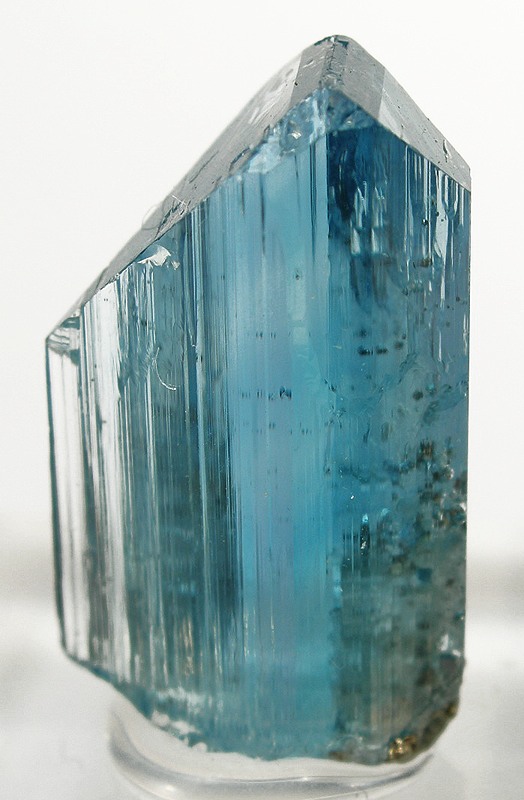
Euclase, 3.0 x 1.6 x 1.6 cm. Lost Hope Mine, Mwami, Mashonaland West Province, Zimbabwe

Euclase crystals are noted for their blue color, ranging from very pale to dark blue. The mineral may also be colorless, white, or light green. Cleavage is perfect, parallel to the clinopinacoid, and this suggested to René Just Haüy the name euclase, from the Greek εὖ, easily, and κλάσις, fracture. The ready cleavage renders the crystals fragile with a tendency to chip, and thus detracts from its use for personal ornament. When cut, it resembles certain kinds of beryl and topaz, from which it may be distinguished by its specific gravity (3.1). Its hardness (7.5) is similar to beryl (7.5 - 8), and a bit less than that of topaz (8).[5] It was first reported in 1792 from the Orenburg district in the southern Urals, Russia, where it is found with topaz and chrysoberyl in the gold-bearing gravels of the Sanarka (nowadays probably, Sakmara River, Mednogorsk district, Orenburgskaya Oblast'). Its type locality is Ouro Prêto, Minas Gerais, Southeast Region, Brazil,[3] where it occurs with topaz. It is found rarely in the mica-schist of the Rauris in the Austrian Alps.

References

[edit]
Revisions and contributorsEdit on WikipediaRead on Wikipedia
from Grokipedia
Euclase is a rare aluminum with the BeAl(SiO₄)(OH), known for its vitreous luster and prismatic crystals in the monoclinic system. It typically occurs as transparent to translucent crystals ranging from colorless to blue, green, or yellowish-green hues, with a Mohs of 7.5 and specific gravity of 3.0 to 3.1, making it a collector's prized for its clarity and brilliance despite its perfect cleavage. First identified in 1792 from the in , euclase derives its name from the Greek words eu (good) and klasis (breaking), reflecting its deceptive ease of cleavage that mimics softer minerals. It forms primarily in granitic pegmatites, low-temperature hydrothermal veins, and metamorphic rocks such as schists and phyllites, often associated with , , and beryl. Notable deposits include in , where gem-quality blue and green crystals are mined; the in ; and localities in , , , and the (). As a , euclase is faceted into rare, brilliant cuts, with and violet varieties being the most valued due to trace impurities like iron and that impart color; however, stones larger than a few carats are exceptionally scarce and often reserved for collections. It lacks significant industrial applications but is sought after by collectors for its aesthetic appeal and structural interest, though its variable (6.5–7.5 within ) requires careful handling to avoid cleavage-related damage.

Etymology and history

Name origin

The mineral euclase derives its name from the Greek words eu (εὖ), meaning "easily," and klasis (κλάσις), meaning "fracture" or "breaking," reflecting its distinctive perfect cleavage. This etymological choice was made by the French mineralogist and crystallographer René Just Haüy, who first named the mineral in 1792 during his systematic study of crystal forms. Haüy's naming convention for euclase aligned with his broader practices in early mineralogy, where he often coined terms from classical roots to highlight key physical and crystallographic traits, such as cleavage directions, to aid in classification and description.

Discovery and early descriptions

Euclase was first described in 1792 by the French mineralogist René Just Haüy, based on specimens originating from . These samples had been collected near in and transported to in 1785 by the naturalist Joseph Dombey, who supplied them to early mineral collections. Haüy's description emphasized the mineral's distinctive perfect cleavage, which inspired its naming—though the is detailed elsewhere. In the early 19th century, chemical analyses further established euclase as a distinct beryllium-bearing mineral. French chemist Nicolas-Louis Vauquelin, who had isolated beryllium in 1798 from beryl, conducted one of the earliest compositional studies of euclase around 1800–1810, reporting approximately 14–15% glucina (beryllia, or BeO), alongside silica (35–36%), alumina (18–19%), minor iron (2–3%), and loss on ignition (27–31%) attributable to water. This work, documented in contemporary mineralogical treatises, confirmed euclase's unique silicate-hydroxide structure incorporating beryllium, distinguishing it from related species like beryl. Initial localities for euclase were primarily noted in European museum collections, derived from Brazilian pegmatites where the mineral occurred as prismatic crystals in granitic formations. These early finds, including those from the region, highlighted euclase's association with hydrothermal alteration in pegmatite environments, sparking interest among crystallographers and collectors in the mineral's rarity and cleavability.

Chemical composition and structure

Formula and composition

Euclase is a aluminum with the BeAlSiO₄(OH). This composition highlights its role as a rare beryllium-bearing , where the group (OH) integrates with the beryllium-aluminum framework. The elemental composition by weight, derived from the , consists of oxygen (55.138%), (19.358%), aluminum (18.597%), (6.212%), and (0.695%). Natural euclase specimens may include trace impurities such as iron, sodium, or , which slightly alter these proportions without fundamentally changing the mineral's identity.

Crystal system and structure

Euclase crystallizes in the with P2₁/a (equivalent to P2₁/b) and Z = 4 formula units per . This defines its atomic arrangement, where the unique b-axis aligns with the direction of structural chains. The original determination of this framework confirmed the monoclinic habit through analysis of natural specimens. Refined unit cell parameters from high-precision measurements are a = 4.7797(7) , b = 14.332(1) , c = 4.6334(6) , β = 100.32(2)°, and a of 312.30(5) ³. These dimensions reflect the packing efficiency of its components, with the structure accommodating the coordination environments of , aluminum, , and oxygen atoms. The crystal structure features zigzag chains of [Be₂(OH)₂(SiO₄)₂]⁶⁻, cross-linked by aluminum octahedra. occupies distorted tetrahedral sites coordinated by three oxygen atoms and one hydroxide oxygen, forming BeO₃(OH) units. resides in nearly regular SiO₄ tetrahedra with a mean Si–O of 1.633 , where each tetrahedron shares edges with adjacent polyhedra but remains isolated as discrete units. Hydroxide groups, with O–H distances of approximately 0.76 , bridge and aluminum sites, contributing to the overall stability through hydrogen bonding. No polymorphs of euclase are known, as its structure is uniquely tied to the specific bonding of its constituent ions under typical formation conditions.

Physical properties

Crystal habit and morphology

Euclase exhibits a , often appearing as slender to stout prisms that are characteristically flattened on {100} and may show morphological complexity due to multiple intersecting faces. Crystals are commonly elongated parallel to the c-axis, with lengths up to 12 cm, and frequently display fine, parallel striations on the prism faces, enhancing their visual texture. Less commonly, euclase occurs in massive or fibrous aggregates, where individual crystals are indistinct and form compact, granular masses. The prismatic growth is facilitated by the , which allows for asymmetric development along the elongation direction. Common forms include the {010} prism, providing the primary lateral faces, and the {001} basal pinacoid, often appearing as the flattened termination. Additional forms such as {021}, {130}, and {1̅30} contribute to the overall complexity, particularly in well-developed specimens from environments. Euclase crystals are transparent to translucent, imparting a gem-like quality to suitable specimens. They possess a vitreous luster, which is somewhat pearly on cleavage surfaces, accentuating the reflective play on prismatic faces.

Mechanical properties

Euclase exhibits a Mohs of 7.5, though values can range from 6.5 to 7.5 within the same due to anisotropic properties arising from its monoclinic structure. This variability affects its suitability for jewelry, as the mineral can scratch more readily along certain directions. The specific gravity of euclase is measured at 2.99 to 3.10 g/cm³, with a calculated value of 3.115 g/cm³ based on its ideal formula BeAlSiO₄(OH). This range reflects minor compositional variations, such as substitutions in the framework, contributing to its moderate weight relative to other minerals like beryl. Euclase displays perfect cleavage on the {010} plane, with imperfect cleavage on {110} and {001}, leading to a pronounced tendency to split along these directions under stress. When cleavage does not control breakage, it exhibits a , and its brittle tenacity makes it prone to chipping or shattering, particularly in applications where precise cutting is required.

Optical properties

Color and pleochroism

Euclase occurs in a variety of colors, including colorless, , pale to deep , (the most common hue), , and violet (the rarest). These specimens are typically transparent to translucent, allowing to pass through and reveal their internal clarity. The coloration in euclase arises primarily from trace impurities. Blue varieties are caused by the presence of iron, while green varieties by , which absorb specific wavelengths of to produce these hues. Pink coloration is attributed to (Mn³⁺) impurities. The vitreous luster of euclase further enhances the vibrancy of these colors by reflecting light smoothly across its surfaces. Euclase exhibits , particularly in its blue varieties, where the displays noticeable color shifts when viewed from different directions, often showing variations in shades of deep blue. This optical effect is due to anisotropic light absorption within the .

Refractive indices and birefringence

Euclase is a biaxial positive , characterized by three unequal principal refractive indices where the maximum index (nγ) corresponds to the extraordinary ray, leading to anisotropic light refraction that distinguishes it from isotropic materials. This optical class results in , observable under polarized light, which aids in identification through techniques like conoscopic examination. The principal refractive indices of euclase are nα = 1.652 (minimum), nβ = 1.655 (intermediate), and nγ = 1.671 (maximum), with slight variations reported across specimens due to compositional differences. These values place euclase's overall range between approximately 1.65 and 1.67, contributing to its vitreous luster and moderate brilliance in gem applications. Birefringence, defined as the difference between the maximum and minimum refractive indices (δ = nγ - nα), measures 0.019 for euclase, indicating moderate double refraction that can produce visible doubling of facets or inclusions in cut stones. This property, combined with a 2V of about 50°, facilitates precise optical orientation during gemological testing. Euclase displays low dispersion, with the r > v orientation showing only slight separation of colors, resulting in minimal fire compared to high-dispersion gems like . In blue crystals, this subtly enhances pleochroic effects noted in color variations.

Occurrence

Formation and paragenesis

Euclase forms primarily through hydrothermal alteration of beryl in granite pegmatites, where primary magmatic minerals destabilize due to fluid infiltration and temperature decline, leading to the replacement of beryl by euclase along with other secondary phases. This process typically occurs at temperatures of 190–240 °C and pressures of 0.57–0.73 kbar, following initial beryl crystallization at higher temperatures of 870–900 °C, and involves the exsolution of fluids from the pegmatitic melt during a ductile-to-brittle transition in the host rocks. Additionally, euclase develops in alpine-type veins within low-grade metamorphic environments, such as schists and gneisses, through low-temperature hydrothermal activity associated with metasomatic reactions and fluid circulation in tectonically active settings. In terms of paragenesis, euclase is commonly associated with , feldspars such as , micas like , and other beryllium minerals including bertrandite, often overprinting earlier magmatic assemblages in pegmatites. frequently co-occurs in these granitic pegmatite settings, alongside and occasional sulfides like , reflecting the beryllium-enriched nature of the evolving fluids. In metamorphic and vein contexts, euclase appears with , , and dolomite, indicating interactions with aluminous host rocks under oxidative hydrothermal conditions. Occurrences of euclase span from to recent geological times, with beryllium-bearing pegmatites and associated minerals first appearing in the geologic record around 3.0–3.1 Ga during the , and significant pulses of formation during the , such as around 2.7 Ga during assembly, and later in the and . Later examples include during the late to (400–650 Ma) in alpine vein systems and tectonic events around 497 Ma influencing hydrothermal vein formation.

Principal localities

Euclase is primarily sourced from granitic pegmatites in several key regions worldwide, with standing out as the most prolific producer of gem-quality crystals. In , , notable localities include , yielding transparent blue to colorless prismatic crystals up to several centimeters long, often associated with and . In , recent finds (2015–2016) in the Paramirim and Catolés areas have produced small quantities (<1 kg) of pink-orange euclase from hydrothermal veins in schistose metaarenite. Another significant site is Santana do Encerrado (also known as Santana do Encoberto), near São Sebastião do Maranhão, producing pale yellow to blue euclase crystals suitable for faceting, mined from pockets in pegmatites during the 1990s. These Brazilian finds are renowned for their clarity and color variety, contributing the majority of cuttable material available. Zimbabwe hosts important deposits in the Karoi District of Mashonaland West, particularly at the Mwami (formerly ) area, including the Last Hope Mine and Trim Mine, which have yielded intense cobalt-blue euclase crystals resembling sapphires, often in aggregates or single crystals up to 5 cm. These African specimens are prized for their deep color due to iron impurities. In , the district in the southern Urals produces fine, colorless to pale green euclase crystals from hydrothermal veins, with as an early European source. Colombia contributes gem-quality euclase from the Boyacá Department, especially the Chivor and Pauna mines, where blue to green crystals occur in association with emeralds in hydrothermal veins, yielding faceted stones up to 10 carats. In Austria, localities in Tyrol (such as Mayrhofen) and Salzburg (Rauris Valley) provide small, colorless alpine cleft crystals from metamorphic environments. The United States has minor occurrences in Colorado's Park County, particularly the Lake George Beryllium area, with euclase found in pegmatites alongside beryl, though specimens are typically small and not gem-quality. Secondary sources include and (Muiane-Naipa group in ) for green varieties in pegmatites; ( Valley) for pale crystals; for rare finds in ; () for blue material; and for historical but limited occurrences. These sites supplement the primary production but yield fewer high-quality specimens.

Uses

Gemstone applications

Euclase's use in jewelry is limited by its rarity and structural vulnerabilities, but its vitreous luster and transparency make it appealing for faceted gems, particularly in and violet. euclase presents significant challenges due to its perfect cleavage in one direction, which can cause the stone to split easily during cutting and polishing. To mitigate this risk, lapidaries prefer step cuts such as and emerald shapes, which distribute stress more evenly and avoid sharp points that could propagate cleavage planes. Euclase may undergo irradiation treatments to enhance colorless stones, producing light green or blue hues by inducing color centers. These enhancements are stable but must be disclosed, as untreated euclase is prized for its natural clarity. In recent years, pink varieties have been identified, offering new options for colored gems. Despite its Mohs hardness of 7.5, euclase's from cleavage requires protective settings like bezels in jewelry to prevent chipping from impacts. This makes it suitable for everyday wear with care, such as in pendants or earrings, but less ideal for exposed ring settings without reinforcement. No synthetic euclase is known to exist, preserving its status as a natural rarity in the gem market. However, light blue or green aquamarines are sometimes misrepresented as euclase to exploit its higher value, necessitating careful identification through refractive indices and specific gravity.

Collecting and market value

Euclase holds significant appeal among mineral collectors due to its rarity and aesthetic qualities, particularly for fine crystals from key localities such as in and the area in , which often command premium prices in the collector market. Strongly colored specimens in blue, green, or violet are especially prized, with violet being the rarest and most desirable hue. Faceted stones exceeding 2–3 carats in these colors are exceptionally scarce, as most gem-quality material yields smaller cuts, making larger examples highly sought after by enthusiasts. The economic value of Euclase is primarily determined by factors such as size, color intensity, and clarity, with transparent, vividly colored gems fetching the highest prices. For instance, as of 2022, faceted Euclase typically ranges from $10 to $103 per carat, while color-zoned or more intense examples can reach $260 to $360 per carat; yellow-green stones fall between $35 and $150 per carat, and high-quality or violet material may exceed $1,000 per carat. Colorless varieties, though less common in the gem trade, command $100 to $150 per carat due to their clarity. Exceptional pieces, such as violet gems from capable of yielding up to 10-carat faceted stones, further elevate market premiums. The gem trade in Euclase grew notably in the , driven by increased exploration and since its initial discovery in 1785 and the emergence of vivid blue material from in the late , which expanded availability to international markets. Prior to this, Euclase was largely confined to scientific and private collections, but 20th-century developments transformed it into a niche but valued among collectors and jewelers.

References

Add your contribution
Related Hubs
User Avatar
No comments yet.