Hubbry Logo
EuroblockEuroblockMain
Open search
Euroblock
Community hub
Euroblock
logo
8 pages, 0 posts
0 subscribers
Be the first to start a discussion here.
Euroblock
Euroblock
from Wikipedia
Phoenix Connector

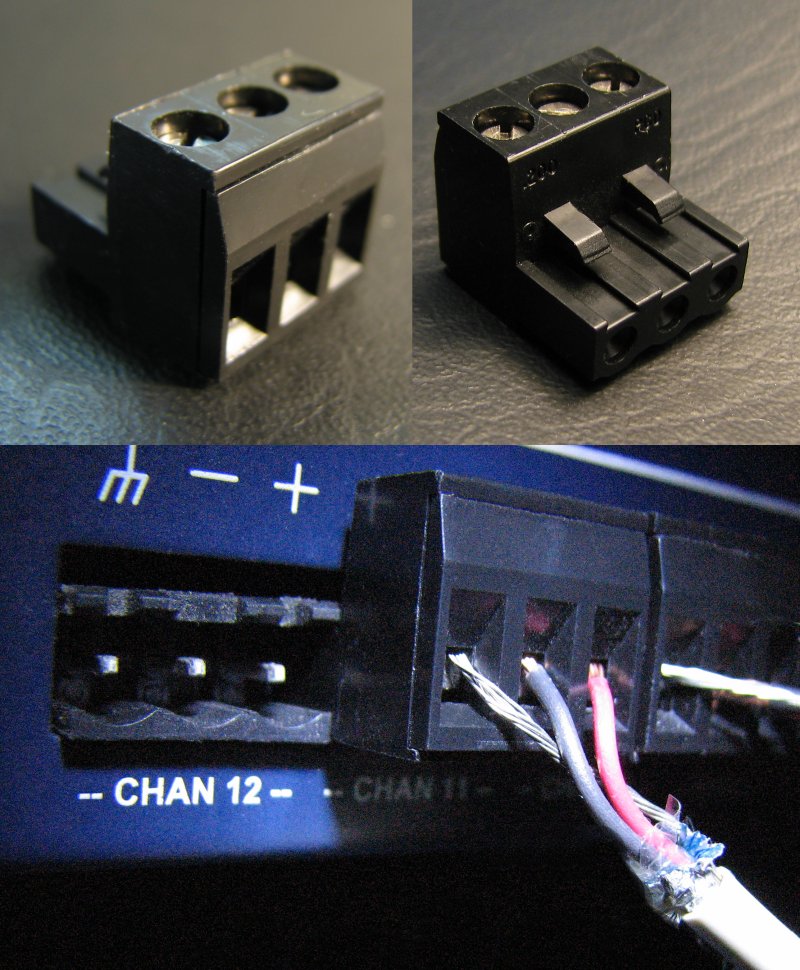
Euroblock, short for "European-style terminal block",[1] is an extra-low voltage disconnectable (or pluggable) connector and terminal block combination commonly used for microphone- and line level-audio signals, and for control signals such as RS-232 or RS-485.

It is also known as the Phoenix connector from one of the manufacturers, Phoenix Contact, a German company whose US operations were established in 1981 in Harrisburg, Pennsylvania; though there are many manufacturers who make compatible products.[1] It is also known as "Combicon", which might be a Phoenix brand name; or more generically as a "pluggable terminal block" or a "two piece terminal block".[2][3]

The Euroblock is a solderless connector that uses screw terminals to clamp connecting wires. Once the wires are installed, the entire assembly is plugged into a matching socket in the electronic device. Euroblocks are more convenient than the terminal strips they replace as the signal cables can be quickly disconnected from or connected to the electronic device, rather than unscrewing and re-screwing each wire individually.[1]

References

[edit]
Revisions and contributorsEdit on WikipediaRead on Wikipedia
from Grokipedia
The Euroblock, also known as a Phoenix connector or European-style terminal block, is a solderless that utilizes screw terminals to securely clamp stripped wire ends, enabling the assembly to be plugged into a matching receptacle on equipment such as amplifiers or processors. It is designed for low-voltage applications, typically handling currents up to 20 amps and voltages up to 300 volts AC or DC, with compatibility for wire gauges ranging from 28 AWG to 14 AWG. Common in and control systems, Euroblocks facilitate reliable connections for signal wires, including audio lines and / control signals, on stationary devices like power amplifiers and high-impedance speakers. The design, often featuring multiple pins (e.g., 2 to 20 positions) with a standard 3.5 mm or 5 mm pitch, allows for dense mounting on device chassis, promoting efficient wiring without and easy disconnection for maintenance. Originating from manufacturers like Phoenix Contact, a German company founded in 1923, these connectors prioritize tool-free or minimal-tool installation methods such as push-in or screw connections for enhanced reliability in industrial and automation settings.

Overview

Definition and purpose

The Euroblock is a solderless, pluggable terminal block that combines or clamp terminals with a disconnectable header, designed for securing and connecting wires in electronic applications. This connector facilitates reliable wire termination without the need for , allowing for easy installation and in fixed . Its primary purpose is to handle low-voltage signals, with typical ratings up to 300 V AC/DC and currents up to 20 A, such as audio lines and control signals, including inputs, line-level audio, , and communications. By providing secure wire clamping, the Euroblock ensures stable connections that minimize signal interference, while its pluggable design enables quick insertion into corresponding device sockets for efficient wiring in and systems. In operation, wires are stripped and inserted into the terminal block, where they are firmly clamped using screws or spring mechanisms; the assembled block then mates with a matching header to establish a disconnectable electrical connection. This modular approach supports rapid deployment and reconfiguration in low-voltage environments.

Naming conventions

The term "Euroblock" originated as a generic descriptor for European-style terminal blocks, which are designed as pluggable, low-voltage connectors featuring a modular header and detachable plug for easy disconnection and reconfiguration, in contrast to the more permanent, screw-down barrier strips prevalent in American electrical applications. This naming reflects the device's roots in European manufacturing standards, emphasizing compact, DIN-rail mountable designs suitable for industrial and audio systems. Due to Phoenix Contact's pioneering role as the inventor of modern terminal blocks in 1928 and its status as a leading producer, these connectors are frequently referred to as "Phoenix connectors" in industry parlance. Phoenix Contact's COMBICON line, introduced in 1972, represents their trademarked portfolio of pluggable PCB terminal blocks and connectors, which has significantly influenced the market and reinforced the association. Other common generic or regional names include "pluggable terminal block," "two-piece terminal block," and "European terminal strip," reflecting variations in connection methods such as rising cage clamps. Standardization bodies like the (IEC) classify them under general terminal block specifications in IEC 60947-7-1 for connections, with pluggable variants addressed in related clauses for disconnectable systems.

History

Origins with Phoenix Contact

Phoenix Contact was founded in 1923 in Essen, Germany, by Hugo Knümann as Phönix Elektro- und Industrie-Bedarfsgesellschaft, initially operating as a sales company for electrical and industrial products. In 1928, Knümann invented the world's first modular terminal block in collaboration with engineers from Rhine-Westphalia Electric (RWE), separating ceramic electrical blocks and mounting them as individual modules on DIN rails to facilitate easier installation and maintenance in power stations. This innovation laid the groundwork for subsequent pluggable terminal block designs by enabling standardized, interchangeable connections. The modern Euroblock style emerged in the late 1970s to early 1980s within Phoenix Contact's Combicon series, which originated in 1972 as a line of PCB terminal blocks and connectors designed to enhance signal, data, and power transmission in electronic applications. These pluggable components, such as those in the MSTB subseries with 5.08 mm pitch, were specifically developed to improve disconnection and reconfiguration in control panels, allowing quick removal and replacement without . A pivotal advancement came in 1978 with the introduction of rising cage clamp technology in the FK 1,5 terminal block, the first modular design featuring a direct plug-in spring connection that simplified wiring and increased reliability by reducing screw loosening over time. Phoenix Contact established its U.S. operations in 1981 near , as one of its first international subsidiaries, which significantly boosted the adoption of Euroblock-style connectors in North American industrial and professional markets.

Industry adoption and evolution

Following its development in the late 20th century, the Euroblock connector saw initial adoption in European industrial during the , where Phoenix Contact introduced specialized terminal blocks as part of broader innovations in modular connection systems for control panels and machinery. This uptake was driven by the need for reliable, pluggable low-voltage connections in growing sectors, aligning with the era's emphasis on standardized electrical interfaces for efficiency in and process control. By the , Euroblock connectors gained traction in professional audio applications, particularly for fixed installations, due to their suitability for balanced and ease of integration in sound reinforcement systems. In the 2000s, the Euroblock evolved with advancements in to enable higher-density wiring in compact devices, alongside deeper integration into DIN rail-mounted systems for industrial enclosures. These developments were influenced by international standards like IEC 60947, which specify requirements for low-voltage terminal blocks, ensuring safety and performance in diverse applications. By around 2000, Euroblocks had become a staple in installed sound systems worldwide, valued for their robustness in permanent setups like venues and broadcast facilities. The 2010s marked further adaptations for networking, with Euroblock interfaces incorporated into protocols like Dante to bridge analog signals to IP-based systems, facilitating hybrid setups in modern AV installations. Today, beyond Phoenix Contact, key market leaders such as and WAGO produce Euroblock variants, expanding options for pluggable connectors in and audio sectors.

Design and construction

Key components

The Euroblock, also known as a Eurostyle terminal block, consists of two primary components: the plug and the header. The plug is a removable connector that accepts wire insertions, featuring multiple terminals arranged in a row for multi-pole configurations. It is typically designed for field wiring and allows for easy disconnection and reconnection without tools for the mating process itself. The header, or socket, is the fixed counterpart mounted directly onto a (PCB) via , providing a stable base for the plug's insertion. Key terminal details include the wire retention mechanisms, such as screw terminals or clamps, which secure the inserted wires. A common design is the rising cage clamp, where turning a screw raises a metal cage to grip the wire firmly against a current bar, ensuring reliable contact without damaging stranded conductors. The insulation housing encloses these elements, usually constructed from halogen-free polyamide 6.6 plastic for durability and flame resistance, with built-in polarization features like mechanical keying or alignment legs to prevent reverse or incorrect insertion. Variations in clamp types, such as push-in spring or wire protector options, allow adaptation to different wire sizes while maintaining the core structure. Assembly involves aligning and inserting the plug into the header, secured by a fit or optional mechanism for resistance. This mating can occur in parallel or perpendicular orientations relative to the PCB, depending on the header's design—straight for parallel or right-angle for perpendicular—facilitating flexible routing in equipment layouts. Built-in interlocks on the components aid in precise alignment during insertion.

Electrical and mechanical specifications

Euroblocks, also known as Eurostyle terminal blocks, typically feature electrical ratings suitable for low- to medium-power applications in and industrial settings. Specifications vary by manufacturer and model. Common specifications include a maximum voltage rating of V AC/DC, with nominal currents up to 8-15 A per pole depending on the conductor size. These blocks accommodate wire gauges typically from 16 to 28 AWG (approximately 1.3 mm² to 0.08 mm² cross-section), though some variants support 28 to 14 AWG, ensuring compatibility with standard stranded or solid conductors. Insulation resistance typically exceeds 1000 MΩ at 500 V DC, while dielectric strength is rated at 1.6-2 kV for 1 minute, providing robust protection against . Mechanical specifications emphasize durability and ease of use in demanding environments. Standard pitches include 3.81 mm, 5.08 mm, and 7.62 mm, allowing for compact multi-pole configurations on printed circuit boards. Operating temperatures range from -40°C to +105°C, supporting reliable performance in extreme conditions without degradation. Vibration resistance meets IEC 60068-2-6 standards, typically up to 5 g over 10 Hz to 500 Hz, ensuring secure connections under mechanical stress. Insertion and withdrawal forces for conductors are generally between 5 N and 20 N, facilitating tool-assisted wiring while preventing accidental disconnection. Compliance with international standards is a key aspect of Euroblock design, including approvals from UL (File E60425), CSA, and VDE for safety and performance. These certifications verify adherence to requirements for flammability (UL 94V-0 housing materials), environmental resistance, and electrical safety, making Euroblocks suitable for global applications. Specifications can vary slightly by manufacturer and specific variant, such as pitch or termination style.

Types and variants

Variations by pitch and configuration

Euroblocks, also known as Euro-style terminal blocks, are available in various pitches that determine the spacing between connection points, influencing the density of connections and suitability for different applications. Common pitches include 3.5 mm for high-density configurations, which allow for a greater number of poles per unit length and are typically used in space-constrained signal applications with currents up to 8 A and voltages up to 160 V. The 5.0 mm or 5.08 mm pitch serves as a general-purpose standard, balancing density and ease of handling for moderate power needs, supporting up to 16 A and 320 V in many designs. Wider pitches like 7.5 mm or 7.62 mm accommodate higher power requirements, with capacities reaching 32 A and 630 V, while 10.0 mm or 10.16 mm variants handle up to 76 A and 1,000 V for heavy-duty uses, though these reduce the pole count per inch. Configurations of Euroblocks vary by the number of poles, orientation, and row arrangement to meet diverse wiring needs. Standard pole counts range from 2 to 24 positions, enabling customization for single circuits or multi-channel setups, with modular designs allowing blocks to be snapped or stacked end-to-end for extended configurations without losing centerline spacing. Headers are offered in straight (180°) or right-angle (90°) orientations to suit PCB mounting preferences, while single-row blocks provide basic inline connections, and double-row variants facilitate bridging between levels for complex signal distribution. These modular setups support daisy-chaining, where multiple blocks interconnect seamlessly for scalable installations. Specialized configurations enhance usability in targeted environments. Low-profile Euroblocks, with reduced heights under 10 mm, are designed for tight enclosures or low-clearance panels, maintaining standard pitches like 5 mm while prioritizing space efficiency. Color-coded options, available in variants such as green for ground, blue for power, or gray for signals, aid in multi-circuit identification and reduce wiring errors in professional setups.

Termination methods

Euroblocks, also known as pluggable terminal blocks, utilize various termination methods to securely connect wires, ensuring reliable while accommodating different installation needs. These methods primarily differ in their mechanical action, tool requirements, and suitability for wire types, with common options including screw terminals, rising cage clamps, spring-loaded push-in connections, wire protectors, and crimp snaps. The terminal represents a traditional approach, employing or M2.5 screws paired with pressure plates to clamp stripped wire ends against a conductive . When tightened, the screw applies axial force through a tension sleeve or wire guard, creating a gas-tight connection that resists and maintains long-term stability via the Reakdyn principle, which prevents screw loosening. Recommended tightening typically ranges from 0.4 to 0.6 Nm to achieve optimal contact without damaging the wire or terminal. Rising cage clamp technology, often integrated into Euroblock designs, features a lever-operated mechanism where a actuates an shaft to lift the clamp cage, allowing insertion of the stripped wire before the cage descends to grip it firmly against the contact point. This rising action provides consistent clamping force, supports multiple connections and disconnections, and minimizes wire creepage under thermal cycling by distributing pressure evenly, enhancing reliability in dynamic environments. The design uses post-tin-plated contacts for resistance and is particularly suited for field installations. Other termination methods expand versatility for specific wire types and applications. Spring-loaded push-in connections enable tool-free insertion by compressing a spring mechanism that clamps the wire directly, offering low insertion force for solid or ferruled conductors up to 2.5 mm² while providing high retention strength. Wire protector variants incorporate a protective sleeve during clamping to shield stranded wires from deformation, accommodating gauges from 0.08 to 4 mm² without ferrules. Crimp options, meanwhile, allow pre-termination of cables via crimping tools for a permanent, vibration-proof joint, ideal for factory assembly of harnessed wires. In comparison, screw terminals excel in high-torque security for demanding vibration-prone settings, though they require tools and precise application to avoid over-tightening. Spring-loaded and push-in methods prioritize speed and ease, enabling rapid, tool-free wiring that reduces installation time, but they may offer slightly lower maximum holding force than s for very large conductors. Overall, the choice depends on factors like limits, typically 0.08 to 4 mm² across methods, and operational context.

Applications

Professional audio systems

Euroblock connectors are widely utilized in professional audio systems for their reliability in fixed installations, particularly in connecting signals within mixers, amplifiers, and speakers. These connectors facilitate the transmission of balanced lines using a three-pin configuration—positive (+), negative (-), and ground—allowing for noise rejection over long cable runs in environments like concert venues and halls. This setup is essential for maintaining audio fidelity in installed sound systems, where equipment such as often features Euroblock inputs for line-level signals. In distributed audio setups, Euroblocks support 70V and 100V constant-voltage systems, enabling efficient power distribution to multiple speakers without individual transformers, which is common in commercial spaces requiring even coverage. For instance, Crown Audio's DriveCore Install series amplifiers, like the DCI 4|300N, incorporate Euroblock connectors for both input and output channels to handle these high-impedance configurations, simplifying wiring in large-scale installations. Similarly, Yamaha's PC-DI series power amplifiers, such as the PC406-DI, use Euroblocks for signal inputs and outputs, integrating seamlessly with Dante networking for digital audio distribution in professional environments. Speaker wiring in venues often employs Euroblocks for secure connections to wall plates or racks, while integration with digital signal processors (DSPs) from manufacturers like Biamp—such as the Tesira series—relies on these connectors for analog I/O in processing chains. The benefits of Euroblocks in audio applications include excellent , with balanced connections providing low —typically better than -90 dB in gear—minimizing interference between channels in multi-line setups. Their pluggable ensures secure, vibration-resistant terminations ideal for permanent installations, reducing needs in high-traffic areas like theaters or houses of worship. Additionally, Euroblocks offer compatibility with Category 5 (Cat5) cabling for remote panels and wall controls, allowing twisted-pair wires to carry signals over extended distances without dedicated shielded cables, which enhances cost-efficiency in system .

Industrial control and automation

Euroblocks, also known as pluggable terminal blocks, play a crucial role in industrial control and systems by providing secure, modular connections for and in harsh environments. These connectors are widely used in programmable logic controllers (PLCs), where they facilitate the integration of sensors and actuators in factory setups, enabling efficient signal routing for monitoring and control processes. For instance, in networks, Euroblocks support multi-drop communication protocols like , allowing reliable exchange between PLCs and field devices over long distances. In 24V DC control circuits, Euroblocks ensure stable power distribution to actuators and sensors, commonly mounted on DIN rails within control panels for applications such as HVAC systems and systems. Their pluggable design allows for quick disconnection and reconnection, minimizing downtime during in vibrant or dusty industrial settings, where resistance and dust-proof maintain connection integrity without the need for . This ease of field servicing is particularly valuable in automated lines, where sensors detect position or proximity, and actuators respond to PLC commands for precise operations. The high reliability of Euroblocks in these environments stems from their robust materials and connection technologies, such as push-in or spring-clamp mechanisms, which provide vibration-proof contacts rated for continuous operation under industrial stresses. In systems, for example, they connect Modbus-enabled controllers to HVAC actuators, optimizing energy use and system responsiveness while adhering to standards for electrical safety and performance. Overall, their adoption has evolved alongside automation technologies to support scalable, serviceable wiring solutions in non-audio industrial contexts.

Other specialized uses

Euroblocks are employed in lighting consoles for control systems, where their pluggable design facilitates quick connections for data transmission between controllers and fixtures, ensuring reliable in dynamic environments. In LED drivers, Euroblocks provide secure, low-voltage terminations for power distribution to lighting arrays, supporting efficient heat dissipation and modular assembly in professional installations. For rigging, they connect control signals to motors and hoists, allowing for safe, removable wiring that complies with temporary setup requirements in theatrical productions. Emerging applications of Euroblocks include , such as solar inverters, where pluggable terminals handle low-voltage communication wiring for monitoring and grid integration; specialized high-voltage variants rated up to 1000 V DC are used in photovoltaic string connections to minimize energy losses. In medical equipment, Euroblocks enable compact, reliable connections for low-voltage signal transmission in devices such as patient monitors, adhering to relevant standards for non-patient-contact applications. Euroblocks are also utilized in low-voltage control and testing setups across various lab environments. Niche adaptations of Euroblocks feature waterproof variants with IP67 ratings, suitable for outdoor installations in exposed environments like marine or architectural , where sealed housings prevent moisture ingress while maintaining pluggable functionality. High-temperature versions, compatible with operating conditions up to 150°C, are adapted for applications near ovens and motors, using heat-resistant housings to ensure stable connections in industrial heating and drive systems.

Installation and maintenance

Wiring procedures

Wiring an Euroblock connector begins with proper preparation of the wire to ensure a secure and reliable connection. Select wire gauge appropriate for the application, such as 18 AWG for typical professional audio use, ensuring it falls within the connector's specified range (e.g., 0.2 mm² to 2.5 mm² for common COMBICON series plugs). Strip the insulation from the wire end to a length of 7-10 mm, avoiding damage to the strands, and use stranded wire without tinning or soldering to prevent issues with the clamp mechanism. If using ferrules on flexible conductors, crimp them according to DIN 46228-4 standards with a length matching the strip specification. To connect the wire to the Euroblock plug, which typically employs a screw or rising clamp termination, insert a flathead (size matching the slot, often 3.5 ) into the designated opening above or beside the terminal slot to release the clamp or loosen the . Fully insert the stripped wire into the round conductor entry hole until it reaches the back of the terminal, ensuring all strands are secured without twisting. Tighten the to the manufacturer's specified , typically 0.5-0.6 Nm for M3 screws in standard 5.08 pitch connectors, to achieve a gas-tight connection without over-tightening, which could the wire or . After connection, perform a gentle tug test on the wire to verify it is firmly held and cannot be pulled out easily. Once all wires are terminated on the plug, mate it to the header by aligning the pins with the header slots on the device or panel, taking care to match the pinout (e.g., positive, negative, ground) as per the equipment's labeling. Push the plug straight into the header with even pressure until it seats fully and any locking mechanism latches, confirming no pins are bent by visually inspecting the alignment. This pluggable design allows for easy disconnection by releasing the latch if present, or by pulling firmly while supporting the header.

Best practices and troubleshooting

To ensure reliable performance and longevity of Euroblock terminal blocks, adherence to established best practices during installation and ongoing use is essential. Employing a calibrated screwdriver to tighten screws to manufacturer-specified values, typically ranging from 0.5 to 0.8 Nm for common models handling conductors up to 4 mm², prevents under- or over-tightening that could lead to loose contacts or damaged insulation. Avoid over-stripping wires by limiting the exposed conductor length to approximately 9 mm, as excessive stripping can cause strands to splay and create short circuits between adjacent terminals. Clearly labeling circuits with standardized marking strips facilitates identification and reduces errors during maintenance. In humid environments, applying environmental sealing solutions, such as gel-filled enclosures rated IPX8, protects against moisture ingress and corrosion. Periodic inspections of connections, including checking and re-tightening as needed in vibration-prone settings, maintains secure clamping without relying on alone. Troubleshooting common issues begins with identifying symptoms like intermittent signals or power loss. For loose connections, which often result from or cycling, re-tighten screws to the specified using a tool, and verify conductor insertion depth. Intermittent signals may indicate corrosion on contact surfaces; inspect and clean affected areas with , then apply grease if reoccurring in moist conditions. failures in pluggable Euroblocks, such as poor contact between header and plug, can stem from or oxidation—clean pins and mating surfaces gently with a non-abrasive cloth before reconnection. Diagnostic tools like digital multimeters are invaluable for measuring continuity, resistance (should be near zero ohms for secure connections), and across terminals to isolate faults efficiently. Maintenance protocols for industrial installations emphasize proactive inspections to preempt failures. Conduct an initial inspection 3 to 4 months after installation to check for settling issues, followed by periodic visual and electrical assessments based on environmental and operational conditions, as recommended in industry guidelines such as NEMA ICS 1.3. During inspections, examine for signs of overheating, such as discoloration, and test connection integrity. Replacement is warranted if the housing exhibits cracks, which compromise insulation and safety, or if has penetrated beyond surface level, ensuring compliance with IEC 60947-7-1 standards. In harsh environments, increase inspection frequency to semi-annually to align with operational demands.

Advantages and limitations

Key benefits

Euroblocks offer significant ease of use due to their tool-minimal installation process, which typically requires only a to tighten the rising cage clamp mechanism, enabling quick and secure wire insertion without specialized tools. This design facilitates hot-swappable maintenance, allowing connectors to be plugged and unplugged at field installations without necessitating full system disassembly, thereby minimizing downtime during repairs or upgrades. In terms of reliability, the secure clamping action of the rising cage clamp prevents wire pull-out even under mechanical stress, while providing low of ≤20 mΩ to ensure efficient . Additionally, the clamp's spring-loaded design maintains consistent pressure on conductors, making Euroblocks highly suitable for environments with , as it compensates for wire expansion or contraction over time without loosening. Euroblocks also provide cost-effectiveness through their modular and reusable construction, which supports scalability with customizable pole counts from 2 to over 20 positions, reducing labor costs in large-scale installations by allowing efficient wiring organization and reconfiguration. This reusability further lowers overall expenses, as connectors can be detached and repurposed without replacement in ongoing projects.

Potential drawbacks

Although the spring-cage clamp in Euroblock terminal blocks provides improved resistance to compared to standard screw terminals, they can still be susceptible to screw loosening in high- environments, where repeated mechanical stress may cause screws to back out over time without the use of lock washers or thread-locking compounds, potentially leading to intermittent electrical connections or failures. In terms of physical footprint, Euroblocks occupy more space than insulation displacement contact (IDC) connectors, making them less suitable for applications requiring ultra-high density wiring, such as compact assemblies where IDC enables multiple connections in a smaller area. Additionally, while standard Euroblocks are typically rated for currents up to 20-25 A, they require for sustained loads exceeding 20 A to prevent overheating, as the internal bus and wire clamping may not dissipate efficiently at higher levels without larger variants. Other limitations include the risk of damage from over-torquing the screws, which can strip threads, crush wire insulation, or crack the plastic housing, compromising long-term reliability. Euroblocks are generally confined to low-voltage applications (up to 300-450 V), and are not designed for mains power distribution due to insufficient creepage distances and insulation for high-energy AC lines, where specialized high-voltage blocks are preferred. Furthermore, their initial cost per position is often higher than that of basic barrier strips for straightforward, low-complexity wiring tasks, though this premium reflects added features like pluggable modularity. These drawbacks can be partially mitigated through adherence to manufacturer torque specifications and vibration-resistant accessories, as outlined in installation best practices.

References

Add your contribution
Related Hubs
User Avatar
No comments yet.