


Community hub
Recent from talks
Contribute something
Nothing was collected or created yet.
SCART
View on Wikipedia | This article has multiple issues. Please help improve it or discuss these issues on the talk page. (Learn how and when to remove these messages)
|

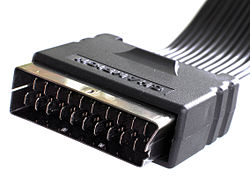
 A male SCART connector (21-pin) | |||
| Type | Analogue audio and video connector | ||
|---|---|---|---|
| Production history | |||
| Designer | CENELEC | ||
| Designed | 1976 | ||
| Superseded | RCA, DIN (in Europe) | ||
| Superseded by | HDMI, DisplayPort | ||
| General specifications | |||
| Audio signal | Bi-directional Stereo | ||
| Video signal |
Composite (bi-directional), RGB (uni-directional), S-Video (sometimes bi-directional), or YPbPr (Component) | ||
| Pins |
21 (21 wires:RGB/10 wires:CVBS) 10 (10 wires:CVBS) | ||
| Data | |||
| Data signal | D²B and widescreen switching | ||
| Pinout | |||
 | |||
| Female connector seen from the front | |||
| Pin 1 | Audio output (right) | ||
| Pin 2 | Audio input (right) | ||
| Pin 3 | Audio output (left/mono) | ||
| Pin 4 | Audio ground (pins 1, 2, 3 & 6 ground) | ||
| Pin 5 | RGB Blue ground (pin 7 ground) | ||
| Pin 6 | Audio input (left/mono) | ||
| Pin 7 |
RGB Blue up S-Video C down[a] Component PB up[b] | ||
| Pin 8 |
Status & Aspect Ratio up[c]
| ||
| Pin 9 | RGB Green ground (pin 11 ground) | ||
| Pin 10 |
Clock / Data 2[d] Control bus (AV.link) | ||
| Pin 11 |
RGB Green up Component Y up[b] | ||
| Pin 12 | Reserved / Data 1[d] | ||
| Pin 13 | RGB Red ground (pin 15 ground) | ||
| Pin 14 | Usually Data signal ground (pins 8, 10 & 12 ground) | ||
| Pin 15 |
RGB Red up S-Video C up Component PR up[b] | ||
| Pin 16 |
Blanking signal up
| ||
| Pin 17 | Composite video ground (pin 19 & 20 ground) | ||
| Pin 18 | Blanking signal ground (pin 16 ground) | ||
| Pin 19 |
Composite video output S-Video Y output | ||
| Pin 20 |
Composite video input S-Video Y input | ||
| Pin 21 | Shell/Chassis[e] | ||
|
output/input denotes symmetrical links | |||
SCART (also known as Péritel or Péritélévision, especially in France, 21-pin EuroSCART in marketing by Sharp in Asia, Euroconector in Spain,[1] EuroAV or EXT, or EIA Multiport in the United States, as an EIA interface) is a French-originated standard and associated 21-pin connector for connecting audio-visual (AV) equipment. The name SCART comes from Syndicat des Constructeurs d'Appareils Radiorécepteurs et Téléviseurs, "Radio and Television Receiver Manufacturers' Association", the French organisation that created the connector in the mid-1970s. The related European standard EN 50049 was refined and published in 1978 by CENELEC, calling it péritelevision, but it is commonly called by the abbreviation péritel in French.
The signals carried by SCART include both composite and RGB (with composite synchronisation) video, stereo audio input/output and digital signalling. SCART is also capable of carrying S-Video signals, using the red pins for chroma.[2] A TV can be woken from standby mode and automatically switch to the appropriate AV channel when the SCART attached device is switched on. SCART was also used for high definition signals such as 720p, 1080i, 1080p with YPbPr connection by some manufacturers, but this usage is scarce due to the advent of HDMI.[citation needed]
In Europe, SCART was the most common method of connecting AV equipment and was a standard connector for such devices; it was far less common elsewhere.
The official standard for SCART is CENELEC document number EN 50049–1. SCART is sometimes referred to as the IEC 933-1 standard.
History
[edit]Before SCART was introduced, TVs did not offer a standardised way of inputting signals other than RF antenna connectors, and these differed between countries. Assuming other connectors even existed, devices made by various companies could have different and incompatible standards. For example, a domestic VCR could output a composite video signal through a German-originated DIN-style connector, an American-originated RCA connector, an SO239 connector or a BNC connector.
The SCART connector first appeared on TVs in 1977. It became compulsory on new TVs sold in France from January 1980,[3][4] and since 1987 in eastern Europe, such as Poland. The actual French legal decree was adopted on 7 February 1980 and revoked on 3 July 2015.[5]
The standard was subject to several amendments and at least 2 major revisions, approved by CENELEC on 13 November 1988 (EN 50049-1:1989) and 1 July 1997 (EN 50049-1:1997).[6]
Features
[edit]The SCART system was intended to simplify connecting AV equipment (including TVs, VCRs, DVD players and games consoles). To achieve this it gathered all of the analogue signal connections into a single cable with a unique connector, which normally made incorrect connections nearly impossible.
The signals carried by SCART include both composite and RGB (with composite synchronisation) video, stereo audio input/output and digital signalling. The standard was extended at the end of the 1980s to support the new S-Video signals. A TV can be awakened from standby mode, and it can automatically switch to appropriate AV channel, when the device attached to it through a SCART connector is turned on.
Daisy chaining
[edit]
SCART is bi-directional regarding standard composite video and analogue audio. A TV will typically send the antenna audio and video signals to the SCART sockets all the time and watch for returned signals, to display and reproduce them. This allows "transparent" set-top boxes, without any tuner, which just "hook" and pre-process the TV signals. This feature is used for analogue pay TV like Canal Plus and was used for decoding teletext.
A VCR will often have two SCART sockets, to connect it to the TV ("up", "primary" or "1"), and for video input from a set-top box or other device ("down", "secondary" or "2"). When idle or powered off, VCRs will usually forward the signals from the TV to the set-top decoder and send the processed result back to the TV. When a scrambled show is recorded, the VCR will drive the set-top box from its own tuner and send the unscrambled signals to the TV for viewing or simple recording control. Alternatively, the VCR could use the signals from the TV, in which case it would be inadvisable to change channels on the TV during the recording.
The "down" socket can also be used to connect other devices, such as DVD players or game consoles. As long as all devices have at least one "down" and "up" socket, this allows for connecting a virtually unlimited number of devices to a single SCART socket on the TV. While audio and video signals can travel both "up" to the TV and "down" to devices farther away from the TV, this is not true for RGB (and non-standard YPBPR) signals, which can only travel towards the TV.
"Down" and "up" are conventional. Logically, the TV is the last device of the "up" chain-path (stream) and the first device in the "down" chain path. Physically, the TV is under the device which sits on its top, hence the name "set-top box" for the device. Moreover, some sockets' relative position may enforce the belief that the TV is physically the last in the down direction.
Logically, the TV is on top and ends the "up" chain-path, translating the electrical info into an image and sound. From the same logical point of view the info stream, wherever it originates, may need processing such as decrypting (decoding, descrambling) or adding captioning/subtitles. In this case the info stream is sent logically "down" to dedicated function devices. From the last processing device the info stream is sent logically "up" to the TV, through all the chain-path. Another case is when the info stream is sent "down" and not expected to be sent back "up", for example when sent to a recorder.
Closing a loop on either the "up" or "down" chain-path may not have useful effects and may create instability.
Direct connections
[edit]As audio and (composite) video use the same pins on "down" and "up" connectors (and require a crosslinked cable), it is also possible to connect two devices directly to each other without paying attention to the type of the socket.
However, this no longer works when S-Video signals are used. As straight links (RGB red and blue up) were re-purposed to carry chrominance information, the S-Video pinouts are different for "down" and "up" SCART connectors.[7] Further, they are often not fully implemented.
Paying attention to the type of socket is essential when handling component RGB/YPBPR/S-video. Damage can be caused to devices incorrectly connected as follows:
- connecting SCART 1 ("up") from one device to SCART 1 ("up") of another device when both SCARTs are configured for RGB/YPBPR/S-video-up. Pins 7, 11 and 15 are outputs.
- connecting SCART 2 ("down") from one device to SCART 2 ("down") of another device when both SCARTs are configured for S-video-down. Pin 7 is an output.
- connecting SCART 1 ("up") from a device configured RGB/YPBPR, to SCART 2 ("down") of another device configured with S-video-down. Pin 7 is an output.
Damaging pins 7, 11 or 15 may result in yellow, purple or blue/green images, due to the missing blue, green or red components respectively. When using S-video, damaging pin 7 or 15 may result in black-white images due to the missing chroma component ("down" and "up" respectively). Similarly, damaging pins 7 and 15 (PB and PR) while leaving pin 11 (Y) undamaged may result in black-white images when using YPBPR. Damaging more than one of these pins may result in combined effects.
RGB overlays
[edit]SCART enables a device to command the TV to very quickly switch between signals, in order to create overlays in the image. In order to implement captioning or subtitles, a SCART set-top box does not have to process and send back a complete new video signal, which would require full decoding and re-encoding of the color information, a signal-degrading and costly process, especially given the presence of different standards in Europe. The box can instead ask the TV to stop displaying the normal signal and display a signal it generates internally for selected image areas, with pixel-level granularity. This can also be driven by the use of a "transparent" color in a teletext page.
Device control
[edit]SCART allows a connected device to bring it in and out of standby mode or to switch it to the AV channel. A VCR or other playback device will optimally power on when a cassette is inserted, power on the TV (or switch it to video mode) and then start playing immediately if the cassette write protection tab is absent. When turned off, the VCR will ask the TV to power off, which it will do if it had been powered on by the VCR's request and if it remained in video mode. Only some TVs will do this—most only implement automatic switching to and from the SCART input.
The same signal can be used by a satellite receiver or set-top box to signal a VCR that it is supposed to start and stop recording ("pin 8 recording"). This configuration usually requires that the VCR be farther from the TV than the source, so the signal usually travels "down".
Design
[edit]Cables
[edit]The cables for connecting equipment together have a male plug at each end. Some of the wires such as ground, data, switching and RGB connect to the identical pin number at each end. Others such as audio and video are swapped so that an output signal at one end of the cable connects to an input signal at the other end. The complete list of wires that are swapped are: pins 1 and 2, pins 3 and 6, pins 17 and 18, pins 19 and 20.
The original SCART specification provided for different cable (cordset) types denoted by a key color, but color-coding is rarely used and cables often use different, non-standard configurations.
| Type | Ring color | Pins | Description | Symmetric | |
|---|---|---|---|---|---|
| U | Universal | black | 1–20, 21 | Fully wired cable. | no |
| V | Video only | white | 17–20, 21 | Only composite wires. | yes |
| C | Combined | grey | 1–4, 6, 17–20, 21 | Composite Video and Audio | yes |
| A | Audio only | yellow | 1–4, 6, 21 | Audio | yes |
| B | Bus | green | 10, 12, 21 | Only data connections | Depends on protocol used |
Maximum SCART cable length is estimated to be about 10 to 15 metres without amplification.[citation needed]
Due to the relatively high signal voltages used in SCART, "hot plugging" (connecting or disconnecting devices while they are on) is not recommended. Although there is no risk of personal injury, there is the possibility of damaging electronics within the devices if the connector is inserted improperly.[citation needed] Also, since many TVs are Class II (double-insulated) rather than earthed, the large exposed shield on the SCART connector will be held at approximately half mains voltage if it is plugged into a powered TV with the other end unplugged. If the cable is then plugged into an earthed device with a metal case, inadvertent contact with the SCART cable shield while the earthed device is touched with the other hand can cause a painful electric shock. For this reason the device end of the cable should always be plugged in first and the TV end plugged in last.[8][9][10]
Quality differences exist in SCART cables. While a proper SCART cable uses miniature coaxial cables for the video signals, cheap SCART cables often use plain wires for all signals, resulting in a loss of image quality and greatly reducing the maximum cable length. A common problem on a cheap SCART cable is that a TV outputs a composite video signal from its internal tuner and this is induced or crosstalked onto an incoming video signal due to inadequate or non-existent screening; the result is ghostly images or shimmering superimposed on the incoming signal. To non-destructively verify if a SCART cable uses coaxial cables, unscrew the strain relief at the SCART connector and fold open the plastic shell.
Using higher-quality cables such as those with ribbon cords that have properly shielded coaxial cables inside might help in reducing a 'ghosting' effect, but it does not always eliminate it due to various factors. A more permanent method is to remove pin 19 (Video Out) from the SCART plug that is put into the TV, preventing a signal from being broadcast by the TV into the cable, so it cannot cross-talk with the incoming signal.
Blanking and switching
[edit]Two pins provide switching signals.
Pin 8, the switch signal pin, carries a DC voltage from the source that indicates the type of video present.
- 0 V–2 V means no signal, or internal bypass
- 4.5 V–7 V (nominal 6 V) means a widescreen (16:9) signal
- 9.5 V–12 V (nominal 12 V) means a normal (4:3) signal
Pin 16, the blanking signal pin, carries a signal from the source that indicates that the signal is either RGB or composite.
- 0 V–0.4 V means composite.
- 1 V–3 V (nominal 1 V) means RGB only.
The original specification defined pin 16 as a high frequency (up to 3 MHz) signal that blanked the composite video. The RGB inputs were always active and the signal 'punches holes' in the composite video. This could be used to overlay subtitles from an external Teletext decoder.
- 0 V–0.4 V means composite with a transparent RGB overlay.
- 1 V–3 V (nominal 1 V) RGB only.
There is no switching signal to indicate S-Video. Some TVs can auto-detect the presence of the S-Video signal but more commonly the S-Video input needs to be manually selected. The same for the rare component YPbPr, which is in many cases implemented over a composite or RGB SCART.
Non-standard extensions
[edit]

The use of the data pins was not standardised in the original SCART specification, resulting in the use of several different protocols, both proprietary protocols and semi-proprietary protocols based on standards such as D²B.
Some of the most creative usages appeared in analogue satellite receivers. The function of decoding hybrid, time-compressed analogue-digital MAC transmissions into RGB and analogue audio was akin to making a digital receiver out of an analogue one. The D²B pins (10 and 12) were used for communicating with satellite dish positioners and for driving magnetic polarisers, before these became incorporated into LNBs. The daisy-chaining features were used to connect both a Pay TV decoder and a dish positioner/polariser to a single Decoder socket on the receiver.[11]
CENELEC EN 50157-1 introduced AV.link as a standardised protocol to carry advanced control information between devices. It is a single-wire serial data bus and allows carrying remote control information and to negotiate analogue signal types (e.g. RGB). AV.link is also known as nexTViewLink or trade names such as SmartLink, Q-Link or EasyLink. It appears as the Consumer Electronics Control channel in HDMI.
The data pins, 10, 12, 14, were used by some manufacturers for Dolby Pro Logic, surround and multichannel on their TV sets (some high end models with built in Dolby decoders, and external surround speakers, both CRT, LCD and plasma sets, and only in Europe - and European versions of Japanese TV Sets and DVD players -, and mainly on S/PDIF), in order to connect a DVD player to the TV set and stream the Dolby and DTS to the surround of the TV set [citation needed]. However, this protocol was rarely used, as it was limited only to a certain manufacturer, and the connections were different from a manufacturer to another, and in some cases, it was only commanded by the pin 8. In this case, it was unusable with RCA to SCART adapters. Also, if a Compatible TV with such connection and a compatible DVD with such connection, but from different manufacturers were interconnected, the surround might not work, and only the stereo sound from the DVD player was available to the TV, because some manufacturers did not use SPDIF, but an own protocol. Also, this connection might be also lost, if the connection of the DVD with the TV was made indirectly (through a VCR in daisy chaining mode, for example), however, some VCR allowed the pass-through of these signals. Some DVD player manufacturers on some models offered SPDIF only on SCART, and an adapter in order to extract the digital audio signal to send it to a home cinema. To the present day this connection remains rare, as HDMI, S/PDIF, and TOSLINK can provide multichannel audio, also some TV sets with Surround built in may have an Optical or S/PDIF INPUT, beside Output [citation needed].
Implementations
[edit]
Nearly all modern DVD players and set-top boxes with SCART sockets can output RGB signal, which offers superior picture quality to composite signal. However, many devices do not have RGB output turned on by default, instead defaulting to composite video: RGB often has to be set up manually in the menu or via switches on the back of the device.[citation needed]
The GameCube, Wii, Neo-Geo, Dreamcast, PlayStation, PlayStation 2, PlayStation 3, Xbox and Xbox 360 can output RGB, component video, S-Video, or composite video. These consoles come with the standard composite video connector, but the manufacturers and third parties sell connectors for component video hookup and for RGB SCART hookup. Where the Nintendo GameCube and Xbox automatically switch to the proper mode, the PlayStation 2 must be told via a selection in the system menu whether it is to use YPBPR or RGB video. RGB is only available on PAL region GameCube and Wii consoles, while S-Video is only available on NTSC consoles.[12]
Some older consoles such as the Master System, Mega Drive/Genesis, and Super Nintendo Entertainment System output RGB, and many older home computers (Amstrad CPC, later ZX Spectrum models, MSX, Amiga, Atari ST, BBC Micro and Acorn Archimedes, etc.) output RGB with composite sync suitable for SCART use, via DIN plugs. Standard-resolution arcade monitors use RGB signals with a composite sync, which is SCART-compatible.
Besides simple connection of external devices to SCART TVs, RGB SCART is used in the retrogaming scene for connecting vintage games consoles (including ones internally modified for RGB or 60 Hz RGB where necessary) to:
- RGB SCART inputs of upscalers / analogue-to-digital converters; these output over HDMI at higher than original resolution, to modern TVs / monitors / projectors / capture cards, or, via further conversion (HDMI to VGA digital-to-analogue) CRT PC monitors
- RGB SCART to RGB BNC adapters and into RGB CRT professional video monitors
- RGB SCART to S-video converters, for achieving the best video quality on a combination of a TV / monitor with S-video as its best input but with a console that cannot output S-video, but can output RGB as its best output
The SAM Coupé microcomputer also uses a SCART connector for its output, however it is a non-standard pinout.[13]
Japanese RGB 21-pin connector
[edit]

There is also a Japanese version of the SCART connector, which is referred to as the Japanese RGB-21 connector, EIAJ TTC-003,[14] or simply JP-21. This version of SCART uses similar signals and the same connector, but it has a different pinout. In Japan and Korea, it is commonly called RGB-21 while it is more generally called JP-21 in the English-speaking world.
JP-21 was standardised in January 1983 with the norm TTC-0003[15] published by EIAJ, which was superseded in March 1993 by the norm CPR-1201[16] to include S-Video. CPR-1201 was withdrawn in March 2003 to be replaced by the equivalent norm CPR-1205, representing Japan's transition from analogue to digital, and thus antiquating analogue connectors.
It was adopted in Japan for the connector's ability to support RGB output format (no compression nor deterioration of original video signals) but, contrary to SCART in Europe, it never saw widespread use on the consumer market.
When using RGB video, the red channel uses the same pins in both standards, so red video with no audio is indicative of mismatching JP-21 SCART with EuroSCART.[17]
| Pin | Function | Pin | Function |
|---|---|---|---|
| 1 | Audio left channel input | 2 | Audio left channel output |
| 3 | Audio ground | 4 | Audio ground |
| 5 | Audio right channel input | 6 | Audio right channel output |
| 7 | Video ground | 8 | Video ground |
| 9 | CVBS input | 10 | CVBS output |
| 11 | AV control input | 12 | Ym input |
| 13 | Red signal ground | 14 | Ground |
| 15 | Red signal I/O | 16 | Ys input |
| 17 | Green signal ground | 18 | Blue signal ground |
| 19 | Green signal I/O | 20 | Blue signal I/O |
| 21 | Plug shield |
Notes:
- Audio input: 0.40 mVrms, > 47K ohms
- Audio output: 0.40 mVrms, > 10K ohms
- CVBS (composite video) in and out: 1 Vp-p, 75 ohms, sync: negative
- Ym input: Switches RGB to half-brightness, for video overlay (L: < 0.4 V, H: > 1 V, 75 ohms)
- Ys input: RGB in/out: (ground for output, 1 V+ for input (preferred))
- All RGB lines: 0.7 Vp-p, 75 ohms[14]
Newer standards
[edit]As it was designed to carry analogue standard-definition content, SCART is rarely used since the adoption of HDMI, which carry high-definition content and multichannel audio.
See also
[edit]
References
[edit]- ^ "Conector SCART (Euroconector)". uvigo.es. Retrieved 17 November 2016.
- ^ "S-Video and SCART interconnection cable pinout". Pinout Guide. Retrieved 19 April 2023.
- ^ "La télé des années 80". croque-vacances.com. Archived from the original on April 3, 2009. Alt URL
- ^ "Le TI-99/4A et la Presse Informatique". perso.orange.fr/fabrice.montupet. Archived from the original on October 14, 2007. Alt URL
- ^ "Arrêté du 3 juillet 2015 abrogeant l'arrêté du 7 février 1980 portant homologation et mise en application obligatoire de la norme française NF C 92-250". Legifrance.
- ^ Domestic and similar electronic equipment interconnection requirements: Peritelevision connector (PDF). British Standards Institution. 15 June 1998. ISBN 0580298604.
- ^ "S-Video to SCART signal conversion guide". Archived from the original on October 8, 2011.
- ^ "Electric shock off aerial coax". DIYnot.com. 7 August 2004. Retrieved 2012-06-15.
- ^ "Guide to preventing shocks from entertainment systems" (PDF). Digital TV Group. Archived from the original (PDF) on March 6, 2016. Retrieved 15 June 2012.
- ^ "EPE Chat Zone: Radio Bygones Message Board: SCART Shock". Chatzones.co.uk. Archived from the original on April 16, 2016. Retrieved 2012-06-15.
- ^ Based on a Pace Micro Technology Prima analogue receiver manual and a DATCOM AP-500/AP-700 dish positioner manual.
- ^ "Game Console RGB SCART Cable Diagrams". Members.optusnet.com.au. Archived from the original on 2021-04-05. Retrieved 2012-06-15.
- ^ "RGB Scart". World of SAM. Retrieved 19 April 2023.
- ^ a b "av:japanese_rgb-21 [NFG Games + GameSX]". gamesx.com.
- ^ "Television receiver measurement" (PDF).
- ^ "JEITA 電子情報技術産業協会 /". www.jeita.or.jp.
- ^ "EuroSCART versus JP21". www.retrogamingcables.co.uk.
External links
[edit]
- SCART connector pinout and cables schemes
- SCART at hardwarebook.info
- RGB/VGA and SCART
- EuroSCART versus JP21
SCART
View on GrokipediaHistory and Development
Origins in France
The Syndicat des Constructeurs d'Appareils Radiorécepteurs et Téléviseurs (SCART), a French trade association representing manufacturers of radio receivers and televisions, originated in the mid-20th century to coordinate industry standards and interests. Records document its existence and activities as early as 1958, when it participated in discussions on merging with other electronics syndicates to form a national federation.[2] This organization later gave its name to the SCART connector, also known initially as Peritel in France, reflecting its central role in developing the interface.[1] Development of the SCART connector began in the mid-1970s, driven by the need for improved interconnection standards following France's adoption of the SECAM color television system in 1967.[3] SECAM, which transmitted color information sequentially using frequency modulation, highlighted the shortcomings of existing composite video connections, particularly for achieving higher-fidelity RGB signal transmission amid the rapid growth of color TV ownership in Europe.[4] French electronics firms, coordinated by the SCART syndicate, designed the connector in 1976 to enable unified cabling between televisions and audio-visual peripherals, prioritizing compatibility with both SECAM and PAL systems. It first appeared on television sets in 1977, marking a shift toward integrated audio-video setups.[1]Standardization and Adoption
The formal standardization of SCART took place in 1978 with the publication of the CENELEC EN 50049-1 document, which defined it as a 21-pin audiovisual connector for interconnecting consumer electronics.[1] This standard, sometimes also referred to as IEC 933-1, built on initial French developments from the mid-1970s and aimed to unify AV connections across Europe by supporting multiple signal types in a single interface.[1] Adoption began mandatorily in France, where the government required all televisions sold after 1980 to include a SCART connector, accelerating its integration into domestic AV systems.[5] By the early 1980s, SCART had become the voluntary standard across the European Union, spreading through VCRs and early home entertainment devices despite initial resistance from the UK, which relied on established RF connectors, and Japan, which favored its own proprietary standards like those for NTSC-based systems.[1] Usage peaked in the 1990s alongside the widespread integration of VCRs and DVD players, which commonly featured SCART for seamless connectivity.[1] A key driver of SCART's success was its promotion of higher-quality RGB video signals over traditional composite video, enabling sharper images and better color fidelity in European broadcasting and playback systems.[1] By the mid-1990s, the vast majority of new European televisions were equipped with SCART ports, solidifying its role as the dominant AV interface on the continent until the rise of digital alternatives.Physical and Electrical Design
Connector Pinout and Interface
The SCART connector is a 21-pin trapezoidal interface standardized for audio-visual connections in Europe, featuring two parallel rows of flat pins arranged in a D-shaped or trapezoidal housing to ensure correct orientation and prevent reverse insertion. The design includes male variants typically used on source devices such as VCRs or DVD players, and female variants on display devices like televisions, facilitating a secure push-fit connection without a mechanical locking latch, relying instead on friction and the connector shell for retention. The overall connector housing measures approximately 52 mm in width, 39 mm in length, and 20 mm in height, with the pin array spanning about 21 mm across the narrower top row (8 pins) and wider bottom row (13 pins).[6][1] The pin assignments are defined in the CENELEC EN 50049-1 standard (also known as IEC 933-1), supporting bidirectional audio, composite video, RGB video inputs, and control signals through specific voltage levels and impedances. Audio signals operate at 0.5 V RMS with low output impedance (<1 kΩ) and high input impedance (>10 kΩ), while video signals use 75 Ω impedance with peak-to-peak voltages of 1 V (including sync) for composite and 0.7 V for RGB components; control signals tolerate 0-2 V for low states and up to 12 V for high states. The 21st "pin" is actually the metal shell providing chassis grounding and electromagnetic interference (EMI) shielding via continuous contact between connector housings, reducing crosstalk and external noise ingress without additional ferrite components. Backward compatibility for mono audio is achieved by linking left and mono signals on pins 3 and 6, allowing single-channel sources to drive both stereo inputs.[1][7] The following table summarizes the standard pinout for a full-featured SCART connector (Table 1 configuration from EN 50049-1), focusing on primary functions, signal directions (from the perspective of the connected device), levels, and notes:| Pin | Function | Signal Type | Level/Impedance | Notes |
|---|---|---|---|---|
| 1 | Audio output right | Analog audio out | 0.5 V RMS / <1 kΩ | Stereo right channel from source |
| 2 | Audio input right | Analog audio in | 0.5 V RMS / >10 kΩ | Stereo right channel to source |
| 3 | Audio output left/mono | Analog audio out | 0.5 V RMS / <1 kΩ | Stereo left or mono from source |
| 4 | Audio ground | Ground | - | Common for pins 1, 2, 3, 6 |
| 5 | Ground (RGB blue) | Ground | - | For pin 7 |
| 6 | Audio input left/mono | Analog audio in | 0.5 V RMS / >10 kΩ | Stereo left or mono to source; mono compatibility via pin 3 link |
| 7 | RGB blue input | Analog video in | 0.7 V pp / 75 Ω | Blue component from source |
| 8 | Switching / fast blanking | Control in/out | 0-2 V (low: composite), 9.5-12 V (high: RGB/AV) / >10 kΩ | Selects RGB mode or aspect ratio |
| 9 | Ground (RGB green) | Ground | - | For pin 11 |
| 10 | Data 2 (AV.link) | Control/bidirectional | 0-5 V / >10 kΩ | Optional communication bus |
| 11 | RGB green input | Analog video in | 0.7 V pp / 75 Ω | Green component from source |
| 12 | Data 1 | Control/bidirectional | 0-5 V / >10 kΩ | Optional data line |
| 13 | Ground (RGB red) | Ground | - | For pin 15 |
| 14 | Data ground | Ground | - | For pins 8, 10, 12 |
| 15 | RGB red input | Analog video in | 0.7 V pp (RGB) / 75 Ω | Red component; also used for chrominance in S-video variants |
| 16 | Blanking signal input | Control in | 0-0.4 V (low: composite), 1-3 V (high: RGB) / 75 Ω | Enables RGB display mode |
| 17 | Composite video ground | Ground | - | For pins 19, 20 |
| 18 | Blanking ground | Ground | - | For pin 16 |
| 19 | Composite video output | Analog video out | 1 V pp (incl. sync) / 75 Ω | From display to source (e.g., TV out) |
| 20 | Composite video input | Analog video in | 1 V pp (incl. sync) / 75 Ω | From source to display |
| 21 | Shell/chassis | Shield | - | EMI shielding via metal contact |