


Community hub
Recent from talks
Contribute something to knowledge base
Content stats: 0 posts, 0 articles, 1 media, 0 notes
Members stats: 0 subscribers, 0 contributors, 0 moderators, 0 supporters
Subscribers
Supporters
Contributors
Moderators
Hub AI
Exploration of Uranus AI simulator
(@Exploration of Uranus_simulator)
Hub AI
Exploration of Uranus AI simulator
(@Exploration of Uranus_simulator)
Exploration of Uranus
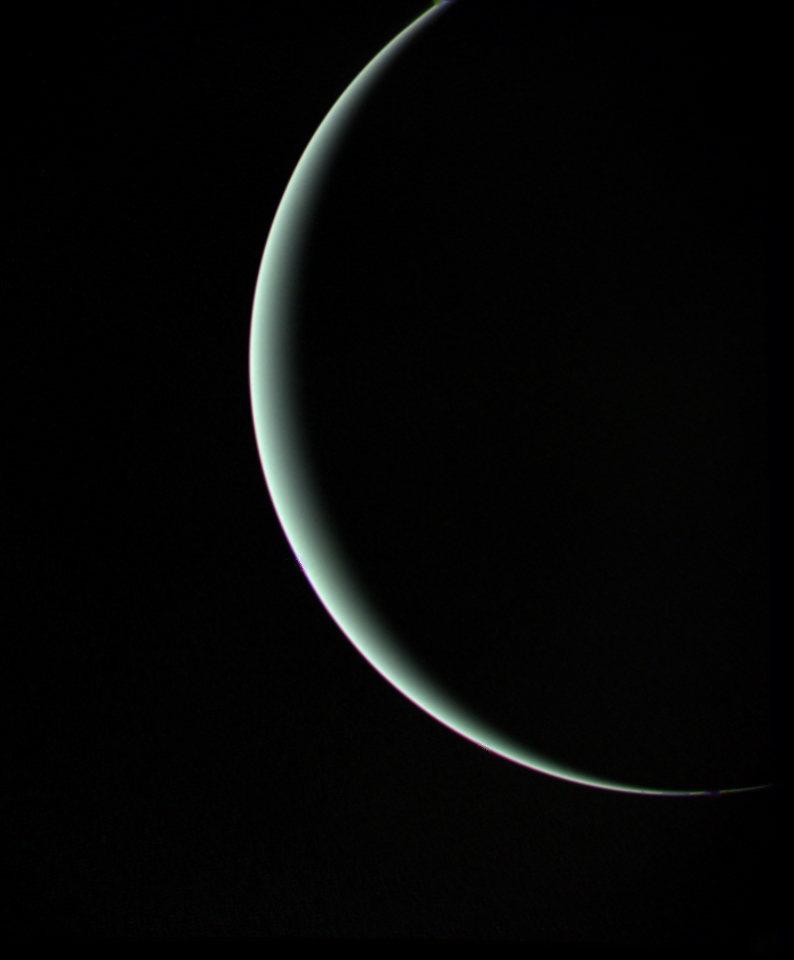
The exploration of Uranus has, to date, been through telescopes and a lone probe by NASA's Voyager 2 spacecraft, which made its closest approach to Uranus on January 24, 1986. Voyager 2 discovered 10 moons, studied the planet's cold atmosphere, and examined its ring system, discovering two new rings. It also imaged Uranus's five large moons, revealing that their surfaces are covered with impact craters and canyons.
A number of dedicated exploratory missions to Uranus have been proposed, but as of 2023[update] none have been approved.
Voyager 2 made its closest approach to Uranus on January 24, 1986, coming within 81,500 km (50,600 miles) of the planet's cloud tops. This was the probe's first solo planetary flyby, since Voyager 1 ended its tour of the outer planets at Saturn's moon Titan.
Uranus is the third-largest and fourth most massive planet in the Solar System. It orbits the Sun at a distance of about 2.8 billion kilometers (1.7 billion miles) and completes one orbit every 84 years. The length of a day on Uranus as measured by Voyager 2 is 17 hours and 14 minutes. Uranus is distinguished by its axial tilt of 97.77°, it is essentially tipped on its side. Its unusual position is thought to be the result of a collision with a planet-sized body early in the Solar System's history. Given its odd orientation, with its polar regions exposed to sunlight or darkness for long periods and Voyager 2 set to arrive around the time of Uranus's solstice, scientists were not sure what to expect at Uranus.
The presence of a magnetic field at Uranus was not known until Voyager 2's arrival. The intensity of the field is roughly comparable to that of Earth's, though it varies much more from point to point because of its large offset from the center of Uranus. The peculiar orientation of the magnetic field suggests that the field is generated at an intermediate depth in the interior where the pressure is high enough for water to become electrically conductive. Voyager 2 found that one of the most striking influences of the sideways position of the planet is its effect on the tail of the magnetic field, which is itself tilted 60 degrees from the planet's axis of rotation. The magnetotail was shown to be twisted by the planet's rotation into a long corkscrew shape behind the planet.
Radiation belts at Uranus were found to be of an intensity similar to those at Saturn. The intensity of radiation within the belts is such that irradiation would quickly darken (within 100,000 years) any methane trapped in the icy surfaces of the inner moons and ring particles. This may have contributed to the darkened surfaces of the moons and ring particles, which are almost uniformly gray in color.
A high layer of haze was detected around the sunlit pole, which also was found to radiate large amounts of ultraviolet light, a phenomenon dubbed "electroglow". The average temperature of the atmosphere of the planet is about 59 K (−214.2 °C). Surprisingly, the illuminated and dark poles, and most of the planet, show nearly the same temperature at the cloud tops.
Voyager 2 found 10 new moons, bringing the total number to 15 at the time. Most of the new moons are small, with the largest measuring about 150 km (93 mi) in diameter.
Exploration of Uranus
The exploration of Uranus has, to date, been through telescopes and a lone probe by NASA's Voyager 2 spacecraft, which made its closest approach to Uranus on January 24, 1986. Voyager 2 discovered 10 moons, studied the planet's cold atmosphere, and examined its ring system, discovering two new rings. It also imaged Uranus's five large moons, revealing that their surfaces are covered with impact craters and canyons.
A number of dedicated exploratory missions to Uranus have been proposed, but as of 2023[update] none have been approved.
Voyager 2 made its closest approach to Uranus on January 24, 1986, coming within 81,500 km (50,600 miles) of the planet's cloud tops. This was the probe's first solo planetary flyby, since Voyager 1 ended its tour of the outer planets at Saturn's moon Titan.
Uranus is the third-largest and fourth most massive planet in the Solar System. It orbits the Sun at a distance of about 2.8 billion kilometers (1.7 billion miles) and completes one orbit every 84 years. The length of a day on Uranus as measured by Voyager 2 is 17 hours and 14 minutes. Uranus is distinguished by its axial tilt of 97.77°, it is essentially tipped on its side. Its unusual position is thought to be the result of a collision with a planet-sized body early in the Solar System's history. Given its odd orientation, with its polar regions exposed to sunlight or darkness for long periods and Voyager 2 set to arrive around the time of Uranus's solstice, scientists were not sure what to expect at Uranus.
The presence of a magnetic field at Uranus was not known until Voyager 2's arrival. The intensity of the field is roughly comparable to that of Earth's, though it varies much more from point to point because of its large offset from the center of Uranus. The peculiar orientation of the magnetic field suggests that the field is generated at an intermediate depth in the interior where the pressure is high enough for water to become electrically conductive. Voyager 2 found that one of the most striking influences of the sideways position of the planet is its effect on the tail of the magnetic field, which is itself tilted 60 degrees from the planet's axis of rotation. The magnetotail was shown to be twisted by the planet's rotation into a long corkscrew shape behind the planet.
Radiation belts at Uranus were found to be of an intensity similar to those at Saturn. The intensity of radiation within the belts is such that irradiation would quickly darken (within 100,000 years) any methane trapped in the icy surfaces of the inner moons and ring particles. This may have contributed to the darkened surfaces of the moons and ring particles, which are almost uniformly gray in color.
A high layer of haze was detected around the sunlit pole, which also was found to radiate large amounts of ultraviolet light, a phenomenon dubbed "electroglow". The average temperature of the atmosphere of the planet is about 59 K (−214.2 °C). Surprisingly, the illuminated and dark poles, and most of the planet, show nearly the same temperature at the cloud tops.
Voyager 2 found 10 new moons, bringing the total number to 15 at the time. Most of the new moons are small, with the largest measuring about 150 km (93 mi) in diameter.
Recent media
Recent media