Hubbry Logo
Fairy ternFairy ternMain
Open search
Fairy tern
Community hub
Fairy tern
logo
8 pages, 0 posts
0 subscribers
Be the first to start a discussion here.
Fairy tern
Fairy tern
from Wikipedia

Fairy tern
Scientific classification Edit this classification
Kingdom: Animalia
Phylum: Chordata
Class: Aves
Order: Charadriiformes
Family: Laridae
Genus: Sternula
Species:
S. nereis
Binomial name
Sternula nereis
Gould, 1843
Subspecies

Sternula nereis davisae
Sternula nereis exsul
Sternula nereis nereis

Synonyms

Sterna nereis

The fairy tern (Sternula nereis) is a small tern which is native to the southwestern Pacific. It is listed as "Vulnerable" by the IUCN and the New Zealand subspecies is "Critically Endangered". Fairy terns live in colonies along the coastlines and estuaries of Australia, New Zealand, and New Caledonia, feeding largely on small, epipelagic schooling fishes, breeding in areas close to their feeding sites. They have a monogamous mating system, forming breeding pairs in which they mate, nest, and care for offspring.

There are three subspecies:

The three subspecies are distinguished by geographical range, and slight morphological differences.[2] Gene flow between subspecies is little to none.[3]

Description

[edit]

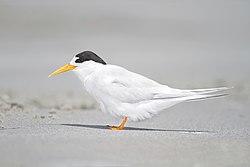
The fairy tern is a small tern with a white body and light bluish-grey wings. A small black patch extends no further than the eye and not as far as the bill. In the breeding plumage both the beak and the legs are yellowish-orange. During the rest of the year the black crown is lost, being mostly replaced by white feathers, and the beak becomes black at the tip and the base. The sexes look alike and the plumage of immature birds is similar to the non-breeding plumage. The total length of the fairy tern is about 25 cm (10 in).[4]

Status

[edit]

Formerly classified as a Species of Least Concern by the IUCN,[5] recent research shows that its numbers have been decreasing rapidly throughout its range; the New Zealand subspecies has been on the brink of extinction for decades. The fairy tern was consequently uplisted to Vulnerable status in 2008.[5] The New Zealand fairy tern has numerous breeding areas, largely incorporating the upper-north region of the North Island. In 2011, there were only about 42 known individuals. With a breeding program in place by the New Zealand Department of Conservation, the population was estimated in 2020 at 40.[6] Since then, their breeding sites have been reduced to only four consistent locations, limited to the South of the Northland Peninsula.[7] In 2023, less than 40 individuals and 9 breeding pairs of the New Zealand fairy tern remained, the subspecies becoming a high priority for conservation.[7]

Behaviour

[edit]

Feeding

[edit]

Fairy terns are surface plungers, feeding on fish that shoal just under the water surface. To forage, fairy terns hover between five and fifteen metres above the water to search for prey, then carrying out a descending aerial dive beak-first towards the water.[8] They then spread their wings and tails just above the water surface, submerging only their bills and heads to catch their prey.[8] This foraging technique means that they catch prey no deeper than around eight centimetres under the water surface, allowing them to make use of shallow waters such as tidal pools.[8] Fairy terns seldom go far out to sea but are often to be seen where predatory fish are feeding on shoals of small fish.

Fairy tern diets consist predominantly of pelagic schooling fishes.[9][10] For instance, Australian fairy terns mostly eat blue sprat, hardyheads, and garfishes.[10] Similarly, New Zealand fairy terns have a diet made up of common estuarine fish, namely gobies and flounders, responsible for most of their consumed biomass, as well as shrimps, comprising up to 21% of their diet.[8] Little research has been done on the diet of New Caledonian fairy terns, but given their foraging technique, it is likely that they too forage for small marine fish that school just below the water surface. Fairy terns also consume crustaceans, molluscs and some plant material.[4] Diets may vary according to location, time of day, developmental stage and breeding season.[9]

Breeding

[edit]

Breeding takes place in the spring in colonies on sheltered beaches on the mainland or on offshore islands. The nest is just above high-water mark and is a scrape in the sand. Fairy terns have a monogamous mating system, forming pair bonds in which they provision food, mate, nest, and care for offspring.[2] One or two eggs are laid and both parents share the incubation and care of the chicks and have occasionally been seen providing post-fledging parental care.[5] Breeding success is low.[11][10]

Breeding Season

[edit]

Fairy terns breed during spring, with courtship beginning in September, and nesting occurring largely from November to February.[2] Their breeding season largely overlaps with the spawning season for much of their prey,[9] allowing fairy terns to make use of a higher abundance of food that is required for courtship provisioning, energy for breeding, and feeding offspring. Females breed at around three years old, while males breed from age two.[2] Each year, fairy terns develop breeding plumage, where their bills, legs, and feet become brighter and darker, and the dark colouration on their heads extends from forehead to nape.[2] This plumage signals sexual maturity, and elicits the courtship process.

Courtship

[edit]

After developing breeding plumage, fairy terns begin the courtship process. During pair-formation, fairy terns exhibit ritualised courtship behaviours. Courtship displays are typically exhibited by male fairy terns to attract females during mate selection. Fairy tern courtship behaviours include aerial displays as well as ground displays. Aerial displays may be social, involving cooperative exhibitions of dynamic flight patterns.[10] Ground displays involve catching and exhibiting fish, to signal foraging ability. As observed in many avian species, courtship displays function to indicate mate quality in order to facilitate reproductive success.[12] In fairy terns, courtship displays are essential to breeding, which will not occur without them.[10] Another key element of courtship in Fairy Terns is the exchange of fish, which is initially essential before copulation can occur in breeding pairs.[10][2] Males will provision food to the female, which persists throughout the breeding season. Male provisioning behaviour is thought to function to demonstrate the parental ability of the male in courtship.[10]

Pair Bonds

[edit]

Following courtship, fairy terns form pair bonds.[10][2][7] In these pairs, fairy terns prospect potential nesting sites within the colony territory. Once chosen, pairs will frequently visit their nesting habitat, feed together, and mate frequently. High levels of fidelity are generally observed. Although fairy terns are typically observed forming single pair bonds during the mating season, multiple mating pairs and copulation have been observed in Australian fairy terns.[10] Here, males will typically guard their partner during breeding, in attempt to prevent polyandrous copulation outside of their breeding pair. Fairy terns stay in their breeding pairs throughout nesting, both investing in the biparental care of chicks and eggs together.

Nesting

[edit]
Tara iti (New Zealand fairy tern) chicks in nest.[13]
Fairy tern eggs camouflage with shells.

Fairy terns nest in low lying sand, eggs and young camouflaging with surrounding shells, shingle or gravel. They construct their nests by scraping the sand with their legs, rotating in a circle until they have dug sand from all directions.[2] Fairy terns may create several nests before their final selection of nest choice.[10] Fairy terns have been observed to nest in different location types, including seaside bays, estuary mouths, sheltered lagoons and saltwater lakes.[10][2][11] Given their gregarious nature, nest selection is influenced by social facilitation, where the observation of nesting success in conspecifics of their colony will direct fairy terns to also nest in that location.[14] Colonies will often abandon nest location once the breeding season ends, driven by changing availability of food, predators, and vegetation.[10]

Nest location may be related to feeding site, where fairy terns will select areas that allow them to easily and quickly access food for their young while nesting.[15] Like many other terns, fairy terns often nest in sandy beach areas with little vegetation, allowing them to detect predators easily, and nest close to feeding sites. However, too little vegetation leaves fairy terns with insufficient shelter, making them more vulnerable to weather and avian predation.[2] So, choice of nest site is influenced by evolutionary trade-offs pressured by a need for safety and food. Another key aspect of nest site selection is an abundance of shell cover, which fairy terns will preferentially choose. This preference seemingly functions to increase camouflage and avoid predator detection, given their colouration which likely evolved to matched the white, orange and black shelled areas in which they nest.[2]

During nesting, female fairy terns rarely leave the nesting site.[10] Males supply their partner with food throughout the nesting and incubation periods, though this behaviour decreases over time until the eggs hatch, when provisioning increases once more to care for the offspring. Male provisional feeding gives the female nutritional support, allowing her to invest more in nesting and attend the eggs. Males may experience a decrease in body mass during this period, given the energy expense of provisioning behaviour.[2] This food provisioning behaviour, typically carried out by males, is therefore important in increasing breeding success.[2]

Breeding Success

[edit]

Fairy tern clutch size varies from one to three eggs,[10][2][16] with clutch size of one or two being most common. Larger broods typically occur with more experienced pairs, and only when resources are abundant.[10] The second egg is typically laid one to four days after the first.[2] The incubation period lasts approximately twenty-two days.[10][16]

Studies on New Caledonian fairy terns find breeding success to be quite low.[11][16][17] Chick mortality may occur due to several factors including predation by other avian species, tidal flooding, egg failure, adverse weather and parental desertion.[16][18] Breeding success is also hindered by nest disturbance from conspecifics nesting nearby.[18] The "grieving parent" syndrome has been observed in New Zealand fairy terns, where parents who experience offspring failure will kill the chicks of a nearby nest.[2] Surveys of New Caledonian fairy terns find breeding success to be highly impacted by adverse weather, where almost all nests across 2 years were destroyed by weathering.[11] In 2020, breeding success in New Caledonian fairy terns was less than 15%.[16] The low breeding success of New Caledonian fairy terns is similar to that of the endangered New Zealand fairy tern.[17] Further research is required to reliably establish breeding success in the Australian and New Zealand subspecies, though it is thought to be very low given their high vulnerability to tidal flooding and predation.[10][18] However, adult survival is considerably higher, where fairy terns are able to mate for multiple breeding seasons, giving hope to the continuation of their species.[10]

Parental Behaviour

[edit]

As observed in other tern species, both male and female fairy terns contribute equally towards parental care.[2] In their pair bonds, both males and females feed their offspring. Males continue to provide food to the female as well as young. When there is only one chick, males feed the chick more than the female, and at night, the females care for the chicks.[2] Chick feeding rates vary considerably between nests, and decrease with disturbance as parents engage more in defensive behaviour.[18] Parents are highly attentive towards chicks particularly in the first few days after hatching.[10][19] Chicks are not left unattended until at least fourteen days of age; fledgling occurs at approximately day twenty-three.[2]

Parental behaviour is influenced by a variety of components. Increased wind speed is associated with increased time spent with young,[2] presumably to increase protection to favour offspring survival. Feeding of young occurs the most frequently approximately three hours past low tide, while foraging occurs at high tide.[2]

Increased aggression, both conspecific and intraspecific, is observed when parents are with young.[2][18] In defence, to protect their offspring, fairy terns will display aggressive behaviours towards perceived potential predators (mammalian, avian, and human), as well as intruding conspecifics.[2][18] This aggressive behaviour will be exhibited upon intrusion within seventy-five metres of the nest site.[2] Parents will also extend their wings over chicks to provide protection to young.[19]

Threats

[edit]

Predation

[edit]

Fairy terns are predated on by small mammals, which may eat adults, chicks and eggs.[7][20][2] In Australia, the presence of semi-wild cats threatens the already declining population of Australian fairy terns.[20] Likewise, in New Zealand, non-native invasive mammalian species including rats, mustelids, hedgehogs and cats, predate on fairy terns.[7][2] As with fairy terns, non-native mammalian predation is a common issue for vulnerable endemic birds in New Zealand, and is a key focus for conversation.

Fairy tern chicks and eggs are also at risk of avian predation.[16][11] Specifically, birds including harrier hawks and black backed gulls will eat chicks and eggs.[7][2] The only defence against predation for fairy tern chicks is their cryptic colouration, which allows them to camouflage with seashells that surround their nests.[2][19] This contributes to a high level of chick mortality that threatens the decreasing population of fairy terns, particularly for the endangered New Zealand and New Caledonian subspecies.[17]

Human Disturbance

[edit]

Human disturbance poses a great threat to fairy terns. Particularly during the breeding season, human activity puts fairy terns at risk of further population decrease, disrupting nesting and breeding behaviours to ultimately reduce breeding success.[2][11] The New Zealand Department of Conservation warns of the danger of human activation including dog walking, drone use, bonfires, vehicular beach use, horse riding, and recreational beach activities in fairy tern breeding areas. These disturbances have been known to not only disrupt breeding behaviours, but to scare fairy terns away from their nests, causing fairy terns to abandon their eggs, leaving them vulnerable to predation as well as embryo death due to thermal exposure.[7] For this reason, conversation efforts are being made to reduce human disturbance towards fairy terns.

References

[edit]
[edit]
Revisions and contributorsEdit on WikipediaRead on Wikipedia
from Grokipedia
The fairy tern (Sternula nereis) is a small, delicate belonging to the family , characterized by its pale grey upperparts, white underparts, and a distinctive black cap and during the breeding season, complemented by a bright bill and orange-yellow legs. Measuring 22–27 cm in length with a of 44–53 cm and weighing approximately 70 g, it is a piscivorous species that primarily feeds on small captured during graceful hovering and diving flights over coastal waters. Native to the southwestern Pacific, the fairy tern inhabits sheltered sandy beaches and estuaries, where it nests in shallow scrapes above the high-tide line, typically laying 1–2 eggs from to . Recognized as a single species with four subspecies—S. n. horni in , S. n. nereis along southeastern including , S. n. exsul in , and the critically endangered S. n. davisae in northern —the fairy tern's global population is estimated at 2,500–9,999 mature individuals (as of 2007), showing a decreasing trend. In , the nominate subspecies numbers 1,300–1,700 mature individuals (as of 2023/2024), while the western horni subspecies numbers approximately 5,000 individuals (as of 2025); however, 's population has dwindled to around 40 birds, with fewer than 12 breeding pairs confined to sites between Whangarei and . The bird's lifespan can reach up to 18 years in the wild, with non-breeding featuring a mottled crown and black-tipped bill, and immatures showing streaked crowns and darker legs. Classified as Vulnerable on the due to ongoing declines driven by habitat loss and small population sizes, the fairy tern faces severe threats from introduced predators such as foxes and cats, human disturbances including recreational activities and beach development, high and storm surges, and invasive weeds that degrade nesting sites. In , where it is critically endangered, conservation efforts include intensive predator control, nest protection with fencing and sandbags, cross-fostering of eggs to surrogate , and public education programs to minimize disturbances at key sites like Waipu and . Australian populations benefit from similar measures, such as habitat management and monitoring, underscoring the ' sensitivity to coastal pressures and the need for sustained protection across its fragmented range.

Taxonomy

Classification

The fairy tern (Sternula nereis) is classified within the order , family , and subfamily Sterninae, which encompasses the terns. It is placed in the Sternula as the species S. nereis. Historically, the fairy tern was included in the large, paraphyletic Sterna along with larger terns. In the early , molecular phylogenetic analyses using sequences demonstrated that small terns, including S. nereis, form a monophyletic distinct from the core Sterna species, prompting the revival of the Sternula Boie, 1822. This reclassification was supported by morphological traits such as smaller body size, specific plumage patterns, and bill structure, and was formally adopted in major checklists around 2005–2006. Within Sternula, the fairy tern is closely related to other diminutive terns, notably the (S. albifrons), sharing a recent common ancestor based on mtDNA phylogenies. However, phylogeographic studies reveal restricted between these , underscoring their distinct evolutionary paths despite occasional hybridization in sympatric areas. The scientific name Sternula nereis derives from Latin and Greek roots: Sternula is a diminutive form of (tern), indicating a small member of the group, while nereis alludes to the , sea nymphs in , fitting for a coastal .

Subspecies

The fairy tern (Sternula nereis) comprises three to four recognized subspecies, depending on taxonomic authority, distinguished by geographic isolation, morphological variations, and genetic divergence. Some sources recognize four, including S. n. horni in Western Australia, while others lump it with the nominate; the other subspecies are S. n. nereis in southeastern Australia, S. n. exsul in New Caledonia, and S. n. davisae in New Zealand. The nominate subspecies, S. n. nereis, occurs along the southern coasts of from southeastern Australia including , serving as the reference form for the . S. n. horni is found in and is sometimes treated as distinct due to slight genetic and morphological differences, though often included in the nominate. Genetic analyses reveal significant divergence among the , attributable to Pleistocene-era isolation events that fragmented populations through rising levels and oceanic barriers, resulting in low to negligible gene flow (e.g., estimated at 0.05 migrants per generation between some populations). S. n. davisae, restricted to the northern of , particularly the and , is the smallest with paler upperwing, longer wings, and a shorter tail compared to the nominate form. This was first described in 1913 and reinstated as distinct in 1990 based on morphological and genetic studies that highlighted these differences and its isolation from Australian populations. S. n. exsul is confined to isolated atolls and islets in , such as the Chesterfield Atoll and sites around Grande Terre, where breeding occurs in small colonies of 200–400 adults. Genetic evidence confirms limited with other due to extensive oceanic separation and differing breeding phenologies, reinforcing its distinct evolutionary trajectory.

Description

Physical characteristics

The fairy tern (Sternula nereis) is a small with an average body length of 22–27 cm, a weight ranging from 50–70 g, and a of 44–53 cm. It possesses a slender build suited to its coastal lifestyle, featuring short legs that facilitate brief terrestrial movements and a forked tail that aids in maneuverability during flight. The wings are long and pointed, enabling agile aerial pursuits typical of terns. The bill is straight and conical, adapted for capturing small and , and turns yellow-orange during the breeding season. The eyes feature a dark iris surrounded by a black patch extending from the crown, providing a distinctive appearance. The feet are short and partially webbed, colored yellowish in breeding adults to match the legs.

Plumage and variations

The fairy tern exhibits distinctive that varies by season, age, and to a lesser extent by . In breeding adults, the underparts are entirely , while the upperparts, including the upperwings and back, are pale grey. The head features a prominent and forming a that extends forward to the eye line, contrasting sharply with a and lores. The forked is pale grey with inner feathers, and the rump is whitish. During the non-breeding season, the black cap is reduced, with the crown becoming largely white and mottled with black streaks, and a broad black band extending across the from eye to eye. The forehead takes on a greyish tone, and the bill develops blackish markings at the base and tip, while the legs dull to a brownish-orange. This eclipse provides a more subdued appearance compared to the breeding phase. Juveniles resemble non-breeding adults but display more scaling or fine fringes on the upperparts, particularly the wing-coverts which are grey-brown. Their tail streamers are shorter, the bill is dark brownish or black, and the are brown, gradually transitioning to adult colors over the first year. The fairy tern undergoes a complete post-breeding moult, replacing flight, tail, and contour feathers in a basic moult pattern, followed by a partial alternate moult during the non-breeding season that primarily affects head feathers, bill, and leg coloration. Primaries exhibit a wave moult, with inner primaries replaced twice annually and outer ones once post-breeding, completing by early spring.

Distribution and habitat

Geographic distribution

The fairy tern (Sternula nereis) is native to the southwestern Pacific region, with its range encompassing coastal areas of , , and . In , the species occurs along the southern and western coastlines, extending from the Dampier Archipelago in eastward through , Victoria, (up to ), and . The species comprises four recognized , each with distinct geographic distributions. S. n. horni occurs along the coast of , while the nominate S. n. nereis is found in southeastern including . S. n. davisae is endemic to northern , primarily along the North Island's east coast. S. n. exsul inhabits , breeding on islets in the southern, eastern, northern, and Chesterfield lagoons around Grande Terre. Historically, the fairy tern's range in New Zealand was more extensive across both main islands, but it has contracted to a few sites in the northern due to habitat loss. The species is non-migratory overall, though it exhibits local movements along coastlines in response to breeding and needs.

Habitat requirements

The fairy tern (Sternula nereis) inhabits sheltered coastal environments across its range in , , and , favoring sandy beaches, estuaries, lagoons, and sandbars characterized by sparse vegetation. These birds select sites with open, unobstructed views of adjacent waters, typically above the high tide line to minimize flooding risks while avoiding dense dunes or stabilized vegetation that could harbor predators or limit visibility. such as S. n. nereis in and S. n. davisae in preferentially use mobile sand substrates or shell-grit areas on exposed yet protected shorelines, demonstrating a tolerance for saline conditions inherent to these intertidal zones. Nesting occurs on bare or minimally vegetated , shell, or shingle substrates, often in scrapes lined with debris for , positioned away from heavy surf and rocky shores that the species avoids due to unsuitable footing and wave exposure. takes place over shallow coastal waters, including tidal flats, channels, and edges, where the birds hover and dive for small in waters generally less than a few meters deep. These habitats provide the calm conditions necessary for efficient plunge-diving, with the species showing a preference for areas influenced by tidal flows that concentrate prey. During the breeding season, fairy terns occupy stable beach segments with low disturbance, such as offshore islands or remote spits, to support ground-nesting colonies. In non-breeding periods, they shift to similar but less human-impacted sites, including flocking areas on sandbars or harbors, maintaining reliance on these coastal microhabitats year-round. This habitat fidelity underscores the species' vulnerability to alterations in shoreline dynamics, such as or encroachment, which can disrupt both nesting and foraging access.

Behaviour

Foraging and diet

The fairy tern (Sternula nereis) is primarily piscivorous, with its diet dominated by small schooling such as blue sprat (Spratelloides robustus), hardyheads (Atherinidae spp.), garfishes (Hyporhamphus spp.), and gobies (Favonigobius spp.). These constitute the majority of prey items, often comprising over 75% of the diet in Australian populations, though the tern also opportunistically consumes crustaceans including prawns, shrimps, and amphipods, as well as molluscs like gastropods. Prey size typically ranges from 8–44 mm, reflecting the tern's focus on shallow-water species accessible via surface-oriented hunting. Foraging occurs mainly in coastal bays, estuaries, and near-shore waters, where fairy terns employ a characteristic technique of hovering 5–15 m above the surface to scan for prey before executing shallow plunge-dives. These dives involve submerging the bill and head to depths of 5–8 cm, rarely exceeding 1 m, and are performed by single individuals or loose flocks without full body immersion. Peak foraging activity aligns with dawn and dusk periods, when prey schools are more active, though in estuarine habitats, it is also concentrated around low tides to exploit exposed shallows and tidal channels. Prey selection is heavily influenced by tidal cycles, which affect water depth and prey accessibility, and by , as foraging efficiency declines in turbid conditions with visibility below 50 cm. In non-breeding periods, fairy terns may engage in more social within mixed flocks to target concentrated prey patches.

Daily activity and social behaviour

The fairy tern exhibits primarily diurnal activity patterns, with typically concentrated in the early morning and late afternoon or evening hours to coincide with optimal prey availability and tidal conditions. During the midday period, particularly in warmer climates, individuals often rest or roost on exposed beaches, sandbars, or open mudflats to avoid peak heat, forming loose aggregations rather than tight colonies. This roosting behavior helps conserve energy and provides opportunities for brief social interactions outside the breeding season. Outside the breeding period, fairy terns display a loosely , often occurring solitarily or in small flocks of 5–30 individuals while or roosting, which facilitates efficient prey location without the intense colonial dynamics seen during nesting. Territoriality is minimal in non-breeding contexts, with birds showing little aggression toward conspecifics except in response to immediate threats; instead, they rely on subtle flight displays and spacing to communicate and maintain group cohesion. occasionally occurs in small groups, enhancing detection of prey schools in shallow coastal waters. Vocalizations play a key role in non-breeding social dynamics, including high-pitched, sharp calls such as "tiet-tiet," "kek-kek," or "zwit" emitted during flight for contact and coordination within flocks. Alarm calls, described as rapid "zipt-zipt-zipt" or "ket-ket-ket," are used to signal potential dangers, prompting evasive maneuvers like dive-bombing or scattering. These softer chirps and sharper alerts help maintain group awareness without the more elaborate advertising calls of the breeding season.

Reproduction

Breeding season

The fairy tern (Sternula nereis) breeds in the during the spring and summer months, primarily from September to February. This period aligns with heightened availability of small fish prey, such as anchovies and , which supports the energetic demands of , and with calmer conditions that facilitate nesting on exposed coastal beaches. The onset of breeding is primarily triggered by increasing day length, or photoperiod, which cues hormonal changes in preparation for , alongside peaks in prey abundance near breeding sites. Delays in breeding can occur due to adverse environmental factors, including storms that nests or cause colony abandonment. Fairy terns typically produce one brood per season, with clutches of one to three eggs (most commonly two); a second brood is rare and only attempted if the initial clutch or young chicks are lost early in the cycle. Incubation commences immediately upon laying of the first egg, lasting about 21–24 days, and is shared by both parents. Variations exist among subspecies: in , breeding commences in early in northern regions and late September in southern areas, extending to January; the New Zealand subspecies (S. n. davisae) initiates in September with egg-laying from late October to early January; while the New Caledonian subspecies (S. n. exsul) breeds earlier, from June to October, reflecting its more .

Courtship and pair formation

Fairy terns (Sternula nereis) exhibit a monogamous , forming seasonal pairs that share reproductive responsibilities equally, including incubation and chick care. Pairs often display high mate fidelity, with many retaining the same partner in successive breeding seasons, though specific retention rates vary by population and are not precisely quantified across studies. This bonding typically begins during the pre-breeding period, aligning with the onset of the breeding season in for populations. Courtship rituals are elaborate and involve both aerial and ground displays to attract and bond with mates. Males perform aerial chases and synchronized social flights with potential partners, showcasing agility over coastal areas, while ground displays include head-waving and wing-spreading to signal readiness. A key element is fish presentation, where males offer whole to females as a courtship gift or during pre-copulation displays, demonstrating foraging prowess and nutritional provisioning; this often precedes copulation, which is brief (3-5 seconds) and may occur on the ground or rarely in flight. Pair formation occurs in pre-breeding flocks at "club" sites near prospective breeding beaches, where birds in breeding condition gather to reform or establish new bonds. Site fidelity plays a crucial role in mate selection, as pairs frequently return to familiar beaches from previous seasons, prioritizing locations with proximity to abundant grounds to support breeding efforts. The in populations is generally near 1:1, with no significant deviations observed in juveniles or adults. First breeding typically occurs at 2-3 years of age, with males often starting slightly earlier than females.

Nesting and incubation

The fairy tern constructs its nest as a shallow scrape in sand or shell substrates, typically on open, low-lying beaches or spits above the high-water mark. Both parents participate in nest preparation, digging the scrape by lowering their chest to the ground and kicking away material with their feet to form a depression, often on raised ridges of shell for added protection and camouflage. The scrape is unlined but may incorporate surrounding pebbles or shell fragments, with nests spaced closely in colonies at an average of about 0.7–0.9 meters apart; shell cover around nests averages 25–65% to aid in concealment. Clutches consist of one to three eggs, most commonly two, laid in the scrape following pair formation and . Eggs measure approximately 35 mm in length and 25 mm in width on average, with a typical weight of 13 g; their pale grey or buff coloration, accented by dark brown spots or blotches concentrated at the larger end, provides critical against the sandy or shelly background to deter predators. Incubation lasts 21–25 days on average and is shared equally between both parents, with shifts varying from minutes to several hours depending on environmental conditions and individual behavior. Parents maintain constant coverage to protect eggs from , , and disturbance, though asynchronous can occur in multi-egg , with the first hatching 1–2 days before the last. Nest abandonment is a common risk, often triggered by high tides flooding low-lying sites or predation by mammals like foxes and cats or birds such as , leading to significant clutch losses.

Chick rearing and fledging

Fairy tern are semi-precocial, hatching covered in pale grey down with buff tips and brown or black markings for on sandy beaches. They possess a reddish-pink bill and legs at hatching, which darken over the first 10-12 days as feathers begin to emerge. Immediately mobile, the are brooded intensively by both parents for the first 2-3 days post-hatching, with brooding sessions averaging 45 minutes before shifts, though this tapers off by day 6-7 as the become unbrooded. After leaving the nest scrape at 2-3 days old, seek shelter under flotsam, debris, or self-dug scrapes in nearby or to evade predators and weather, initially moving less than 5 meters but ranging up to hundreds of meters by 14-15 days. Both parents provide care, with biparental guarding until the chicks are about 14-15 days old; males often intercept intruders while females may continue brooding longer. Feeding is biparental, primarily consisting of regurgitated small such as gobies, flounders, and elvers, supplemented occasionally by like , isopods, and amphipods. Early feeds occur at a rate of about one every 2 hours (roughly 4-6 per day assuming a 12-hour active period), increasing to multiple feeds per hour as chicks age and become more mobile. For defense, parents emit sharp alarm calls such as "zipt-zipt-zipt" to signal chicks to freeze in place, and perform distraction displays including flight maneuvers and defecation toward threats like avian predators or humans. Chick development progresses rapidly, with juveniles capable of short flights by 22-23 days and full fledging occurring at 21-23 days post-hatching, after which they leave the colony site within 8 days. Parents continue provisioning regurgitated food with decreasing frequency for 4-6 weeks post-fledging, until the young achieve around 50-60 days old and begin proficiently on their own. Mortality is particularly high in the first week, primarily from flooding, predation by birds like , and exposure, accounting for a significant portion of overall chick losses. Fledging success varies by site and year due to environmental factors and predation pressure, typically yielding 0.2-0.5 fledglings per annually across populations. For instance, in monitored sites from 1991-1994, rates ranged from 0.33 to 1.0 chicks per pair, but long-term averages remain low, reflecting the species' vulnerability.

Conservation

Conservation status

The fairy tern (Sternula ) is classified as Vulnerable on the , a status it has held since 2008 under criteria C1, reflecting a small global population of 2,500–9,999 mature individuals (estimated in 2007) and a decline of 20–29% over three generations (approximately 1980–2010). This classification is based on the species' restricted coastal range, fragmented breeding populations across , , and , and continued declines driven by multiple pressures. Recent estimates suggest a global population of approximately 7,000–8,000 mature individuals as of 2025, but the overall trend remains decreasing. Regionally, the New Zealand subspecies (S. n. davisae), known as tara-iti, is listed as Nationally Critical under the , indicating an extremely high risk of extinction in the wild. In , the species is classified as Vulnerable under the federal Environment Protection and Biodiversity Conservation Act 1999, with Endangered status in certain states such as . It receives additional legal protection under international migratory bird treaties, including the Japan-Australia Migratory Bird Agreement () and the China-Australia Migratory Bird Agreement (CAMBA).

Population estimates

The global population of the fairy tern (Sternula nereis) is estimated at approximately 7,000–8,000 mature individuals as of 2025, with an ongoing decreasing trend. Australian populations (subspecies S. n. nereis and S. n. horni) number 5,000–10,000 birds across all age classes, with approximately 7,450 mature individuals (range 6,800–8,100) recorded in 2020; the population has remained relatively stable overall since the but is fragmented, with declines in eastern regions. The western S. n. horni in is estimated at 5,000–6,000 birds (stable). The southeastern S. n. nereis numbers around 1,200–1,500 mature individuals as of 2025, distributed across (900–1,150), (200–240), Victoria (200–300), and (fewer than 50). The subspecies S. n. davisae has fewer than 40 adults as of July 2025, including only 10 known breeding pairs at four sites in Northland; this represents a decline from approximately 42 individuals (10 breeding pairs) in 2010. In , the S. n. exsul is estimated at 250–500 birds, though monitoring is limited and historical declines have been documented, with surveys suggesting 100–200 breeding pairs (potentially 200–400 individuals overall).

Threats and challenges

The fairy tern (Sternula nereis) encounters a range of natural and human-induced threats that compromise its breeding success and population viability, particularly in its coastal habitats across Australia, New Zealand, and nearby islands. Predation by introduced and native species is a primary concern, as the bird's ground-nesting behavior leaves eggs and chicks highly vulnerable. In Australia, invasive mammals such as red foxes (Vulpes vulpes), domestic cats (Felis catus), rats (Rattus spp.), and dogs (Canis familiaris) frequently prey on nests, disrupting most nesting attempts in areas like the Younghusband Peninsula. Native predators, including raptors, silver gulls (Chroicocephalus novaehollandiae), and Australian ravens (Corvus coronoides), also target eggs, chicks, and occasionally adults. In New Zealand, the subspecies S. n. davisae faces similar risks from introduced mammals like cats, stoats (Mustela erminea), weasels (Mustela nivalis), ferrets (Mustela furo), rats, and hedgehogs (Erinaceus europaeus), which have caused at least 32% of documented egg and chick losses since 1992. Native birds such as southern black-backed gulls (Larus dominicanus), red-billed gulls (Chroicocephalus scopulinus), and Australasian harriers (Circus approximans) further contribute to predation pressure on adults and young. Human disturbance exacerbates these risks, often leading to nest abandonment and high breeding failure rates. Recreational activities on beaches, including walking, cycling, vehicle use, and the presence of dogs, can cause adults to flush from nests within 80–100 meters, exposing eggs and chicks to overheating, predation, or trampling; such disturbances have been linked to up to 50% colony failure in Australian populations. The increasing use of drones for or near breeding sites adds to this stress, prompting similar desertions in both Australian and New Zealand colonies. In New Zealand, human and pets have heightened vulnerability, with disturbance contributing to egg and chick losses alongside weather events. Habitat loss and degradation further challenge the by reducing suitable sandy and spit sites essential for nesting. Coastal development, including residential expansion and infrastructure like ports, has cleared or fragmented breeding areas in , while in , pine plantations, pastoral farming, and residential growth have diminished mobile sand habitats. Invasive plants cause overgrowth that shades nests and alters dynamics, and —intensified by —erodes nesting substrates. Additional pressures include pollution and climate-related impacts. Oil spills and chemical contaminants, such as detected in 49% of fairy terns from Australia's Abrolhos Islands, pose health risks through ingestion or exposure, potentially affecting and survival. drives sea-level rise and intensified storm surges, which flood nests and cause adult mortality, particularly in low-lying Australian sites like Victoria's bays. In , extreme weather events like high tides, storms, and cyclones account for about 40% of and chick losses, often leading to abandonment or embryo failure from exposure. For the New Zealand , low —resulting from its small, isolated and lack of with Australian birds—increases susceptibility to environmental stressors and reduces adaptive potential.

Conservation initiatives

In New Zealand, the Department of Conservation (DOC) leads predator control efforts through intensive trapping of introduced mammals such as rats, cats, and mustelids at key breeding sites like Waipu, , and Pakiri, which has reduced egg and chick predation rates from 32% to 12% since the late 1990s. Habitat management includes the creation of man-made nesting sites using shell patches and sandbagging to protect against and storms, alongside the use of eggs during high-risk periods to allow continued incubation without abandonment. Public education initiatives involve signage, media campaigns, and volunteer programs to minimize human disturbance, with community wardens patrolling beaches during breeding seasons. Since 2020, captive rearing trials in partnership with have included artificial incubation and hand-rearing of eggs and chicks from vulnerable nests, resulting in a record 19 fledglings released to the wild in 2025 and contributing to improved overall breeding success. In , state and federal programs implement beach closures using temporary fencing around breeding colonies during the season to limit human and vehicle access, particularly at sites like and the Lakes. Habitat restoration efforts focus on sand renourishment and vegetation control to rebuild eroded nesting beaches, supplemented by innovative measures such as decoys for and floating nest platforms in areas prone to tidal flooding. Monitoring is coordinated through BirdLife Australia's Birdata platform and regional state initiatives, enabling real-time tracking of colony formation and breeding outcomes. These measures have supported stable populations in protected western areas, estimated at 5,000–6,000 individuals, and led to increased fledging success, with 65 chicks surviving at an extended site in 2025. Internationally, advocates for the fairy tern through its threatened small terns project, promoting cross-border collaboration on habitat protection and research into to inform potential supplementation programs for isolated like the New Zealand population. Genetic studies have identified distinct lineages between Australian and New Zealand birds, guiding considerations for translocations or nest relocations to enhance viability without hybridization risks.

References

Add your contribution
Related Hubs
User Avatar
No comments yet.