Hubbry Logo
Phalgu RiverPhalgu RiverMain
Open search
Phalgu River
Community hub
Phalgu River
logo
8 pages, 0 posts
0 subscribers
Be the first to start a discussion here.
Phalgu River
Phalgu River
from Wikipedia
Phalgu River
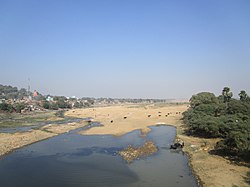
Phalgu River at Gaya
Map
Location
CountryIndia
StateBihar, Jharkhand
DistrictGaya
Physical characteristics
SourceConfluence of Lilajan and Mohana rivers
 • locationnear Gaya
 • coordinates24°43′41″N 85°00′47″E / 24.72806°N 85.01306°E / 24.72806; 85.01306
MouthPunpun River

The Phalgu or Falgu, a river that flows past Gaya, India in the Indian state of Bihar, is a sacred river for Hindus and Buddhists. Lord Vishnu's Temple Vishnupad Mandir is situated on the bank of Phalgu river, also called Niranjana river in sanskrit and Lilagan river. Its called ଭାଲୁକୀ (Bhāluki) in Odia and is also mentioned in Odia Ramayana. Before attaining Enlightenment, the prince Siddhārtha Gautama practiced asceticism for six years (ten or twelve years according to some accounts) on the banks of the river, residing in a forest near the village of Uruvilvā. After realizing that strict asceticism would not lead to Enlightenment, he recuperated after bathing in the river and receiving a bowl of milk-rice from the milkmaid Sujātā.

He sat under the nearby pippala tree, where he finally achieved Enlightenment. This tree became known as the Bodhi Tree, and the site became known as Bodh Gayā.

Course

[edit]
Phalgu River at Gaya in winter

The Phalgu is formed by the confluence, some 3 kilometres (2 mi) below Bodh Gaya, of the Lilajan (also called Niranjan or Nilanjan) and the Mohana, two large hill streams each of which is over 270 metres (300 yd) wide.[1] The Phalgu is also mentioned as Niranjan.[2] The united stream flows on to the north past the town of Gaya, where it attains a breadth of over 820 metres (900 yd). The Phalgu here passes by a high rocky bank, on the steep sides of which are many paved stairs leading down to the river bed, while high above are the Vishnupad Mandir, with many minor shrines around it. It then runs in a north-easterly direction for about 27 kilometres (17 mi), and opposite the Barabar hills it again takes the name of Mohana, and divides into two branches which eventually flow into a branch of the Punpun.[1]

The Phalgu like its confluent streams, Lilajan and Mohana, is subject to high floods during the monsoons but in other seasons of the year it dwindles to a stream wandering through a wide expanse of sand.[1]

Religious significance

[edit]

Buddhism

[edit]

Before attaining Enlightenment, the Siddhārtha Gautama practiced asceticism on a tributary of the river.

Hinduism

[edit]

There is reference to the city of Gaya and the Phalgu in the Ramayana in which it says that Sita had cursed the Phalgu River. There is an interesting story and the purana states that on account of this curse, the Phalgu lost its water, and the river is simply a vast stretch of sand dunes. According to mythology, in the absence of Rama, his wife Sita offered pinda on its banks to Dasharatha father of Rama.[1]

The story goes that Rama, along with his brothers and Sita, came to Gaya to perform the sacred rites for his father, Dasaratha. When the brothers were bathing in the river, Sita was sitting on the banks, playing with the sand. Suddenly, Dasaratha appeared out of the sand, and asked for the Pindam, saying he was hungry. Sita asked him to wait till his sons returned, so that she could give him the traditional Pindam of rice and til. He refused to wait, asking her to give him pindams made of the sand in his hand.

Having no other option, in the presence of five witnesses – the Akshaya Vatam, the Falguni River, a cow, a Tulsi plant and a Brahmin, she gave him the Pindam he desired. Soon, Rama returned and started the rituals. In those days apparently, the ancestors would arrive in person to collect their share, and when Dasaratha did not appear, they wondered why. Sita then told them what had happened, but Rama could not believe that his father would accept pindams made of sand. Sita now mentioned her witnesses, and asked them to tell Rama the truth.

Among the five, only the Akshaya Vatam took her side and told the truth, while the others lied, trying to take Rama’s side. In her anger, Sita cursed all of them thus: the Falguni river henceforth would have no water at Gaya; the Cow would no longer be worshipped from the front as all others are: only its backside would be worshipped; there would be no more Tulsi plants at Gaya and the Gaya Brahmins would never be satisfied, they would always be hungry and crave more and more. She then blessed the Akshaya Vatam saying that all who came to Gaya would perform the Pinda pradaanam at the Akshaya Vatam too.[3]

History

[edit]

The portion of the course of the Phalgu flowing by Gaya is sacred to the Hindus. It is the first holy site visited by the pilgrim and here his first offering must be made for the souls of his ancestors. According to the Gaya Mahatmya, which forms part of the Vayu Purana, the Phalgu is the embodiment of Vishnu himself. One tradition states that it formerly flowed with milk.[1]

According to Hindu belief, the soul wanders after death until pindadan, or religious service seeking salvation for the dead from the cycle of rebirth, is performed. The fortnight-long pitrapaksh period is considered auspicious to offer pindadan. The 15 days of the waning moon during the Hindu month of Ashvin are known as pitrapaksh. Pindadan is traditionally offered on the banks of the Phalgu at Gaya. It is mandatory for Hindu devotees offering pindadan to shave their heads and take a holy dip and head for the Baitarni pond. The prayers are performed at the Vishnupad Mandir. Priests, known as Gaywal-pandas, conduct the ritual. Thousands of Hindus visit Gaya for the purpose of pindadan.[4]

References

[edit]
Revisions and contributorsEdit on WikipediaRead on Wikipedia
from Grokipedia
The Phalgu River, also known as the Falgu and anciently as the Niranjana, is a seasonal of the Ganga River in the Indian state of , formed by the confluence of the (originating in the of ) and the Mohana River near the city of Gaya. It flows eastward for approximately 135 kilometers through the Gaya, , and districts before merging with the Ganga near Fatuha. The river is characterized by its intermittent flow, often appearing dry due to a legendary curse, yet it remains vital for local irrigation and in the region. Renowned for its profound religious significance, the Phalgu holds a central place in Hinduism as the primary site for pind daan (ancestral offerings) during shraddha rituals in Gaya, where pilgrims perform tarpan (libations) on its banks to seek purification and blessings for departed souls. In Buddhism, it is inextricably linked to the enlightenment of Gautama Buddha, who is believed to have bathed in and crossed the then-flowing Niranjana River before meditating under the Bodhi tree in nearby Bodh Gaya, marking the site's status as one of the holiest Buddhist pilgrimage centers. The river's banks also host key temples like the Vishnupad Temple and serve as venues for festivals such as Chhath Puja, underscoring its enduring spiritual and cultural role. Despite its sanctity, the Phalgu faces environmental challenges, including severe from urban waste, reduced water flow exacerbated by and variability, and recent flooding as in August 2025 affecting Gaya and districts, leading to initiatives like the construction of the in —the longest of its kind in at approximately 400 meters—to aid rejuvenation and irrigation. These efforts highlight the river's broader importance to the socio-economic fabric of , supporting agriculture in a region prone to seasonal droughts while preserving its heritage as a conduit between the living and the ancestral.

Geography

Origin and Course

The Phalgu River originates from the of the (also known as Niranjana or Nilanjan) and the Mohana River, two sizable highland streams, approximately 3 km south of in the of , . At the point of confluence, these streams combine to form a waterway over 270 meters wide. The river's formation marks the beginning of its distinct course through the region. From its source, the Phalgu flows northward for about 15 km, passing through Gaya city at coordinates approximately 24°48′N 85°00′E, where it expands to a width exceeding 820 meters. Beyond Gaya, the river shifts to a northeast trajectory, covering roughly 25 km toward the Barabar Hills before merging with the , a of the , at its mouth. This overall path spans about 40 km from the confluence to the mouth. The river briefly passes notable sites such as the Vishnupad Temple along its banks in Gaya. The Phalgu traverses the flat terrain of the in , characterized by sandy beds and low-gradient flow. Its elevation descends from around 100 m above mean near the to near by the time it reaches the Punpun, contributing to its ephemeral nature outside the season.

Hydrology and Unique Features

The Phalgu River displays pronounced seasonal hydrological patterns typical of peninsular Indian rivers in the Ganga basin. During the period from July to September, heavy rainfall leads to substantial flooding, causing widespread inundation across low-lying areas in Gaya and surrounding regions of southern . Outside the , particularly in the from to May, surface flow diminishes dramatically, often reducing to a narrow trickle or leaving the broad riverbed entirely dry due to high , limited rainfall, and subsurface losses. These fluctuations result in average discharge rates that peak during monsoons but approach zero in summer months, reflecting the river's dependence on seasonal rather than perennial sources. A distinctive hydrological feature of the Phalgu is its partial subterranean flow, particularly near Gaya, where water percolates into the sandy and gravelly riverbed, rendering the surface channel largely invisible except during intense rains. This occurs as the river traverses permeable alluvial deposits—composed of coarse sand, pebbles, and gravel—over a low-gradient plain, facilitating rapid infiltration rather than sustained . The notes that such subsurface channeling is evident from observations of water movement within the sand bed, up to several meters deep, influenced by the region's alluvial geology. The Phalgu drains a relatively small basin spanning approximately 1,500 km² across southern Bihar and adjacent parts of Jharkhand, characterized by undulating terrain transitioning from hilly uplands to flat Indo-Gangetic plains. This compact catchment limits the river's overall volume but concentrates flow from key tributaries. The Lilajan (also known as Niranjana) River, originating in the Chota Nagpur Plateau hills of Jharkhand, serves as the primary contributor, merging with the Mohana River about 3 km south of Bodh Gaya to form the Phalgu proper; the Mohana adds supplementary flow from local drainages, enhancing the combined channel's capacity during peak seasons. Monsoon floods from this integrated system occasionally disrupt local agriculture by submerging fields and depositing sediment, though the ephemeral nature aids in groundwater recharge.

Religious Significance

In Hinduism

In Hindu mythology, the Phalgu River is prominently featured in the Ramayana, where it is associated with a curse pronounced by Goddess Sita. During their exile, Lord Rama, Sita, and Lakshmana visited Gaya to perform shraddha rituals for King Dasharatha. While Rama and Lakshmana were away, Sita conducted the pindadan ceremony using sand from the riverbed as a substitute for traditional offerings, with the river, a cow, a tulsi plant, a , and a tree as witnesses. Upon their return, all except the banyan tree denied witnessing the ritual, prompting Sita's curse that the Phalgu would flow underground, concealed beneath sand for most of the year, visible only during monsoons. This narrative symbolizes for deceit and underscores themes of truth and impermanence in Hindu lore. The river holds profound ritual significance in , particularly as a site for pindadan, the offering of rice balls to deceased ancestors, performed along its banks in Gaya. Devotees believe these rituals, often involving digging into the sandy bed to access subterranean water for ablutions, grant (liberation) to the souls of the departed and absolve pitra dosha (ancestral debts). The adjacent Vishnupad Temple, situated on the Phalgu's banks, enhances this sanctity; it enshrines a large rock etched with Lord 's footprint, marking the spot where he subdued the demon Gayasura by placing his foot upon him. Pilgrims visit the temple as part of the shraddha sequence, offering prayers to for ancestral peace. Symbolically, the Phalgu embodies the Hindu philosophical concept of transience and the insignificance of worldly attachments, reflected in its name "phalgu," meaning small, trivial, or ephemeral. Its predominantly dry, subterranean flow represents the illusory and fleeting nature of material existence, reminding devotees of the deeper spiritual truths beyond surface appearances. As a primary tirtha (sacred ford) in Gaya, the river is integral to shraddha ceremonies, reinforcing Gaya's status as a paramount pilgrimage center for ancestor veneration in Hindu tradition.

In Buddhism

The Phalgu River holds a significant place in Buddhist tradition as a site associated with Siddhartha Gautama's period of severe before his enlightenment. For six years, Siddhartha practiced extreme austerities along the riverbanks and in nearby forests, engaging in rigorous to seek liberation from . This phase of renunciation culminated in his decision to abandon such extremes after realizing their futility, leading him to accept nourishment that restored his strength. Known in ancient as the Niranjana or Nerañjara River—a name derived from its clear, pleasant waters—the Phalgu is depicted as a key location in Siddhartha's spiritual journey. He bathed in its waters just before proceeding to meditate under the Bodhi Tree in , marking a moment of purification on the path to awakening. Early scriptures, such as Aśvaghoṣa's Buddhacarita, reference the river during this renunciation phase, portraying it as part of the landscape where the future confronted temptation and deepened his resolve. The river thus symbolizes detachment and the transition from ascetic hardship to the . In contemporary Buddhism, the Phalgu River forms an integral part of the sacred enlightenment circuit around , which includes the Complex designated as a in 2002. Pilgrims from around the world visit its banks to retrace Siddhartha's steps, viewing the waters as emblematic of spiritual cleansing and the pursuit of enlightenment. This reverence underscores the river's enduring role in Buddhist , distinct yet occasionally overlapping with shared ritual practices in the Gaya region.

Associated Rituals and Sites

The Phalgu River serves as a focal point for the , a 15-day observance in the Hindu lunar month of Ashvin (typically September-October), during which pilgrims perform pind daan, or ancestral offerings, to seek liberation for departed souls. These rituals involve preparing rice balls (pindas) mixed with sesame seeds and other items, followed by (libations of water) and immersion in the river, guided by local priests on the riverbanks. The practice is believed to grant to ancestors, drawing thousands of devotees annually to Gaya. Key sites along the river include Falgu Ghat, the primary location for ritual bathing and pind daan immersions, where devotees collect sacred water and offer prayers before proceeding to other venues. Adjacent to the ghat stands the Vishnupad Mandir, a revered Hindu temple housing a natural rock impression interpreted as the footprint of Lord Vishnu, where additional offerings and circumambulation occur as part of the pind daan sequence. Further along the traditional route, the Akshayavat—an ancient banyan tree considered indestructible—marks the site for final rituals, including tree worship and parikrama (circumambulation) to symbolize eternal life and ancestral peace. The river's location near enhances its interfaith role, with its banks shared by Hindus, Buddhists, and Jains for purification rites such as ceremonial dips and offerings that transcend sectarian boundaries. Buddhists, in particular, incorporate the Phalgu's vicinity during festivals like Buddha Purnima, where combined processions and meditations link Hindu and Buddhist pilgrims in shared spiritual practices around nearby sites. The annual Bodh Mahotsav, a three-day cultural extravaganza organized by the government, further promotes the river's heritage through performances, exhibitions, and walks that highlight Gaya's syncretic traditions. The Phalgu's distinctive sandy bed, often appearing dry outside monsoons, uniquely enables rituals like sand-based pind daan, where offerings are placed directly on the riverbed to invoke divine acceptance.

History

Mythological Origins

The mythological origins of the Phalgu River are rooted in ancient Hindu legends, particularly a variant from the Ramayana tradition where the river incurs a curse from Sita, leading to its predominantly subterranean flow. According to this tale, during their exile, Rama, Sita, and Lakshmana visited Gaya to perform pind daan (ancestral offerings) for King Dasharatha. While Rama and Lakshmana were away gathering materials, the spirit of Dasharatha appeared to Sita, prompting her to offer pind using sand from the riverbed. Sita invoked the Phalgu River, a cow, a Tulsi plant, a Brahmin, and a banyan tree as witnesses to the ritual. Upon the brothers' return, all witnesses except the banyan tree denied the act, claiming no such offering occurred. Enraged by the deception, Sita cursed the Phalgu River to hide its waters beneath the sand, visible only during monsoons, explaining its dry bed in non-rainy seasons. This narrative, detailed in the medieval text Ānanda Rāmāyaṇa, portrays the Phalgu as a deceptive entity whose curse underscores themes of truth and retribution in Hindu lore. The river's transformation symbolizes the consequences of failing cosmic duties, tying into broader motifs of and familial piety. Local , such as the Purana's Gaya Mahatmya section, further elevate the river's status by identifying it as the embodiment of Lord Vishnu, the preserver of cosmic order, whose incarnations like restore balance amid moral failings. Additional myths link the Phalgu to 's interventions against demonic forces, enhancing its role in maintaining universal harmony. One such legend recounts how subdued the demon Gayasur, whose body formed the landscape of Gaya, with the river facilitating offerings that grant ancestral salvation and uphold the cycle of karma. These stories, preserved through oral traditions in medieval , have shaped the river's dual identity as a "cursed yet holy" , blending themes of divine punishment and redemptive sanctity in regional .

Historical and Modern Developments

The Phalgu River, historically referred to as Niranjana in ancient Buddhist accounts, gained prominence as a pilgrimage route following Siddhartha Gautama's enlightenment near its banks in around the 5th century BCE. During the Mauryan Empire in the 3rd century BCE, Emperor Ashoka's construction of stupas and monasteries at formalized the river's role in structured Buddhist pilgrimages, as evidenced by rock edicts and archaeological remains promoting visits to the sacred riverine landscape. In the medieval period from the 4th to 12th centuries CE, the river became integral to Hindu shraddha ceremonies under and Pala-Sena kingdoms, where royal endowments and land grants supported Brahmin-led rituals for ancestral offerings along its banks, reinforcing Gaya's status as a center for such practices. British colonial records, including the 1905 for Gaya, highlight the Phalgu's propensity for devastating floods, such as those in 1901 and 1905, which eroded riverbanks and disrupted agrarian economies in the region. Following India's independence, 20th-century in Gaya intensified , with expanding settlements channeling untreated domestic sewage directly into the river, diminishing its perennial flow. In contemporary times, the Phalgu faces severe from municipal and industrial effluents, particularly from units in Gaya, resulting in high levels of and dyes that render the water unsafe for aquatic life. These pollutants, combined with excessive , have caused significant ecological degradation, including among fish and invertebrate in the river basin. To address these challenges, the government initiated rejuvenation efforts in the under the Namami Niranjana Campaign, which includes constructing sewage treatment plants to intercept , for desiltation to revive natural flow, and afforestation to stabilize the basin's ecosystem. The World Heritage designation of the Complex at in 2002 has bolstered protections for the site's sacred landscape, which includes the nearby Phalgu River as part of the broader pilgrimage context.

References

Add your contribution
Related Hubs
User Avatar
No comments yet.