Hubbry Logo
FangFangMain
Open search
Fang
Community hub
Fang
logo
8 pages, 0 posts
0 subscribers
Be the first to start a discussion here.
Contribute something
Fang
Fang
from Wikipedia
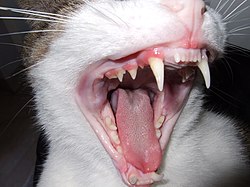
The four canines, or fangs, of a domestic cat. (The largest two teeth of the top and bottom rows of teeth.)

A fang is a long, pointed tooth.[1] In mammals, a fang is a modified maxillary tooth, used for biting and tearing flesh. In snakes, it is a specialized tooth that is associated with a venom gland (see snake venom).[2] Spiders also have external fangs, which are part of the chelicerae.

Fangs are most common in carnivores or omnivores, but some herbivores, such as fruit bats, have them as well. They are generally used to hold or swiftly kill prey, such as in large cats. Omnivorous animals, such as bears, use their fangs when hunting fish or other prey, but they are not needed for consuming fruit. Some apes also have fangs, which they use for threats and fighting. However, the relatively short canines of humans are not considered to be fangs.

Fangs in religion, mythology and legend

[edit]

Certain mythological and legendary creatures such as dragons, gargoyles, demons and yakshas are commonly depicted with prominent fangs. The fangs of vampires are one of their defining characteristics.[3]

The iconographic representation of some Hindu deities include fangs, to symbolize the ability to hunt and kill. Two examples are fierce warrior goddess Chamunda and god of death Yama in some iconographic representations. Fangs are also common among guardian figures such as Verupaksha in Buddhism art in China and East Asia,[4] as well as Rangda in Balinese Hinduism.[5]

Halloween costumer with vampire fangs
Hindu god of death Yama with fangs
Hindu warrior goddess Chamunda.
Dragon head on the replica ship, "Hugin"
Snake fangs

See also

[edit]

References

[edit]
[edit]
Revisions and contributorsEdit on WikipediaRead on Wikipedia
from Grokipedia
A fang is a long, pointed found in many animals, particularly used for seizing, tearing, or injecting substances into prey. In mammals, such as carnivores like wolves and , fangs typically refer to enlarged canine teeth adapted for gripping and ripping flesh. In reptiles, especially venomous snakes, fangs are specialized maxillary teeth that are often hollow or grooved to deliver , functioning like hypodermic needles. Fangs vary in structure and function across taxa; for example, in arthropods like spiders, they form the hollow tips of for and feeding. These adaptations have evolved multiple times to enhance predation, defense, and resource acquisition in diverse ecosystems.

Definition and General Characteristics

Anatomical Definition

A fang is defined in as a long, pointed , often enlarged and specialized for seizing, holding, or tearing prey in . This structure distinguishes it from typical by its hyper-elongated form, serving as an for predation rather than general mastication. The term "fang" originates from Old English fang, meaning "prey" or "that which is seized," derived from the Proto-Germanic fanganą ("to catch" or "to seize"). In anatomical contexts, fangs are frequently equated with or refer to the canine teeth when they exhibit pronounced elongation, particularly in carnivorous where standard canines are shorter and less specialized for deep penetration. Structurally, a fang consists of a core made of , which may be solid in most cases or hollow/grooved in venomous to facilitate delivery, and is typically curved for efficient prey engagement. The exposed crown is coated with a layer of hard enamel for protection and durability, similar to other teeth, while the anchors it firmly in the jawbone. The primary functions of fangs include immobilizing prey through piercing and gripping, injecting in select taxa to subdue victims rapidly, and occasionally serving as a display mechanism for or recognition.

Physical Properties and Variations

Fangs consist primarily of , a calcified tissue forming the bulk of the structure, with a thin outer layer of enamel providing enhanced hardness and resistance to abrasion. In venomous , an internal runs through the , originating from epithelial invaginations during development and connecting to associated glands for delivery. Size and shape variations in fangs adapt to functional demands, with lengths spanning from under 1 cm in small species to more than 20 cm in large predators. Relative fang length can range from 13.6% to 37.1% of head length in vipers, reflecting evolutionary where fangs elongate disproportionately to body size. Shapes often incorporate curvature, from slight bends to pronounced sickle-like forms, which improve retention during penetration by hooking into tissue. Biomechanical properties emphasize penetration efficiency and structural integrity. Fang tips exhibit acute included angles that minimize puncture force, with tip morphology serving as the primary predictor of performance in tissue entry. Dentin's material properties, including a of approximately 20 GPa, confer flexibility to absorb impact stresses and reduce fracture likelihood during use. Regrowth occurs through continuous replacement in species, such as reptiles, where the dental lamina—a lingual epithelial extension—generates successive teeth to offset wear and breakage from mechanical loading. In diphyodont mammals, replacement is limited, increasing to permanent in specialized fangs. Wear patterns arise from abrasive contact, while breakage risks stem from high-impact strikes, prompting evolutionary adaptations in replacement frequency.

Fangs in Animals

In Mammals

In mammals, fangs are typically the elongated canine teeth, positioned in the upper jaw's and deeply rooted for enhanced stability during forceful actions such as prey capture. These teeth lack venom-conducting grooves, distinguishing them from reptilian fangs, but some species produce saliva with properties to facilitate feeding. The enamel covering canine teeth provides high , often exceeding 3-6 GPa, enabling resistance to wear from tearing tough tissues. Among felids, such as lions and extinct saber-toothed cats like Smilodon, fangs serve primarily for tearing flesh and subduing prey through precise neck bites that target vital arteries. In Smilodon fatalis, these upper canines reached lengths of up to 18 cm, with serrated edges for enhanced cutting efficiency during predation on large herbivores. Ursids, including bears like the grizzly (Ursus arctos), possess prominent but proportionally shorter canines compared to felids, adapted for gripping and piercing omnivorous diets that include meat and vegetation. In primates such as baboons (Papio spp.), elongated canines function in intra-species combat and threat displays, with males exhibiting significantly larger sizes—up to 20% longer than in females—to establish dominance. Sexual dimorphism in fang size is pronounced across many mammals, particularly in species where males engage in agonistic interactions; for instance, male baboon canines grow rapidly post-maturity, correlating with higher social rank and mating success. In bears, males also display slightly larger canines than females, aiding in territorial disputes. While fangs are rare in herbivores, vampire bats (Desmodus rotundus) represent a unique adaptation, using sharp, self-sharpening incisor-like canines to make shallow incisions in prey skin, followed by lapping blood aided by salivary anticoagulants like draculin. Fossil records highlight exaggerated fang development in extinct mammals, such as Smilodon, underscoring their role in specialized predation strategies.

In Reptiles

In reptiles, fangs are specialized dental structures primarily found in venomous snakes, serving as conduits for venom delivery to subdue prey. These fangs evolved from ancestral grooved teeth into enclosed hollow structures, enabling efficient injection of toxins such as neurotoxins that paralyze the or hemotoxins that disrupt blood clotting and tissue integrity. Vipers (Viperidae) possess solenoglyphous fangs, which are long, hinged, and foldable, allowing them to rotate forward during a via contraction of jaw adductor muscles. These fangs are hollow tubes with a smooth internal surface and two orifices—one connecting to the gland via a duct at the base and the other at the tip for injection—resembling hypodermic needles. In large species like the (Bitis gabonica), fangs can reach lengths of up to 5 cm, facilitating deep penetration and precise delivery. In contrast, elapids such as cobras ( spp.) and mambas (Dendroaspis spp.) feature proteroglyphous fangs, which are shorter, fixed in the front of the upper on a relatively immobile , and also hollow for conduction from associated glands. These fangs, averaging 5 mm in length in many species but extending to about 1.3 cm in the king cobra (Ophiophagus hannah), enable rapid strikes without the need for folding mechanisms. The mechanics of venom injection involve fang penetration followed by glandular contraction, which pressurizes the through the fang's for immobilization of prey. Fangs are subject to breakage during use and are continuously replaced throughout the snake's life, with multiple successor teeth developing in sequence behind the functional pair; replacement occurs approximately every few months in many species, ensuring minimal downtime in venom delivery capability. Non-venomous constricting snakes, such as pythons and boas, lack true fangs but possess enlarged, recurved teeth adapted for gripping and holding prey mechanically rather than through .

In Arthropods and Other

In arthropods, fang-like structures are most prominently developed in arachnids as chitinous appendages distinct from the keratin- or enamel-based fangs of vertebrates, serving primarily for prey capture and through functional in piercing and delivery. These structures, known as in spiders and scorpions, are paired appendages with hollow, pointed tips that facilitate injection of liquids into prey. Composed of sclerotized , they exhibit significant size variation, ranging from approximately 0.5 mm in small species like the black widow ( spp.) to over 10 mm in large tarantulas such as Theraphosa blondi. In spiders, the chelicerae function as specialized fangs for piercing exoskeletons and injecting from associated glands located in the , often accompanied by that liquefy internal tissues for subsequent consumption. For instance, black widow spiders use their short fangs to deliver neurotoxic that rapidly immobilizes and small vertebrates. In some species, the fang's internal duct serves dual purposes, channeling both paralytic and predigestive juices through a single opening near the tip, enhancing feeding efficiency. Diversity in fang morphology is evident across spider clades: mygalomorphs, including tarantulas, possess robust, paraxial chelicerae that move vertically like pincers for crushing and stabbing, while araneomorphs, such as orb-weavers and black widows, have slender, diaxial fangs that articulate horizontally for precise . Scorpions exhibit fang-like chelicerae that are smaller and more pincer-shaped compared to those of spiders, primarily aiding in prey manipulation and tearing rather than primary venom delivery, which occurs via the tail stinger; these structures are also chitinous and vary from 0.5 to 2 mm in length depending on species size. In other arachnids, such as solifuges, chelicerae can be massively enlarged and fang-like for shearing tough prey, though lacking venom glands. Fang-like appendages are rarer in insects, but assassin bugs (Reduviidae) possess a segmented proboscis with stylet tips that function analogously, piercing prey to inject paralytic saliva and digestive enzymes before sucking liquefied tissues.

Evolutionary Biology

Origins and Development

The phylogenetic origins of fangs in s trace back to the evolution of specialized elongated teeth from simpler conical forms in early synapsids, particularly within therapsids during the late era. These structures emerged around 270 million years ago in the Middle Permian, as evidenced by the gorgonopsians, a group of saber-toothed therapsids that developed enlarged, laterally compressed canines up to 13 cm long, adapted for predation. Recent findings from have identified the oldest gorgonopsian fossils in , , dating to around 275 million years ago, further supporting their early Permian origins. This innovation represented a key step in the differentiation of dental morphology beyond the uniform conical teeth of earlier amniotes, driven by selective pressures for efficient prey capture in terrestrial ecosystems. Independently, in arthropods, fang-like structures evolved from cheliceral precursors in chelicerates, such as spiders, where the distal segment of the chelicera modified into a hollow fang for delivery, a process involving segment-specific distinct from vertebrate odontogenesis. Developmentally, fangs form through regulated elongation of tooth primordia originating from the , a mesenchymal condensation within the during embryogenesis. In vertebrates, this process involves (BMP) signaling pathways, which promote differentiation and formation, leading to the structural reinforcement necessary for fang elongation and durability. , while absent in the Hox-free zone of the oral region where teeth initiate, indirectly influence patterning and regional identity that supports subsequent morphogenesis, ensuring positional specificity for specialized structures like fangs. In arthropods, cheliceral fang development relies on analogous patterning genes, but without the vertebrate-specific dental lamina. The fossil record documents the earliest mammalian-like fangs in Permian gorgonopsids from and , where these therapsids exhibited serrated, blade-like canines indicative of a predatory , predating similar adaptations in later mammals by over 200 million years. For reptiles, specialized venom-conducting fangs appear later, with grooved in the Uatchitodon around 215 million years ago, evolving into enclosed tubular forms in advanced snakes by the , though the diversification of such structures accelerated in the amid the of squamate reptiles. This record highlights across lineages, with archosaurian reptiles like theropods developing serrated, fang-like teeth for shearing during the same era, but without delivery mechanisms. Key evolutionary events during the era marked the transition from simple, homodont teeth to arrangements featuring specialized fangs, coinciding with ecological shifts toward more complex food webs. In synapsids, the Permian-Triassic transition solidified fang-like canines in therapsids, while in lepidosaurs, the Jurassic-Cretaceous boundary saw the refinement of rear fangs into front-fanged systems in advanced snakes, facilitated by modifications to folding and vascularization. These changes, observed in fossils from diverse deposits, underscore how environmental upheavals, such as the end-Triassic , spurred dental innovations that enhanced predatory efficiency across clades.

Adaptations and Diversity

The diversification of fangs through has been shaped by selective pressures associated with predatory lifestyles, particularly the need to subdue larger or more challenging prey. In venomous snakes such as vipers, fang elongation facilitates deeper penetration and efficient delivery, enhancing success in predation where rapid immobilization is critical. Similarly, in rear-fanged colubriform snakes, the integration of grooved or hollow fangs with Duvernoy's glands allows for targeted , reducing energy expenditure compared to and enabling exploitation of agile prey like and birds. These adaptations reflect broader evolutionary trade-offs, where fang morphology optimizes killing efficiency against prey size and escape potential. Diversity in fang structure exhibits clear patterns linked to dietary specialization, with hypercarnivores displaying the longest relative fangs to handle prey. For instance, in vipers, species preying heavily on mammals evolve fangs up to 18% longer than those of ectothermic specialists, correlating with the biomechanical demands of piercing tough hides. has produced similar fang-like piercing structures in unrelated lineages, such as the sharp, blade-edged lower incisors of vampire bats (Desmodus rotundus) for skin incision during blood-feeding, with canines assisting in fur removal, and the hollow fangs of viperid snakes, both adapted for precise tissue penetration despite distinct phylogenetic origins. This convergence underscores how ecological niches, rather than shared ancestry, drive analogous morphologies across mammals and reptiles. In modern taxa, fang variations also arise from non-trophic pressures, including that favors exaggerated canine size for display and intra-male competition. Male mandrills ( sphinx) and baboons exhibit sexually dimorphic canines up to twice the length of females', serving as visual signals of dominance and fitness during agonistic encounters. Conversely, artificial selection in domesticated animals has led to fang reduction; in dogs (Canis familiaris), canine teeth are notably shorter and less robust than in ancestral wolves, reflecting relaxed predatory demands and paedomorphic changes under human breeding. Central to fang evolution are key concepts like allometric scaling, where fang length exhibits positive relative to body size, growing disproportionately faster in larger individuals to maintain functional efficacy. In vipers, fang length scales with head length at an exponent of approximately 1.36, implying an overall relationship to body mass near the 0.67 power typical of linear traits under metabolic scaling principles, while diet further modulates morphology—mammal-eaters show enhanced elongation for grappling larger quarry. These patterns build briefly on fang origins in early therapsids and archosaurs, where initial dental specializations set the stage for niche-specific diversification.

Cultural and Symbolic Roles

In Religion and Mythology

In , the serpent is associated with and embodies themes of destruction and protection, as seen in myths such as the churning of the ocean. Similarly, the goddess is depicted in with protruding fangs, embodying fierce protection against chaos while enacting necessary destruction to pave the way for renewal. In Western mythology, fangs became associated with vampires in 19th-century literature, portraying the undead as beings driven by bloodlust. This imagery was popularized in . Across other traditions, fangs appear as markers of imperial power and divinity. In , the dragon's sharp fangs underscore its authority over natural forces and imperial sovereignty, evoking the ruler's unyielding strength and ability to ward off threats to the realm. For the Aztec , ceremonial artifacts feature menacing fangs, blending serpentine ferocity with celestial benevolence. Symbolically, fangs often serve as emblems of guardianship and chaos in religious narratives. The Egyptian goddess is portrayed as a lioness acting as a fierce protector of pharaohs and order, purging impurities to restore ma'at (cosmic harmony). In , the wolf Fenrir's massive jaws and greedy fangs herald apocalyptic chaos, embodying uncontrollable rage that devours the god during , thus representing the inevitable disruption of divine stability. These motifs, inspired by the predatory nature of animal fangs, highlight fangs as dual icons of safeguarding creation and unleashing primordial disorder.

In Folklore and Modern Media

In , werewolves are often depicted as humans transforming into wolves or wolf-like beings during the , with their lupine forms featuring sharp, predatory teeth that symbolize their savage hunger and capacity for violence during hunts. These fangs-like teeth underscore the creature's role in tales of lycanthropy, where the transformation amplifies primal instincts, leading to attacks on or humans as cautionary narratives against moral deviance or curses. In West African Akan , the trickster figure , commonly portrayed as a , embodies cunning and wit through schemes that outmaneuver stronger foes. Stories like those collected from Ashanti oral traditions highlight Anansi's deceptive ploys, such as stealing stories from the sky god Nyame, where his spider form represents indirect cleverness rather than brute force. In 20th-century horror literature, fangs became a hallmark of vampiric menace, blending with terror in blood-draining bites. This portrayal influenced subsequent films, such as the 1994 adaptation , where fangs visually emphasize the vampires' predatory allure and eternal damnation. In superhero media, fangs appear stylized in character designs to evoke ferocity, exemplified by Wolverine's animal-like canine teeth in , which protrude prominently alongside his retractable claws, marking his wolverine-mutant heritage and berserker rage in battles across storylines. These exaggerated canines function as fangs, enhancing his portrayal as a outsider in narratives like (1982) miniseries. Fangs symbolize rebellion and otherness in modern subcultures, particularly within goth and punk scenes, where wearers don prosthetic fangs as accessories to challenge societal norms and embrace nocturnal, anti-establishment aesthetics inspired by lore. This fashion element emerged in the late 1970s punk wave and evolved into vampire goth styles by the 1990s, featuring fangs alongside black attire and piercings to signify defiant individuality. In video games, fangs feature prominently on dragon bosses as emblems of draconic terror, such as in (2016), whose massive, jagged fangs deliver devastating bites amid fire-breathing assaults, or Alduin in (2011), where fang-lined maws underscore the world-ending Dovahkiin's apocalyptic threat. These depictions heighten intensity, with fangs often targeting players in close-range mechanics. Depictions of fangs in media have evolved from monstrous horror to romanticized allure, beginning with Bram Stoker's Dracula (1897), where Count Dracula's sharp fangs represent invasive, sexualized predation on Victorian purity. By the , Stephenie Meyer's Twilight series (2005–2008) softens this, portraying vampires with retractable fangs that emerge subtly during intimate moments, shifting fangs from symbols of revulsion to markers of forbidden desire and emotional depth.

References

Add your contribution
Related Hubs
Contribute something
User Avatar
No comments yet.