


Community hub
Recent from talks
Contribute something
Nothing was collected or created yet.
Wolverine
View on Wikipedia
| Wolverine Temporal range: Pleistocene–recent, [1]
| |
|---|---|

| |
Scientific classification 
| |
| Kingdom: | Animalia |
| Phylum: | Chordata |
| Class: | Mammalia |
| Order: | Carnivora |
| Suborder: | Caniformia |
| Family: | Mustelidae |
| Genus: | Gulo |
| Species: | G. gulo
|
| Binomial name | |
| Gulo gulo | |
| Subspecies | |
|
American wolverine (G. g. luscus) | |

| |
| Wolverine ranges | |
| Synonyms | |
|
Mustela gulo Linnaeus, 1758 | |


The wolverine (/ˈwʊlvəriːn/ WUUL-və-reen, US also /ˌwʊlvəˈriːn/ WUUL-və-REEN;[4] Gulo gulo), also called the carcajou or quickhatch (from East Cree, kwiihkwahaacheew), is the largest land-dwelling member of the family Mustelidae. It is a muscular carnivore and a solitary animal.[2] The wolverine has a reputation for ferocity and strength out of proportion to its size, with the documented ability to kill prey many times larger than itself.
The wolverine is found primarily in remote reaches of the northern boreal forests and subarctic and alpine tundra of the Northern Hemisphere, with the greatest numbers in Northern Canada, the U.S. state of Alaska, the mainland Nordic countries of Europe, and throughout western Russia and Siberia. Its population has steadily declined since the 19th century owing to trapping, range reduction and habitat fragmentation. The wolverine is now essentially absent from the southern end of its range in both Europe and North America.
Naming
[edit]The wolverine's questionable reputation as an insatiable glutton (reflected in its Latin genus name Gulo, meaning "glutton") may be in part due to a false etymology. The less common name for the animal in Norwegian, fjellfross, meaning "mountain cat", is thought to have worked its way into German as Vielfraß,[5] which means "glutton" (literally "devours much"). Its name in other West Germanic languages is similar (e.g. Dutch: veelvraat).
The Finnish name is ahma, derived from ahmatti, which is translated as "glutton". Similarly, the Estonian name is ahm, with the equivalent meaning to the Finnish name. In Lithuanian, it is ernis; in Latvian, tinis or āmrija.
The Eastern Slavic росомаха (rosomakha) and the Polish and Czech name rosomák seem to be borrowed from the Finnish rasva-maha (fat belly). Similarly, the Hungarian name is rozsomák or torkosborz which means "gluttonous badger".[citation needed]
In French-speaking parts of Canada, the wolverine is referred to as carcajou, borrowed from the Innu-aimun or Montagnais kuàkuàtsheu.[6] However, in France, the wolverine's name is glouton (glutton).
Purported gluttony is reflected neither in the English name wolverine nor in the names used in North Germanic languages. The English word wolverine (alteration of the earlier form, wolvering, of uncertain origin) probably implies "a little wolf". The name in Proto-Norse, erafaz and Old Norse, jarfr, lives on in the regular Icelandic name jarfi, regular Norwegian name jerv, regular Swedish name järv and regular Danish name jærv.
Taxonomy and evolutionary history
[edit]Classification
[edit]

Genetic evidence suggests that the wolverine is most closely related to the tayra and martens, all of which shared a Eurasian ancestor.[7]
There are two subspecies: the Old World form, Gulo gulo gulo, and the New World form, G. g. luscus. Some authors had described as many as four additional North American subspecies, including ones limited to Vancouver Island (G. g. vancouverensis) and the Kenai Peninsula in Alaska (G. g. katschemakensis). However, the most currently accepted taxonomy recognizes either the two continental subspecies or G. gulo as a single Holarctic taxon.[2][8]
Evolution
[edit]Recently compiled genetic evidence suggests most of North America's wolverines are descended from a single source, likely originating from Beringia during the last glaciation and rapidly expanding thereafter, though considerable uncertainty to this conclusion is due to the difficulty of collecting samples in the extremely depleted southern extent of the range.[8]
Physical characteristics
[edit].jpg)
.jpg)
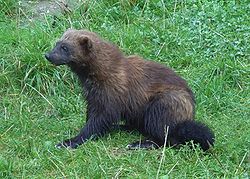
Anatomically, the wolverine is an elongated animal that is low to the ground. With strong limbs, broad and rounded head, small eyes and short rounded ears, it most closely resembles a large fisher. Though its legs are short, its large, five-toed paws with crampon-like claws and plantigrade posture enable it to climb up and over steep cliffs, trees and snow-covered peaks with relative ease.[9]
The adult wolverine is about the size of a medium dog, with a body length ranging from 65–109 cm (26–43 in); standing 36–45 cm (14–18 in) at the shoulder; and a tail length of 17–26 cm (6+1⁄2–10 in). Weight is usually 11–18 kg (24–40 lb) in males, and in females 8–12 kg (18–26 lb).[10][11][12][13][14] Exceptionally large males of as much as 32 kg (71 lb) are referenced in Soviet literature, though such weights are deemed in Mammals of the Soviet Union to be improbable.[15][16][17] The males are often 10–15% larger than the females in linear measurements and can be 30–40% greater in weight. According to some sources, Eurasian wolverines are claimed to be larger and heavier than those in North America, with weights of up to 20 kg (44 lb). However, this may refer more specifically to areas such as Siberia, as data from Fennoscandian wolverines shows they are typically around the same size as their American counterparts.[16][18][19][20][21] It is the largest of terrestrial mustelids; only the marine-dwelling sea otter, the giant otter of the Amazon basin and the semi-aquatic African clawless otter are larger—while the European badger may reach a similar body mass, especially in autumn.
Wolverines have thick, dark, oily fur which is highly hydrophobic, making it resistant to frost. This has led to its traditional popularity among hunters and trappers as a lining in jackets and parkas in Arctic conditions. A light-silvery facial mask is distinct in some individuals, and a pale buff stripe runs laterally from the shoulders along the side and crossing the rump just above a 25–35 cm (10–14 in) bushy tail. Some individuals display prominent white hair patches on their throats or chests.[9]
Like many other mustelids, it has potent anal scent glands used for marking territory and sexual signaling. The pungent odor has given rise to the nicknames "skunk bear" and "nasty cat." The anal gland secretion for the samples obtained from six animal's secretion was complex and variable: 123 compounds were detected in total, with the number per animal ranging from 45 to 71 compounds. Only six compounds were common to all extracts: 3-methylbutanoic acid, 2-methylbutanoic acid, phenylacetic acid, alpha-tocopherol, cholesterol, and a compound tentatively identified as 2-methyldecanoic acid. The highly odoriferous thietanes and dithiolanes found in anal gland secretions of some members of the Mustelinae [ferrets, mink, stoats, and weasels (Mustela spp.) and zorillas (Ictonyx spp.)] were not observed. The composition of the wolverine's anal gland secretion is similar to that of two other members of the Mustelinae, the pine and beech marten (Martes spp.)[22]
Wolverines, like other mustelids, possess a special upper molar in the back of the mouth that is rotated 90 degrees, towards the inside of the mouth. This special characteristic allows wolverines to tear off meat from prey or carrion that has been frozen solid.[23][24]
Wolverine have the highest compressive strength per trabecular bone volumetric fraction (A 10mm high × 5mm diameter cilinder) at the mandibular condyle among all carnivore mammals at 940.8 Newtons, followed by the cheetah at 784.4 Newtons, the Malagasy civet at 714.4 Newtons, the honey badger at 710.8 Newtons and the kinkajou at 693.2 Newtons.[25]
Distribution
[edit]

Wolverines live primarily in isolated arctic, boreal, and alpine regions of northern Canada, Alaska, Siberia, and Fennoscandia; they are also native to European Russia, the Baltic countries, the Russian Far East, northeast China and Mongolia.[26][27][28][29]
Wolverine remains have been found in Ukraine, but they are extirpated there today and it is unclear whether the wolverines would have formed sustainable populations.[30]
Unique records of encounters with wolverines have been noted in Latvia, the most recent one being in late July 2022 (although it can be disputed because of the unclear footage); the population was widespread in the 16th and 17th centuries, but nowadays it is not native to the area.[31]
Most New World wolverines live in Canada and Alaska.[32] However, wolverines were once recorded as also being present in Colorado,[33] areas of the southwestern United States (Arizona and New Mexico); the Midwest (Indiana, Nebraska, North and South Dakota, Ohio, Minnesota, and Wisconsin); New England (Maine, New Hampshire, Vermont, and Massachusetts); and in New York[34] and Pennsylvania.[35]
In the Sierra Nevada, wolverines were sighted near Winnemucca Lake in spring 1995 and at Toe Jam Lake north of the Yosemite border in 1996; and later photographed by baited cameras, including in 2008 and 2009, near Lake Tahoe.[36][37][38][39] According to a 2014 U.S. Fish and Wildlife Service publication, "wolverines are found in the North Cascades in Washington and the Northern Rocky Mountains in Idaho, Montana, Oregon (Wallowa Range), and Wyoming. Individual wolverines have also moved into historic range in the Sierra Nevada Mountains of California and the Southern Rocky Mountains of Colorado, but have not established breeding populations in these areas".[40] In 2022, Colorado Parks and Wildlife considered plans to reintroduce the wolverine to the state.[41]
Wolverines are also found in Utah but are very rarely seen, with only six confirmed sightings since the first confirmed sighting in 1979. Three of these six confirmed Utah sightings have been caught on video.[42] A wolverine, a male, was finally captured and tagged in Utah in 2022 before being released back into the wild to better understand the animal's range.[43][44]
In August 2020, the National Park Service reported that wolverines had been sighted at Mount Rainier, Washington, for the first time in more than a century. The sighting was of a reproductive female and her two offspring.[45]
In 2004, the first confirmed sighting of a wolverine in Michigan since the early 19th century took place when a Michigan Department of Natural Resources wildlife biologist photographed a wolverine in Ubly, Michigan.[46] The specimen was found dead at the Minden City State Game Area in Sanilac County, Michigan, in 2010.[47]
Behavior and ecology
[edit]Diet and hunting
[edit]_7_kallerna.jpg)
Wolverines are primarily scavengers.[48] Most of their food is carrion, especially in winter and early spring. They may find carrion themselves, feed on it after the predator (often, a wolf pack) has finished, or simply take it from another predator. Wolverines are known to follow wolf and lynx trails to scavenge the remains of their kills. Whether eating live prey or carrion, the wolverine's feeding style appears voracious, leading to the nickname of "glutton" (also the basis of the scientific name). However, this feeding style is believed to be an adaptation to food scarcity, especially in winter.[49]
The wolverine is also a powerful and versatile predator. Its prey mainly consists of small to medium-sized mammals, but wolverines have been recorded killing prey many times larger than thenselves, such as adult deer. Prey species include porcupines, squirrels, chipmunks, beavers, marmots, moles, gophers, rabbits, voles, mice, rats, shrews, lemmings, caribou, roe deer, white-tailed deer, mule deer, sheep, goats, cattle, bison, moose,[50] and elk.[51] Smaller predators are occasionally preyed on, including martens, mink, foxes, Eurasian lynx,[52] weasels,[52] coyote, and wolf pups. Wolverines have also been known to kill Canada lynx in the Yukon of Canada.[53] Wolverines often pursue live prey that are relatively easy to obtain, including animals caught in traps, newborn mammals, and deer (including adult moose and elk) when they are weakened by winter or immobilized by heavy snow. Their diets are sometimes supplemented by birds' eggs, birds (especially geese), roots, seeds, insect larvae, and berries. Adult wolverines appear to be one of the few conspecific mammal carnivores to pose an active threat to golden eagles. Wolverines were observed to prey on nestling golden eagles in Denali National Park.[54] During incubation in Northern Sweden, an incubating adult golden eagle was killed in its nest by a wolverine.[55]
Wolverines inhabiting the Old World (specifically, Fennoscandia) hunt more actively than their North American relatives.[56] This may be because competing predator populations in Eurasia are less dense, making it more practical for the wolverine to hunt for itself than to wait for another animal to make a kill and then try to snatch it. They often feed on carrion left by wolves, so changes in wolf populations may affect the population of wolverines.[57] They are also known on occasion to eat plant material.[32]
Wolverines often cache their food during times of plenty. This is of particular importance to lactating females in the winter and early spring, a time when food is scarce.[58]
Reproduction
[edit]Wolverines are induced ovulators.[59] Successful males will form lifetime relationships with two or three females, which they will visit occasionally, while other males are left without a mate.[60] Mating season is in the summer, but the actual implantation of the embryo (blastocyst) in the uterus is stayed until early winter, delaying the development of the fetus. Females will often not produce young if food is scarce. The gestation period is 30–50 days, and litters of typically two or three young ("kits") are born in the spring. Kits develop rapidly, reaching adult size within the first year. The typical longevity of a wolverine in captivity is around 15 to 17 years, but in the wild the average lifespan is more likely between 8 and 10 years.[61]: 676 Fathers make visits to their offspring until they are weaned at 10 weeks of age; also, once the young are about six months old, some reconnect with their fathers and travel together for a time.[60]
Interspecies interactions
[edit]Wolves, American black bears, brown bears and cougars are capable of killing adult wolverines, while smaller predators (like golden eagles) can kill young and inexperienced individuals.[62] Wolves are thought to be the wolverine's most important natural predator, with the arrival of wolves to a wolverine's territory presumably leading the latter to abandon the area.[63] Armed with powerful jaws, sharp claws, and a thick hide,[64] wolverines, like most mustelids, are remarkably strong for their size. They may defend against larger or more numerous predators such as wolves or bears.[65] By far, their most serious predator is the grey wolf, with an extensive record of wolverine fatalities attributed to wolves in both North America and Eurasia.[66][67][68][69] In North America, another (less frequent) predator is the cougar.[70] At least one account reported a wolverine's apparent attempt to steal a kill from a black bear, although the bear won what was ultimately a fatal contest for the wolverine.[71] There are a few accounts of brown bears killing and consuming wolverines as well and, although also reported at times to be chased off prey, in some areas such as Denali National Park, wolverines seemed to try to actively avoid encounters with grizzly bears as they have been reported in areas where wolves start hunting them.[72][73]
Urine scent marking
[edit]Wolverines have been observed to use urine as a scent-marking behavior. Headspace analysis of the volatiles emanating from urine samples identified 19 potential semiochemicals. The major classes of identified chemicals are the ketones: 2-heptanone, 4-heptanone and 4-nonanone and the monoterpenes: alpha-pinene, beta-pinene, limonene, linalool and geraniol. In other mammals, the excretion of these terpenes is unusual. The conifer needles that are found in wolverine scat are likely the source of these monoterpenes.[74]
Threats and conservation
[edit]The world's total wolverine population is not known. The animal exhibits a low population density and requires a very large home range.[57] The wolverine is listed by the IUCN as Least Concern because of its "wide distribution, remaining large populations, and the unlikelihood that it is in decline at a rate fast enough to trigger even Near Threatened".[2]
The range of a male wolverine can be more than 620 km2 (240 sq mi), encompassing the ranges of several females which have smaller home ranges of roughly 130–260 km2 (50–100 mi2). Adult wolverines try for the most part to keep nonoverlapping ranges with adults of the same sex.[24] Radio tracking suggests an animal can range hundreds of miles in a few months.
Female wolverines burrow into snow in February to create a den, which is used until weaning in mid-May. Areas inhabited nonseasonally by wolverines are thus restricted to zones with late-spring snowmelts. This fact has led to concern that global warming will shrink the ranges of wolverine populations.[60]
This requirement for large territories brings wolverines into conflict with human development, and hunting and trapping further reduce their numbers, causing them to disappear from large parts of their former range; attempts to have them declared an endangered species have met with little success.[57] In February 2013, the United States Fish and Wildlife Service proposed giving Endangered Species Act protections to the wolverine due to its winter habitat in the northern Rockies diminishing. This was as a result of a lawsuit brought by the Center for Biological Diversity and Defenders of Wildlife.[75][76] In November 2023, the United States Fish and Wildlife Service announced that it was adding the wolverine in the United States Lower 48 states to the threatened list.[77]
The Wildlife Conservation Society reported in June 2009 that a wolverine researchers had been tracking for almost three months had crossed into northern Colorado. Society officials had tagged the young male wolverine in Wyoming near Grand Teton National Park, and it had traveled southward for about 500 miles (800 km). It was the first wolverine seen in Colorado since 1919, and its appearance was also confirmed by the Colorado Division of Wildlife.[78] In May 2016 the same wolverine was killed by a cattle ranch-hand in North Dakota, ending a greater-than-800-mile (1,300 km) trip by this lone male wolverine, dubbed M-56. This was the first verified sighting of a Wolverine in North Dakota in 150 years.[79] In February 2014, a wolverine was seen in Utah, the first confirmed sighting in that state in 30 years.[80]
| Country | Population in surveyed area | Surveyed area | Year | State of population |
|---|---|---|---|---|
| Sweden | 265+[9] | Norrbotten[9] | 1995–97[9] | Stable[9] |
| Norway | 150+[9] | Snøhetta plateau and North[9] | 1995–97[9] | Decline[9] |
| Norway and Sweden – overall[81] | 1065[81] | Overall[81] | 2012[81] | Increase[81] |
| Finland | 155–170[9] | Karelia and North[9] | 2008[9] | Stable[9] |
| Finland – overall[81] | 165–175[81] | Overall[81] | 2012[81] | Increase[81] |
| Russia | 1500[9] | European Russia[9] | 1970, 1990,[9] | Decline[9] |
| Russia – Komi | 885[9] | – | 1990[9] | – |
| Russia – Archangelsk Oblast | 410[9] | Nenetsky Autonomous Area[9] | 1990[9] | Limited[9] |
| Russia – Kola Peninsula | 160[9] | Hunting Districts[9] | 1990[9] | Decline[9] |
| United States – Alaska[82] | Unknown[82] | Kobuk Valley National Park,[82] Selawik National Wildlife Refuge[82] | 1998[82] | Decline[82] |
| United States – Alaska[83] | 3.0 (± 0.4 SE) wolverines/1,000 km2[83] | Turnagain Arm and the Kenai Mountains[83] | 2004[83] | –[83] |
| United States – Rocky Mountains[84] | 28–52[84] | Montana, Idaho, Wyoming[84] | 1989–2020[84][85] | Unknown[84] |
| United States – California[86] | 3[86] | Tahoe National Forest[86] | 2008[86] | Unknown[86] |
| Canada – Yukon | 9.7 (± 0.6 SE) wolverines/1,000 km2[83] | Old Crow Flats[83] | 2004[83] | –[83] |
| Canada – Ontario[87] | Unclear[87] | Red Lake – Sioux Lookout to Fort Severn – Peawanuck[87] | 2004[87] | Stable to expanding[87] |
| Canada – overall[88] | 15,000–19,000[88] | Overall[88] | –[88] | Stable[88] |
In captivity
[edit]
Around a hundred wolverines are held in zoos across North America and Europe, and they have been bred in captivity, but only with difficulty and high infant mortality.[89]
Human interactions
[edit]

Many North American cities, sports teams, and organizations use the wolverine as a mascot. For example, the US state of Michigan is, by tradition, known as "the Wolverine State", and the University of Michigan takes the animal as its mascot. There have also been professional baseball and football clubs called the "Wolverines". The association is well and long established: for example, many Detroiters volunteered to fight during the American Civil War and George Armstrong Custer, who led the Michigan Brigade, called them the "Wolverines". The origins of this association are obscure; it may derive from a busy trade in wolverine furs in Sault Ste. Marie in the 18th century or may recall a disparagement intended to compare early settlers in Michigan with the vicious mammal. Wolverines are, however, extremely rare in Michigan. A sighting in February 2004 near Ubly was the first confirmed sighting in Michigan in 200 years.[90] The animal was found dead in 2010.[91]
The Marvel Comics superhero James "Logan" Howlett was given the nickname "Wolverine" while cage fighting because of his skill, short stature, keen animal senses, ferocity, and most notably, claws that retract from both sets of knuckles.[92][93]
The wolverine is prevalent in stories and oral history from various Algonquian tribes and figures prominently in the mythology of the Innu people of eastern Quebec and Labrador.[94] The wolverine is known as Kuekuatsheu, a conniving trickster who created the world. The story of the formation of the Innu world begins long ago when Kuekuatsheu built a big boat similar to Noah's Ark and put all the various animal species in it. There was a great deal of rain, and the land was flooded. Kuekuatsheu told a mink to dive into the water to retrieve some mud and rocks which he mixed together to create an island, which is the world that is presently inhabited along with all the animals.[95] Many tales of Kuekuatsheu are often humorous and irreverent and include crude references to bodily functions.[96] Some Northeastern tribes, such as the Miꞌkmaq and Passamaquoddy, refer to the wolverine as Lox, who usually appears in tales as a trickster and thief (although generally more dangerous than its Innu counterpart) and is often depicted as a companion to the wolf.[97] Similarly, the Dené, a group of the Athabaskan-speaking natives of northwestern Canada, have many stories of the wolverine as a trickster and cultural transformer much like the coyote in the Navajo tradition or raven in Northwest Coast traditions.[98]
References
[edit]- ^ "Gulo gulo Linnaeus 1758 (wolverine)-". PBDB.
- ^ a b c d Abramov, A.V. (2016). "Gulo gulo". IUCN Red List of Threatened Species. 2016 e.T9561A45198537. doi:10.2305/IUCN.UK.2016-1.RLTS.T9561A45198537.en. Retrieved 11 November 2021.
- ^ Andrén, H. (2025). "Gulo gulo (Europe assessment)". IUCN Red List of Threatened Species. 2025 e.T9561A216872666. Retrieved 6 June 2025.
- ^ Jones, Daniel (2011). Roach, Peter; Setter, Jane; Esling, John (eds.). Cambridge English Pronouncing Dictionary (18th ed.). Cambridge University Press. ISBN 978-0-521-15255-6.
- ^ "Vielfraß | Rechtschreibung, Bedeutung, Definition, Herkunft". www.duden.de (in German). Archived from the original on 9 November 2014. Retrieved 7 February 2023.
- ^ "The Free Dictionary". The Free Dictionary. Retrieved 4 October 2010.
- ^ Koepfli, Klaus-Peter; Deere, KA; Slater, GJ; Begg, C; Begg, K; Grassman, L; Lucherini, M; Veron, G; Wayne, RK (February 2008). "Multigene phylogeny of the Mustelidae: Resolving relationships, tempo and biogeographic history of a mammalian adaptive radiation". BMC Biology. 6 10. doi:10.1186/1741-7007-6-10. PMC 2276185. PMID 18275614.
- ^ a b Tomasik, Eric & Cook, Joseph A. (2005). "Mitochondrial phylogeography and conservation genetics of wolverine (gulo gulo) of Northwestern North America". Journal of Mammalogy. 86 (2): 386–396. CiteSeerX 10.1.1.385.2735. doi:10.1644/BER-121.1. S2CID 14887344.
- ^ a b c d e f g h i j k l m n o p q r s t u v w x y z aa ab Landa, Arild; Lindén, Mats & Kojola, Ilpo (2000). "Action Plan for the conservation of Wolverines (Gulo gulo) in Europe" (PDF). Nature and environment, No. 115. Convention on the Conservation of European Wildlife and Natural Habitats (Bern Convention). Archived (PDF) from the original on 29 April 2015. Retrieved 25 January 2008.
- ^ "Gulo gulo" (PDF). Mammalian Species. The American Society of Mammalogists. 1995. doi:10.1644/0.499.1. S2CID 253916056. Retrieved 16 August 2021.
- ^ Burton, Maurice; Burton, Robert (1970). The international wildlife encyclopedia. Marshall Cavendish. pp. 2959–. ISBN 978-0-7614-7266-7. Archived from the original on 31 December 2013. Retrieved 16 September 2011.
- ^ "The Northern Wolverine Project" (PDF). Env.gov.bc.ca. Archived from the original (PDF) on 20 August 2021. Retrieved 20 August 2021.
- ^ "Gulo gulo — USDA Forest Service". Retrieved 20 August 2021.
- ^ Zigouris, J.; Schaefer, J.A.; Fortin, C.; Kyle, C.J. (2013). "Phylogeography and post-glacial recolonization in wolverines (Gulo gulo) from across their circumpolar distribution". PLOS ONE. 8 (12) e83837. Bibcode:2013PLoSO...883837Z. doi:10.1371/journal.pone.0083837. PMC 3875487. PMID 24386287.
- ^ "Mammals of the Soviet Union". 1988. Retrieved 16 September 2021.
- ^ a b Holbrow, W. C. (1976). The biology, mythology, distribution, and management of the wolverine (Gulo gulo) in western Canada. The University of Manitoba (Masters Thesis).
- ^ Krott, P. (1959). Demon of the North. A.A. Knopf, New York. 260pp. (Translated from German).
- ^ Weedle, F. (1968). The wolverine: the problems of a wilderness outcast. Defenders of Wildlife News 43: 156–168.
- ^ Pulliainen, E. (1968). Breeding biology of the wolverine (Gulo gulo L.) in Finland. In Annales Zoologici Fennici (Vol. 5, No. 4, pp. 338–344). Finnish Zoological and Botanical Publishing Board.
- ^ Järvenpää, J., & Norberg, H. (2011). Carnivore Nature Guide. European Agricultural Fund for Rural Development.
- ^ Wiig, Ø. (1989). Craniometric variation in Norwegian wolverines Gulo gulo L. Zoological Journal of the Linnean Society, 95(3), 177–204.
- ^ Wood, William F.; Terwilliger, Miranda N.; Copeland, Jeffrey P. (2005). "Volatile compounds from anal glands of the wolverine, Gulo gulo". J. Chemical Ecology. 31 (9): 2111–2117. Bibcode:2005JCEco..31.2111W. doi:10.1007/s10886-005-6080-9. PMID 16132215. S2CID 6072649.
- ^ Pratt, Philip. "Dentition of the Wolverine". The Wolverine Foundation, Inc. Archived from the original on 27 May 2008. Retrieved 1 July 2007.
- ^ a b Taylor, Ken (1994). "Wolverine". Wildlife Notebook Series. Alaska Department of Fish & Game. Archived from the original on 6 December 2006. Retrieved 21 January 2007.
- ^ Wysocki, M. A.; Tseng, Z. J. (2018). "Allometry predicts trabecular bone structural properties in the carnivoran jaw joint". PLOS ONE. 13 (8) e0202824. Bibcode:2018PLoSO..1302824W. doi:10.1371/journal.pone.0202824. ISSN 1932-6203. PMC 6108490. PMID 30142221.
- ^ "Wolverine | Size, Habitat, & Facts | Britannica". www.britannica.com. 10 May 2024. Retrieved 12 May 2024.
- ^ "The Wolverine Foundation | Wolverine Distribution". The Wolverine Foundation. Retrieved 12 May 2024.
- ^ LIU Xu, MA Ming, XU Fujun, XIONG Jiawu, Zhu Shibing, CUI Shaopeng, JIANG Zhigang, ZHANG Tong, GUO Hong, ERBOLAT Tuoliuhan. A preliminary study of wolverine in Altay, Xinjiang[J]. ACTA THERIOLOGICA SINICA, 2018, 38(5): 519–524.
- ^ "Wolverine, facts and information". National Geographic. 29 December 2023. Retrieved 12 May 2024.
- ^ Marciszak, Adrian; Kovalchuk, Oleksandr (July 2011). "The wolverine Gulo gulo Linnaeus, 1758 from the Late Pleistocene site at Kaniv: a short review of the history of the species in the Ukraine". researchgate.net. Retrieved 5 October 2021.
- ^ "Mednieki Matīšu pagastā sastapušies ar neparastu, iepriekš neredzētu dzīvnieku". Jauns.lv. 25 July 2022. Retrieved 25 July 2022.
- ^ a b Rickert, Eve (28 June 2007). "The perils of secrecy". High Country News. Archived from the original on 28 September 2007.
- ^ Wilson, Spencer (24 August 2023). "Wolverines could be next up for reintroduction in Colorado". CBS News. Retrieved 25 August 2023.
- ^ "Extirpated and Rare Species of New York State" (PDF). Esf.edu. Archived from the original (PDF) on 8 February 2022. Retrieved 4 March 2022.
- ^ "Wolverine – Gulo gulo | Wildlife Journal Junior". Nhpbs.org. Retrieved 28 February 2022.
- ^ Knudson, Tom (5 April 2008). "Sighting prompts California to expand search for elusive wolverine". Sacramento Bee. Archived from the original on 18 July 2008.
- ^ Griffith, Martin (22 March 2009). "A year later, wolverine spotted again in Sierra". San Francisco Chronicle. Archived from the original on 26 April 2009.
- ^ Wolverine Sighting on SPI Land near Truckee Archived 6 February 2011 at the Wayback Machine. yubanet.com. 18 March 2009
- ^ "Scientists capture rare images of wolverine in Sierra Nevada | U.S. News | US News". Archived from the original on 13 September 2017. Retrieved 12 July 2017.
- ^ "Endangered Species – Mountain Prairie Region – WOLVERINE". U.S. Fish & Wildlife Service. 25 August 2014. Archived from the original on 6 July 2017.
- ^ Blevins, Jason (7 March 2022). "Colorado Parks and Wildlife is dusting off a plan to reintroduce wolverines". The Colorado Sun. Retrieved 21 March 2022.
- ^ Williams, Carter; July 2, KSL com | Updated-; July 1, 2021 at 11:04 a m | Posted-; P.m, 2021 at 6:07. "Rare wolverine sighting in Layton may be same animal spotted in May". www.ksl.com. Retrieved 5 October 2021.
{{cite web}}:|first2=has generic name (help)CS1 maint: numeric names: authors list (link) - ^ Williams, Carter. "'A once-in-a-lifetime experience' Utah biologists catch wolverine 43 years after 1st sighting". www.ksl.com. Retrieved 14 March 2022.
- ^ Madani, Doha (15 March 2022). "Rare wolverine captured in Utah is 'once-in-a-lifetime' find for researchers". NBC News. Retrieved 19 March 2022.
- ^ "Wolverines Return to Mount Rainier National Park After More Than 100 Years". nps.gov. National Park Service. 20 August 2020. Archived from the original on 24 August 2020. Retrieved 25 August 2020.
- ^ Runk, David (25 February 2004). "First Michigan wolverine spotted in 200 years". NBC News. Associated Press. Archived from the original on 1 February 2016. Retrieved 7 February 2023.
- ^ Mattson, Kyle (18 January 2016). "No, Michigan's first wolverine in 200 years was not just spotted". mlive. Archived from the original on 1 July 2018. Retrieved 7 February 2023.
- ^ Van Dijk, J., Gustavsen, L., Mysterud, A., May, R., Flagstad, Ø., Brøseth, H., ... and Landa, A. (2008). "Diet shift of a facultative scavenger, the wolverine, following recolonization of wolves". Journal of Animal Ecology. 77 (6): 1183–1190. Bibcode:2008JAnEc..77.1183V. doi:10.1111/j.1365-2656.2008.01445.x. PMID 18657209.
{{cite journal}}: CS1 maint: multiple names: authors list (link) - ^ Wolverine Gulo gulo Archived 4 June 2012 at the Wayback Machine, eNature.com
- ^ Scrafford, Matthew A.; Boyce, Mark S. (2018). "Temporal patterns of wolverine (Gulo gulo luscus) foraging in the boreal forest". Journal of Mammalogy. 99 (3): 693–701. doi:10.1093/jmammal/gyy030.
- ^ Bret Weinstein; Liz Ballenger; Matthew Sygo (1999). "Gulo gulo". Animal Diversity Web. University of Michigan Museum of Zoology. Archived from the original on 15 October 2013. Retrieved 7 February 2023.
- ^ a b Heptner, V.G. and Sludskii, A.A. (1992). Humans are apparently exempt. Mammals of the Soviet Union. Volume II Part 2 Carnivora: Hyenas and Cats. New Delhi: Amerind Publishing, p. 625
- ^ Rockwood, Larry L (2015). Introduction to Population Ecology. Wiley. pp. 273–. ISBN 978-1-118-94755-5. Archived from the original on 5 May 2016.
- ^ Petersen, M. R., D. N. Weir, and M. H. Dick. 1991. Birds of the Kilbuck and Ahklun Mountain Region, Alaska. U.S. Department of the Interior, Fish & Wildlife Service, North American Fauna 76, Washington, D.C.
- ^ Bjärvall, A. and R. Franzén. 1986. Wolverine killed Golden Eagle. Fauna Och Flora 81:205-206.
- ^ "World Wildlife Fund–Sweden: 1st International Symposium on Wolverine Research and Management" (PDF). Archived from the original (PDF) on 20 June 2007. Retrieved 4 March 2022.
- ^ a b c Hurowitz, Glenn (5 March 2008). "First wolverine in 30 years spotted in California". Grist. Archived from the original on 11 August 2012. Retrieved 7 February 2023.US Forest Service (6 March 2008). "Camera Spots Wolverine in Sierra Nevada". physorg.com. Archived from the original on 12 October 2008. Retrieved 21 February 2010.
- ^ "Climate change could melt wolverines' snowy refrigerators". Live Science. 13 July 2012. Archived from the original on 29 July 2015. Retrieved 22 October 2015.
- ^ Mead, Rodney A.; Bowles, Mark; Starypan, Greg; Jones, Mike (1 January 1993). "Evidence for pseudopregnancy and induced ovulation in captive wolverines (Gulo gulo)". Zoo Biology. 12 (4): 353–358. doi:10.1002/zoo.1430120405. ISSN 1098-2361.
- ^ a b c Raloff, Janet (21 October 2010). "Wolverine: Climate warming threatens comeback". Science News. 178. Society for Science & the Public. Archived from the original on 13 May 2013. Retrieved 31 October 2010.
- ^ Copeland, Jeffrey P.; Whitman, Jackson S. (2003). "Wolverine (Gulo gulo)". In Feldhamer, George A.; Thompson, Bruce C.; Chapman, Joseph A. (eds.). Wild Mammals of North America: Biology, Management, and Conservation. Johns Hopkins University Press. pp. 672–681. ISBN 978-0-8018-7416-1.
- ^ Hornocker, M.G., Messick, J.P. & Melquist, W.E. 1981. "The wolverine in northwestern Montana". Canadian Journal of Zoology, 59: 1286–1301.
- ^ "Gulo gulo – The American Society of Mammalogists" (PDF). smith.edu. Archived from the original (PDF) on 17 June 2012. Retrieved 23 September 2011.
- ^ "World Biomes: Wolverine". Blueplanetbiomes.org. Archived from the original on 23 September 2010. Retrieved 4 October 2010.
- ^ "Wolverine – Montana Fish, Wildlife & Parks". Montana Outdoors. Archived from the original on 28 September 2013.
- ^ Burkholder, B. L. (1962). "Observations concerning wolverine". Journal of Mammalogy. 43 (2): 263–264. doi:10.2307/1377101. JSTOR 1377101.
- ^ Boles, B. K. (1977). Predation by wolves on wolverines. Canadian Field-Naturalist, 91(1), 68–69.
- ^ Palomares, F.; Caro, T. M. (1999). "Interspecific killing among mammalian carnivores" (PDF). The American Naturalist. 153 (5): 492–508. Bibcode:1999ANat..153..492P. doi:10.1086/303189. hdl:10261/51387. PMID 29578790. S2CID 4343007.
- ^ White, K. S., Golden, H. N., Hundertmark, K. J., & Lee, G. R. (2002). Predation by Wolves, Canis lupus, on Wolverines, Gulo gulo, and an American Marten, Martes americana, in Alaska. Canadian Field-Naturalist, 116(1), 132–134.
- ^ White River National Forest (N.F.), Land and Resource Management Plan: Environmental Impact Statement. 2002. p. 36.
- ^ "When Predators Attack (Each Other): Researchers Document First-known Killing of a Wolverine by a Black Bear in Yellowstone" (Press release). Science Daily. 6 May 2003. Archived from the original on 20 February 2007. Retrieved 16 January 2007.
- ^ Krebs, John; Lofroth, Eric; Copeland, Jeffrey; Banci, Vivian; Cooley, Dorothy; Golden, Howard; Magoun, Audrey; Mulders, Robert; Shults, Brad (2004). "Synthesis of Survival Rates and Causes of Mortality in North American Wolverines". Journal of Wildlife Management. 68 (3): 493–502. doi:10.2193/0022-541X(2004)068[0493:SOSRAC]2.0.CO;2. JSTOR 3803381. S2CID 85682054.
- ^ Murie, A. (2012). The grizzlies of Mount McKinley. University of Washington Press.
- ^ Wood, William F.; Copeland, Jeffrey P.; Yates, Richard E.; Horsey, Iman K.; McGreevy, Lynne R. (2009). "Potential semiochemicals in urine from free ranging wolverines (Gulo gulo Pallas, 1780)". Biochemical Systematics and Ecology. 37 (5): 574–578. Bibcode:2009BioSE..37..574W. doi:10.1016/j.bse.2009.09.007.
- ^ Barringer, Felicity (2 February 2013). "U.S. Proposes to Protect Wolverines". The New York Times. ISSN 0362-4331. Retrieved 7 February 2023.
- ^ "Judge: Climate change imperils wolverines". Union-Bulletin.com. 5 April 2016. Retrieved 7 February 2023.
- ^ Grandoni, Dino (29 November 2023). "It's furry, it's fierce — and in much of the U.S., it's now protected". Washington Post. Retrieved 10 December 2023.
- ^ "Wolverine confirmed in Colo., the first since 1919". The Atlanta Journal-Constitution. Associated Press. 19 June 2009. Archived from the original on 22 June 2009.
- ^ Levin, Sam (13 May 2016). "'Killed this here critter': outrage after US rancher shoots rare wolverine". The Guardian. Archived from the original on 10 June 2016.
- ^ Crofts, Natalie (2 July 2014). "Wolverine caught on camera in Utah for 1st time". Archived from the original on 14 July 2014.
- ^ a b c d e f g h i j "Conservation status of large carnivores". Environment > Nature and Biodiversity. European Commission. 10 May 2016. Archived from the original on 13 January 2017. Retrieved 12 December 2016.
- ^ a b c d e f Shults, Brad; Peltola, Gene; Belant, Jerrold & Kunkel, Kyran (1998). "population ecology of wolverines within Kobuk valley national park and Selawik national wildlife refuge". Rocky Mountain Research Station, US Department of Agriculture – Forest Service. Archived from the original on 18 December 2010. Retrieved 26 January 2008.
- ^ a b c d e f g h i Golden, Howard N.; Henry, J. David; Becker, Earl F.; Goldstein, Michael I.; Morton, John M.; Frost, Dennis; Poe, Aaron J. (2007). "Estimating wolverine Gulo gulo population size using quadrat sampling of tracks in snow". Wildlife Biology. 13 (sp2): 52. doi:10.2981/0909-6396(2007)13[52:EWGGPS]2.0.CO;2. S2CID 54021734.
- ^ a b c d e Schwartz, Michael K.; Copeland, Jeffrey P.; Anderson, Neil J.; Squires, John R.; Inman, Robert M.; McKelvey, Kevin S.; Pilgrim, Kristy L.; Waits, Lisette P. & Cushman, Samuel A. (2010). "Wolverine gene flow across a narrow climatic niche" (PDF). Ecology. 90 (11). Ecological Society of America: 3222–32. doi:10.1890/08-1287.1. PMID 19967877. Archived (PDF) from the original on 29 June 2011. Retrieved 14 October 2010.
- ^ "Wolverine Spotted in Yellowstone". Cowboy State Daily. 13 January 2021. Retrieved 14 January 2021.
- ^ a b c d e "Wolverines in California – California Department of Fish and Game". Dfg.ca.gov. Archived from the original on 18 January 2015. Retrieved 15 September 2012.
- ^ a b c d e Magoun, Audrey; Dawson, Neil; Lipsett-Moore, Geoff; Ray, Justina C. (2004). "Boreal Wolverine: A Focal Species for Land Use planning in Ontario's Northern Boreal Forest – Project Report" (PDF). The Wolverine Foundation, Inc., Ontario Ministry of Natural Resources, Ontario Parks, Wildlife Conservation Society (WCS)/University of Toronto. Archived from the original (PDF) on 4 November 2010. Retrieved 26 January 2008.
- ^ a b c d e Slough, Brian; et al. (May 2003). "COSEWIC Assessment and Update Status Report on the Wolverine (Gulo gulo) – Eastern Population Western Population in Canada" (PDF). COSEWIC (committee on the status of endangered wildlife in Canada) 2003. COSEWIC assessment and update status report on the wolverine Gulo gulo in Canada. Committee on the Status of Endangered Wildlife in Canada. Ottawa. vi + 41 pp. Retrieved 26 January 2008.
- ^ "Gulo gulo – Wolverine". International Species Identification System. May 2010. Retrieved 9 May 2010.
- ^ Runk, David (25 February 2004). "First Michigan wolverine spotted in 200 years". Associated Press. Retrieved 23 December 2008.
- ^ Bell, Dawson (15 March 2010). "Only known wolverine in the Michigan wild dies". Detroit Free Press. Archived from the original on 6 July 2015.
- ^ "The History of Wolverine". www.marvel.com. Retrieved 16 August 2024.
- ^ "Wolverine: In Comics, Full Report". MARVEL. Retrieved 23 September 2024.
- ^ Swann, Brian, editor. (2005). Algonquian Spirit: Contemporary Translations of the Algonquian Literatures of North America. Bison Books. ISBN 978-0803293380
- ^ Armitage, Peter (1992). "Religious ideology among the Innu of eastern Quebec and Labrador" (PDF). Religiologiques. 6. Archived from the original (PDF) on 1 January 2007. Retrieved 29 June 2007.
- ^ Millman, Lawrence. (1993). Wolverine Creates the World: Labrador Indian Tales. Capra Press. ISBN 978-0884963639
- ^ Lynch, Patricia Ann and Jeremy Roberts. (2010). Native American Mythology A to Z. Chelsea House Publishers. ISBN 978-1604138948
- ^ Moore, Patrick and Angela Wheelock. (1990). Wolverine Myths and Visions: Dene Traditions from Northern Alberta. University of Nebraska Press. ISBN 978-0803281615
External links
[edit] Media from Commons
 Quotations from Wikiquote
 Taxa from Wikispecies


- Large Carnivore Initiative for Europe: Wolverine: scientific articles about wolverines
- Forest Service Wolverine research
- Patsy, V. and M. Sygo (2009). Gulo gulo Animal Diversity Web, University of Michigan Museum of Zoology. Accessed 8 September 2012.

Wolverine
View on GrokipediaEtymology and Naming
Common Names and Etymology
The wolverine (Gulo gulo) bears several common English names reflecting its reputation for ferocity and scavenging, including glutton, carcajou (a French term adopted in North America), quickhatch (of Indigenous North American origin), skunk bear, and stink-bear.[7][3] These designations often allude to its strong odor, aggressive demeanor, or bear-like appearance despite its classification as the largest member of the weasel family (Mustelidae).[4] The English term "wolverine" first appeared in altered form from the earlier "wolvering" around 1574, derived from the inflectional stem of "wolf" with an unclear suffix formation, possibly evoking a wolf-like predator.[8] This etymology underscores early European perceptions of the animal as a cunning, wolf-resembling scavenger in northern forests, though the precise morphological link remains obscure in historical linguistic records.[9] The binomial scientific name Gulo gulo, assigned by Carl Linnaeus in 1758, repeats the Latin gulo—meaning "glutton" or "voracious eater"—to emphasize the species' prodigious appetite and ability to consume large quantities of food relative to its size, often scavenging carcasses in harsh environments.[10][4] This nomenclature aligns with observations of its opportunistic feeding, where individuals have been documented eating up to 10 kilograms of meat in a single sitting after starvation periods.[7]Indigenous and Regional Names
In North America, Indigenous names for the wolverine (Gulo gulo) vary across language families, often reflecting its reputation as a fierce scavenger or trickster figure. Among Algonquian-speaking peoples, such as the Cree, it is known as kwiihkwahaacheew or variations like quickhatch, emphasizing its rapid and opportunistic nature.[11] The term carcajou, a regional French-Canadian name adopted in English, derives from East Cree and Innu-aimun words like kwiikwahaachew, denoting the animal's gluttonous habits.[11] In Athabaskan languages of Alaska and the Yukon, names include Koyukon Nełtseel, Dena'ina Nełchish (in certain dialects), Deg Xinag Niłtreth, and Holikachuk Niłtseth, typically evoking its predatory traits.[12] In Fennoscandia and northern Europe, regional names trace to Germanic and Finnic roots. Swedish speakers call it järv, Norwegian jerv, Danish jærv, and Icelandic jarfi, all descending from Proto-Norse erafaz or Old Norse jarfr, unrelated to the English "wolverine" but highlighting its weasel-like ferocity.[13] In Finnish, it is ahma, a term possibly linked to its vocalizations or solitary demeanor.[14] Eastern European names, such as Russian rosomakha and Polish/Czech rosomák, appear borrowed from Finnish rasvamakha ("fat belly"), alluding to the animal's stocky build and scavenging.[15] Siberian Indigenous languages yield diverse terms, though less documented in English sources; for instance, some Uralic and Paleosiberian groups use onomatopoeic or descriptive words akin to Eurasian patterns, often portraying the wolverine as a cunning survivor in folklore.[16] Across regions, English-derived nicknames like "glutton" (from Latin gulo) or "skunk bear" persist in trapping and folk traditions, stemming from observed behaviors rather than Indigenous origins.[5]Taxonomy and Phylogeny
Classification and Subspecies
The wolverine (Gulo gulo) belongs to the order Carnivora, family Mustelidae (which includes weasels, otters, and badgers), genus Gulo, and species Gulo gulo (Linnaeus, 1758).[10][17] This places it among the largest terrestrial mustelids, distinct from smaller relatives like martens and fishers due to its robust build and adaptations for scavenging in harsh environments. Some classifications include it in the subfamily Guloninae, emphasizing its close relation to extinct forms like Gulo schlosseri.[17] Taxonomic debate persists regarding whether North American and Eurasian populations represent subspecies or distinct species. The prevailing view treats G. gulo as a single Holarctic species with two subspecies: the Eurasian wolverine (G. g. gulo), distributed across northern Europe and Asia, and the North American wolverine (G. g. luscus), found in Alaska, Canada, and the contiguous United States.[18][19] These subspecies differ in cranial morphology, pelage coloration (North American forms often show lighter markings), and mitochondrial DNA haplotypes, with limited gene flow across Beringia.[20] However, genetic analyses indicate sufficient divergence—such as fixed differences in cytochrome b sequences—for some authorities to recognize Gulo luscus as a separate species endemic to North America, while G. gulo is restricted to Eurasia.[21] This split aligns with phylogeographic barriers post-Pleistocene, though hybridization potential remains unconfirmed.[20] Historically, up to 14 subspecies were proposed based on regional variations (e.g., G. g. katschemakensis for Alaskan islands or G. g. vancouverensis for coastal British Columbia), but molecular evidence has consolidated them into the two primary forms, dismissing most as clinal variations without diagnostic traits.[18][19] IUCN assessments retain Gulo gulo as the binomial for conservation purposes, reflecting the subspecies framework despite the species-level debate.[22]Evolutionary History and Fossil Record
The wolverine (Gulo gulo) is classified within the family Mustelidae, subfamily Guloninae, with molecular phylogenetic analyses consistently placing the genus Gulo as sister to Martes (martens) based on complete mitochondrial genomes and multigene datasets.[23][24] Mustelids as a whole trace back to late Eocene origins, with musteloid carnivorans emerging around 32–31 million years ago in Asia, but Gulo appears to have diverged later from a North American ancestor resembling the fisher (Pekania), marked by adaptations for bone-crushing dentition and robust cranial morphology.[25][26] The fossil record of Gulo remains limited, reflecting its specialized ecology and northern distribution, but key discoveries indicate an earlier origin than previously recognized. The earliest confirmed species, Gulo sudorus, is known from the Gray Fossil Site in eastern Tennessee, dated to the Early Pliocene (4.9–4.5 million years ago), near the Hemphillian-Blancan North American Land Mammal Age transition.[26] This specimen exhibits dental traits such as a robust P4 with a large protocone and tapering metastyle, sharing similarities with early Pekania but distinct from the broader, squared P4 of modern G. gulo, suggesting an intermediate form in the lineage toward enhanced carnassial shearing.[26] The discovery extends the genus's record by over 1 million years beyond prior Eurasian and North American finds, supporting a Nearctic origin for Gulo followed by Pliocene dispersal to Eurasia via Beringian land bridges.[26] Pleistocene fossils document G. gulo's radiation across Holarctic regions, with remains from mid-Pleistocene sites like Old Crow Basin (Yukon, Canada) showing progressive increases in body size and P4 broadening, trends linked to intensified competition and dietary specialization on frozen carrion.[27] Late Pleistocene records include Ukrainian localities, where G. gulo co-occurred with megafauna, though many sites lack precise dating.[28] Earlier Miocene-Pliocene mustelids like Plesiogulo, once proposed as direct ancestors due to their large size (up to 70 kg), are now interpreted as convergent hypercarnivores rather than stem-Gulo, based on disparate cranial and dental metrics.[26][29] Overall, the sparse record underscores Gulo's evolutionary conservatism, with modern traits like delayed sexual maturity and solitary habits likely predating the Pleistocene.[26]Physical Description
Morphology and Adaptations
The wolverine (Gulo gulo) exhibits a robust, stocky build characteristic of the largest terrestrial mustelid, with adults measuring 65 to 105 cm in body length, 13 to 26 cm in tail length, and 36 to 45 cm in shoulder height.[10] Weights range from 9 to 30 kg, with males typically heavier than females, reflecting sexual dimorphism that supports greater foraging demands in males.[10] This bear-like morphology, including a thick body, short bowed legs, and broad flat head, enables powerful locomotion suited to rugged terrains.[4] The skeletal structure reinforces a heavy, muscular frame, with robust bones adapted for supporting intense physical exertions such as digging and climbing.[30] The head features short rounded ears, small dark eyes, and a broad rounded shape, contributing to a low-profile silhouette that aids in navigating dense snow or underbrush.[31] Dentition includes heavy carnassial teeth and a robust skull, coupled with powerful jaw and neck musculature, allowing the wolverine to crush bones and consume frozen carrion—key adaptations for scavenging in harsh northern environments where fresh kills may be scarce.[1] [4] Claws are long, sharp, curved, and semi-retractile, facilitating digging through snow or ice for cached food and climbing trees to raid prey or stores.[1] Fur is dense and flowing, particularly long on the tail and undersides, providing insulation against extreme cold and moisture; the hairy soles of the feet enhance traction and warmth in snow, increasing surface area for "chionphilic" adaptations to deep winter accumulations. [32] The semiplantigrade posture, walking on the soles rather than digits alone, further supports efficient travel over soft snow, distributing weight to prevent sinking.[4] These traits collectively enable the wolverine to exploit high-latitude niches, defending food caches against larger competitors and enduring prolonged fasting periods through metabolic efficiency tied to its muscular build.[33]Sensory and Physiological Traits
Wolverines exhibit an acute sense of olfaction, which serves as their primary sensory modality for detecting prey, carrion, and potential threats, enabling them to locate food sources buried under snow or soil.[31][34] They employ vision, hearing, and tactile senses supplementally, though evidence indicates no exceptional capabilities in sight or audition beyond typical mustelid levels.[31] Physiologically, wolverines possess robust jaws and dentition adapted for crushing bones and tearing frozen flesh, facilitating access to nutrient-dense marrow and meat in harsh environments.[10] Their high metabolic rate demands substantial caloric intake, supporting sustained activity in cold climates but rendering them vulnerable to food scarcity.[35] Exceptional endurance allows daily travel distances up to 40 miles (64 km), aiding in foraging across expansive territories.[4] Dense, hydrophobic fur provides superior insulation and repels moisture, with frost readily shedding to maintain dryness and thermal regulation during extreme cold exposure.[36][37][38] Large, padded paws enhance traction and distribute weight on snow, complementing these traits for winter mobility.[39]Habitat and Geographic Distribution
Preferred Habitats
Wolverines (Gulo gulo) select habitats characterized by remote, rugged wilderness with minimal human disturbance, primarily in northern high-latitude ecosystems including boreal forests, taiga, tundra, and alpine zones.[3] [40] These preferences stem from their need for expansive territories—often exceeding 500 square kilometers for males—and access to food resources like carrion and small mammals in low-density populations.[4] In North America, they favor coniferous-dominated mountain forests and open areas above timberline, such as alpine tundra and boreal shrub transitions, where structural features like boulder fields and dense cover provide security.[10] [41] Seasonal variations influence habitat use, with wolverines occupying higher elevations in summer for foraging amid cooler temperatures and shifting to lower elevations or riparian zones in winter to exploit snow-covered landscapes for travel and caching.[3] Persistent deep snow, essential for natal and maternal dens, is a critical factor, particularly in subalpine and alpine regions where snow lasts into spring, enabling females to raise kits in insulated cavities.[42] [43] Den sites often occur in ravines, rock outcrops, or forest edges offering natural cover, underscoring their adaptation to structurally complex terrains that deter predators and humans alike.[44] Human activities degrade preferred habitats by fragmenting wilderness and increasing disturbance; wolverines avoid roads, groomed trails, and high-recreation areas, selecting instead for low-impact zones with greater forest cover to maintain connectivity and genetic flow.[45] [46] In the contiguous United States, suitable habitat is confined to high-elevation montane systems with near-arctic conditions, limiting occupancy to areas like the Rockies and Cascades where such features persist.[47] Empirical models confirm high-quality habitat along continuous mountain ranges with elevation gradients supporting year-round suitability.[48]Current and Historical Range
The wolverine's historical range encompassed vast areas of the Holarctic region, including boreal forests, tundra, and alpine habitats across northern North America, Europe, and Asia. In North America, populations extended southward into the continental United States, reaching as far as Colorado, Idaho, Minnesota, Montana, Nevada, North Dakota, Utah, Wyoming, and the Sierra Nevada mountains along the Pacific Coast.[47][49] In Eurasia, the range included southern extensions into all of Norway, southern Sweden, Estonia, Lithuania, and northeast Poland.[50] Current distribution is largely confined to remote northern latitudes, with significant contractions in southern and eastern portions of the former range due to habitat loss, persecution, and low population densities. In North America, wolverines persist primarily in Alaska, the Yukon, and northern Canada, with isolated populations in Washington, Idaho, Montana, and Wyoming; they have been extirpated from most of their historical U.S. range outside these areas.[19][10][51] In Eurasia, core populations occupy northern Scandinavia, Russia, and Siberia, with ongoing recolonization in parts of Norway and Sweden but extirpations in Finland and other southern European locales.[52][53] Northern populations in Canada and Alaska appear stable or increasing, while southern fringes continue to face declines.[54][21]Population Densities and Movements
Wolverine (Gulo gulo) populations exhibit characteristically low densities across their circumpolar range, typically measured in individuals per 1,000 km², reflecting their reliance on expansive territories in remote boreal and tundra habitats. In North America, estimates vary by region and methodology; for instance, densities reach approximately 9.7 wolverines per 1,000 km² in parts of Alaska using quadrat sampling techniques. [55] In the Canadian boreal forest, spatial capture-recapture models yield averages of 3.64 to 6.74 individuals per 1,000 km², with higher values in northwestern boreal zones compared to foothills. [56] Alberta-specific data align with this, ranging from 0.71 per 1,000 km² in foothills to 6.74 in boreal areas. [57] Earlier studies report denser local pockets, such as one per 65 km² in Montana, though broader areas often fall below one per 200 km². [21] European and Asian populations follow similar patterns of sparsity, though quantitative estimates are sparser; Scandinavian monitoring indicates densities supporting stable but low numbers, influenced by habitat fragmentation. [58] Movements are primarily tied to territorial defense and resource acquisition within large home ranges, with no evidence of long-distance seasonal migrations but notable dispersal events facilitating gene flow. Adult male home ranges average 359–666 km² annually in North American studies, often exceeding 700 km² in Alaska and up to 1,000 km² in boreal contexts, while females maintain smaller ranges of 300–600 km². [3] [4] [59] In Europe, Swedish data show male ranges averaging 669 km² versus 170 km² for females, with intrasexual territoriality minimizing overlap among same-sex adults. [58] Juveniles establish initial ranges of around 81–85 km² before dispersal, which averages 51 km for males and 60 km for females but can involve exploratory excursions underestimating true distances; documented dispersals exceed 300 km, enabling recolonization of vacant areas. [60] [61] These patterns underscore wolverines' adaptation to low-prey-density environments, where extensive roaming—often tracked via GPS collars—supports scavenging and caching strategies amid fluctuating food availability. [62]Ecology and Behavior
Diet, Foraging, and Hunting Strategies
The wolverine (Gulo gulo) is an opportunistic carnivore with a diet dominated by carrion from large ungulates such as moose (Alces alces), caribou (Rangifer tarandus), elk (Cervus canadensis), and deer, which constitute the primary food source, particularly in winter when alternative prey is scarce.[3][4] Small mammals including ground squirrels, snowshoe hares (Lepus americanus), voles, and lemmings supplement the diet, especially in summer, alongside birds like ptarmigan, fish, insects, and occasionally vegetation such as berries.[3] In coastal Alaskan populations, scavenging of marine mammal carcasses including whales, walruses, and seals occurs.[3] Seasonal shifts are pronounced: winter diets emphasize frozen ungulate carrion, while summer foraging targets active prey like marmots and caching of birds or eggs.[3][63] In Arctic regions, ungulates like caribou remain central year-round, with reliance on cached remains during periods without migrating herds.[63] Foraging involves extensive travel, with individuals covering up to 40 miles (64 km) per day across large home ranges—typically 200-260 square miles (518-673 km²) for males and 115 square miles (298 km²) for females—to locate food patches.[4] Wolverines primarily scavenge, exploiting kills by larger predators like wolves or bears, raiding their caches, and accessing winter-killed or avalanche-buried ungulates; this strategy is facilitated by powerful jaws and neck muscles adapted for crushing bones and consuming frozen flesh.[3][4] They also opportunistically consume trapped bait or human-discarded remains, reflecting adaptability to altered landscapes.[3] In Arctic tundra, scavenging at goose colonies or ungulate carcasses supplements hunting, with long-distance movements to seasonal resources.[63] Hunting strategies focus on small to medium prey via direct capture, but wolverines occasionally pursue larger weakened animals, such as caribou calves or adults after prolonged chases exceeding 0.6 miles (1 km), employing charges that allow initial escapes before re-engagement.[3] Success rates are higher with smaller quarry like hares or marmots, often in spring under deep snow cover that hampers prey escape.[3] To mitigate food scarcity and competition, wolverines cache surplus from both scavenged and hunted sources—such as birds, eggs, or small mammals—by burying under snow, soil, or in trees, which preserves meat via natural refrigeration and deters thieves through wide spacing and scent marking.[3][63] This caching buffers seasonal variability, with summer stores sustaining winter needs.[3]Reproduction and Parental Care
Wolverines (Gulo gulo) mate polygamously from May to August, with males covering large distances to encounter multiple females.[64][65] Fertilized eggs develop to the blastocyst stage but undergo delayed implantation, arresting development until late fall or early winter.[64][10] This results in a total gestation of 120 to 272 days, with active gestation lasting 30 to 50 days after implantation.[10][66] Parturition occurs from January to April, most commonly February to March, yielding litters of 1 to 5 kits (average 2 to 3).[64][67] Females reach sexual maturity at 2 to 3 years but typically breed only in alternate years due to high energetic demands.[10][4] Females select secluded den sites such as snow caves, rock crevices, or dense thickets for birthing and initial rearing, providing protection from predators and harsh weather.[66][43] Kits are born altricial, blind, and helpless, weighing approximately 80 to 100 grams, and remain in the den until capable of short-distance travel.[4] Weaning completes at 9 to 10 weeks, after which the mother introduces solid food and relocates the family to natal dens or follows a nomadic pattern while caching food.[4][3] Males provide no parental care, focusing instead on territorial defense.[64] Kits develop rapidly, achieving adult size by 10 to 12 months and beginning independent foraging at 5 to 7 months while still accompanying the mother.[10] Juveniles typically remain with the female for up to a year, learning foraging and caching behaviors essential for survival in sparse environments.[68] Dispersal occurs around 13 months of age, with subadults traveling 100 to 400 kilometers to establish territories, often facing high mortality from starvation or predation.[69] This extended maternal investment, combined with low litter sizes and biennial breeding, underlies the species' slow population recovery rates.[64][70]Social Structure and Territoriality
Wolverines (Gulo gulo) exhibit a predominantly solitary social structure, with adults interacting minimally outside of mating periods and maternal care of juveniles.[4] Individuals maintain intrasexual territoriality, where same-sex adults defend exclusive areas to minimize competition for resources and mates.[71] Female home ranges show little to no overlap with other females, while male ranges are typically fully exclusive, enforcing spatial separation through aggressive encounters or avoidance.[58] Territorial boundaries are maintained via scent marking with urine, feces, and anal gland secretions, often deposited on prominent features like rocks or trees, alongside visual and auditory signals such as ground scratching and vocalizations.[72] Home range sizes vary by sex, habitat quality, and prey availability; adult males occupy expansive areas averaging 500–1,500 km², enabling them to patrol and access dispersed food sources, whereas females hold smaller ranges of 50–400 km², which contract further during denning to focus on natal sites.[10] [73] In boreal forests, female ranges can reach approximately 260–450 km², reflecting adaptations to local ungulate densities.[74] Dispersing subadults, particularly males, traverse vast distances—up to thousands of kilometers—before establishing territories, contributing to gene flow but facing high mortality risks from intraspecific conflicts or predation.[75] Maternal family units represent the primary social aggregation, consisting of a female and her kits (typically 1–4) for 10–15 months post-weaning, after which juveniles disperse independently.[4] Males do not participate in rearing, and encounters between unrelated adults are rare and often agonistic, underscoring the species' reliance on territorial exclusivity for reproductive success, as evidenced by genetic studies confirming high paternity certainty within defended ranges.[76] This structure aligns with the ecological demands of a low-density scavenger-predator in harsh northern environments, where resource unpredictability favors solitary foraging over group dynamics.[71]Environmental Adaptations and Daily Activity
Wolverines (Gulo gulo) possess morphological and physiological traits enabling survival in cold, snowy boreal and alpine environments. Their thick, dark fur, composed of dense underfur and long guard hairs, offers superior insulation, retaining heat in temperatures as low as -40°C and resisting moisture from snow. [1] Large, furred paws with strong claws act as snowshoes, supporting body weight over deep powder—up to 1 meter—facilitating travel and prey pursuit where other carnivores falter. [77] [78] Powerful shoulder and neck musculature, combined with rotated carnassial teeth, allow consumption of frozen carrion, a critical resource in winter when fresh kills are scarce. [79] These adaptations support year-round activity without hibernation, unlike many northern mammals; wolverines maintain high metabolic rates to generate body heat, foraging persistently across vast territories averaging 1,000–2,000 km² for males. [35] In reproductive seasons, females excavate snow dens up to 3–4 meters deep for insulation and protection, leveraging persistent spring snowpacks above 1,500 meters elevation. [42] Daily activity patterns are flexible and seasonally variable, with individuals active both day and night rather than adhering to strict circadian rhythms. [80] Peaks occur during crepuscular periods—dawn and dusk—across seasons, though winter reduces 24-hour periodicity due to limited daylight, prompting more continuous foraging. [81] Telemetry data from collared wolverines in Scandinavia and North America indicate average daily movements of 10–20 km, influenced by prey availability and weather, with no pronounced nocturnal bias except in human-proximate areas. [82] Juveniles and subordinates may shift patterns to avoid dominant adults, underscoring behavioral plasticity over fixed rhythms. [83]Interspecies Interactions
Predation and Competition
Adult wolverines (Gulo gulo) possess few natural predators owing to their formidable strength, aggression, and solitary habits, which deter most interspecific attacks.[4] Wolves (Canis lupus) represent the principal natural predator, capable of overpowering wolverines through pack hunting; a single wolf pack in Alaska killed three individual wolverines over 13 months between 2017 and 2018, as documented via GPS collar data and necropsies confirming predation wounds.[84] Bears (Ursus arctos and Ursus americanus) and mountain lions (Puma concolor) occasionally prey on wolverines, particularly when food scarcity heightens intraguild aggression, though such events remain infrequent.[85] Predation risk is elevated for juveniles and subadults, with golden eagles (Aquila chrysaetos) targeting kits and inexperienced dispersers.[86] Intraspecific mortality also occurs, as dominant wolverines may kill subordinates during territorial disputes.[4] Interspecific competition primarily involves kleptoparasitism and scavenging disputes with sympatric carnivores, including wolves, bears, lynx (Lynx lynx or Lynx canadensis), and foxes (Vulpes vulpes). Wolverines frequently exploit ungulate carcasses abandoned or left by these larger predators, which dominate direct encounters; wolves, for instance, evict wolverines from kills and may inflict lethal injuries during confrontations.[87] Despite this asymmetry, wolverines defend cached food aggressively, sometimes harassing or displacing smaller competitors like lynx or foxes to secure resources.[88] Spatial avoidance behaviors facilitate coexistence; in Scandinavia, wolverines and Eurasian lynx monitor each other's movements via scent marking, reducing overlap and aggressive interactions while partitioning habitat use.[89] Competition intensifies in winter, when deep snow limits wolverine access to prey and heightens reliance on carrion contested by multiple species.[88]Scavenging and Symbiotic Roles
Wolverines (Gulo gulo) frequently engage in scavenging, incorporating carrion into their diet as facultative opportunists, with ungulate remains comprising a substantial portion, particularly in winter when fresh kills by conspecifics or smaller prey decline.[87] [90] In Arctic Alaska, winter scat analyses from the 1980s revealed that large ungulates, primarily as carrion, dominated the diet, reflecting reliance on carcasses from predators like wolves (Canis lupus) and caribou natural mortality.[91] This behavior intensifies following pulsed carrion availability, such as after severe winters causing moose (Alces alces) die-offs, where females shift diets toward low-cost scavenging to support energetic demands.[92] Morphological traits enhance scavenging efficiency: powerful jaws and enlarged neck musculature allow crushing bones and tearing frozen flesh, enabling access to nutrient-dense marrow and organs overlooked by less specialized competitors.[4] Wolverines often track trails of larger carnivores to locate kills, arriving to exploit remains while minimizing search costs, though they reduce visit durations at sites with active predators present to avoid interference.[93] [10] At carcasses, they display dominance through persistent harassment, displacing mid-sized scavengers like ravens (Corvus corax) or foxes (Vulpes vulpes), and occasionally challenging bears or wolves via vocalizations and feints despite size disparity.[94] In interspecies dynamics, wolverines exhibit commensalistic interactions with apex predators, benefiting from their kills without reciprocal cost to the providers, as evidenced by spatial associations with wolf packs yielding carrion hotspots.[95] This facilitates ecosystem-level nutrient recycling, as wolverines rapidly deplete carrion, reducing pathogen spread and redistributing biomass in nutrient-poor boreal and tundra environments.[96] Intraguild tolerance with species like Canada lynx (Lynx canadensis) occurs at shared scavenging sites, blending kleptoparasitism—where wolverines usurp portions—with coexistence, though competition escalates during scarcity.[97] Such roles underscore wolverines' position in food webs, where scavenging supplements predation and buffers against prey scarcity, though over-reliance on predator-provided carrion ties their persistence to guild stability.[98]Responses to Human-Altered Landscapes
Wolverines (Gulo gulo) exhibit behavioral avoidance of landscapes heavily modified by human activities, particularly those involving direct infrastructure or high disturbance levels, as these reduce perceived habitat quality and increase mortality risks. Studies indicate that wolverines select for remote, low-disturbance areas, with neophobia driving avoidance of novel human features like roads and settlements, though responses vary by sex and disturbance type.[99][100] Female wolverines display stronger avoidance than males, potentially limiting dispersal and gene flow in fragmented habitats.[101][102] Roads and highways act as significant barriers, prompting wolverines to avoid proximity and accelerate movement when crossing, which effectively diminishes available habitat. Empirical GPS tracking in Canada revealed that wolverines maintain greater distances from roads with higher traffic volumes, though movement rates may increase near busier routes without corresponding shifts in avoidance intensity.[103] This barrier effect is pronounced for females, who rarely cross major highways, contributing to reduced genetic diversity in isolated populations as of observations in 2020.[104][102] Off-road linear features, such as trails from motorized recreation, elicit similar female-biased avoidance, exacerbating indirect habitat loss during winter when snow-dependent foraging is critical.[105] In forested landscapes altered by logging, wolverine responses are context-dependent, with attraction to recently logged areas for enhanced prey access contrasting avoidance of immediate post-harvest disturbance. Research in British Columbia from 2017 showed positive selection for logging sites during active operations and the subsequent summer, likely due to increased ungulate forage drawing scavengable carcasses, though use declines in highly fragmented stands lacking mature timber cover.[106] Wolverines favor medium-density coniferous forests over dense or clear-cut zones, utilizing logged habitats where denning structures like snags and talus remain intact, but avoid sites logged within the prior decade in Finland as of 2025 assessments.[107][108] Protection of potential natal dens in such altered forests is emphasized to sustain reproduction amid ongoing timber harvest.[109] Broader human disturbances, including dispersed recreation and development, intensify competitive interactions and displacement, with wolverines showing heightened activity in less disturbed zones under elevated anthropogenic footprints. In disturbed boreal systems, human activity elevates encounters with smaller carnivores like coyotes, doubling resource competition as of 2022 analyses, while overall landscape viability hinges on disturbance magnitude—low-level forestry may be tolerated, but cumulative infrastructure erodes persistence.[110][111] Wolverines thus serve as indicators of intact wilderness, with functional responses underscoring the need for buffered core habitats amid expanding human modification.[112][45]Threats and Population Dynamics
Natural and Anthropogenic Threats
Wolverines face limited natural predation as adults due to their aggressive defense and solitary habits, though juveniles and subadults are vulnerable to attacks by larger carnivores such as wolves (Canis lupus), grizzly bears (Ursus arctos horribilis), and mountain lions (Puma concolor).[113] Intraspecific conflicts can result in mortality, particularly among males competing for territories, with documented cases of lethal fights observed in tracked populations.[3] Food scarcity during prolonged winters or in low-prey areas poses a risk of starvation, exacerbated by the species' high metabolic demands and reliance on cached food stores.[3] Parasitic and bacterial infections occur but rarely drive population-level declines, as wolverines exhibit robust immune responses adapted to boreal environments.[47] Anthropogenic threats primarily stem from direct human exploitation and incidental mortality. Trapping for fur, historically the leading cause of population declines since the 19th century, continues in regions with legal harvest, where wolverines are attracted to baited traps intended for other furbearers like wolves or martens.[3] [114] Incidental capture in wolf snares has increased following regulatory changes in states like Idaho and Montana, potentially elevating non-target mortality despite low overall densities.[115] [116] Vehicle collisions represent a growing hazard in peripheral ranges, with at least three confirmed fatalities in Washington state from highway impacts.[117] Human disturbance from backcountry recreation, such as snowmobiling, can displace wolverines from optimal foraging areas, though some individuals habituate to trails for scavenging opportunities.[21] Predator control programs involving poisoning have incidentally affected wolverines, reducing local abundances in areas with active campaigns against coyotes or wolves.[118]Genetic and Demographic Factors
Wolverine populations are characterized by low densities, typically 0.7 to 6.4 adults per 1,000 km² across North American habitats, with even lower figures in fragmented southern ranges.[119] These small effective population sizes, often estimated below 1,000 individuals in the contiguous United States distinct population segment (DPS), heighten vulnerability to demographic stochasticity and Allee effects, where low numbers reduce mating success and juvenile survival.[42] Population growth rates (λ) are generally low, around 1.0 to 1.1 in unharvested areas, but highly sensitive to adult female mortality, with harvesting in Canada potentially constraining recovery by limiting λ below replacement levels in some models. Genetic diversity in wolverines has been reduced by historical bottlenecks from predator control programs, as seen in Scandinavian populations where early 20th-century reductions to fewer than 100 individuals led to inbreeding and population substructure until immigration from Finland restored heterozygosity.[120] In North America, isolated subpopulations, such as those in the Rocky Mountains, exhibit limited gene flow, resulting in lower allelic richness and elevated inbreeding coefficients (F_IS up to 0.15), which correlate with reduced fitness metrics like kit survival.[121] Genetic exchange via dispersal over hundreds of kilometers is crucial for countering drift and inbreeding depression, yet habitat fragmentation from roads and development disrupts this, exacerbating risks in small, peripheral populations where effective sizes (N_e) fall below 500, a threshold for short-term viability.[119][122] Demographic models indicate that without connectivity to larger Canadian populations, U.S. DPS wolverines face elevated extinction probabilities over 100 years due to combined genetic load and fluctuating recruitment rates, with females producing litters only every 1-2 years at rates of 2-4 kits.[54] Recent Scandinavian estimates show abundance fluctuating between 1,012 and 1,210 individuals (2015-2024), with declines linked to density-dependent factors and harvest, underscoring how low intrinsic growth limits resilience to perturbations.[123] Overall, these factors amplify threats in human-modified landscapes, where isolation prevents natural augmentation of genetic and demographic health.Climate and Habitat Change Realities
Wolverines (Gulo gulo) require habitats characterized by cold temperatures, low precipitation, and persistent deep snow cover, particularly for reproductive denning, where females excavate multi-chambered snow tunnels exceeding 1.5 meters in depth to provide thermal insulation and protection from predators during the February to May whelping period.[43][47] These dens are typically sited in alpine cirques, under boulders, or amid avalanche debris in north- or northeast-facing slopes that retain snow into late spring, with year-round activity concentrated in boreal forests and tundra maintaining snow depths over 2 meters in winter.[117][41] Empirical data indicate no historical persistence of wolverine populations in regions lacking such spring snowpack, underscoring a strict physiological dependence on cryogenic microhabitats for survival and reproduction.[124] Observed declines in winter snowpack, driven by regional warming, have correlated with reduced wolverine densities in North American populations; for instance, fur harvest returns from 1960 to 2000 declined nonlinearly as snowpack diminished, with models estimating a population growth rate drop to 0.925 annually in affected areas like Canada's Rocky Mountains.[125][126] Projections from high-resolution climate models forecast 30-80% losses in persistent spring snow at lower denning elevations (below 2,500 meters) by mid-century under moderate emissions scenarios, potentially fragmenting suitable habitat into isolated patches and limiting dispersal across barriers like valleys.[127][128] Prey species such as caribou and marmots, also snow-dependent, face parallel declines, compounding food scarcity as wolverine home ranges—spanning 500-1,000 km²—demand expansive, contiguous cold refugia.[129] Habitat realities extend beyond climate, with topographic constraints amplifying vulnerabilities; wolverines occupy only 4-10% of potentially suitable landscapes even in optimal conditions due to elevational limits and low densities (1-5 individuals per 1,000 km²), rendering populations sensitive to cumulative fragmentation from natural barriers like ice fields or human-induced alterations that intersect with snow loss.[130][131] While core northern ranges in Alaska and Siberia show relative stability tied to persistent Arctic snow regimes, southern peripheral populations exhibit occupancy drops of up to 39% where snow persistence has shortened by 10-20 days since the 1980s, highlighting causal linkages between snow hydrology and demographic viability without evidence of adaptive shifts to warmer regimes.[132][42]Conservation Efforts and Status
Legal Protections and Listings
The wolverine (Gulo gulo) is classified as Least Concern on the IUCN Red List globally, reflecting its wide distribution across northern boreal forests and tundra despite localized declines. This assessment, last evaluated in 2015, accounts for an estimated global population of 50,000–100,000 mature individuals, with no evidence of substantial overall decline, though subpopulations in peripheral ranges face higher risks from habitat fragmentation and human activities. In the United States, the contiguous (lower 48 states) distinct population segment of the North American wolverine (G. g. luscus) was listed as Threatened under the Endangered Species Act on November 29, 2023, by the U.S. Fish and Wildlife Service, following decades of petitions and litigation.[133] This status prohibits take, including hunting and incidental trapping, across its range in the Rockies, Cascades, and Sierra Nevada, where fewer than 400 individuals remain, primarily due to climate-driven snowpack loss affecting denning sites.[134] A Section 4(d) rule accompanies the listing, allowing limited exceptions for research and incidental take in Alaska, where populations are stable and not federally protected.[133] Prior proposals for Endangered status in 2014 were withdrawn in 2016 and 2020, citing insufficient evidence of imminent extinction risk, though critics argued this overlooked projected habitat contraction. In Canada, protections vary by ecotype and province. The Eastern population (G. g. borealis), restricted to Quebec and Labrador, is designated Endangered under the Species at Risk Act since 2014 by the Committee on the Status of Endangered Wildlife in Canada (COSEWIC), banning harvest and requiring recovery strategies amid evidence of ongoing decline from trapping and habitat loss.[73] The Western population is not federally listed as at risk, but provincial regulations limit trapping quotas in areas like British Columbia and Alberta to sustain densities of 1–5 per 1,000 km².[135] European populations, assessed as Vulnerable by IUCN in 2021, receive protections under the EU Habitats Directive (Annex IV), mandating strict safeguards against deliberate disturbance or killing across member states like Sweden and Finland, where densities have rebounded to 1,000–1,200 individuals through regulated culling and translocations. National action plans, such as Norway's 2008–2017 strategy, further restrict legal harvest to prevent overexploitation, though illegal poaching persists as a challenge. The wolverine is not listed under CITES appendices, as international trade does not pose a primary threat to its persistence.Monitoring and Research Initiatives
In North America, monitoring initiatives for wolverines (Gulo gulo) primarily rely on non-invasive techniques such as remote camera traps, hair snares, and genetic analysis to assess distribution, occupancy, and population trends. The Cascades Wolverine Project, active since approximately 2016, has documented at least 11 individual wolverines over eight years of monitoring in the Cascade Mountains using these methods, contributing to baseline data on recolonization in Washington and Oregon.[136] Similarly, the Woodland Park Zoo's Cascades Carnivore Monitoring Program, a collaborative 20-year effort, deploys wildlife cameras in mountainous terrain to track wolverines and Canada lynx, with summer-based protocols tested in Washington's North Cascades involving targeted surveys for detection probability enhancement.[137] [138] State-level surveys provide distribution baselines; for instance, Montana Fish, Wildlife & Parks conducted wolverine surveys in 2016–2017 and 2021–2022 using camera stations and hair snares across 15 km × 15 km cells to identify occupancy gaps and current limits in the Rockies.[139] The Washington Wolverine Research and Monitoring Group, formed in 2019, coordinates statewide efforts to advance collaboration on demographics, genetics, and habitat use through shared data protocols.[140] In Alaska and the Northern Rockies, the Wildlife Conservation Society conducts aerial surveys to evaluate population dynamics and habitat preferences, informing broader connectivity assessments.[141] The U.S. Fish and Wildlife Service's 2023 recovery outline for the contiguous U.S. distinct population segment emphasizes establishing standardized programs for monitoring numbers, vital rates, and gene flow to address small population vulnerabilities.[42] In Scandinavia, coordinated long-term research contrasts with North America's more fragmented approaches, yielding detailed ecological insights. The Swedish Wolverine Project, ongoing since the early 2000s, tracks radio-collared individuals to study population dynamics, life history traits, foraging, and denning behavior, enabling annual monitoring of resident territories.[142] [143] Complementary efforts, such as those under the Swedish Environmental Protection Agency, examine habitat selection, spatial ecology, and interspecies interactions to support management amid southward expansion.[144] The ScandLynx collaboration between Sweden and Norway integrates wolverine data with lynx monitoring, providing spatiotemporal density estimates; a 2023 analysis reported 980–1,088 wolverines across the peninsula, highlighting variability driven by environmental factors.[145] [146] These initiatives underscore genetic and demographic monitoring to mitigate inbreeding risks in recovering populations.[129]Reintroduction and Management Debates
In the United States, wolverines were extirpated from the contiguous states by the early 20th century due to trapping and habitat loss, prompting recent reintroduction proposals in the Rocky Mountains. Colorado enacted Senate Bill 24-171 in May 2024, authorizing the Colorado Parks and Wildlife Commission to develop a plan for reintroducing wolverines from Alaska or Canada into the Southern Rocky Mountains, where suitable high-elevation habitat persists despite climate constraints.[147][148] This effort aims to restore ecological roles such as scavenging and predation on mid-sized ungulates, but implementation remains pending scientific feasibility studies on denning sites and dispersal corridors.[149] In Europe, wolverines have undergone natural recolonization rather than formal reintroductions, expanding from core populations in Scandinavia into southern Finland by 2025, where they were previously hunted to local extinction. The species' range increased by 4% since 2016, covering 745,000 km², driven by reduced persecution and connectivity across borders like Norway and Sweden.[150][151] However, management varies by country, with Finland listing them as endangered and implementing monitoring to mitigate livestock depredation, which occurs at low rates compared to larger carnivores.[150] Debates surrounding wolverine management center on balancing conservation with human activities, including incidental trapping and potential conflicts. The U.S. Fish and Wildlife Service listed wolverines as threatened under the Endangered Species Act in November 2023, citing climate-driven habitat loss and small populations estimated at 318 in the Rockies, but included a 4(d) rule permitting exceptions for trapping in wolf sets, which conservation groups argue undermines protections by allowing continued incidental mortality.[152][153] States like Idaho opposed the listing, asserting populations are stable and federal intervention ignores local management successes in sustaining low-density populations without economic disruption from livestock losses, which empirical data show are rare given wolverines' preference for wild prey and carrion.[152][154] Reintroduction proponents emphasize benefits to ecosystem resilience, such as regulating mesocarnivore populations, while critics highlight risks of genetic bottlenecks in translocated groups and maladaptation to warming climates that reduce persistent snow cover essential for natal dens.[96][155] These tensions reflect broader causal realities: wolverines' solitary, low-reproductive nature (one litter of 2-3 kits every 2-3 years) limits rapid recovery, making management reliant on minimizing anthropogenic mortality over idealistic habitat restoration alone.[154]Captivity and Ex Situ Conservation
Husbandry and Breeding in Zoos
Husbandry practices for wolverines (Gulo gulo) in zoos emphasize spacious enclosures to accommodate their solitary and territorial behaviors, with outdoor enclosure size identified as a key factor influencing welfare and reproductive outcomes.[156] Zoos provide diets consisting of varied raw meats, bones, and supplements high in calcium, particularly prior to denning periods, to support skeletal health and mimic natural scavenging.[157] Enclosures often incorporate elements like dens, climbing structures, and substrates for digging to replicate boreal forest or tundra habitats, while minimizing human disturbance during maintenance to reduce stress.[156] Breeding wolverines in captivity remains challenging, with low success rates attributed to small global populations and limited genetic diversity in ex situ groups.[158] In Europe, the European Endangered Species Programme (EEP) maintains a studbook and husbandry guidelines, yet surveys indicate that only select facilities achieve reproduction, often linked to larger enclosures and consistent keeper familiarity without separation routines.[156] Mating typically occurs in early summer, followed by delayed implantation until late fall or winter, with gestation lasting about 30-40 days post-implantation, resulting in litters of 1-4 kits born in dens.[157] Notable successes include the Minnesota Zoo, where female kits were born in June 2021 from the sole U.S. captive breeding pair at the time, and two kits in February 2023.[159] [160] ZooMontana achieved its third captive breeding success with a kit born in March 2024, positioning it among only three U.S. zoos with viable programs.[161] The Alaska Zoo reported a litter of three male kits in May 2023, highlighting rare multi-kit survivals.[162] These efforts support genetic management but face ongoing hurdles, such as kit mortality and the need for specialized neonatal care to boost viability.[163]Challenges and Ethical Considerations
Wolverines (Gulo gulo) in captivity face significant husbandry challenges due to their solitary nature, high aggression levels, and extensive territorial requirements, which often exceed typical zoo enclosure capacities. These animals require large, enriched environments mimicking boreal forest or tundra habitats to reduce stereotypic behaviors like pacing and self-injurious aggression, yet many facilities struggle with providing sufficient space, leading to chronic stress and elevated cortisol levels.[158] Their predatory instincts necessitate a varied diet including carrion and live prey analogs, but inconsistencies in feeding regimes can result in nutritional deficiencies or obesity, complicating long-term health management.[156] Breeding success remains low in ex situ programs, with European Endangered Species Programme (EEP) surveys indicating that only a subset of pairs produce viable offspring annually, often attributed to disrupted reproductive cues from artificial lighting, inadequate denning privacy, and social stressors. For instance, aggregating wolverines in multi-animal exhibits correlates with reproductive failure linked to suppressed progesterone levels and endocrine imbalances, as solitary females in the wild delay breeding until optimal conditions. Factors such as keeper visibility—where separation from human handlers negatively impacts pair bonding—further hinder mating, with overall success rates mirroring the species' naturally low fecundity (typically 1-3 kits every 1-2 years) but exacerbated by captivity artifacts.[156][164][165] Ethical concerns center on the welfare implications of confining a highly mobile carnivore adapted to roaming hundreds of square kilometers, raising questions about whether ex situ efforts justify potential suffering from thwarted natural behaviors and increased disease susceptibility in unnatural groupings. Critics argue that for a species classified as Least Concern globally, with stable wild populations, the conservation value of captive breeding is marginal compared to in situ protections, potentially diverting resources while perpetuating animal rights objections to any non-rehabilitative confinement. Proponents counter that targeted programs enhance genetic management and public education, though empirical data on post-release viability remains limited, underscoring debates over prioritizing wild habitat integrity over zoo-based interventions.[166][167][168]Human Interactions and Cultural Role
Historical Exploitation and Trapping
Wolverine pelts have long been valued for their density and resistance to moisture and frost, making them suitable for trimming parkas and other cold-weather garments, which drove targeted trapping in North America and Eurasia.[169] In the North American fur trade, wolverine furs were harvested alongside more abundant species like beaver and marten, with records indicating their inclusion in exchanges as early as the 18th century in regions such as the Great Lakes area.[169] Trappers often encountered wolverines incidentally while pursuing other furbearers, but deliberate sets using bait like carrion increased captures due to the animal's scavenging behavior and territorial curiosity.[170] In Canada, British Columbia's trapping records show annual wolverine harvests averaging 200 to 400 individuals from 1920 to the late 1960s, peaking at higher levels in the early 1970s before regulatory quotas were imposed to curb overexploitation.[171] Alaska reported a long-term average harvest of 427 wolverines per year from 1910 onward, with notable declines during periods of low trapper effort, such as World War II, and a 16% drop in the 1967–1968 season attributed to reduced trapping pressure rather than population crashes.[172][173] These harvests reflected sustainable yields in vast, low-density habitats but contributed to localized depletions where access improved via roads and aircraft. Early 20th-century exploitation in the contiguous United States intensified through unregulated trapping combined with predator control programs involving strychnine poisoning, which targeted wolverines as perceived threats to livestock and game species, leading to near-extirpation from the Northwest by the mid-1900s.[174] In Eurasia, particularly Fennoscandia, hunting statistics document a steep population decline from around 1870 until legal protections in 1969, driven by fur demand and retaliatory killings by reindeer herders responding to wolverine depredation on domesticated stock.[50] Such practices exploited the wolverine's low reproductive rate—females produce litters of 1–4 kits every 1–2 years after a delayed implantation gestation—rendering recovery slow under heavy pressure, though remote populations persisted where trapping was limited by terrain.[3]Conflicts and Economic Impacts
Wolverines primarily conflict with human activities through opportunistic predation on semi-domestic reindeer calves in Fennoscandia, where increasing wolverine densities correlate with higher claims of predator-induced losses among herders.[175] In Scandinavia, wolverines contribute to verified reindeer kills, though lynx predation rates are estimated at nine times higher; overall, such depredations impose substantial economic strain on reindeer husbandry, with predation pressure varying by predator and reindeer densities.[88] [176] Governments in Sweden and Norway provide financial compensations for documented losses, but undocumented kills create gaps between actual damages and reimbursements, exacerbating tensions and prompting licensed culls to manage populations.[177] [178] In North America, human-wolverine conflicts are less frequent and typically involve scavenging or predation on wild ungulates rather than livestock, reducing direct economic impacts on ranchers; however, trappers and managers occasionally target wolverines to mitigate potential threats to caribou herds or game species.[179] [63] Economically, wolverine fur sustains a niche trade, prized for its durability and frost resistance in Arctic garments like parka hood trims, with pelts averaging $250–$500 USD at auctions and select prime specimens fetching $900–$1,800 USD in the 2020s.[180] [181] [182] This harvest generates income for indigenous and rural communities in Alaska and Canada, though conservation quotas limit yields to balance ecological persistence against revenue opportunities.[53]Symbolism in Culture and Folklore
In indigenous North American cultures, the wolverine (Gulo gulo) symbolizes fierceness, strength, cleverness, endurance, courage, and the ability to confront challenges alone, traits revered in oral traditions across tribes.[183] These qualities position it as a figure of resilience, with some groups viewing it as possessing special powers that bridge the spiritual and physical realms.[184] Among Dene peoples, stories explain its scavenging behaviors, such as raiding food caches and traps, attributing them to inherent opportunism rather than malice.[185] The wolverine often embodies the trickster archetype in folklore, particularly among Algonquian-speaking groups like the Innu of Labrador and Quebec, where it features as Kuekuatsheu, a central character in tales of mischief, heroism, and moral lessons—sometimes saving communities through cunning exploits or outwitting larger animals.[169] [186] In Cree narratives, it deceives birds like geese and brant by promising feathers in exchange for proximity, only to consume them, illustrating themes of gluttony and deception.[187] Other stories portray it as a bully or anti-social loner, contrasting with cooperative animals and underscoring individualism.[186] Certain traditions associate the wolverine with fortune, success in gambling, and protective qualities, including mental fortitude and the removal of negative influences, as reflected in its nickname "skunk bear" among some tribes.[188] [189] It holds broader cultural importance for Aboriginal peoples in Canada, integral to traditional knowledge systems and valued for its role in ecosystems and stories that transmit ecological and ethical insights.[190] In European contexts, such as Finland, folklore casts it as a gluttonous scavenger tied to superstitions of evil or taboo, with historical fears leading to reluctance in depicting or hunting it, though without the profound trickster symbolism seen in indigenous American lore.[14]References
- https://en.wiktionary.org/wiki/wolverine