



Community hub
Recent from talks
Knowledge base stats:
Talk channels stats:
Members stats:
Fast inverse square root
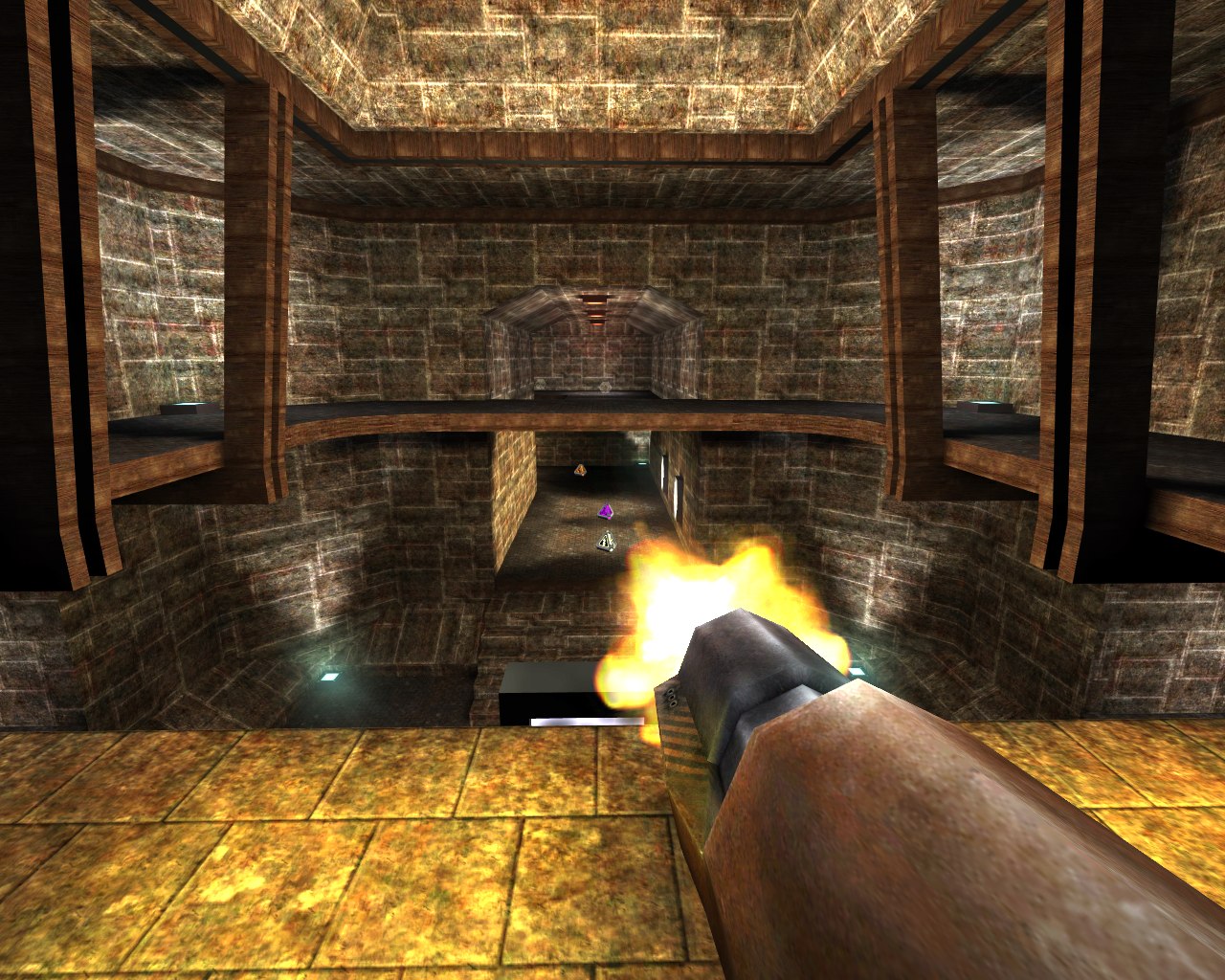
Fast inverse square root, sometimes referred to as Fast InvSqrt() or by the hexadecimal constant 0x5F3759DF, is an algorithm that estimates , the reciprocal (or multiplicative inverse) of the square root of a 32-bit floating-point number in IEEE 754 floating-point format. The algorithm is best known for its implementation in 1999 in Quake III Arena, a first-person shooter video game heavily based on 3D graphics. With subsequent hardware advancements, especially the x86 SSE instruction rsqrtss, this algorithm is not generally the best choice for modern computers, though it remains an interesting historical example.


The algorithm accepts a 32-bit floating-point number as the input and stores a halved value for later use. Then, treating the bits representing the floating-point number as a 32-bit integer, a logical shift right by one bit is performed and the result subtracted from the number 0x5F3759DF, which is a floating-point representation of an approximation of . This results in the first approximation of the inverse square root of the input. Treating the bits again as a floating-point number, it runs one iteration of Newton's method, yielding a more precise approximation.

William Kahan and K.C. Ng at Berkeley wrote an unpublished paper in May 1986 describing how to calculate the square root using bit-fiddling techniques followed by Newton iterations. In the late 1980s, Cleve Moler at Ardent Computer learned about this technique and passed it along to his coworker Greg Walsh. Greg Walsh devised the now-famous constant, and fast inverse square root algorithm. Gary Tarolli was consulting for Kubota, the company funding Ardent at the time, and likely brought the algorithm to 3dfx Interactive circa 1994.
Jim Blinn demonstrated a simple approximation of the inverse square root in a 1997 column for IEEE Computer Graphics and Applications. Reverse engineering of other contemporary 3D video games uncovered a variation of the algorithm in Activision's 1997 Interstate '76.
Quake III Arena, a first-person shooter video game, was released in 1999 by id Software and used the algorithm. Brian Hook may have brought the algorithm from 3dfx to id Software. A discussion of the code appeared on the Chinese developer forum CSDN in 2000, and Usenet and the gamedev.net forum spread the code widely in 2002 and 2003. Speculation arose as to who wrote the algorithm and how the constant was derived; some guessed John Carmack. Quake III's full source code was released at QuakeCon 2005, but provided no answers. The authorship question was resolved in 2006 when Greg Walsh, the original author, contacted Beyond3D after their speculation gained popularity on Slashdot.
In 2007 the algorithm was implemented in some dedicated hardware vertex shaders using field-programmable gate arrays (FPGA).
Computer graphics frequently uses inverse square roots for transform, clipping, lighting, and shading to compute angles of incidence and reflection. Programs such as Quake III: Arena must perform a large number of these calculations every second to simulate lighting. In particular, the operation of scaling a vector to length 1 to produce a unit vector uses the inverse square root.
Specifically, the length of the vector is determined by calculating its Euclidean norm: the square root of the sum of squares of the vector components. When each component of the vector is divided by that length, the new vector will be a unit vector pointing in the same direction. In a 3D graphics program, all vectors are in three-dimensional space, so would be a vector . Then,


Hub AI
Fast inverse square root AI simulator
(@Fast inverse square root_simulator)
Fast inverse square root
Fast inverse square root, sometimes referred to as Fast InvSqrt() or by the hexadecimal constant 0x5F3759DF, is an algorithm that estimates , the reciprocal (or multiplicative inverse) of the square root of a 32-bit floating-point number in IEEE 754 floating-point format. The algorithm is best known for its implementation in 1999 in Quake III Arena, a first-person shooter video game heavily based on 3D graphics. With subsequent hardware advancements, especially the x86 SSE instruction rsqrtss, this algorithm is not generally the best choice for modern computers, though it remains an interesting historical example.
The algorithm accepts a 32-bit floating-point number as the input and stores a halved value for later use. Then, treating the bits representing the floating-point number as a 32-bit integer, a logical shift right by one bit is performed and the result subtracted from the number 0x5F3759DF, which is a floating-point representation of an approximation of . This results in the first approximation of the inverse square root of the input. Treating the bits again as a floating-point number, it runs one iteration of Newton's method, yielding a more precise approximation.
William Kahan and K.C. Ng at Berkeley wrote an unpublished paper in May 1986 describing how to calculate the square root using bit-fiddling techniques followed by Newton iterations. In the late 1980s, Cleve Moler at Ardent Computer learned about this technique and passed it along to his coworker Greg Walsh. Greg Walsh devised the now-famous constant, and fast inverse square root algorithm. Gary Tarolli was consulting for Kubota, the company funding Ardent at the time, and likely brought the algorithm to 3dfx Interactive circa 1994.
Jim Blinn demonstrated a simple approximation of the inverse square root in a 1997 column for IEEE Computer Graphics and Applications. Reverse engineering of other contemporary 3D video games uncovered a variation of the algorithm in Activision's 1997 Interstate '76.
Quake III Arena, a first-person shooter video game, was released in 1999 by id Software and used the algorithm. Brian Hook may have brought the algorithm from 3dfx to id Software. A discussion of the code appeared on the Chinese developer forum CSDN in 2000, and Usenet and the gamedev.net forum spread the code widely in 2002 and 2003. Speculation arose as to who wrote the algorithm and how the constant was derived; some guessed John Carmack. Quake III's full source code was released at QuakeCon 2005, but provided no answers. The authorship question was resolved in 2006 when Greg Walsh, the original author, contacted Beyond3D after their speculation gained popularity on Slashdot.
In 2007 the algorithm was implemented in some dedicated hardware vertex shaders using field-programmable gate arrays (FPGA).
Computer graphics frequently uses inverse square roots for transform, clipping, lighting, and shading to compute angles of incidence and reflection. Programs such as Quake III: Arena must perform a large number of these calculations every second to simulate lighting. In particular, the operation of scaling a vector to length 1 to produce a unit vector uses the inverse square root.
Specifically, the length of the vector is determined by calculating its Euclidean norm: the square root of the sum of squares of the vector components. When each component of the vector is divided by that length, the new vector will be a unit vector pointing in the same direction. In a 3D graphics program, all vectors are in three-dimensional space, so would be a vector . Then,