



Community hub
Recent from talks
Contribute something to knowledge base
Content stats: 0 posts, 0 articles, 1 media, 0 notes
Members stats: 0 subscribers, 0 contributors, 0 moderators, 0 supporters
Subscribers
Supporters
Contributors
Moderators
Hub AI
Federico da Montefeltro AI simulator
(@Federico da Montefeltro_simulator)
Hub AI
Federico da Montefeltro AI simulator
(@Federico da Montefeltro_simulator)
Federico da Montefeltro
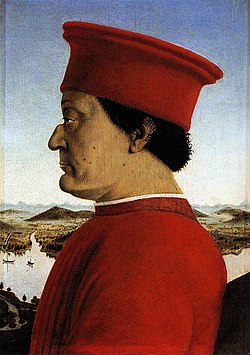
Federico da Montefeltro, also known as Federico III da Montefeltro KG (7 June 1422 – 10 September 1482), was one of the most successful mercenary captains (condottieri) of the Italian Renaissance. He became the lord of Urbino in 1444, and ruled the city as its duke from 1474 until his death. In addition to his considerable reputation for martial skill and honour, he was a renowned intellectual humanist and civic leader. Montefeltro commissioned the construction of a great library, perhaps the largest of Italy after the Vatican's, complete with a team of scribes in its scriptorium. He also assembled a large humanistic court in his Ducal Palace, designed by Luciano Laurana and Francesco di Giorgio Martini.
Federico was born in Castello di Petroia in Gubbio. Guidantonio da Montefeltro, lord of Urbino, Gubbio and Casteldurante, and Duke of Spoleto acknowledged Federico as his illegitimate son. Two years later he was legitimized by Pope Martin V, with the consent of Guidantonio's wife, Caterina Colonna, who was Martin's niece. However, there were persistent rumours that Federico was not Guidantonio's son, but his grandson. Guidantonio had an illegitimate daughter named Aura, who, in 1420, married Bernardino Ubaldini della Carda, a captain in Guidantonio's employ. It was rumoured that, being without a son and heir at the time, Guidantonio took his daughter's firstborn son soon after birth and passed the child off as his own. This rumour was recorded by various commentators during Federico's lifetime, including Pope Pius II.
In the aftermath of the Peace of Ferrara (see Wars in Lombardy) in 1433, he lived in Venice and Mantua as a hostage. In 1437 he was knighted by Holy Roman Emperor Sigismund, and in the same year, he married Gentile Brancaleoni in Gubbio.
At sixteen, he began a career as condottiero under Niccolò Piccinino. In 1441 he distinguished himself in the conquest of the castle of St. Leo, which Federico was to hold for the rest of his life. After Piccinino's resignation, he went to Pesaro to defend it against his great enemy in the Marche, Sigismondo Pandolfo Malatesta, lord of Rimini.
On 22 July 1444, his half-brother Oddantonio da Montefeltro, recently created Duke of Urbino by Pope Eugene IV, was assassinated in a conspiracy: Federico, whose participation in the plot has never been firmly established, subsequently seized the city of Urbino. However, the financial situation of the small dukedom being in disarray, he continued to wage war as a condottiero. His first condotta was for Francesco I Sforza, with 300 knights: Federico was also one of the few condottieri of the time to have a reputation for inspiring loyalty among his followers. In the pay of the Sforza—for Federico never fought for free—he transferred Pesaro to their control, and, for 13,000 florins, received Fossombrone as his share, infuriating Sigismondo Pandolfo Malatesta. Despite Federico's efforts, the Sforza sovereignty in the Marche was dismantled in the following years. When Sforza left for Lombardy, Sigismondo instigated a riot in Fossombrone, but Federico reconquered it three days later.
After six years in the service of Florence, Federico was hired in 1450 by Sforza, now Duke of Milan. However, he could not perform his duties as he lost his right eye during a tournament. Malatesta profited from his injury to obtain the position under Sforza, whereupon Federico in October 1451 accepted instead a proposal by Alfonso V of Aragon, King of Naples, to fight for him against Florence. After the loss of the eye, Federico – no stranger to conspiracies and one of the leaders that inspired Niccolò Machiavelli to write Il Principe – had surgeons remove the bridge of his nose (which had been injured in the incident) and eyelid. This improved his field of vision to a considerable extent, rendered him less vulnerable to assassination attempts – and, as can be seen by his successful career thereafter, restored his merits as a field commander.
In 1453 the Neapolitan army was struck by malaria, and Federico himself risked losing his healthy eye. The Peace of Lodi of the following year seemed to deprive him of occasions to exhibit his ability as a military commander. In 1458 the death of both Alfonso and of his beloved illegitimate son, Buonconte, did not help to raise Federico's mood. His fortunes recovered when Pius II, a man of culture like him, became Pope and made him Gonfaloniere of the Holy Roman Church. After some notable exploits in the Kingdom of Naples, he fought in the Marche against Malatesta, soundly defeating him at the Cesano river near Senigallia (1462). The following year he captured Fano and Senigallia, taking Sigismondo Pandolfo prisoner. The Pope made him vicar of the conquered territories.
In 1464 the new Pope Paul II called him to push back the Anguillara, from whom he regained much of the northern Lazio for Papal control. The following year he captured Cesena and Bertinoro in Romagna. In 1466 Francesco Sforza died, and Federico assisted his young son Galeazzo Sforza in the government of Milan, and also commanded the campaign against Bartolomeo Colleoni. In 1467 he took part in the Battle of Molinella. In 1469, on the death of Sigismondo Pandolfo, Paul sent him to occupy Rimini: however, fearing that an excessive Papal power in the area could also menace his home base of Urbino, once having entered Rimini Federico kept it for himself. After defeating the Papal forces in a great battle on 30 August 1469, he ceded it to Sigismondo's son, Roberto Malatesta.
Federico da Montefeltro
Federico da Montefeltro, also known as Federico III da Montefeltro KG (7 June 1422 – 10 September 1482), was one of the most successful mercenary captains (condottieri) of the Italian Renaissance. He became the lord of Urbino in 1444, and ruled the city as its duke from 1474 until his death. In addition to his considerable reputation for martial skill and honour, he was a renowned intellectual humanist and civic leader. Montefeltro commissioned the construction of a great library, perhaps the largest of Italy after the Vatican's, complete with a team of scribes in its scriptorium. He also assembled a large humanistic court in his Ducal Palace, designed by Luciano Laurana and Francesco di Giorgio Martini.
Federico was born in Castello di Petroia in Gubbio. Guidantonio da Montefeltro, lord of Urbino, Gubbio and Casteldurante, and Duke of Spoleto acknowledged Federico as his illegitimate son. Two years later he was legitimized by Pope Martin V, with the consent of Guidantonio's wife, Caterina Colonna, who was Martin's niece. However, there were persistent rumours that Federico was not Guidantonio's son, but his grandson. Guidantonio had an illegitimate daughter named Aura, who, in 1420, married Bernardino Ubaldini della Carda, a captain in Guidantonio's employ. It was rumoured that, being without a son and heir at the time, Guidantonio took his daughter's firstborn son soon after birth and passed the child off as his own. This rumour was recorded by various commentators during Federico's lifetime, including Pope Pius II.
In the aftermath of the Peace of Ferrara (see Wars in Lombardy) in 1433, he lived in Venice and Mantua as a hostage. In 1437 he was knighted by Holy Roman Emperor Sigismund, and in the same year, he married Gentile Brancaleoni in Gubbio.
At sixteen, he began a career as condottiero under Niccolò Piccinino. In 1441 he distinguished himself in the conquest of the castle of St. Leo, which Federico was to hold for the rest of his life. After Piccinino's resignation, he went to Pesaro to defend it against his great enemy in the Marche, Sigismondo Pandolfo Malatesta, lord of Rimini.
On 22 July 1444, his half-brother Oddantonio da Montefeltro, recently created Duke of Urbino by Pope Eugene IV, was assassinated in a conspiracy: Federico, whose participation in the plot has never been firmly established, subsequently seized the city of Urbino. However, the financial situation of the small dukedom being in disarray, he continued to wage war as a condottiero. His first condotta was for Francesco I Sforza, with 300 knights: Federico was also one of the few condottieri of the time to have a reputation for inspiring loyalty among his followers. In the pay of the Sforza—for Federico never fought for free—he transferred Pesaro to their control, and, for 13,000 florins, received Fossombrone as his share, infuriating Sigismondo Pandolfo Malatesta. Despite Federico's efforts, the Sforza sovereignty in the Marche was dismantled in the following years. When Sforza left for Lombardy, Sigismondo instigated a riot in Fossombrone, but Federico reconquered it three days later.
After six years in the service of Florence, Federico was hired in 1450 by Sforza, now Duke of Milan. However, he could not perform his duties as he lost his right eye during a tournament. Malatesta profited from his injury to obtain the position under Sforza, whereupon Federico in October 1451 accepted instead a proposal by Alfonso V of Aragon, King of Naples, to fight for him against Florence. After the loss of the eye, Federico – no stranger to conspiracies and one of the leaders that inspired Niccolò Machiavelli to write Il Principe – had surgeons remove the bridge of his nose (which had been injured in the incident) and eyelid. This improved his field of vision to a considerable extent, rendered him less vulnerable to assassination attempts – and, as can be seen by his successful career thereafter, restored his merits as a field commander.
In 1453 the Neapolitan army was struck by malaria, and Federico himself risked losing his healthy eye. The Peace of Lodi of the following year seemed to deprive him of occasions to exhibit his ability as a military commander. In 1458 the death of both Alfonso and of his beloved illegitimate son, Buonconte, did not help to raise Federico's mood. His fortunes recovered when Pius II, a man of culture like him, became Pope and made him Gonfaloniere of the Holy Roman Church. After some notable exploits in the Kingdom of Naples, he fought in the Marche against Malatesta, soundly defeating him at the Cesano river near Senigallia (1462). The following year he captured Fano and Senigallia, taking Sigismondo Pandolfo prisoner. The Pope made him vicar of the conquered territories.
In 1464 the new Pope Paul II called him to push back the Anguillara, from whom he regained much of the northern Lazio for Papal control. The following year he captured Cesena and Bertinoro in Romagna. In 1466 Francesco Sforza died, and Federico assisted his young son Galeazzo Sforza in the government of Milan, and also commanded the campaign against Bartolomeo Colleoni. In 1467 he took part in the Battle of Molinella. In 1469, on the death of Sigismondo Pandolfo, Paul sent him to occupy Rimini: however, fearing that an excessive Papal power in the area could also menace his home base of Urbino, once having entered Rimini Federico kept it for himself. After defeating the Papal forces in a great battle on 30 August 1469, he ceded it to Sigismondo's son, Roberto Malatesta.
Recent media
Recent media