Recent from talks
Nothing was collected or created yet.
Pesaro
View on Wikipedia
Key Information
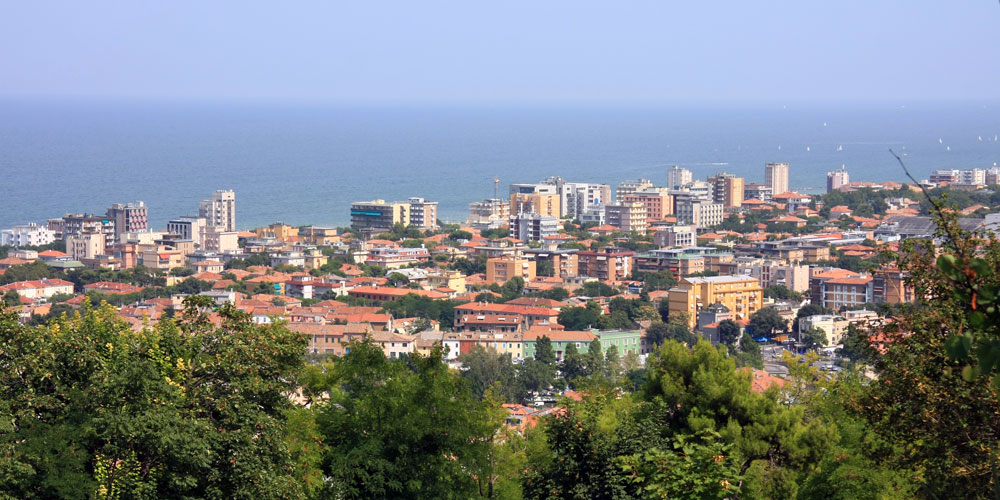
Pesaro (Italian: [ˈpeːzaro] ⓘ; Romagnol: Pés're) is a comune (municipality) in the Italian region of Marche, capital of the province of Pesaro and Urbino, on the Adriatic Sea. According to the 2011 census, its population was 95,011, making it the second most populous city in the Marche, after Ancona. Pesaro was dubbed the "Cycling City" (città della bicicletta) by the Italian environmentalist association Legambiente in recognition of its extensive network of bicycle paths and promotion of cycling. It is also known as "City of Music" (città della musica), for it is the birthplace of the composer Gioachino Rossini. In 2015 the Italian Government applied for Pesaro to be declared a "Creative City" in UNESCO's World Heritage Sites. In 2017 Pesaro received the European City of Sport award together with Aosta, Cagliari and Vicenza.
Local industries include fishing, furniture making and tourism. In 2020 it absorbed the former comune of Monteciccardo, now a frazione of Pesaro. Its frazione of Fiorenzuola di Focara is one of I Borghi più belli d'Italia ("The most beautiful villages of Italy").[3]
History
[edit]
The city was established as Pisaurum by the Romans in 184 BC as a colony in the territory of the Picentes, the people who lived along the northeast coast during the Iron Age.[4][better source needed] In 1737, fourteen ancient votive stones were unearthed in a local farm field, each bearing the inscription of a Roman god; these were written in a pre-Etruscan script, indicating a much earlier occupation of the area than the 184 BC Picentes colony.[4]
A settlement of the Picentes tribe has been found at Novilara. The northern Picentes were invaded in the 4th century BC by the Gallic Senones, earlier by the Etruscans, and when the Romans reached the area the population was an ethnic mixture. The Roman separated and expelled the Gauls from the country.
Under the Roman administration Pesaro, a hub across the Via Flaminia, became an important centre of trading and craftmanship.[citation needed] After the fall of the Western Empire, Pesaro was occupied by the Ostrogoths, and destroyed by Vitigis (539) in the course of the Gothic War. Hastily rebuilt five years later after the Byzantine reconquest, it formed the so-called Pentapolis, part of the Exarchate of Ravenna. After the Lombard and Frankish conquests of that city, Pesaro became part of the Papal States.
During the Renaissance it was ruled successively by the houses of Montefeltro (1285–1445), Sforza (1445–1512) and Della Rovere (1513–1631). Under the last family, who selected it as capital of their duchy, Pesaro saw its most flourishing age, with the construction of numerous public and private palaces,[5] and the erection of a new line of walls (the Mura Roveresche). In 1475, a legendary wedding took place in Pesaro, when Costanzo Sforza and Camilla d'Aragona married.[6]
On 11 September 1860 Piedmontese troops entered the city, and after their win over the Papal States at the Battle of Castelfidardo 8 days later, Pesaro was subsequently annexed to the new Kingdom of Italy along with the entire Marche (and Umbria) regions.
Pesaro was significantly damaged in the 1916 Rimini earthquakes.[7] Its historic centre was abandoned after the 16 August earthquake, leaving 14,000 displaced people crowded into 2,000 tents.[8] Many villages in its hinterland also suffered collapsed buildings.[9]
Demographics
[edit]
|
| ||||||||||||||||||||||||||||||||||||||||||||||||||||||
| Source: ISTAT | |||||||||||||||||||||||||||||||||||||||||||||||||||||||
Government
[edit]Main sights
[edit]Buildings and museums
[edit]- Ducal Palace (15th century): commissioned by Alessandro Sforza, the façade has a portico with six arcades supported by six heavy pilasters and an upper floor with five windows crowned by coats of arms, festoons and puttoes.
- Rocca Costanza (15th century): massive castle built by Costanzo I Sforza; it has a square plan with four cylindrical corner towers and a wide dry moat. Later used as prison.
- Villa Imperiale of Pesaro (c. 1530): suburban palace with gardens designed by Girolamo Genga for Duke Francesco Maria Della Rovere and his duchess Eleanora[10] and built from c. 1530 onwards, stands atop the San Bartolo hill. Its sunken court is the direct precedent for the more famous one at the Roman Villa Giulia.[11] Rooms are frescoed by prominent Mannerist painters Bronzino, Francesco Menzocchi, Girolamo Genga, and Raffaellino del Colle.
- Mura Roveresche (17th century): "Della Rovere Walls", demolished in the early 20th century), only two gates, Porta del Ponte and Porta Rimini, and a short section remain.
- Birthplace of Gioachino Rossini: now a museum dedicated to the composer, located at 34 Via Rossini. It has a museum with manifestos, prints, portraits and his spinet. Also some of his papers are on display at the Biblioteca della Fondazione Rossini housed in the Palazzo Montani Antaldi.
- Conservatorio Statale di Musica Gioachino Rossini: located in the 18th century Palazzo Olivieri–Machirelli on the Piazza Oliveri.
- Musei Civici di Palazzo Mosca: civic museum which contains mainly paintings and ceramics. Among the art is the Pesaro Altarpiece by Giovanni Bellini.
- Oliveriano Archeologic Museum and Oliveriana Library:[12] archaeological Collection and Manuscript Library; founded in 1756 by Annibale degli Abati Olivieri.
- Villino Ruggeri: notable early 20th century art nouveau home, designed by Giuseppe Brega.
Churches and other religious buildings
[edit]- Pesaro Cathedral (5th-14th centuries): Romanesque-Gothic Basilica built over remains of a late Roman edifice and dedicated to St Terence during the Middle Ages. The façade, in Romanesque-Gothic style, is unfinished: it has a simple ogival portal surmounted by a band of small arches. A recent restoration has brought to light floor mosaics.
- The Baroque Sanctuary of Beata Vergine del Carmelo (18th century).
- Church of the Maternità
- Santissima Annunziata
- Oratory of the Nome di Dio
- San Giacomo
- San Giovanni Battista
- Sant'Agostino
- Santa Lucia
- Municipal Chapel of Sant'Ubaldo
- Church and Convent of the Girolimini
- Madonna del Porto
- Santa Maria delle Grazie
- Pieve di Ginestreto
- Pieve di Santo Stefano
- Santa Veneranda
- Sacred Grove of Lucus Pisaurensis, pre-Roman era sacerdotal lucus
Cultural events and attractions
[edit]The Pesaro film festival (Mostra Internazionale del Nuovo Cinema) has taken place in Pesaro since 1965.[13]
The Rossini Opera Festival has taken place every summer since 1980 in Pesaro, home as well as the Conservatorio Statale di Musica "Gioachino Rossini" founded with a legacy from the composer.
Sport
[edit]Pesaro hosts the home games of Victoria Libertas basketball; they play at the Adriatic Arena, the third biggest Italian indoor arena behind Mediolanum Forum in Milan and PalaLottomatica in Rome.
The city's other professional sports clubs are futsal club Pesaro Calcio a 5, volleyball club Volley Pesaro and football club Vis Pesaro dal 1898.
The city hosted the 2017 Rhythmic Gymnastics World Championships.
Notable people
[edit]- Anna Maria Alberghetti (born 1936), singer and actress
- Massimo Ambrosini (born 1977), footballer
- Pasquale Bini (1716–1770), violinist
- Antonello Bonci, neuroscientist
- Francesco Braschi (born 2004), racing driver
- Roberto Burioni (born 1962), physician and professor of microbiology and virology
- Bartolomeo Campi (died 1573), artist and military engineer
- Stefano Gabellini (born 1965), racing driver
- Camilla Guerrieri (1628–after 1693), court painter[14]
- Giovanni Francesco Guerrieri (1589–1655), painter
- Matilde Leonardi, neurologist and paediatrician
- Filippo Magnini (born 1982), swimmer
- Gianni Morbidelli (born 1968), Formula 1 driver
- Cristiano Mozzati, drummer for Lacuna Coil
- Luca Nardi (born 2003), professional tennis player
- Riz Ortolani (1926–2014), film composer
- Angelo Romani (1934–2003), Olympic swimmer
- Graziano Rossi (born 1954), motorcycle racer, father of Valentino Rossi
- Gioachino Antonio Rossini (1792–1868), composer
- Dorino Serafini (1909–2000), motorcycle racer and racing driver
- Giovanni Sforza (1466–1510), condottiero and first husband of Lucrezia Borgia
- Renata Tebaldi (1922–2004), operatic soprano
- Giuseppe Vaccai (1836–1912), painter
- Gaius Suetonius Paulinus (~40 AD), Roman General and Governor of Britain
International relations
[edit]Climate
[edit]| Climate data for Pesaro (1998–2017) | |||||||||||||
|---|---|---|---|---|---|---|---|---|---|---|---|---|---|
| Month | Jan | Feb | Mar | Apr | May | Jun | Jul | Aug | Sep | Oct | Nov | Dec | Year |
| Record high °C (°F) | 19.0 (66.2) |
20.5 (68.9) |
25.2 (77.4) |
29.4 (84.9) |
33.4 (92.1) |
37.4 (99.3) |
38.1 (100.6) |
38.4 (101.1) |
36.4 (97.5) |
28.0 (82.4) |
25.0 (77.0) |
21.8 (71.2) |
38.4 (101.1) |
| Mean daily maximum °C (°F) | 8.2 (46.8) |
9.9 (49.8) |
14.0 (57.2) |
17.4 (63.3) |
22.4 (72.3) |
26.7 (80.1) |
29.3 (84.7) |
29.1 (84.4) |
24.4 (75.9) |
19.1 (66.4) |
13.4 (56.1) |
9.1 (48.4) |
18.6 (65.5) |
| Daily mean °C (°F) | 4.9 (40.8) |
6.0 (42.8) |
9.7 (49.5) |
13.3 (55.9) |
18.2 (64.8) |
22.5 (72.5) |
24.9 (76.8) |
24.5 (76.1) |
19.8 (67.6) |
15.3 (59.5) |
10.2 (50.4) |
5.9 (42.6) |
14.6 (58.3) |
| Mean daily minimum °C (°F) | 2.2 (36.0) |
2.7 (36.9) |
5.8 (42.4) |
8.9 (48.0) |
13.2 (55.8) |
17.2 (63.0) |
19.5 (67.1) |
19.4 (66.9) |
15.5 (59.9) |
12.0 (53.6) |
7.5 (45.5) |
3.3 (37.9) |
10.6 (51.1) |
| Record low °C (°F) | −7.2 (19.0) |
−12.8 (9.0) |
−5.2 (22.6) |
−1.4 (29.5) |
4.6 (40.3) |
7.0 (44.6) |
11.2 (52.2) |
11.2 (52.2) |
6.2 (43.2) |
3.0 (37.4) |
−2.4 (27.7) |
−9.2 (15.4) |
−12.8 (9.0) |
| Average precipitation mm (inches) | 54.6 (2.15) |
60.1 (2.37) |
69.2 (2.72) |
69.0 (2.72) |
54.6 (2.15) |
61.4 (2.42) |
45.5 (1.79) |
57.3 (2.26) |
97.2 (3.83) |
85.4 (3.36) |
93.8 (3.69) |
78.1 (3.07) |
826.2 (32.53) |
| Average relative humidity (%) | 80 | 75 | 70 | 70 | 66 | 62 | 60 | 64 | 71 | 80 | 82 | 80 | 72 |
| Source: COMUNE di PESARO[19] | |||||||||||||
See also
[edit]References
[edit]- ^ "Superficie di Comuni Province e Regioni italiane al 9 ottobre 2011". Italian National Institute of Statistics. Retrieved 16 March 2019.
- ^ "Popolazione Residente al 1° Gennaio 2018". Italian National Institute of Statistics. Retrieved 16 March 2019.
- ^ "Marche" (in Italian). Retrieved 1 August 2023.
- ^ a b "History of Pesaro, Italy".
- ^ Oggioni, Paolo (2024-01-22). "Cosa vedere a Pesaro, la capitale italiana della cultura 2024". L'Intellettuale Dissidente (in Italian). Retrieved 2024-05-10.
- ^ A Renaissance Wedding: The Celebrations at Pesaro for the Marriage of Costanzo Sforza & Camilla Marzano D'Aragona (26–30 May 1475): (Studies in Medieval and Early Renaissance Art History). Harvey Miller Publ., 2013, ISBN 978-1905375936
- ^ "Storia del Terremoto a Rimini" [History of the earthquake in Rimini]. RomagnaZone (in Italian). 27 October 2016. Retrieved 4 January 2024.
- ^ "8 dicembre 1916 - Legge speciale per Rimini distrutta dal terremoto" [8 December 1916 – Special law for Rimini destroyed by the earthquake]. Chiamami Città (in Italian). 7 December 2023. Retrieved 4 January 2024.
- ^ "Terremoto del 17.05.1916, Alto Adriatico (Rimini)" [Earthquake of 17 May 1916, High Adriatic (Rimini)]. www.lavalledelmetauro.it. 28 July 2004. Retrieved 4 January 2024.
- ^ Andrew Hopkins, 2002. Italian Architecture from Michelangelo to Borromini, p.23f.
- ^ Hopkins 2002 p 24.
- ^ Oliveriano Museum http://www.euromuse.net/en/museums/museum/view-m/museo-archeologico-oliveriano
- ^ "Pesaro film festival site".
- ^ "Guerrieri, Camilla". Benezit Dictionary of Artists. Oxford University Press. 31 October 2011. doi:10.1093/benz/9780199773787.article.b00080576. Retrieved 2025-03-10.
- ^ "Pesaro". italien.de (in German). Italien.de. Retrieved 2019-12-22.
- ^ "Pesaro". primaria-resita.ro (in Romanian). Reșița. Retrieved 2019-12-22.
- ^ "Si rafforza il gemellaggio Pesaro-Kakegawa. Cerimonia del tè verde con la delegazione giapponese guidata dal sindaco Saburo Matsui". pu24.it (in Italian). PU24. 2019-11-15. Retrieved 2019-12-22.
- ^ "Collaborazione internazionale". rovinj-rovigno.hr (in Italian). Rovinj. Retrieved 2019-12-22.
- ^ "Valori normali del clima di Pesaro (1988 - 2017) (per i dati del vento 1998 - 2017)" (PDF). COMUNE di PESARO. Retrieved 28 June 2024.
External links
[edit]Pesaro
View on GrokipediaGeography
Location and topography
Pesaro lies on the Adriatic Sea coast in Italy's Marche region, serving as the capital of Pesaro e Urbino province, at the mouth of the Foglia River where it discharges into the sea.[9] The city's central coordinates are 43°55′N 12°54′E, with an average elevation of approximately 10 meters above sea level, reflecting its low-lying coastal position.[10] [11] This setting positions Pesaro about 30 kilometers east of the inland hill town of Urbino and 60 kilometers north of the regional capital Ancona, integrating flat coastal plains with adjacent Apennine foothills.[12] [13] The urban layout centers on a compact historic core elevated slightly above the shoreline, extending westward from the beaches toward surrounding hills including Monte San Bartolo (elevation up to 200 meters) to the north and Monte Ardizio to the south.[14] These features frame over 7 kilometers of continuous sandy beaches, shaped by Adriatic wave action and river sediment deposition, with the Foglia delineating northern boundaries and influencing floodplain development.[14] Natural topography emphasizes Adriatic coastal dynamics, including relic coastal dunes near river outlets—formed by aeolian transport and littoral drift—and the adjacent Monte San Bartolo Regional Natural Park, which preserves high cliffs rare along this low-relief seafront, featuring overhanging bluffs, fossilized marine deposits, and chalk outcrops.[15] [16] These elements create a transitional landscape of marine erosion, dune stabilization, and hill promontories that buffer the urban area from northerly winds while enhancing scenic variability.[17]Climate
Pesaro experiences a hot-summer Mediterranean climate (Köppen Csa), marked by mild winters, warm to hot summers, and precipitation concentrated in the cooler months.[18] The proximity to the Adriatic Sea moderates extremes, fostering relatively stable temperatures with frequent coastal breezes that reduce summer humidity and heat discomfort.[19] Annual average temperatures hover around 14.6 °C, with daily highs typically ranging from 8 °C in January to 28 °C in July and lows from 3 °C to 20 °C over the same period; extremes rarely drop below -1 °C or exceed 32 °C based on historical records from 1980–2016.[18][20] Precipitation totals approximately 700–800 mm annually, with the wettest months from October to December averaging 70–90 mm each, while summers see under 40 mm, contributing to drier conditions favorable for outdoor activities.[18][20] The city records about 130–135 rainy days per year, predominantly as showers or thunderstorms influenced by maritime air masses.[21] Relative humidity averages 70–80% year-round, peaking in late summer due to sea evaporation, though the bora wind from the northeast occasionally brings drier, cooler air in winter.[20]| Month | Avg. High (°C) | Avg. Low (°C) | Precipitation (mm) |
|---|---|---|---|
| January | 8 | 3 | 60 |
| February | 9 | 3 | 60 |
| March | 12 | 6 | 60 |
| April | 15 | 9 | 60 |
| May | 20 | 13 | 50 |
| June | 24 | 17 | 40 |
| July | 28 | 20 | 30 |
| August | 28 | 20 | 50 |
| September | 24 | 16 | 70 |
| October | 19 | 12 | 90 |
| November | 13 | 8 | 90 |
| December | 10 | 5 | 80 |
History
Antiquity and early medieval period
Pisaurum was founded as a Roman colony in 184 BC by consuls Lucius Valerius Flaccus and Marcus Porcius Cato in the territory of the Galli Senones, positioned at the mouth of the Pisaurus River (modern Foglia) to secure Roman control along the Adriatic coast. [23] As a coastal settlement between Ariminum (Rimini) and Fanum Fortunae (Fano), it integrated into Roman maritime and overland networks, supporting veteran resettlement, trade, and defense against Gallic threats. Archaeological evidence, including remnants of city walls, mosaic pavements, thermal structures, and epigraphic inscriptions, confirms urban infrastructure typical of mid-Republican colonies, with the sacred lucus Pisaurensis grove yielding altars dedicated to local deities.[24] [25] [26] During the Gothic War (535–554 AD), Ostrogothic king Vittigis ordered the demolition of Pisaurum's walls in early 536 AD to hinder Byzantine advances under Belisarius, effectively rendering the site defenseless amid broader regional devastation. Belisarius promptly reconstructed and fortified the town, leveraging its strategic Adriatic position to establish a Byzantine outpost. This revival positioned Pesaro within the Byzantine Exarchate of Ravenna's coastal defenses, contributing to the network of Adriatic strongholds that resisted Ostrogothic resurgence until the war's conclusion. In the early medieval era, Pesaro endured Lombard invasions from 568 AD onward, which fragmented central Italian control while Byzantine forces retained Adriatic enclaves; a 6th–7th-century necropolis near the Via Flaminia reveals 'alla cappuccina' tombs indicative of Lombard burial customs amid hybrid Roman-Germanic settlement patterns.[27] Following Charlemagne's conquest of the Lombard Kingdom in 774 AD, Carolingian administration integrated the region, fostering ecclesiastical ties and rural continuity, as layered excavations demonstrate persistent habitation without full depopulation.[28] These transitions underscore Pesaro's resilience, with archaeological stratigraphy evidencing gradual adaptation from Roman urbanism to fortified early medieval outposts.[27] [29]Renaissance and Sforza rule
Pesaro came under Sforza control in 1445 following the acquisition by Alessandro Sforza, an illegitimate son of the condottiero Muzio Attendolo Sforza, who expanded the family's influence beyond Milan into the Marche region.[30] Alessandro, ruling until his death in 1473, initiated significant architectural projects, including the Palazzo Ducale, which served as a residence reflecting the family's rising status during the early Renaissance.[31] His successors, including his son Costanzo Sforza (r. 1473–1481), prioritized fortifications amid regional conflicts; the Rocca Costanza, a key defensive structure, was begun in 1474 under architects Giorgio Marchesi of Settignano and later Luciano Laurana, integrating into the city walls to bolster Pesaro's strategic position.[32] The Sforza era marked Pesaro's integration into broader Renaissance patronage networks, with the family hosting Emperor Frederick III in 1468 at the Villa Imperiale, where the foundation stone was laid, symbolizing imperial alliances and cultural ambitions.[33] However, dynastic instability culminated in 1512 when Pope Julius II, leveraging papal authority, expropriated Pesaro from Giovanni Sforza—grandson of Alessandro—for his nephew Francesco Maria I della Rovere, Duke of Urbino, transferring control to the Della Rovere family.[34] This shift aligned Pesaro with the Urbino duchy, enhancing the Urbino-Pesaro axis as a center of Renaissance humanism and arts in the Marche, though initial years involved exiles and reconquests, such as Francesco Maria's return in 1522 after papal ousting by Leo X.[35] Under the Della Rovere (1513–1631), Pesaro experienced continued cultural patronage, with Francesco Maria I expanding the Villa Imperiale alongside his wife Leonora Gonzaga using designs by Girolamo Genga, blending Sforza foundations with new Mannerist elements.[35] The family relocated the ducal capital from Urbino to Pesaro in 1523, elevating its political prominence and fostering artistic endeavors tied to papal nepotism and alliances, while maintaining fortifications like Rocca Costanza for defense against Venetian and papal threats.[35] This period solidified Pesaro's role in the Renaissance Marche, emphasizing dynastic consolidation over prior feudal fragmentation, though reliant on fragile papal favor.[36]Modern era to unification
In 1631, following the death of Francesco Maria II della Rovere without male heirs, Pesaro and the Duchy of Urbino reverted to direct papal control under Pope Urban VIII, who appointed Lorenzo Campeggi as Governor-General.[37] The city's economy stagnated without the ducal court's patronage, shifting reliance to agriculture, fishing, and limited trade, while papal administration emphasized ecclesiastical oversight through legates and governors.[31] French forces occupied Pesaro in 1797 during the Napoleonic Wars, opening the Jewish ghetto gates and granting citizenship to Jews, briefly disrupting papal authority.[38] From 1801 to 1814, Pesaro formed part of the French-administered Department of Ancona within the Italian Republic and later Kingdom of Italy under Napoleon.[37] The Congress of Vienna restored it to the Papal States in 1815, reinstating clerical governance amid suppressed liberal revolts in 1821 and 1831 that echoed broader Risorgimento aspirations for constitutional reform and national unity.[37] Under Pope Pius IX, Pesaro remained in the Papal March of Ancona through the 1840s and 1850s, with local elites like Terenzio Mamiani—born in Pesaro in 1799—exiled for participating in early uprisings but later contributing to unification efforts. In September 1860, Piedmontese troops under Enrico Cialdini captured Ancona, leading to the annexation of the Marche including Pesaro by the Kingdom of Sardinia. The proclamation of the Kingdom of Italy on March 17, 1861, integrated Pesaro as a provincial center, with its population at 29,496 per the 1861 census, marking initial administrative reforms toward centralized governance and modest infrastructure like road improvements, though economic activity stayed agrarian with nascent craft industries.[39][39]20th century and contemporary developments
During the interwar period, Pesaro, as part of the Kingdom of Italy, fell under Benito Mussolini's fascist regime established in 1922, which imposed centralized control, suppressed political opposition, and promoted autarkic economic policies alongside imperial ambitions. World War I had already strained the region with conscription and economic disruption, but the fascist era intensified militarization, with local industries redirected toward war preparation. In World War II, Pesaro's strategic Adriatic position placed it near German defensive lines, including the Gothic Line established in 1944; the city endured aerial bombings and partisan resistance against occupation forces following Italy's 1943 armistice with the Allies.[40] Allied forces, primarily the British Eighth Army, liberated Pesaro on September 1, 1944, during the Adriatic coastal advance, with involvement from units like the Jewish Brigade, marking a shift from fascist control to provisional Allied administration.[38] Post-war reconstruction in Pesaro aligned with Italy's broader "economic miracle" of the 1950s and 1960s, fueled by Marshall Plan aid and domestic investment, leading to infrastructure rebuilding and industrial expansion; the city's population grew from approximately 70,000 in 1951 to over 90,000 by 1971, supported by nascent manufacturing clusters and seasonal tourism leveraging its beaches. This period saw recovery from wartime damage, including damaged ports and buildings, through public works that enhanced urban connectivity and laid foundations for later growth, though challenges like rural exodus persisted.[41] In contemporary developments, Pesaro has emphasized cultural and environmental revitalization. Designated a UNESCO Creative City of Music in 2017 for its promotion of over 700 local musicians, 40 ensembles, and the Rossini Opera Festival, the city has integrated music into urban policy for sustainable development.[42] As Italy's Capital of Culture in 2024, Pesaro hosted more than 300 events across its province, focusing on urban regeneration, green initiatives, and social cohesion, with themes of "happiness" and heritage preservation drawing international attention.[6] Recent sustainability efforts include the "Green Pesaro" project for renewable energy adoption and carbon reduction, alongside the Local Green Deal promoting citizen participation via digital platforms; these contributed to Pesaro ranking as Italy's most sustainable city in 2023, with expanded urban green spaces averaging 12.79 square meters per inhabitant.[43][44] By 2025, ongoing initiatives emphasize low-impact urban planning, aligning cultural designations with empirical goals like biodiversity enhancement and energy efficiency.[45]Demographics
Population dynamics
As of January 1, 2025, Pesaro's resident population stands at 95,360 inhabitants, reflecting a minor decline of 32 individuals from the previous year, or -0.03%.[46] This figure aligns with data from the Italian National Institute of Statistics (ISTAT), indicating stabilization after peaking near 96,000 in the early 2020s.[47] Historically, Pesaro's population has grown significantly from 29,496 in 1861 to 91,000 by 2001, driven by post-World War II industrialization and rural-to-urban migration, which boosted numbers from approximately 60,000 in 1951 to over 90,000 by the 1990s.[39] Growth rates averaged 1-2% annually during the mid-20th century boom, fueled by internal migration toward coastal areas like Pesaro for economic opportunities in manufacturing and services.[47] Since the early 2000s, expansion slowed to about 0.2-0.5% per year, with cumulative increase of roughly 5% from 2001 to 2021, before recent flattening.[47] Demographic trends reveal a natural population decrease, with a birth rate of 4.9 per 1,000 inhabitants and a death rate of 12.4 per 1,000 in recent years, resulting in a negative natural balance offset partially by net migration of 5.1 per 1,000.[48] This pattern contributes to an aging profile, evidenced by an old-age dependency index exceeding 220 (over-65s per 100 under-15s) as of 2020, higher than national averages and indicative of low fertility and elevated longevity.[49] Internal shifts from inland Marche regions to Pesaro's coastal zones have sustained modest inflows, countering outflows to larger urban centers.[48] ISTAT projections suggest potential stabilization or slight growth to around 97,000 by the early 2030s, contingent on sustained migration inflows amid persistent low birth rates below replacement levels.[50] However, recent census data from 2023 show a 0.3% annual decline in the broader Marche region, underscoring risks of further stagnation without policy interventions.[51]| Year | Population | Annual Change (%) |
|---|---|---|
| 2001 | 91,086 | - |
| 2011 | 95,011 | +0.4 (avg) |
| 2021 | 95,670 | +0.1 (avg) |
| 2025 | 95,360 | -0.03 |
Composition and migration patterns
Pesaro's population is predominantly ethnic Italian, with foreign residents comprising 7.9% of the total as of January 1, 2023, totaling 7,535 individuals.[52] The immigrant community is primarily from Eastern Europe, with Romanians forming the largest group at 22% of foreigners (1,655 persons), followed by Moldovans at 11.2% (841) and Ukrainians at 9% (676).[52] Smaller contingents hail from North Africa and other regions, reflecting labor migration rather than large-scale ethnic enclaves. Religiously, the area maintains a strong Catholic majority, with approximately 92% of the population in the Archdiocese of Pesaro identifying as Catholic in 2023, encompassing over 121,000 adherents amid a total diocesan population of 132,406.[53] This dominance aligns with longstanding regional traditions, though secularization trends observed nationally have marginally reduced affiliation from 94.3% in 2019.[53] Migration patterns since 2000 have been shaped by economic pulls in Marche's manufacturing and service sectors, drawing workers to fill gaps in industries like furniture production and tourism support amid native aging and low birth rates. Eastern European inflows accelerated post-EU enlargements in 2004 and 2007, providing low-skilled labor that integrated into local economies without forming isolated communities.[52] North African migrants, though fewer, contribute to agriculture and construction, often via family reunification or seasonal work. Socially, Pesaro retains traditional Italian family structures, characterized by multi-generational households and emphasis on kinship ties, which persist despite modernization and immigrant influxes. Immigrants exhibit patterns of cultural assimilation, adopting prevailing norms in language, education, and labor participation, bolstered by regional policies promoting workforce integration over multiculturalism. This fosters social cohesion, with limited evidence of parallel societies, though challenges like employment precarity for newcomers underscore ongoing adaptation dynamics.Economy
Primary industries and employment
Pesaro's primary industries center on manufacturing, with the local furniture district serving as a cornerstone of economic activity. The area hosts a cluster of small and medium-sized enterprises (SMEs) specializing in wood processing, cabinetry, and upholstery, transitioning from artisanal crafts to industrialized production since the mid-20th century. Scavolini, founded in Pesaro in 1961 by brothers Valter and Elvino Scavolini, exemplifies this sector as Italy's leading kitchen furniture manufacturer, with its headquarters and primary production facilities remaining in the city.[54] [55] Complementary firms like Biesse, also based in Pesaro, produce machinery for woodworking and composites, supporting the district's supply chain and export focus.[56] Agriculture in Pesaro's hinterland emphasizes olives and viticulture, integral to the Marche region's output. Olive groves yield extra virgin oils from native varieties, while vineyards under the Colli Pesaresi DOC appellation produce notable reds from Sangiovese and Pinot Noir grapes, alongside whites like Biancame.[57] [58] These activities, though employing a smaller workforce than manufacturing, underpin local food processing and contribute to provincial GDP through branded exports. The Adriatic harbor handles commercial cargo and regional trade, facilitating imports of raw materials for industry and exports of finished goods, albeit on a limited scale compared to larger ports.[59] In the Province of Pesaro e Urbino, employment remains robust, with an unemployment rate of 5.2% in 2023—below the regional Marche average of around 5.5% and national figure near 7%—driven by manufacturing's role in sustaining low joblessness amid a network of SMEs.[60] [61]Tourism and cultural economy
Tourism constitutes a significant component of Pesaro's economy, with the city recording over 1 million overnight stays (presenze turistiche) in 2024, marking a 28% increase compared to 2023. This surge is largely attributed to Pesaro's designation as the Italian Capital of Culture for 2024, which drew an additional 265,000 presenze linked directly to cultural programming, alongside boosts from its Adriatic beaches—recognized with Blue Flag status for water quality—and events such as the Rossini Opera Festival. The influx has stimulated hospitality and real estate sectors, with extended visitor durations contributing to higher revenue multipliers, though precise economic figures remain provisional pending full ISTAT validation.[62][63][64] Supporting infrastructure includes approximately 2,000 hotel beds in the municipality, supplemented by transport links via the Adriatic railway and Federico Fellini Airport in nearby Rimini, facilitating access for domestic and international visitors. Summer months dominate, with presenze peaking from June to September due to beach tourism, reflecting broader Adriatic coastal patterns where over 70% of annual activity concentrates seasonally. Regional data indicate tourism accounts for about 10% of Marche's GDP, with Pesaro's provincial area contributing around 3 million presenze pre-pandemic.[65] While events generate economic spillovers—estimated at up to 34 euros per euro invested in similar cultural capitals—Pesaro's heavy dependence on seasonal trade exposes it to vulnerabilities, including employment fluctuations and underutilized capacity in off-peak periods. Official assessments highlight the need for diversification to mitigate risks from weather-dependent beach revenue and post-event lulls, as evidenced by Marche's slower recovery in non-summer segments compared to national averages.[66][65]Government and politics
Administrative framework
Pesaro operates as a comune (municipality) in Italy's decentralized administrative system, which divides powers among regions, provinces, and local entities under the 1948 Constitution and subsequent reforms like Title V of the 2001 constitutional revision. As the provincial capital, it coordinates with the Province of Pesaro e Urbino for supra-municipal functions such as secondary road maintenance and high school oversight, while adhering to Marche regional policies on health, economic development, and environmental standards. The municipal executive is headed by the mayor (sindaco), Andrea Biancani, who assumed office following his election on June 10, 2024, with 60.6% of the valid votes in a runoff against center-right challenger Marco Lanzi. The mayor appoints a giunta comunale (executive board) of up to eight assessori (assessors) to handle sectors like urban planning, social services, and public works, with Biancani delegating key areas including territorial planning to himself.[67][68] Legislative authority rests with the consiglio comunale (city council), comprising 36 elected members serving five-year terms, selected via a mixed majoritarian-proportional system where the winning coalition receives a premium to ensure majority control. The council approves the annual budget, land-use plans (piano regolatore generale), and bylaws, meeting publicly for transparency as mandated by Law No. 241/1990 on administrative procedure.[69] Fiscal operations follow Italy's local finance framework under Legislative Decree No. 23/2011, with revenue from property taxes (IMU), waste fees (TARI), and service surcharges (TASI), supplemented by central government transfers and EU funds allocated via the region. Service delivery encompasses core competencies like waste collection, local policing (polizia municipale), nursery schools, and public green spaces, with expenditures audited annually by the municipal finance office and reported to the Court of Auditors. Provincial integration includes shared competencies, such as the Province of Pesaro e Urbino—led by President Giuseppe Paolini—managing 2,568 km² of territory across 67 comuni and coordinating disaster response under national civil protection laws.[70]Political landscape and controversies
Pesaro's municipal government has historically been dominated by the center-left Democratic Party (PD), exemplified by Matteo Ricci's tenure as mayor from 2014 to 2021.[71] This local alignment contrasts with the Marche region's right-leaning leadership under President Francesco Acquaroli, who was re-elected in the September 28–29, 2025, regional elections with 52.5% of the vote, defeating PD candidate Ricci who received approximately 47.5%.[72] Ricci, now a PD Member of the European Parliament, had positioned his "Alleanza del Cambiamento" coalition as a broad center-left front including 19 parties and civic lists, but the loss underscored persistent regional divides between urban center-left strongholds like Pesaro and broader conservative support. A major controversy emerged in July 2025 when Ricci received a notice of investigation in the "Affidopoli" probe, implicating him among 24 individuals in alleged corruption tied to irregular contract awards by Pesaro's city council during his mayoralty, spanning 2014 onward and involving non-profit associations.[71] [73] Prosecutors alleged graft and falsified documents in direct assignments bypassing competitive tenders, with one associate reportedly found with €119,000 in cash; Ricci denied direct involvement in procurement, describing himself as "serene" yet "bitter" and underwent a five-hour interrogation on July 30, 2025, expressing satisfaction with his testimony.[74] [75] Tensions between local PD leadership and Acquaroli's regional administration intensified over Pesaro port infrastructure, particularly dredging works. In September 2025, amid the regional election campaign, Acquaroli asserted that dredging and related projects had commenced under regional oversight, prompting disputes from local opponents who accused delays or mismanagement in funding allocation, escalating into public debates on port viability and economic priorities.[76] The August 2025 Rossini Opera Festival drew criticism for a large Palestinian flag unfurled across the stage during the closing bows of a performance, described by attendees and critics as a gratuitous political gesture that alienated portions of the audience without contextual relevance to the operas staged, such as Zelmira and L'italiana in Algeri.[77] [78] This incident highlighted divides in cultural institutions, with reports noting discomfort among spectators amid broader European debates on performative activism in the arts.[79]Culture and heritage
Musical traditions and Rossini legacy
Gioachino Rossini was born in Pesaro on February 29, 1792, in a modest residence on Via Rossini that now serves as the Casa Rossini museum, preserving artifacts from his early life including family furnishings and musical scores.[4] The composer's legacy forms the bedrock of Pesaro's musical identity, with his operas such as The Barber of Seville and William Tell exemplifying bel canto techniques that influenced subsequent European music.[80] Rossini's formative years in Pesaro, amid a local environment of theater bands and itinerant performers—his father was a town trumpeter—fostered his precocious talent, evident in his first compositions by age 12.[80] The Rossini Opera Festival, established in 1980 by Pesaro's municipality to revive and perform the composer's works using critical editions, has staged over 100 productions, emphasizing philological accuracy through collaborations with musicologists for unpublished scores.[5] Held annually in August at venues like the 850-seat Teatro Rossini—restored in 1984—the festival drew 13,156 attendees in 2023, generating €958,825 in revenue while prioritizing rare operas over popular staples to advance scholarly understanding.[81] This approach has accelerated Rossini's critical reevaluation, countering earlier neglect of his output beyond a few hits.[82] Pesaro's designation as a UNESCO Creative City of Music in 2017 recognizes its integration of Rossini's heritage with broader initiatives, including repurposed spaces for music education and interdisciplinary projects linking opera to theater and visual performance.[42] These efforts build on historical synergies, such as 19th-century local publications like La Cronaca Musicale that promoted Italian composers' archival works.[83] While the festival's focus on authentic scores garners acclaim for authenticity, some observers critique its emphasis on obscure pieces as potentially curtailing wider commercial appeal and attendance compared to more accessible programming.[84]Festivals and contemporary events
The Rossini Opera Festival (ROF), held annually in August, presents staged operas, concerts, and scholarly events centered on Gioachino Rossini's compositions, blending historical performances with modern interpretations. In 2024, expanded to four operas to mark Pesaro's status as Italian Capital of Culture, the festival set a record with 21,473 admissions and €1,366,000 in box office revenue, reflecting 63% Italian attendance amid international draw.[85][86] The 2025 edition, from August 10 to 22, featured premieres like a new production of Zelmira alongside rarities, though some critiques noted production choices prioritizing directorial innovation over vocal clarity, with venue safety concerns in temporary spaces.[87][88] Pesaro's 2024 Capital of Culture designation encompassed over 300 events across music, film, and visual arts, inaugurating with 8,000 attendees at the Vitrifrigo Arena and spotlighting 150 artists through immersive installations and workshops tied to regional heritage.[89][90] These initiatives boosted local economy via tourism spikes, with ROF alone contributing significantly to seasonal revenue, though broader program evaluations highlight sustained visitor growth over transient hype.[85] Recurring events include the Carnevale dei Ragazzi, a children's carnival in February or March featuring parades with themed floats crafted by local groups, organized by the municipality and diocese to preserve folk traditions.[91] The Pesaro Film Festival, focused on international new cinema, complements musical programming with screenings and debates, fostering contemporary discourse without diluting classical emphases.[9] Summer beach festivities, akin to regional Notte Rosa celebrations along the Adriatic, draw crowds for open-air music and lights, emphasizing empirical attendance metrics over ideological framing in event curation.[92]Museums and visual arts
The Musei Civici in Palazzo Mosca maintain a core collection of Italian Renaissance and post-Renaissance visual arts, prominently featuring Giovanni Bellini's Coronation of the Virgin altarpiece, executed around 1475 for the Pesaro church of San Francesco and restored in 2021.[93] Additional holdings include Guido Reni's Caduta dei Giganti from the 17th century, Simone Cantarini's paired penitents paintings, and still lifes by artists such as Christian Berentz, acquired through bequests like that of Marquise Vittoria Mosca in 1885.[93] The Hercolani Rossini collection, comprising 38 paintings from Emilian, Venetian, and Sienese schools and inherited via Gioachino Rossini in 1883, underscores the museum's emphasis on verifiable provenance from private legacies.[93] Complementing these are displays of maiolica ceramics and decorative arts arranged in a Wunderkammer-style room, sourced from regional centers like Urbino and Deruta, reflecting 16th- to 19th-century production techniques.[93] The galleries, renovated in 2013, organize works chronologically to highlight artistic evolution, prioritizing empirical attribution over interpretive narratives.[93] The Museo Archeologico Oliveriano houses ancient visual artifacts, including Greek bronze statuettes and Roman sculptures, derived from Annibale degli Abbati Olivieri's foundational donation in the late 18th century alongside the adjacent library.[94] Reopened on December 13, 2022, following a comprehensive redesign that dissected and reassembled collections into scientifically grounded units, it prioritizes material analysis for curatorial display.[95] [96] For contemporary expressions, the Pescheria Centro Arti Visive, repurposed from an 1820s fish market and operational since 1996, focuses on temporary exhibitions without a fixed permanent collection, such as site-specific installations by artists like Jannis Kounellis during Pesaro's 2024 designation as Italian Capital of Culture.[97] [98] These efforts integrate local heritage with modern curatorial practices, though sustained funding remains contingent on fluctuating tourism inflows.Architecture and landmarks
Secular structures and urban planning
The Rocca Costanza, also known as Rocca di Sforza, is a prominent Renaissance fortress in Pesaro, commissioned toward the end of the 15th century by Costanzo I Sforza as a defensive structure overlooking the city.[99] Construction began in 1474 under Giorgio Marchesi of Settignano, with contributions from architects Luciano Laurana and Cherubino di Giovanni, featuring a quadrilateral layout reinforced by cylindrical stone towers.[32] This fortification exemplifies late medieval military architecture adapted to Renaissance proportions, serving as a symbol of Sforza authority until the family's rule ended in 1512.[100] The Palazzo Ducale stands as Pesaro's primary civic palace, initiated in the first half of the 15th century by Alessandro Sforza and expanded under the Della Rovere dukes until 1631.[101] Positioned adjacent to Piazza del Popolo in the historic center, its facade directly fronts the main square, forming a massive complex that integrated administrative functions with ducal residence.[101] The structure reflects iterative 15th- and 16th-century modifications, prioritizing symmetry and scale over ornate decoration, consistent with Marche region's ducal building traditions.[102] Pesaro's urban layout traces to Roman origins, with a grid of cardo and decumani evident in the historic center, augmented during the imperial era when Augustus designated it a commercial port colony around 39 BCE.[103] Renaissance rulers, particularly the Sforza and Della Rovere, imposed orthogonal expansions and fortified perimeters, aligning civic spaces like Piazza del Popolo with palatial axes for ceremonial efficiency.[37] By the 19th century, neoclassical infill supported population growth, while early 20th-century Liberty-style villas, such as Villino Ruggeri (1902–1907), introduced sinuous facades with floral stucco and wrought-iron balconies, marking Pesaro's embrace of Art Nouveau secular residential design.[104] Post-World War II developments focused on coastal expansion to accommodate tourism, involving linear beachfront promenades and mid-rise residential blocks from the 1950s onward, often prioritizing rapid construction over integrated planning.[43] Preservation initiatives since the 1990s have emphasized seismic retrofitting of Renaissance structures and zoning restrictions on the historic core, with recent projects under Italy's cultural capital designation integrating green infrastructure for climate resilience.[43] These efforts, verified through architectural surveys, balance expansion with heritage integrity, as seen in regulated villa restorations exemplifying Liberty-era engineering.[105]Religious buildings and sites
The Cathedral of Santa Maria Assunta serves as Pesaro's principal ecclesiastical structure, erected atop the foundations of a 5th-century basilica situated within the confines of the ancient Roman city. The edifice incorporates a 13th-century Romanesque facade and retains a 6th-century mosaic pavement observable through protective glass flooring, underscoring its layered paleochristian origins. Its nave adopts a Latin cross configuration, entered via a 14th-century portal, with the overall form resulting from late-13th-century reconstructions necessitated by the building's subsidence relative to rising street levels.[106][107] The Church of Sant'Agostino, established in 1258, exemplifies transitional medieval styles, commencing in Romanesque form before Gothic alterations in the latter 14th century and subsequent Baroque embellishments during the 18th. Originally linked to an adjacent Augustinian convent suppressed in 1861 and repurposed until the convent's demolition in 1919, the church received its current dedication to Saint Augustine that year, preserving artifacts of its evolving architectural patronage.[108] Pesaro's Chiesa del Nome di Dio, initiated in 1577 under the auspices of the Confraternity of the Name of God—a lay group formed to suppress blasphemy and fund indigent burials—represents a rare integration of architectural and theatrical Baroque elements, distinctive among local religious sites. The structure's Istrian stone facade was overhauled in 1763 to designs by Gian Andrea Lazzarini, with further restorations completed in 1912 to maintain its ornate interior and altarpieces.[109][110]Sports and recreation
Professional sports teams
Victoria Libertas Pesaro, commonly known as VL Pesaro or Carpegna Prosciutto Basket Pesaro, is the city's primary professional basketball club, competing in Italy's Lega Basket Serie A, the top tier of domestic basketball. Founded in 1946, the team has maintained a presence in elite competition, achieving notable success including the 1982–83 FIBA European Cup Winners' Cup under its prior Scavolini sponsorship.[111] [112] The club plays home games at Vitrifrigo Arena, a multi-purpose indoor facility with a capacity of approximately 10,323 for sporting events, supporting both league matches and occasional international fixtures.[113] In women's volleyball, Pesaro has historically fielded competitive professional squads, with teams like Scavolini Pesaro securing three consecutive Italian Serie A1 titles in the early 2000s, alongside European successes such as the CEV Champions League.[114] These clubs have contributed to the city's sports economy through sponsorships and fan engagement, though recent seasons have seen fluctuations in top-tier participation. No active professional cycling teams are based in Pesaro, though the city hosts stages of major races like the Giro d'Italia, leveraging its coastal terrain for events that draw international competitors.[116] Overall, basketball remains the dominant professional sport, with the Vitrifrigo Arena serving as a key venue that hosts up to 13,000 for non-sporting events but prioritizes athletic programming during seasons.Local facilities and events
Pesaro's Adriatic coastline features public beaches equipped for amateur water and sand-based sports, including dedicated courts at Maracanà Beach Tennis e Volley on Viale Trieste, which hosts community beach volleyball and tennis sessions.[117] Similarly, Smash Sport City provides additional beach tennis and volleyball fields, integrating recreational play with the city's 18-kilometer sandy shoreline accessible to residents and tourists year-round.[117] Inland, the municipal Campo Scuola offers an athletics track for public training and local meets, while Peace Park's Sport Village includes outdoor gyms, swimming pools, and multipurpose areas for fitness classes and casual exercise.[118] [119] Youth-oriented facilities like Villa San Martino's Villa Park support amateur soccer programs, with fields used for training over 200 local players annually.[120] Community events leverage these venues, such as periodic beach volleyball tournaments tied to summer tourism, drawing hundreds of participants.[121] The surrounding hilly terrain hosts annual cycling events in Pesaro e Urbino province, including amateur gran fondos and routes exceeding 100 kilometers, with at least nine scheduled races in 2025-2026 accommodating recreational riders.[122] These grassroots activities prioritize broad access, contrasting with professional venues by emphasizing free or low-cost public use for health promotion among the city's 95,000 residents.[121]Notable people
Born in Pesaro
Gioachino Rossini (1792–1868), the preeminent Italian opera composer of the early 19th century, was born in Pesaro on February 29, 1792, to musician parents who introduced him to performance early in life.[80] [123] His prodigious output, including 39 operas such as The Barber of Seville (1816) and the William Tell overture (1829), established the bel canto style, with Pesaro's cultural milieu providing initial exposure through local theaters and his mother's singing career.[124] [125] Other natives include Riz Ortolani (1926–2014), a film score composer who earned Academy Award nominations for A Fistful of Dynamite (1971) and The Adventures of Pinocchio (1996), drawing on Pesaro's artistic heritage in his eclectic works spanning over 300 soundtracks. Massimo Ambrosini (born 1977), a professional footballer, captained AC Milan to Serie A titles in 2004 and 2011, representing Pesaro's contributions to Italian sports through youth academies in the region. Anna Maria Alberghetti (1936–2016), an operatic soprano and actress, debuted professionally at age 12 and starred in Broadway's Carnival (1961), earning a Tony Award, with her early training rooted in Pesaro's vocal traditions before emigrating to the U.S.Associated figures
Francesco Maria I della Rovere (1490–1538), born in Senigallia, served as Duke of Urbino and lord of Pesaro from 1508, inheriting control through his uncle Pope Julius II, who granted him the territory amid conflicts with the Sforza family.[37] During his rule, he resided in the region and commissioned expansions to local structures, including the Villa Imperiale, originally founded by Alessandro Sforza but enlarged under his patronage with his wife Eleonora Gonzaga after 1522 by architect Girolamo Genga.[35] These efforts contributed to Pesaro's Renaissance-era urban and artistic development, reflecting the Della Rovere's broader influence over the Marche territories until the duchy's absorption by the Papal States in 1631.[37] Eleonora Gonzaga (1498–1550), born in Mantua, married Francesco Maria I in 1509 and exerted influence as Duchess, supporting cultural projects such as the Villa Imperiale's remodeling, which integrated Mannerist elements into Pesaro's landscape.[35] Her residency and patronage helped foster the city's role as a ducal outpost, distinct from the primary court at Urbino. Earlier, the Sforza lords, originating from Cotignola, governed Pesaro from 1445, with Alessandro Sforza acquiring the city through purchase and military alliances, establishing a dynasty that promoted local fortifications and administration until ousted in the early 16th century.[37] Giovanni Sforza (1466–1510), a later Sforza ruler, briefly hosted Lucrezia Borgia as his wife in 1497, during which she resided in Pesaro before their marriage's annulment by Pope Alexander VI.[31] These transient but notable ties underscored Pesaro's strategic marital and political connections in Renaissance Italy.International relations
Twin towns and sister cities
Pesaro maintains formal twin town and sister city agreements with several international municipalities, primarily established to foster cultural exchanges, economic cooperation, and development initiatives. These partnerships, formalized through municipal protocols, have facilitated reciprocal visits, joint events, and collaborative projects, though outcomes vary by agreement.[126] The following table lists Pesaro's active twin cities as of 2025, including establishment dates where documented:| City | Country | Year Established | Focus Areas |
|---|---|---|---|
| Ljubljana | Slovenia | 1969 | Cultural and educational exchanges[126] |
| Keita | Niger | August 1987 | Development aid and humanitarian cooperation[126] |
| Nanterre | France | 1987 | Urban planning and youth programs[126] |
| Qinhuangdao | China | 1987 | Trade, sustainability, and tourism; recent initiatives include commercial delegations and cultural events as of 2023[127][126][128] |
| Watford | United Kingdom | 1990 | Sports and community partnerships[126] |
| Rafah | Palestine | 2010 | Solidarity and peace-building efforts, upheld despite geopolitical tensions[126][129] |
References
- https://www.[sofascore](/page/Sofascore).com/volleyball/team/volley-pesaro/24977
