



Community hub
Recent from talks
Knowledge base stats:
Talk channels stats:
Members stats:
Audio feedback
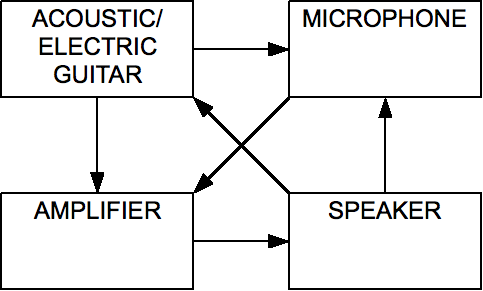
Audio feedback (also known as acoustic feedback, howlround in the UK, or simply as feedback) is a positive feedback situation that may occur when an acoustic path exists between an audio output (for example, a loudspeaker) and its audio input (for example, a microphone or guitar pickup). In this example, a signal received by the microphone is amplified and passed out of the loudspeaker. The sound from the loudspeaker can then be received by the microphone again, amplified further, and then passed out through the loudspeaker again. The frequency of the resulting howl is determined by resonance frequencies in the microphone, amplifier, and loudspeaker, the acoustics of the room, the directional pick-up and emission patterns of the microphone and loudspeaker, and the distance between them. The principles of audio feedback were first discovered by Danish scientist Søren Absalon Larsen, hence it is also known as the Larsen effect.
Feedback is almost always considered undesirable when it occurs with a singer's or public speaker's microphone at an event using a sound reinforcement system or PA system. Audio engineers typically use directional microphones with cardioid pickup patterns and various electronic devices, such as equalizers and, since the 1990s, automatic feedback suppressors, to prevent feedback, which detracts from the audience's enjoyment of the event and may damage equipment or hearing.
Since the 1960s, electric guitar players in rock music bands using loud guitar amplifiers, speaker cabinets and distortion effects have intentionally created guitar feedback to create different sounds including long sustained tones that cannot be produced using standard playing techniques. The sound of guitar feedback is considered to be a desirable musical effect in heavy metal music, hardcore punk and grunge. Jimi Hendrix was an innovator in the intentional use of guitar feedback in his guitar solos to create unique musical sounds.
The conditions for feedback follow the Barkhausen stability criterion, namely that, with sufficiently high gain, a stable oscillation can (and usually will) occur in a feedback loop whose frequency is such that the phase delay is an integer multiple of 360 degrees and the gain at that frequency is equal to 1. If the small-signal gain is greater than 1 for some frequency, then the system will start to oscillate at that frequency because noise at that frequency will be amplified. Sound will be produced without anyone actually playing. The sound level will increase until the output starts clipping, reducing the loop gain to exactly unity. This is the principle upon which electronic oscillators are based; in that case, although the feedback loop is purely electronic, the principle is the same. If the gain is large but slightly less than 1, then ringing will be introduced, but only when at least some input sound is already being sent through the system.
Early academic work on acoustical feedback was done by Dr. C. Paul Boner. Boner was responsible for establishing basic theories of acoustic feedback, room-ring modes, and room-sound system equalizing techniques. Boner reasoned that when feedback happened, it did so at one precise frequency. He also reasoned that it could be stopped by inserting a very narrow notch filter at that frequency in the loudspeaker's signal chain. He worked with Gifford White, founder of White Instruments to hand craft notch filters for specific feedback frequencies in specific rooms.
To maximize gain before feedback, the amount of sound energy that is fed back to the microphones must be reduced as much as is practical. As sound pressure falls off with 1/r with respect to the distance r in free space, or up to a distance known as reverberation distance in closed spaces (and the energy density with 1/r2), it is important to keep the microphones at a large enough distance from the speaker systems. As well, microphones should not be positioned in front of speakers, and individuals using mics should be asked to avoid pointing the microphone at speaker enclosures.
Additionally, the loudspeakers and microphones should have non-uniform directivity and should stay out of the maximum sensitivity of each other, ideally in a direction of cancellation. Public address speakers often achieve directivity in the mid and treble region (and good efficiency) via horn systems. Sometimes the woofers have a cardioid characteristic.
Professional setups circumvent feedback by placing the main speakers away from the band or artist, and then having several smaller speakers known as monitors pointing back at each band member, but in the opposite direction to that in which the microphones are pointing taking advantage of microphones with a cardioid pickup pattern which are common in sound reinforcement applications. This configuration reduces the opportunities for feedback and allows independent control of the sound pressure levels for the audience and the performers.
Hub AI
Audio feedback AI simulator
(@Audio feedback_simulator)
Audio feedback
Audio feedback (also known as acoustic feedback, howlround in the UK, or simply as feedback) is a positive feedback situation that may occur when an acoustic path exists between an audio output (for example, a loudspeaker) and its audio input (for example, a microphone or guitar pickup). In this example, a signal received by the microphone is amplified and passed out of the loudspeaker. The sound from the loudspeaker can then be received by the microphone again, amplified further, and then passed out through the loudspeaker again. The frequency of the resulting howl is determined by resonance frequencies in the microphone, amplifier, and loudspeaker, the acoustics of the room, the directional pick-up and emission patterns of the microphone and loudspeaker, and the distance between them. The principles of audio feedback were first discovered by Danish scientist Søren Absalon Larsen, hence it is also known as the Larsen effect.
Feedback is almost always considered undesirable when it occurs with a singer's or public speaker's microphone at an event using a sound reinforcement system or PA system. Audio engineers typically use directional microphones with cardioid pickup patterns and various electronic devices, such as equalizers and, since the 1990s, automatic feedback suppressors, to prevent feedback, which detracts from the audience's enjoyment of the event and may damage equipment or hearing.
Since the 1960s, electric guitar players in rock music bands using loud guitar amplifiers, speaker cabinets and distortion effects have intentionally created guitar feedback to create different sounds including long sustained tones that cannot be produced using standard playing techniques. The sound of guitar feedback is considered to be a desirable musical effect in heavy metal music, hardcore punk and grunge. Jimi Hendrix was an innovator in the intentional use of guitar feedback in his guitar solos to create unique musical sounds.
The conditions for feedback follow the Barkhausen stability criterion, namely that, with sufficiently high gain, a stable oscillation can (and usually will) occur in a feedback loop whose frequency is such that the phase delay is an integer multiple of 360 degrees and the gain at that frequency is equal to 1. If the small-signal gain is greater than 1 for some frequency, then the system will start to oscillate at that frequency because noise at that frequency will be amplified. Sound will be produced without anyone actually playing. The sound level will increase until the output starts clipping, reducing the loop gain to exactly unity. This is the principle upon which electronic oscillators are based; in that case, although the feedback loop is purely electronic, the principle is the same. If the gain is large but slightly less than 1, then ringing will be introduced, but only when at least some input sound is already being sent through the system.
Early academic work on acoustical feedback was done by Dr. C. Paul Boner. Boner was responsible for establishing basic theories of acoustic feedback, room-ring modes, and room-sound system equalizing techniques. Boner reasoned that when feedback happened, it did so at one precise frequency. He also reasoned that it could be stopped by inserting a very narrow notch filter at that frequency in the loudspeaker's signal chain. He worked with Gifford White, founder of White Instruments to hand craft notch filters for specific feedback frequencies in specific rooms.
To maximize gain before feedback, the amount of sound energy that is fed back to the microphones must be reduced as much as is practical. As sound pressure falls off with 1/r with respect to the distance r in free space, or up to a distance known as reverberation distance in closed spaces (and the energy density with 1/r2), it is important to keep the microphones at a large enough distance from the speaker systems. As well, microphones should not be positioned in front of speakers, and individuals using mics should be asked to avoid pointing the microphone at speaker enclosures.
Additionally, the loudspeakers and microphones should have non-uniform directivity and should stay out of the maximum sensitivity of each other, ideally in a direction of cancellation. Public address speakers often achieve directivity in the mid and treble region (and good efficiency) via horn systems. Sometimes the woofers have a cardioid characteristic.
Professional setups circumvent feedback by placing the main speakers away from the band or artist, and then having several smaller speakers known as monitors pointing back at each band member, but in the opposite direction to that in which the microphones are pointing taking advantage of microphones with a cardioid pickup pattern which are common in sound reinforcement applications. This configuration reduces the opportunities for feedback and allows independent control of the sound pressure levels for the audience and the performers.