Hubbry Logo
Audio feedbackAudio feedbackMain
Open search
Audio feedback
Community hub
Audio feedback
logo
8 pages, 0 posts
0 subscribers
Be the first to start a discussion here.
Audio feedback
Audio feedback
from Wikipedia
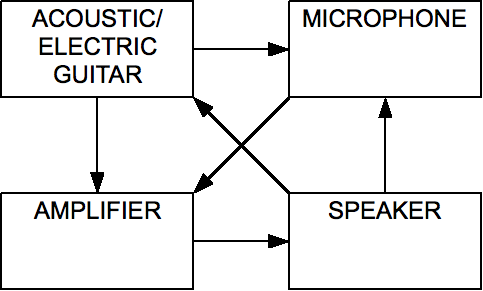
Block diagram of the signal-flow for a common feedback loop[1]: 118 

Audio feedback (also known as acoustic feedback, howlround in the UK, or simply as feedback) is a positive feedback situation that may occur when an acoustic path exists between an audio output (for example, a loudspeaker) and its audio input (for example, a microphone or guitar pickup). In this example, a signal received by the microphone is amplified and passed out of the loudspeaker. The sound from the loudspeaker can then be received by the microphone again, amplified further, and then passed out through the loudspeaker again. The frequency of the resulting howl is determined by resonance frequencies in the microphone, amplifier, and loudspeaker, the acoustics of the room, the directional pick-up and emission patterns of the microphone and loudspeaker, and the distance between them. The principles of audio feedback were first discovered by Danish scientist Søren Absalon Larsen, hence it is also known as the Larsen effect.

Feedback is almost always considered undesirable when it occurs with a singer's or public speaker's microphone at an event using a sound reinforcement system or PA system. Audio engineers typically use directional microphones with cardioid pickup patterns and various electronic devices, such as equalizers and, since the 1990s, automatic feedback suppressors, to prevent feedback, which detracts from the audience's enjoyment of the event and may damage equipment or hearing.

Since the 1960s, electric guitar players in rock music bands using loud guitar amplifiers, speaker cabinets and distortion effects have intentionally created guitar feedback to create different sounds including long sustained tones that cannot be produced using standard playing techniques. The sound of guitar feedback is considered to be a desirable musical effect in heavy metal music, hardcore punk and grunge. Jimi Hendrix was an innovator in the intentional use of guitar feedback in his guitar solos to create unique musical sounds.

History and theory

[edit]

The conditions for feedback follow the Barkhausen stability criterion, namely that, with sufficiently high gain, a stable oscillation can (and usually will) occur in a feedback loop whose frequency is such that the phase delay is an integer multiple of 360 degrees and the gain at that frequency is equal to 1. If the small-signal gain is greater than 1 for some frequency, then the system will start to oscillate at that frequency because noise at that frequency will be amplified. Sound will be produced without anyone actually playing. The sound level will increase until the output starts clipping, reducing the loop gain to exactly unity. This is the principle upon which electronic oscillators are based; in that case, although the feedback loop is purely electronic, the principle is the same. If the gain is large but slightly less than 1, then ringing will be introduced, but only when at least some input sound is already being sent through the system.

Early academic work on acoustical feedback was done by Dr. C. Paul Boner.[2][3] Boner was responsible for establishing basic theories of acoustic feedback, room-ring modes, and room-sound system equalizing techniques. Boner reasoned that when feedback happened, it did so at one precise frequency. He also reasoned that it could be stopped by inserting a very narrow notch filter at that frequency in the loudspeaker's signal chain.[4] He worked with Gifford White, founder of White Instruments to hand craft notch filters for specific feedback frequencies in specific rooms.[5]

Distance

[edit]

To maximize gain before feedback, the amount of sound energy that is fed back to the microphones must be reduced as much as is practical. As sound pressure falls off with 1/r with respect to the distance r in free space, or up to a distance known as reverberation distance in closed spaces (and the energy density with 1/r2), it is important to keep the microphones at a large enough distance from the speaker systems. As well, microphones should not be positioned in front of speakers, and individuals using mics should be asked to avoid pointing the microphone at speaker enclosures.

Directivity

[edit]

Additionally, the loudspeakers and microphones should have non-uniform directivity and should stay out of the maximum sensitivity of each other, ideally in a direction of cancellation. Public address speakers often achieve directivity in the mid and treble region (and good efficiency) via horn systems. Sometimes the woofers have a cardioid characteristic.

Professional setups circumvent feedback by placing the main speakers away from the band or artist, and then having several smaller speakers known as monitors pointing back at each band member, but in the opposite direction to that in which the microphones are pointing taking advantage of microphones with a cardioid pickup pattern which are common in sound reinforcement applications. This configuration reduces the opportunities for feedback and allows independent control of the sound pressure levels for the audience and the performers.

Frequency response

[edit]

Almost always, the natural frequency response of a sound reinforcement systems is not ideally flat as this leads to acoustical feedback at the frequency with the highest loop gain, which may be a resonance with much higher than the average gain over all frequencies. It is therefore helpful to apply some form of equalization to reduce the gain at this frequency.

Feedback can be reduced manually by ringing out a sound system prior to a performance. The sound engineer can increase the level of a microphone until feedback occurs. The engineer can then attenuate the relevant frequency on an equalizer, preventing feedback at that frequency but allowing sufficient volume at other frequencies. Many professional sound engineers can identify feedback frequencies by ear but others use a real-time analyzer to identify the ringing frequency.

To avoid feedback, an automatic feedback suppressor can be used. Some of these work by shifting the frequency slightly, with this upshift resulting in a chirp-sound instead of a howling sound of unaddressed feedback. Other devices use sharp notch filters to filter out offending frequencies. Adaptive algorithms are often used to automatically tune these notch filters.

Deliberate uses

[edit]
Electric guitarist Jimi Hendrix, pictured here in a 1967 concert, was an innovator in the use of guitar feedback effects.

To intentionally create feedback, an electric guitar player needs a guitar amplifier with very high gain (amplification) or the guitar brought near the speaker. The guitarist then allows the strings to vibrate freely and brings the guitar close to the loudspeaker of the guitar amp. The use of distortion effects units adds additional gain and facilitates the creation of intentional feedback.

[edit]

A deliberate use of acoustic feedback was pioneered by blues and rock and roll guitarists such as Willie Johnson, Johnny Watson and Link Wray. According to AllMusic's Richie Unterberger, the very first use of feedback on a commercial rock record is the introduction of the song "I Feel Fine" by the Beatles, recorded in 1964.[6] Jay Hodgson agrees that this feedback created by John Lennon leaning a semi-acoustic guitar against an amplifier was the first chart-topper to showcase feedback distortion.[1]: 120–121  The Who's 1965 hits "Anyway, Anyhow, Anywhere" and "My Generation" featured feedback manipulation by Pete Townshend, with an extended solo in the former and the shaking of his guitar in front of the amplifier to create a throbbing noise in the latter. Canned Heat's "Fried Hockey Boogie" also featured guitar feedback produced by Henry Vestine during his solo to create a highly amplified, distorted boogie style of feedback. In 1963, the teenage Brian May and his father custom-built his signature guitar Red Special, which was purposely designed to feed back.[7][8]

Feedback was used extensively after 1965 by the Monks,[9] Jefferson Airplane, the Velvet Underground and the Grateful Dead, who included in many of their live shows a segment named Feedback, a several-minute long feedback-driven improvisation. Feedback has since become a striking characteristic of rock music, as electric guitar players such as Jeff Beck, Pete Townshend, Dave Davies, Steve Marriott and Jimi Hendrix deliberately induced feedback by holding their guitars close to the amplifier's speaker. An example of feedback can be heard on Hendrix's performance of "Can You See Me?" at the Monterey Pop Festival. The entire guitar solo was created using amplifier feedback.[10] Jazz guitarist Gábor Szabó was one of the earliest jazz musicians to use controlled feedback in his music, which is prominent on his live album The Sorcerer (1967). Szabó's method included the use of a flat-top acoustic guitar with a magnetic pickup.[11] Lou Reed created his album Metal Machine Music (1975) entirely from loops of feedback played at various speeds.

Introductions, transitions, and fade-outs

[edit]

In addition to "I Feel Fine", feedback was used on the introduction to songs including Jimi Hendrix's "Foxy Lady", the Beatles' "It's All Too Much", Hendrix's "Crosstown Traffic", David Bowie's "Little Wonder", the Strokes's "New York City Cops", Ben Folds Five's "Fair", Midnight Juggernauts's "Road to Recovery", Nirvana's "Radio Friendly Unit Shifter", the Jesus and Mary Chain's "Tumbledown" and "Catchfire", the Stone Roses's "Waterfall", Porno for Pyros's "Tahitian Moon", Tool's "Stinkfist", and the Cure's "Prayer For Rain".[1]: 121–122  Examples of feedback combined with a quick volume swell used as a transition include Weezer's "My Name Is Jonas" and "Say It Ain't So"; The Strokes' "Reptilia", "New York City Cops", and "Juicebox"; Dream Theater's "As I Am"; as well as numerous tracks by Meshuggah and Tool.[1]: 122–123 

Cacophonous feedback fade-outs ending a song are most often used to generate rather than relieve tension, often cross-faded too after a thematic and musical release. Examples include Modwheelmood's remix of Nine Inch Nail's "The Great Destroyer"; and the Jesus and Mary Chain's "Teenage Lust", "Tumbledown", "Catchfire", "Sundown", and "Frequency".[1]: 123 

Examples in modern classical music

[edit]

Though closed circuit feedback was a prominent feature in many early experimental electronic music compositions, intentional acoustic feedback as sound material gained more prominence with compositions such as John Cage's Variations II (1961) performed by David Tudor and Robert Ashley's The Wolfman (1964). Steve Reich makes extensive use of audio feedback in his work Pendulum Music (1968) by swinging a series of microphones back and forth in front of their corresponding amplifiers.[12]: 88  Hugh Davies[12]: 84  and Alvin Lucier[12]: 91  both use feedback in their works. Roland Kayn based much of his compositional oeuvre, which he termed "cybernetic music," on audio systems incorporating feedback.[13][14] More recent examples can be found in the work of, for example, Lara Stanic,[12]: 163  Paul Craenen,[12]: 159  Anne Wellmer,[12]: 93  Adam Basanta,[15] Lesley Flanigan,[16] Ronald Boersen,[17] Erfan Abdi.[18] and Tyler Quinn [19]

Pitched feedback

[edit]

Pitched melodies may be created entirely from feedback by changing the angle between a guitar and amplifier after establishing a feedback loop. Examples include Tool's "Jambi", Robert Fripp's guitar on David Bowie's "Heroes" (album version), and Jimi Hendrix's "Third Stone from the Sun" and his live performance of "Wild Thing" at the Monterey Pop Festival.[1]: 119 

Regarding Fripp's work on "Heroes":

Fripp [stood] in the right place with his volume up at the right level and getting feedback...Fripp had a technique in those days where he measured the distance between the guitar and the speaker where each note would feed back. For instance, an 'A' would feed back maybe at about four feet from the speaker, whereas a 'G' would feed back maybe three and a half feet from it. He had a strip that they would place on the floor, and when he was playing the note 'F' sharp he would stand on the strip's 'F' sharp point and 'F' sharp would feed back better. He really worked this out to a fine science, and we were playing this at a terrific level in the studio, too.

— Tony Visconti[20][1]: 119 

Contemporary uses

[edit]

Audio feedback became a signature feature of many underground rock bands during the 1980s. American noise-rockers Sonic Youth melded the rock-feedback tradition with a compositional and classical approach (notably covering Reich's "Pendulum Music"), and guitarist/producer Steve Albini's group Big Black also worked controlled feedback into the makeup of their songs. With the alternative rock movement of the 1990s, feedback again saw a surge in popular usage by suddenly mainstream acts like Nirvana, the Red Hot Chili Peppers, Rage Against the Machine and the Smashing Pumpkins. The use of the "no-input-mixer" method for sound generation by feeding a mixing console back into itself has been adopted in experimental electronic and noise music by practitioners such as Toshimaru Nakamura.[21]

Devices

[edit]
The Boss DF-2 Super Feedbacker and Distortion pedal (on the left) helps electric guitarists to create feedback effects.

The principle of feedback is used in many guitar sustain devices. Examples include handheld devices like the EBow, built-in guitar pickups that increase the instrument's sonic sustain, and sonic transducers mounted on the head of a guitar. Intended closed-circuit feedback can also be created by an effects unit, such as a delay pedal or effect fed back into a mixing console. The feedback can be controlled by using the fader to determine a volume level. The Boss DF-2 Super Feedbacker and Distortion pedal is an electronic effect unit that helps electric guitarists create feedback effects.[22] The halldorophone is an electro-acoustic string instrument specifically made to work with string-based feedback.[23]

See also

[edit]

References

[edit]
[edit]
Revisions and contributorsEdit on WikipediaRead on Wikipedia
from Grokipedia
Audio feedback, also known as the Larsen effect, is a positive feedback phenomenon that occurs in electro-acoustic systems, such as sound reinforcement setups, when sound emitted from a is captured by a nearby , re-amplified through the system, and looped continuously, resulting in a loud, piercing howl or screech at specific frequencies once the overall loop gain reaches or exceeds unity (0 dB). This arises from the acoustic coupling between the output () and input (), often exacerbated by room reflections or direct sound paths, and can rapidly increase in volume, potentially damaging equipment if not addressed. The primary causes of audio feedback include improper microphone and loudspeaker placement, excessive system gain, and environmental factors like reverberant spaces that facilitate sound re-entry into the microphone. In practice, feedback typically manifests at resonant frequencies determined by the system's delay and the room's acoustics, limiting the maximum usable gain before instability occurs. Its effects extend beyond unwanted noise, as it constrains the overall volume and clarity in live sound applications, such as concerts or public speaking, where achieving sufficient sound pressure levels without feedback is a key engineering challenge. Prevention and mitigation strategies focus on breaking the feedback loop through techniques like optimizing to reduce off-axis pickup, physically separating from loudspeakers (e.g., placing speakers behind or above performers), and employing graphic equalizers to notch out problematic identified during "ring-out" procedures. Advanced digital tools, including automatic feedback suppressors and adaptive filters, detect and attenuate feedback in real-time by analyzing signal characteristics, while shifting or methods can stabilize the system without significant audio degradation. These approaches are essential in to maximize potential acoustic gain while maintaining system stability. Despite its disruptive nature, audio feedback has been intentionally harnessed in music since the mid-20th century to create expressive, experimental sounds, marking a shift from mere technical flaw to artistic tool. ' 1964 hit "" featured the first deliberate use of recorded guitar feedback in a major pop song, with generating the iconic opening note by leaning his guitar against an . further popularized controlled feedback in the late 1960s, using it in performances like his 1967 rendition of "Wild Thing" at the Monterey Pop Festival to produce swirling, psychedelic textures that expanded the electric guitar's sonic palette. Such applications continue in genres like rock, experimental, and , where feedback contributes to timbral innovation and emotional intensity.

Fundamentals

Definition and mechanism

Audio feedback, also known as acoustic feedback or the Larsen effect, is an unintended loop in electroacoustic systems where sound emitted from a is picked up by a nearby , re-amplified, and re-emitted at an increased intensity, typically resulting in a sustained high-pitched squeal or howl. This phenomenon arises in systems designed for sound reinforcement or amplification, creating a self-reinforcing cycle that can rapidly escalate in volume if not interrupted. The basic mechanism of audio feedback involves a closed loop through the electroacoustic . Initially, an acoustic —such as a voice or instrument—is captured by the and converted into an electrical signal. This signal then passes through the audio processing , including a to boost the weak microphone output, a mixer for level adjustment and routing, and a power to drive the . The converts the amplified electrical signal back into acoustic , which propagates through the air and is partially recaptured by the if it is within the speaker's field. This recaptured is then reintroduced into the system, undergoing the same amplification , thereby closing the loop and intensifying the original component. In a simple schematic representation, this forms a cycle: → preamp/mixer → power amp → → acoustic path back to . Feedback onset occurs when the loop gain—the product of the system's amplification and the acoustic efficiency—exceeds unity (1, or 0 dB) at a where the total phase shift around the loop is a multiple of 360 degrees, leading to constructive reinforcement and sustained . At this threshold, even a slight excess gain causes the signal to build exponentially, with the growth rate depending on the excess gain and any in the loop; for instance, a 0.5 dB excess can result in rapid volume increase. This effect commonly manifests in environments involving electroacoustic amplification, such as public address (PA) systems in lecture halls or conference rooms, live sound reinforcement at concerts or events, and occasionally in recording studios during monitoring or overdubbing sessions.

Occurrence in systems

Audio feedback commonly occurs in electroacoustic systems where sound from an output device, such as a loudspeaker, is captured by an input device like a microphone, creating a regenerative loop that amplifies specific frequencies. The phenomenon was first systematically analyzed in 1911 by Danish scientist Søren Absalon Larsen, who outlined its principles in electrical circuits, leading to its designation as the Larsen effect; early practical instances emerged in the nascent telephone and radio systems of the early 20th century, where acoustic coupling between receivers and transmitters produced unintended howls during amplification experiments. In live sound reinforcement systems, audio feedback is prevalent during concerts and public speeches, where positioned near high-powered loudspeakers amplify ambient sound in real-time, often exacerbated by the dynamic volume demands of performers or speakers. Broadcast setups, including studio environments for radio and television, experience feedback when open inadvertently pick up monitor speakers or audio, though modern isolation techniques have reduced its frequency compared to early 20th-century broadcasts. Home audio systems, such as those using wireless for or video calls, are susceptible in enclosed spaces where speakers and are in close proximity without proper muting protocols. Key triggering factors include the physical proximity between and speakers, which increases the sound pressure level reaching the input and lowers the threshold for loop gain exceeding unity; room acoustics, such as high times or reflective surfaces like hard walls and ceilings, promote multiple sound paths that reinforce the feedback signal. Signal chain vulnerabilities, including excessive gain staging on amplifiers or mixers and leaving unnecessary channels open, further heighten the risk by amplifying low-level pickup into sustained . Audio feedback manifests in two primary types: discrete tones, often high-pitched squeals at resonant frequencies determined by the system's acoustics (typically 1-5 kHz in vocal ranges), resulting from a single dominant loop; and rarer broadband noise, a chaotic howl across a wider , arising from multiple overlapping loops or nonlinear distortions in the amplification chain. Microphone significantly influences susceptibility, with omnidirectional models—sensitive to sound from all directions—more prone to capturing speaker output than cardioid patterns, which reject off-axis sound and allow higher gain before feedback onset. Notable case studies illustrate these occurrences: in 1960s rock concerts, rudimentary public address systems frequently produced uncontrolled feedback squeals, where stacks and stage monitors overwhelmed primitive mixing capabilities, turning accidental loops into disruptive howls amid high-volume guitar . In modern VoIP conference calls, such as those on Zoom, feedback loops commonly arise when a participant's captures audio from nearby speakers during hybrid meetings, leading to echoing squeals that disrupt remote discussions, particularly in reverberant office spaces with elevated speaker volumes.

Physics and Theory

Acoustic principles

Audio feedback arises from the interaction of sound waves in a closed-loop involving a , , and . waves are longitudinal waves that propagate through a medium such as air, where molecules are alternately compressed and rarefied, creating variations in that travel from the source. In air at standard (20°C), these waves propagate at approximately 343 meters per second, determined by the medium's and elasticity. The of the wave represents the magnitude of variation, while its intensity, which measures power per unit area, is proportional to the square of the ; this relationship is critical in feedback, as amplified waves can rapidly increase intensity through reinforcement. In audio systems, feedback manifests as sustained when the output sound from the is picked up by the and re-amplified, creating a positive reinforcement loop. This occurs through constructive interference, where the phase of the fed-back signal aligns with the original (a phase shift of 0° or multiples of 360°), allowing the signal to build upon itself. The condition for instability follows the , adapted to acoustic systems: the total loop gain must exceed unity while satisfying the phase condition. The basic loop gain can be expressed as the product of the gains in the signal path (normalized for dimensionality): Gtotal=GmicHacGelec>1G_{\text{total}} = G_{\text{mic}} \cdot H_{\text{ac}} \cdot G_{\text{elec}} > 1 Here, GmicG_{\text{mic}} is the microphone's sensitivity, HacH_{\text{ac}} is the acoustic transfer function from loudspeaker to microphone, and GelecG_{\text{elec}} combines the amplifier gain and loudspeaker/transducer efficiencies. The propagation medium, typically air, influences wave behavior, with speed varying primarily with temperature (approximately increasing by 0.6 m/s per °C above 0°C) and slightly with humidity, which reduces air density and thus marginally increases speed. Initial wave generation begins with transducer vibrations: the loudspeaker's diaphragm oscillates, displacing air molecules to initiate the pressure wave, while the microphone's diaphragm responds to incoming pressure fluctuations to convert them back into an electrical signal, closing the loop.

Distance and gain factors

The risk of audio feedback is inversely related to the physical separation between the and , as greater attenuates the sound pressure level (SPL) reaching the microphone from the speaker output. In free-field conditions approximating point sources, sound intensity decays according to the , where intensity II at dd is given by I=P4πd2I = \frac{P}{4\pi d^2}, with PP as the acoustic power radiated by the speaker; this results in sound pressure p1dp \propto \frac{1}{d} and an SPL drop of approximately 6 dB for every doubling of . Consequently, increasing microphone- separation reduces the acoustic coupling in the feedback loop, allowing higher system gain before the loop gain reaches unity and oscillation occurs. Gain margins in audio systems are determined by the cumulative amplification across preamplifiers, mixers, and equalizers, which contribute to the overall loop gain Gloop=Gamp×HacG_{loop} = G_{amp} \times H_{ac}, where HacH_{ac} represents the acoustic transfer function from speaker to microphone. To prevent feedback, systems are typically operated with a gain margin of at least 6 dB below the potential acoustic gain (PAG), ensuring stability; for instance, a 0 dB margin corresponds to the onset of feedback, while negative margins indicate oscillation. The potential acoustic gain can be approximated as PAG (dB) ≈ 20 log_{10}(d_{MS} / d_{SL}), where d_{MS} is the microphone-loudspeaker distance and d_{SL} is the loudspeaker-source distance. Measurement techniques, such as sine wave sweeps through frequencies, identify the feedback threshold by incrementally increasing gain until ringing appears, allowing engineers to quantify safe operating levels. In practice, minimum microphone-loudspeaker separations of 1-2 meters are recommended in small rooms to achieve adequate PAG, with each doubling of distance adding roughly 6 dB to the available gain before feedback. Multiple microphones reduce the effective gain margin by 3 dB per doubling of the number open (e.g., four microphones yield -6 dB relative to one), as each contributes to the feedback paths, while multiple speakers can compound risks unless delayed or zoned appropriately.

and

The of and loudspeakers plays a in determining the susceptibility of an to feedback by influencing how is captured and radiated in specific directions. Omnidirectional pick up equally from all angles, offering broad coverage but minimal rejection of off-axis sources, which increases the likelihood of feedback from nearby loudspeakers. In contrast, cardioid patterns exhibit a heart-shaped sensitivity lobe with significant rear rejection (typically 10-20 dB), allowing for higher gain before feedback in live applications by reducing pickup of monitor speakers positioned behind the performer. Supercardioid and hypercardioid patterns further narrow the acceptance angle (around 65-120 degrees), providing even greater off-axis rejection (up to 25 dB in the nulls), though they require precise aiming to avoid self-cancellation from side sources. These patterns are frequency-dependent, with improving at higher frequencies due to the smaller relative to size, which narrows the radiation or pickup lobe and exacerbates feedback risks in directional setups. The factor quantifies this angular selectivity, defined as D(θ)=10log10(Ion-axisIoff-axis(θ))D(\theta) = 10 \log_{10} \left( \frac{I_{\text{on-axis}}}{I_{\text{off-axis}}(\theta)} \right), where Ion-axisI_{\text{on-axis}} is the sound intensity along the primary axis and Ioff-axis(θ)I_{\text{off-axis}}(\theta) is the intensity at θ\theta from that axis, expressed in decibels. This metric highlights how directional devices concentrate energy, with typical values ranging from 0 dB for omnidirectional patterns to 10-15 dB for supercardioid microphones at mid-frequencies. In feedback loops, higher factors enhance system gain margins by minimizing the acoustic coupling between output and input, as the effective loop gain decreases with improved rejection of reverberant or reflected sound paths. For , similar patterns (e.g., horn-loaded designs) direct output away from microphones, further mitigating feedback onset. Frequency response characteristics of the electroacoustic system significantly influence feedback susceptibility, as the overall often exhibits peaks in the 1-5 kHz range, aligning with human hearing sensitivity and the increased at these wavelengths. This spectral region sees heightened vulnerability due to the ear's equal-loudness contours peaking around 3-4 kHz, where small loop gains can amplify to audible howling, while low frequencies below 200 Hz are damped by room absorption and high frequencies above 8 kHz are attenuated by air and beaming. The system's , plotting magnitude (gain in dB) and phase (in degrees) versus log , reveals these resonances as sharp peaks where the magnitude exceeds 0 dB and phase approaches multiples of 360 degrees, indicating instability points for feedback oscillation. For instance, a typical plot might show a gradual below 500 Hz, a resonant hump at 2-3 kHz with 6-12 dB gain, and rapid phase shift leading to loop closure. Room modes contribute to these frequency-specific behaviors, with simplified resonance frequencies for axial modes given by fn=nc2Lefff_n = \frac{n c}{2 L_{\text{eff}}}, where n=1,2,n = 1, 2, \dots, cc is the (≈343 m/s), and LeffL_{\text{eff}} is the effective or path length. For direct-path feedback, oscillation frequencies occur at fk=kcdf_k = \frac{k c}{d} (k=1,2,...), where d is the microphone-loudspeaker ; for example, with d=5 m, the lowest is approximately 69 Hz. This half-wavelength model for modes ties to mode excitation: directional setups excite fewer modes by avoiding off-axis reflections, but when aligned with a mode's maximum, feedback intensifies at that . Multipath propagation in the acoustic path introduces interaction effects like comb filtering, where direct sound and delayed reflections interfere, creating periodic notches in the frequency response that can evolve into feedback sites under high gain. These notches, spaced by Δf=c2d\Delta f = \frac{c}{2 d} (with dd as path difference), form narrow-band suppressions (e.g., 20-40 dB deep) that shift with microphone or speaker movement, but if gain overcomes the notch, ringing occurs selectively at comb peaks. In feedback scenarios, this results in tonal howls at discrete frequencies, distinct from broadband noise, and is exacerbated in rooms with parallel surfaces amplifying specific delays. Directional patterns mitigate this by reducing multipath contributions, smoothing the response and delaying instability.

Prevention and Control

Engineering techniques

One key engineering technique for minimizing audio feedback involves strategic placement relative to . Placing behind the loudspeaker line ensures that the speakers' output falls within the microphone's null or least sensitive area, such as the rear rejection lobe of cardioid or supercardioid patterns, thereby reducing the loop gain that causes feedback. A common guideline, often referred to as the 45-degree rule, positions the microphone at a 45-degree off-axis angle from the loudspeaker direction to exploit the polar pattern's rejection zone, particularly for hypercardioid microphones where the null point is approximately 45 degrees off the rear axis. strategies further enhance this by dividing the stage or room into separate coverage areas, with confined to zones where loudspeaker dispersion is minimized, such as keeping vocal mics forward of the main PA stacks while isolating instrument mics in side zones. These practices evolved from rudimentary setups in the , when stage monitors were absent and feedback was primarily managed through basic vocal amplification and singer positioning, to the introduction of dedicated monitors in the early that necessitated more precise placement to achieve usable gain levels. Speaker array design plays a critical role in feedback prevention by controlling sound dispersion and reducing unwanted rear radiation toward . Line arrays, consisting of vertically stacked modules, provide controlled vertical and cylindrical wavefront propagation, which minimizes sound spill onto microphones compared to traditional point-source systems, allowing higher system gain before feedback occurs. Front-filled systems complement this by deploying low-profile speakers along the stage front to cover near-field areas, enabling main arrays to operate at reduced volume levels and thus lowering the overall acoustic pressure incident on microphones. Optimization for gain before feedback involves modeling array configurations to maximize forward coverage while attenuating rearward energy, often providing additional usable gain in live environments through precise splay angles and height adjustments. Equalization using manual graphic equalizers remains a foundational method for addressing feedback in live and installed systems. The process, known as "ringing out" the room, entails gradually increasing system gain with open microphones until feedback rings, then identifying the offending frequency—typically via ear or real-time analyzer—and applying narrow notches (Q factors of 10-20) to attenuate it by 3-12 dB. This is repeated for the primary resonances, usually limiting to 3-4 notches per channel to avoid over-equalization that could degrade tonal balance, targeting frequencies informed by directivity patterns where feedback is most likely (e.g., midrange peaks around 1-4 kHz). Proper cabling and grounding practices are essential to prevent ground loops, which introduce hum and noise that can mask or exacerbate feedback. Balanced connections using XLR cables employ differential signaling to reject common-mode interference, including ground-induced , provided pin 1 (shield) is connected only at the input end to avoid completing unintended current paths. Adhering to recommended practices for analog audio interconnections ensures shielding continuity without creating loops, significantly reducing in multi-device setups.

Modern tools and software

Modern automatic feedback suppressors represent a significant advancement in processing, enabling real-time detection and elimination of feedback frequencies without manual intervention. Devices such as the dbx AFS series employ Precision Frequency Detection algorithms combined with adaptive filter bandwidth to identify and apply narrow notches at feedback points, supporting up to 24 filters per channel with values as fine as 1/80 of an . Similarly, Klark Teknik's DF1000 unit uses proprietary detection algorithms to automatically deploy up to 32 parametric filters per channel, providing up to 10 dB of additional gain before feedback occurs in live sound environments. These systems rely on adaptive filtering techniques to dynamically track and suppress frequencies as they shift during performances. Digital signal processing (DSP) integrations in professional mixers have further streamlined feedback control through embedded software tools. In Yamaha's QL series consoles, parametric equalization (PEQ) allows precise notching of problem frequencies, often augmented by phase analysis to distinguish feedback from desired signals and optimize filter placement. These implementations frequently incorporate adaptive algorithms like the least mean squares (LMS) method, which iteratively adjusts filter coefficients to minimize error between input and output signals, effectively tracking time-varying feedback paths in real-time audio systems. Such DSP features enable automatic suppression modes that activate filters only when feedback is detected, preserving overall sound quality in applications like concert mixing. App-based solutions have democratized feedback prevention by extending these capabilities to mobile and desktop platforms for tuning and conferencing. Tools like Rational Acoustics' software facilitate acoustic measurements using dual-channel FFT analysis to identify room modes and feedback-prone frequencies, guiding users to apply corrective EQ for optimal gain before feedback. Likewise, EQ Wizard (REW) provides free, open-source analysis of responses and impulse responses, helping users generate parametric filters to suppress potential feedback in home studios or small venues. In video conferencing, Zoom's built-in cancellation processes audio streams to detect and subtract looped signals, reducing feedback in hybrid setups. To determine if microphone feedback is specific to a particular application such as Tencent Meeting, test the microphone in another application, such as Windows Voice Recorder, Mac Voice Memos, or Discord. If feedback does not occur in the other application, the issue is likely specific to the original app's audio processing or settings. Post-2020 developments have increasingly incorporated (ML) for feedback suppression, particularly in immersive audio environments. ML models can estimate feedback paths in real-time using neural networks, enabling dynamic cancellation in applications such as public address systems and hearing devices. Ongoing advancements in DSP leverage these ML techniques to support low-latency suppression in systems.

Artistic Applications

Historical uses in music

One of the earliest documented instances of intentional audio feedback in music occurred in 1958 with Link Wray's instrumental track "Rumble," where Wray achieved the effect by puncturing his guitar amplifier's speaker cone with a pencil to produce distortion and feedback, marking a pioneering sabotage of equipment for sonic innovation. Although Les Paul's experiments in the 1940s and 1950s, such as his 1947 overdubs on "Lover," revolutionized audio layering, these were primarily focused on and texture rather than deliberate feedback as an expressive element. In jazz contexts during the same era, improvisational guitarists like those in ensembles sometimes encountered feedback from early electric amplification but rarely harnessed it intentionally, viewing it more as a technical challenge than a musical tool. The 1960s saw audio feedback emerge as a deliberate technique in rock, though The Shadows' recordings emphasized clean tones with subtle sustain. A pivotal moment came in 1965 when The Who's Pete Townshend incorporated controlled feedback into "Anyway, Anyhow, Anywhere," using high-volume amplification to create sustained, melodic howls that extended guitar solos and added raw aggression to the track. Jimi Hendrix elevated this approach in 1966's "Foxy Lady," where the opening riff features a bent note ringing out into piercing feedback, achieved by positioning his guitar toward the amplifier for harmonic sustain, transforming the phenomenon into a signature of expressive chaos. Similarly, the Grateful Dead integrated venue-specific feedback "howls" into their psychedelic jams, as heard in their 1969 Fillmore West performances, where Jerry Garcia's guitar would generate eerie, room-resonant tones that varied by acoustic environment, enhancing improvisational space. This shift from feedback as a nuisance to an expressive tool accelerated after with advancements in high-gain amplification, notably the introduction of Marshall stacks—100-watt heads paired with 4x12 cabinets—that allowed guitarists like Townshend to generate sustained feedback at concert volumes without distortion overload. These rigs enabled precise control over feedback frequencies, turning it into a compositional device in rock arrangements. Audio feedback profoundly influenced , where it evoked altered states in recordings like Hendrix's Monterey Pop Festival set in 1967, featuring prolonged feedback during "Wild Thing," and the Grateful Dead's live explorations that blurred noise and melody. By the 1970s and into the 1980s, it permeated punk, with bands like the employing chaotic feedback in live shows such as their infamous 1976 Anarchy Tour to amplify fury. In the no-wave punk scene, Sonic Youth's 1980s albums like (1988) weaponized feedback through alternate tunings and prepared guitars, creating dissonant walls of sound in tracks like "Silver Rocket," influencing underground movements up to the decade's end.

Techniques in performance

Musicians employ various setup manipulations to generate and sustain deliberate during live performances. One common approach involves guitar volume swells, where the player gradually increases the instrument's volume control while positioning the guitar close to the to initiate a feedback loop without excessive . Pedal effects such as fuzz or pedals enhance sustain by amplifying the signal, allowing tones to loop more reliably, while compression pedals further boost sustain and volume to facilitate controlled feedback. Amp positioning is crucial; directing the guitar toward the speaker cone maximizes wave interaction, creating predictable loops when the setup is at moderate volumes. In performance structures, feedback serves to build tension in song intros through sustained, swelling drones that transition into the main . It enables seamless shifts during transitions by using volume swells or pedal boosts to bridge sections without abrupt stops. For fade-outs, musicians sustain feedback as a droning backdrop, often modulating it with for a gradual decay. Pitched feedback can be achieved by lightly notes and allowing the amp to resonate with harmonics, fine-tuning the pitch by maintaining vibration against the as the feedback stabilizes. Control parameters focus on balancing gain for stability versus controlled chaos; players set amp and pedal gains just below the feedback threshold, then engage it incrementally with techniques like or a wah pedal to sweep specific frequencies and avoid unwanted squeals. In genres like , as exemplified by My Bloody Valentine, this balance creates immersive walls of sound, while noise artists use higher gain for chaotic, expressive solos that push the edge of predictability. For safety and reliability in live settings, musicians test setups in advance to map "hotspots" where feedback occurs consistently, ensuring predictability across venues. Temperature fluctuations can impact amp , altering feedback onset and stability—warmer conditions may increase gain sensitivity, so allowing time for equipment warm-up helps maintain control. Monitoring overall volume prevents hearing damage during prolonged use.

Contemporary devices and examples

In the 2010s and beyond, specialized hardware has enabled musicians to harness audio feedback more precisely in live and studio settings. The Freeze Sound Retainer, introduced in 2011, captures and sustains notes or chords indefinitely via a momentary footswitch, creating feedback-like drones and harmonies that can be layered with effects for experimental soundscapes. Similarly, the Make Noise Wogglebug, a module released in the mid-2000s and refined through the , generates chaotic random voltages and includes capabilities that facilitate unpredictable feedback loops when integrated into systems for tonal experimentation. Digital emulations have expanded access to feedback effects within digital audio workstations (DAWs). Ableton Live's built-in effects, such as the Delay device with adjustable feedback parameters, allow producers to simulate infinite sustain and howling tones in without physical hardware, enabling controlled feedback integration in electronic compositions. Plugins like Soundtoys Decapitator provide analog-style saturation that enhances leading to feedback emulation, adding warmth and grit to tracks in professional mixes. In the , AI-assisted tools have begun supporting generative music production. Contemporary examples span genres and disciplines. In , Pauline Oliveros's Deep Listening practices, which emphasize immersive sonic environments including feedback elements, continue to influence 2020s performances, such as the Los Angeles Philharmonic's 2025 rendition of her Sonic Meditations, fostering collective improvisation with environmental sounds. Interdisciplinary installations like Rafael Lozano-Hemmer's Voice Array (2011, with ongoing exhibitions into the 2020s) use amplified voices in sculptural arrays to evoke feedback-like accumulation of sound layers, engaging participants in public spaces. In pop and electronic music, artists like have incorporated live guitar and sustain effects resembling feedback during 2020s tours, notably shredding on tracks like "" to heighten emotional intensity. Emerging trends by 2025 integrate audio feedback with immersive technologies. In VR soundscapes, multisensory systems combine auditory feedback with tactile cues to enhance emotional in music experiences, reducing anxiety through synchronized loops and vibrations. hybrids merge real-time physiological data, such as brainwave entrainment via binaural beats, with algorithmic feedback generation in music therapy applications, promoting relaxation and creativity. Algorithmic approaches in EDM, exemplified by systems like the Generative Electronic Dance Music Algorithmic System (GEDMAS), employ Markov chains to produce rhythmic and melodic structures, evolving genre conventions in the .

References

Add your contribution
Related Hubs
User Avatar
No comments yet.