Hubbry Logo
Fernand GraveyFernand GraveyMain
Open search
Fernand Gravey
Community hub
Fernand Gravey
logo
8 pages, 0 posts
0 subscribers
Be the first to start a discussion here.
Fernand Gravey
Fernand Gravey
from Wikipedia

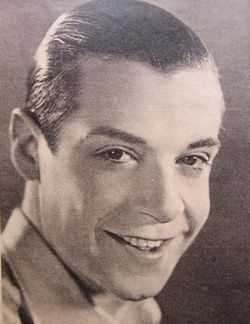
Fernand Gravey (25 December 1905 in Ixelles (Belgium) – 2 November 1970 in Paris, France),[2] also known as Fernand Gravet in the United States, was a Belgian-born French actor.

Key Information

Early life

[edit]

Gravey was the son of actors Georges Mertens and Fernande Depernay, who appeared in silent films produced by pioneer Belge Cinéma Film (a subsidiary of Pathé).

Gravey started performing at age five under his father's direction.

Before World War I, he received an education in Britain and could speak both French and English fluently, something which became useful in his movie roles. During the war, Gravey served in the British Merchant Navy.

In 1936, he married the French actress Jane Renouardt, who was 15 years his senior. They remained together until his death on 2 November 1970 of a heart attack. Jane died on 3 February 1972. They had no children.

Film career

[edit]

Gravey performed in four films in 1913 and 1914 (as Fernand Mertens), but his first film of importance was L'Amour Chante, released in 1930. In 1933 he made Bitter Sweet, his first English language movie which became more famous in its 1940 incarnation with Jeanette MacDonald and Nelson Eddy.

In 1937, after several more French and British movies, Gravey went to Hollywood where the spelling of his last name was altered to Gravet, and he became the focus of a rather extensive Hollywood publicity campaign (instructing moviegoers to pronounce his name properly: "Rhymes with Gravy"). Unfortunately for Gravey, he was offered only standard parts, the Gallic lover roles that Louis Jourdan played in the 1950s and 1960s.

The first two films he made in Hollywood were for Warner Brothers: The King and the Chorus Girl (1937), with Joan Blondell and Jane Wyman, and Fools for Scandal (1938), with Carole Lombard and Ralph Bellamy. Gravey then signed with Metro-Goldwyn-Mayer and was cast as Johann Strauss in the expensive biopic The Great Waltz with Luise Rainer and Miliza Korjus.

MGM next planned to star Gravey in a film version of Rafael Sabatini's adventure novel Scaramouche, but instead he returned to France just before the Nazi occupation began. Although he had agreed to appear in German-approved French films, Gravey was an underminer of the invaders as a member of the French Secret Army and the Foreign Legion.[citation needed]

At the end of the war, Gravey was considered a war hero and continued to be featured in French productions such as La Ronde (with Danielle Darrieux), and Royal Affairs in Versailles (1954). Among his last English language performances were How to Steal a Million (1966), Guns for San Sebastian (1968), and The Madwoman of Chaillot (1969), in which he played the police inspector.

Selected filmography

[edit]

References

[edit]

Bibliography

[edit]
[edit]
Revisions and contributorsEdit on WikipediaRead on Wikipedia
from Grokipedia
Fernand Gravey (born Fernand Maurice Noël Mertens; 25 December 1905 – 2 November 1970) was a Belgian-born French actor celebrated for his sophisticated roles in stage, screen, and television productions across Europe and Hollywood. The son of actors Georges Mertens and Fernande Depernay, Gravey—taking his stage name from his mother's maiden surname—debuted in film at age five and rose to prominence in French cinema during the 1930s with leading parts in comedies and dramas. Under the anglicized billing Fernand Gravet, he ventured to Hollywood in the late 1930s, starring in Warner Bros. musicals such as The Great Waltz (1938), though his American career proved short-lived amid shifting studio preferences. Returning to Europe, he sustained a prolific output in post-war French and international films, including La Ronde (1950) and How to Steal a Million (1966), while upholding a distinguished theater career. An enthusiast of painting and Napoleonic memorabilia, Gravey married actress Jane Renouardt in 1936, a union ending in divorce in 1966; he succumbed to a heart attack in Paris at age 64.

Early life

Family background and birth

Fernand Maurice Noël Mertens, known professionally as Fernand Gravey, was born on 25 December 1905 in , a municipality of , . His parents, Georges Mertens and Fernande Dépernay (also spelled Depernay), were both actors active in the Belgian and French theater scenes. The Mertens family maintained strong ties to the , with Georges and Fernande appearing in silent films produced during the early , including works affiliated with Belge Cinéma Film, a subsidiary. This environment of professional theater and nascent cinema in exposed Gravey to performance from infancy, fostering an innate familiarity with and screen techniques that characterized his lineage. His Belgian origins, rooted in the French-speaking cultural milieu of , thus formed the bedrock of his multilingual proficiency and adaptability across European entertainment circuits.

Initial entry into acting

Born Fernand Maurice Noël Mertens on December 25, 1905, in , , to actors Georges Mertens and Fernande Depernay, he began his acting career as a child in family-involved theatrical productions. At age five, he performed in a theater managed by his father, including appearances alongside established performers such as Mounet-Sully in . These early stage efforts leveraged his parents' connections in the theater scene, where both had worked in silent films produced by Belge Cinéma Film. Mertens transitioned to cinema around age seven, debuting in the 1913 short Saïda a enlevé Manneken-Pis, directed by Alfred Machin and featuring his mother's trained lion Mimir. He appeared under his birth name in this and four other Machin films that year, establishing a precocious screen presence amid the nascent . In 1914, he played the role of young in (Une tragédie dans les nuages), again collaborating with his parents. The German invasion of in 1914 and ensuing disruptions halted local film production, prompting Mertens and his family to prioritize stage work for continuity. During the war, he continued theatrical engagements, often in family-led troupes, while receiving education in Britain to evade occupation risks. Post-war, as he pursued more formal stage ambitions in by the late , he adopted the professional name Fernand Gravey—likely drawing from familial or artistic associations—to differentiate from his early child roles and establish a distinct identity.

Stage career

Early theater appearances

Gravey, born Fernand Mertens, made his initial stage appearance at the age of five in a theater managed by his father, Georges Mertens, who directed the Théâtre des Galeries. His mother, Fernande Depernay, was also an , providing familial immersion in the profession from infancy. By age seven, he had debuted formally on the stage, capitalizing on these connections for child roles in local productions. Following , during which Gravey received education in Britain that enhanced his English proficiency, he undertook an apprenticeship at age 14 through provincial theater tours in and France. These tours involved s and lighter dramas, honing his versatile presence and elegant demeanor, traits that would define his boulevard style. In 1927, Gravey relocated to , adopting his stage name and securing roles in intimate s at smaller venues, often alongside performers like and Jane Renouard. His Paris debut came in the adapted Anglo-Saxon comedy Romance by Flers and Croisset, followed by his first original creation in Le . At the Théâtre Daunou, he appeared in Paul Géraldy's Si je voulais, establishing his reputation for sophisticated, charm-driven characterizations in comedic and formats.

Major stage roles and transitions

Gravey's prominence in French theater persisted into the , where he performed in light comedies that showcased his charm and versatility, including roles in plays such as Mistigri and La Chienne aux yeux de femme, which elevated his status in Parisian stages during the . These performances, rooted in his early training from a theatrical , refined the elegant, romantic that defined his later career, enabling seamless shifts between live audiences and screen adaptations of similar comedic and dramatic fare. The 1930s and early 1940s saw Gravey balancing burgeoning film commitments with engagements, though imposed restrictions on theatrical output across occupied , curtailing major productions and forcing actors toward alternative venues or hiatuses. Post-liberation in 1945, he resumed significant work, exemplified by his 1950 portrayal of the lead character Fred in the production of Mary Chase's Harvey, a French version of the Pulitzer-winning Broadway hit; reviewers commended Gravey's nuanced comic timing and delivery, even as they critiqued the play's whimsical premise involving an invisible rabbit. This era marked a transition toward more selective stage roles amid film dominance, with Gravey's theater experience providing a foundation for his interpretive depth in romantic leads, as evidenced by critical acclaim for his ability to infuse live performances with the poise honed over decades. By the late , he appeared in adaptations like Le Cœur léger, further bridging Anglo-American works to French audiences and sustaining his reputation as a bilingual veteran.

Film career

Silent era and early sound films

Gravey, born Fernand Mertens, entered cinema as a in silent produced under the Belge Cinéma banner, a subsidiary. In 1913, at age eight, he debuted in Saïda a enlevé Manneken-Pis, directed by Alfred Machin, followed by supporting roles in Un épisode de Waterloo and Monsieur Beulemeester. These early works capitalized on his parents' involvement as actors Georges Mertens and Fernande Depernay, who also appeared in Machin's productions. In 1914, he played the role of little Kef in Un drame dans les airs (A Tragedy in the Clouds), again alongside his family, amid a total of four to five juvenile appearances limited by his youth and the primitive technology of pre-World War I filmmaking. Following these initial forays, Gravey shifted focus to theater during the , with no documented film roles until the transition to sound. His cinematic breakthrough arrived in 1930 with L'amour chante (Love Songs), a French-German musical comedy directed by Robert Florey, where he portrayed Armand Petitjean, a character entangled in a ruse involving a feigned instructor to shield a married woman's reputation. This role, emphasizing vocal performance and romantic intrigue, aligned with the era's demand for versatile leads in talking pictures and propelled him toward adult romantic parts. Throughout the early 1930s, Gravey consolidated his position in French cinema through leads in sound films that accentuated his debonair persona, such as Chérie (1930), where he played Burton, and L'Homme en smoking (The Man in Evening Clothes, 1931). These productions, often comedies or light romances, positioned him as an emerging heartthrob, drawing on his stage-honed charisma amid the rapid proliferation of synchronized dialogue features in .

Breakthrough in European cinema

Gravey's transition to sound films marked his breakthrough in French cinema during the early , where he appeared in a prolific series of productions that capitalized on his suave demeanor and vocal abilities. His debut in the medium came in 1930 with the comedy L'amour chant (also known as Love Songs), directed by Robert Florey, in which he portrayed Armand Petitjean alongside co-stars including Danièle Parola. This role, followed by appearances in Chérie (1930) as Burton and L'homme en habit (The Man in Evening Clothes, 1931), established him as a in light romantic and musical fare, with outputs including at least five French-language films that year alone demonstrating his rapid ascent amid the shift from silents. His versatility extended to operetta adaptations that highlighted his singing talents, notably in the 1933 British-French co-production Bitter Sweet, the first screen version of Noël Coward's 1929 stage work, where he starred opposite as Carl Linden. This film, emphasizing Viennese-style melodies and romantic intrigue, showcased Gravey's baritone in sequences that drew on his stage-honed musicality, contributing to his cross-Channel appeal before . In and , his pre-war roles in vehicles like Fanfare d'amour (1935), a Depression-era comedy pairing him with Julien Carette as out-of-work musicians, further solidified his status through relatable everyman characters amid economic hardship. By the late 1930s, Gravey tackled more dramatic territory in Le Dernier tournant (The Last Turning, 1939), directed by Pierre Chenal, an early cinematic adaptation of James M. Cain's The Postman Always Rings Twice. In this precursor, he played the drifter Frank, who becomes entangled in an adulterous affair and murder scheme with Corinne Luchaire's Cora at a remote garage owned by Michel Simon's Nick Marino, emphasizing fatalistic choices over overt moralizing in its narrative structure. The production, released just before the war, reflected Gravey's broadening range in European thrillers, with co-stars like Simon underscoring his integration into France's ensemble-driven cinema.

Hollywood interlude

In 1936, Fernand Gravey arrived in Hollywood and signed a contract with Warner Bros., adopting the anglicized Fernand Gravet to appeal to American audiences. His debut under the studio was The King and the Chorus Girl (1937), directed by , in which he portrayed the aristocratic Alfred opposite . This was followed by Fools for Scandal (1938), another Warner Bros. production starring , where Gravet played the sophisticated Victor, a role that highlighted his elegant Continental persona but contributed to the film's commercial failure. Gravet's most notable Hollywood role came in MGM's The Great Waltz (1938), where he starred as composer in a biopic musical, sharing the screen with and ; the film earned Korjus an Academy Award nomination for Best Supporting Actress. These appearances often confined him to typecast parts as charming, suave foreigners—reflecting studios' demand for exotic leads amid the era's preference for American stars in protagonist roles—which limited his versatility and broader stardom despite his refined screen presence. Subsequent credits included supporting roles in (1941), (1942), and (1943), but escalating disruptions, including Europe's fall to Nazi occupation, prompted his voluntary return to France in 1940 just before the regime's full control. Contractual constraints at Warner Bros., coupled with the war's impact on international talent mobility and his cultural affinity for European theater, outweighed Hollywood's opportunities, as foreign actors faced diminishing prospects amid isolationist sentiments and production shifts.

Post-war and later European films

Following , Fernand Gravey resumed his film career primarily in French productions, appearing in historical dramas such as Du Guesclin (1949), where he portrayed the titular 14th-century Breton knight and military leader in a chronicle of his campaigns against English forces during the . The film, directed by Bernard de Latour, emphasized Gravey's commanding presence in period attire, though it received mixed reviews for its straightforward narrative lacking deeper psychological insight. In the early 1950s, Gravey transitioned toward supporting roles in ensemble pieces, including the anthology La Ronde (1950), directed by Max Ophüls, where he played a sophisticated seducer in one segment adapting Arthur Schnitzler's play, contributing to the film's exploration of Viennese social circles through interlocking romantic vignettes. He also featured in Le Traqué (1950), a noir thriller directed by Borys Lewin, as a character entangled in a pursuit narrative alongside Simone Signoret, highlighting his adaptability to tense, modern genres amid post-war French cinema's emphasis on moral ambiguity. These roles marked a shift from leading man status, as Gravey increasingly embodied elegant, urbane figures rather than romantic protagonists, reflecting industry trends favoring younger leads and his own established matinee idol image. By the mid-1950s and into the 1960s, Gravey maintained steady output in Franco-Belgian and co-productions, demonstrating versatility in comedies like Variétés (1956), a circus-themed , and international efforts such as Totò a Parigi (1958), an Italian-French where he supported the titular in Parisian escapades. His later credits included character parts in European western Guns for San Sebastian (1968), portraying the Governor in a story of frontier defense against raids, and the Paris-set heist comedy How to Steal a Million (1966), as the excitable art dealer Grammont, which garnered strong critical acclaim for its witty script and ensemble chemistry despite Gravey's minor role. In contrast, his appearance as a police sergeant in The Madwoman of Chaillot (1969), a satirical of Jean Giraudoux's play critiquing , faced harsher reception for its uneven tone and overlong runtime, underscoring variable fortunes in his final projects. Gravey's post-war work, spanning historical epics to light comedies and thrillers, showcased his linguistic fluency and refined demeanor across genres, yet critics noted persistent as the polished continental gentleman, limiting opportunities for more diverse or challenging leads as he aged into his 50s and 60s. He continued filming until 1970, with his final roles in Les Caprices de Marie and Promise at Dawn affirming a career of reliable support rather than reinvention.

Personal life

Marriage and relationships

Gravey was the son of Georges Mertens and Fernande Dépernay, both performers in early Belgian cinema produced by Belge Cinéma Film. Limited details exist on his early familial ties beyond this theatrical lineage, with no documented siblings or other immediate relatives influencing his adult personal sphere. In 1936, Gravey married French actress Jane Renouardt (born Victorine Catherine Renouard on July 7, 1890), who was fifteen years his senior. The union produced no children. They divorced in 1966 after three decades of . No prior or subsequent relationships, nor impacts of the cohabitation on his professional relocations, appear in verifiable records from contemporary accounts or obituaries.

Interests outside acting

Gravey pursued amateur as a personal hobby throughout his life. He maintained an avid collection of Napoleonic memorabilia, reflecting a sustained interest in historical artifacts unrelated to his professional endeavors. No records indicate involvement in political or prominent social causes, suggesting a preference for private pursuits over public engagements.

Death and legacy

Final years and passing

In the late 1960s, Gravey maintained an active presence in European cinema, appearing in supporting roles such as the police sergeant in The Madwoman of Chaillot (1969) and Captain Ragot in Give Her the Moon (1970), alongside his ongoing involvement as president of the French Federation of Actors since 1958. His marriage to actress Jane Renouardt, which began in 1936, ended in divorce in 1966. Gravey died on November 2, 1970, at his home in Paris's 8th arrondissement from a at the age of 64. No prior chronic health issues are documented in contemporary accounts of his . He was buried in the Cimetière Communal de Saint-Cloud in , .

Enduring impact and recognition

Gravey's career exemplified the transition from silent films to the sound era, earning him recognition as an elegant Franco-Belgian performer adept at multilingual roles, which enabled cross-cultural appeal in European cinema during . His proficiency in French, English, and occasional German productions highlighted early strategies for international , influencing the handling of bilingual talent in studios like UFA. Posthumously, Gravey receives mention in film histories for supporting roles such as the sophisticated Major Mitford in (1939), where analyses critique Hollywood's tendency to marginalize European imports in favor of American leads, limiting their star potential despite evident craftsmanship. His steady output—spanning over 100 credits from 1913 to 1970—lacks major accolades like , with nominations tied instead to ensemble films such as The Great Waltz (1938). Today, Gravey's enduring impact remains niche, confined largely to archival appreciation among historians valuing pre-war continental polish over post-1960s cinematic trends, underscoring a realism in his era-bound fame rather than widespread modern revival.

References

Add your contribution
Related Hubs
User Avatar
No comments yet.