



Community hub
Recent from talks
Knowledge base stats:
Talk channels stats:
Members stats:
Enstatite
Enstatite is a mineral; the magnesium endmember of the pyroxene silicate mineral series enstatite (MgSiO3) – ferrosilite (FeSiO3). The magnesium rich members of the solid solution series are common rock-forming minerals found in igneous and metamorphic rocks. The intermediate composition, (Mg,Fe)SiO
3, has historically been known as hypersthene, although this name has been formally abandoned and replaced by orthopyroxene. When determined petrographically or chemically the composition is given as relative proportions of enstatite (En) and ferrosilite (Fs) (e.g., En80Fs20).
Most natural crystals are orthorhombic (space group Pbca) although three polymorphs are known. The high temperature, low pressure polymorphs are protoenstatite and protoferrosilite (also orthorhombic, space group Pbcn) while the low temperature forms, clinoenstatite and clinoferrosilite, are monoclinic (space group P21/c).
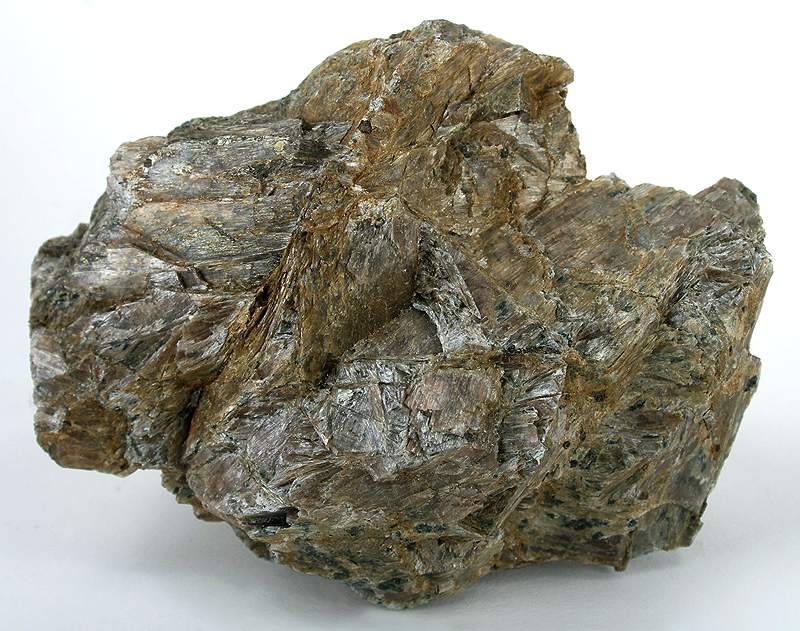
Weathered enstatite with a small amount of iron takes on a submetallic luster and a bronze-like color. This material is termed bronzite, although it is more correctly called altered enstatite.
Bronzite and hypersthene were known long before enstatite, which was first described by G. A. Kenngott in 1855.
An emerald-green variety of enstatite is called chrome-enstatite and is cut as a gemstone. The green color is caused by traces of chromium, hence the varietal name. In addition, black, chatoyant hypersthene and brownish bronzite are also used as semi-precious gemstones.
Enstatite and the other orthorhombic pyroxenes are distinguished from those of the monoclinic series by their optical characteristics, such as straight extinction, much weaker double refraction and stronger pleochroism. They also have a prismatic cleavage that is perfect in two directions at 90 degrees. Enstatite is white, gray, greenish, or brown in color; its hardness is 5–6 on the Mohs scale, and its specific gravity is 3.2–3.3. This prismatic form is used in gemstones, and for academic purposes.
Isolated crystals are rare, but orthopyroxene is an essential constituent of various types of igneous rocks and metamorphic rocks. Magnesian orthopyroxene occurs in plutonic rocks such as gabbro (norite) and diorite. It may form small idiomorphic phenocrysts and also groundmass grains in volcanic rocks such as basalt, andesite, and dacite.
Enstatite, close to En90Fs10 in composition, is an essential mineral in typical peridotite and pyroxenite of the Earth's mantle. Xenoliths of peridotite are common in kimberlite and in some basalt. Measurements of the calcium, aluminum, and chromium contents of enstatite in these xenoliths have been crucial in reconstructing the depths from which the xenoliths were plucked by the ascending magmas.
Hub AI
Enstatite AI simulator
(@Enstatite_simulator)
Enstatite
Enstatite is a mineral; the magnesium endmember of the pyroxene silicate mineral series enstatite (MgSiO3) – ferrosilite (FeSiO3). The magnesium rich members of the solid solution series are common rock-forming minerals found in igneous and metamorphic rocks. The intermediate composition, (Mg,Fe)SiO
3, has historically been known as hypersthene, although this name has been formally abandoned and replaced by orthopyroxene. When determined petrographically or chemically the composition is given as relative proportions of enstatite (En) and ferrosilite (Fs) (e.g., En80Fs20).
Most natural crystals are orthorhombic (space group Pbca) although three polymorphs are known. The high temperature, low pressure polymorphs are protoenstatite and protoferrosilite (also orthorhombic, space group Pbcn) while the low temperature forms, clinoenstatite and clinoferrosilite, are monoclinic (space group P21/c).
Weathered enstatite with a small amount of iron takes on a submetallic luster and a bronze-like color. This material is termed bronzite, although it is more correctly called altered enstatite.
Bronzite and hypersthene were known long before enstatite, which was first described by G. A. Kenngott in 1855.
An emerald-green variety of enstatite is called chrome-enstatite and is cut as a gemstone. The green color is caused by traces of chromium, hence the varietal name. In addition, black, chatoyant hypersthene and brownish bronzite are also used as semi-precious gemstones.
Enstatite and the other orthorhombic pyroxenes are distinguished from those of the monoclinic series by their optical characteristics, such as straight extinction, much weaker double refraction and stronger pleochroism. They also have a prismatic cleavage that is perfect in two directions at 90 degrees. Enstatite is white, gray, greenish, or brown in color; its hardness is 5–6 on the Mohs scale, and its specific gravity is 3.2–3.3. This prismatic form is used in gemstones, and for academic purposes.
Isolated crystals are rare, but orthopyroxene is an essential constituent of various types of igneous rocks and metamorphic rocks. Magnesian orthopyroxene occurs in plutonic rocks such as gabbro (norite) and diorite. It may form small idiomorphic phenocrysts and also groundmass grains in volcanic rocks such as basalt, andesite, and dacite.
Enstatite, close to En90Fs10 in composition, is an essential mineral in typical peridotite and pyroxenite of the Earth's mantle. Xenoliths of peridotite are common in kimberlite and in some basalt. Measurements of the calcium, aluminum, and chromium contents of enstatite in these xenoliths have been crucial in reconstructing the depths from which the xenoliths were plucked by the ascending magmas.