


Community hub
Recent from talks
Contribute something
Nothing was collected or created yet.
Hypersthene
View on Wikipedia| Hypersthene | |
|---|---|
 | |
| General | |
| Category | Inosilicate |
| Formula | (Mg,Fe)SiO3 |
| Strunz classification | 8/F.02-20 |
| Crystal system | Orthorhombic |
| Identification | |
| Color | Gray, brown, or green |
| Twinning | On [100] |
| Cleavage | {100} Perfect, {010} Perfect |
| Fracture | Uneven |
| Mohs scale hardness | 5.5–6 |
| Luster | Vitreous to pearly |
| Streak | Greyish white, greenish |
| Specific gravity | 3.4–3.9 |
| Optical properties | Biaxial (−) |
| Refractive index | nα = 1.669 – 1.755 nβ = 1.674 – 1.763 nγ = 1.680 – 1.773 |
| Birefringence | δ = 0.011 – 0.018 |
| Dispersion | Weak |
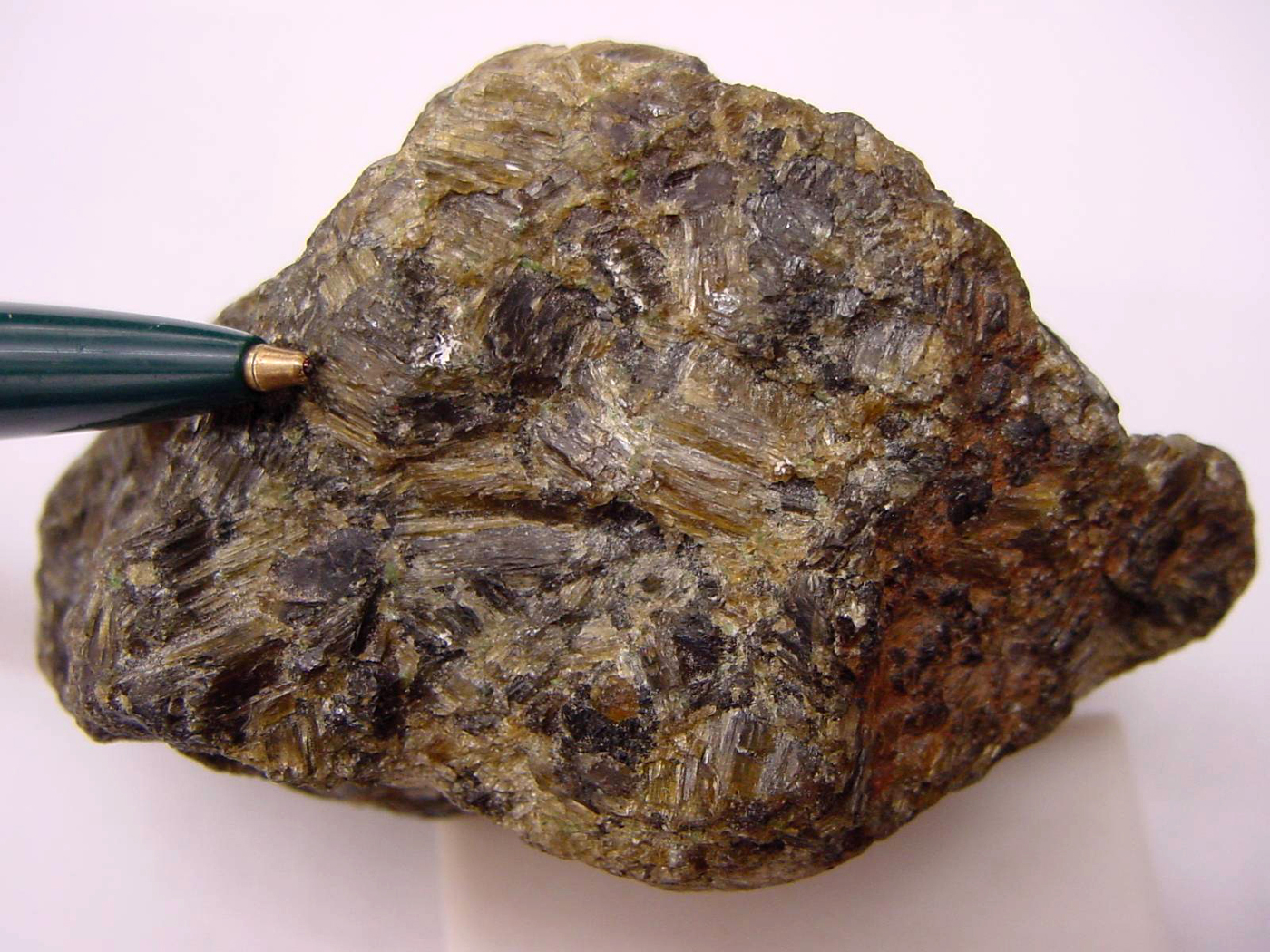
Hypersthene is a common rock-forming inosilicate mineral belonging to the group of orthorhombic pyroxenes.[1] Its chemical formula is (Mg,Fe)SiO3. It is found in igneous and some metamorphic rocks as well as in stony and iron meteorites. Many references have formally abandoned this term, preferring to categorise this mineral as enstatite or ferrosilite. It forms a solid solution series with the minerals enstatite and ferrosilite, being a mid-way member between the two. Pure enstatite contains no iron, while pure ferrosilite contains no magnesium; hypersthene is the name given to the mineral when a significant amount of both elements are present. Enstatite is stable at atmospheric pressure, but ferrosilite is stable only at elevated pressure, decomposing into quartz and fayalite at atmospheric pressure unless stabilized by magnesium or other impurities.[2]
Distinctly developed crystals are rare, the mineral being usually found as foliated masses embedded in the igneous rocks norite and hypersthene-andesite, of which it forms an essential constituent.[1] The coarse-grained labradorite-hypersthene-rock (norite) of Paul's Island off the coast of Labrador has furnished the most typical material; for this reason, the mineral has been known as Labrador hornblende or paulite.[1]
Color is often gray, brown, or green, and the luster is usually vitreous to pearly. The pleochroism is strong, the hardness is 5–6, and the specific gravity is 3.4–3.9. On certain surfaces it displays a brilliant copper-red metallic sheen, or schiller, which has the same origin as the bronzy sheen of bronzite, but is even more pronounced. Like bronzite, it is sometimes cut and polished as a gemstone.[1]
The name "hypersthene" comes from the Greek and means "over strength", and is an allusion to its being harder than the amphibole mineral hornblende (a mineral with which it is often confused.[3]
Hypersthene has been discredited by the International Mineralogical Association and is no longer considered a valid mineral type; specimens labelled as hypersthere are usually ferroan enstatite.[4]
References
[edit]- ^ a b c d One or more of the preceding sentences incorporates text from a publication now in the public domain: Spencer, Leonard James (1911). "Hypersthene". In Chisholm, Hugh (ed.). Encyclopædia Britannica. Vol. 14 (11th ed.). Cambridge University Press. p. 200.
- ^ Bohlen, Steven R.; Essene, Eric J.; Boettcher, A.L. (March 1980). "Reinvestigation and application of olivine-quartz-orthopyroxene barometry". Earth and Planetary Science Letters. 47 (1): 1–10. Bibcode:1980E&PSL..47....1B. doi:10.1016/0012-821X(80)90098-9. hdl:2027.42/23295.
- ^ "Hypersthene". ClassicGems.net.
- ^ "Hypersthene". mindat. Retrieved 1 May 2025.


Hypersthene
View on GrokipediaHypersthene typically exhibits a vitreous to pearly or submetallic luster, often with a bronzite variety displaying an iridescent schiller effect due to thin lamellae of exsolution.[3] It has a Mohs hardness of 5 to 6, a specific gravity of 3.4 to 3.9, and perfect cleavage in two directions nearly at right angles (87° and 93°), producing a conchoidal to uneven fracture.[4] Colors range from grayish-green to brownish-black, and it is usually translucent to opaque, though rarely transparent; it may show weak pleochroism from light pink to light green in thin sections.[1] Optically, it is biaxial, with refractive indices of nα = 1.669–1.755, nβ = 1.674–1.763, and nγ = 1.680–1.773, and a 2V angle of 50° to 90° that varies with composition—positive near enstatite and negative for intermediate ranges—along with parallel extinction relative to cleavage.[1][4] Occurrence and Formation
Hypersthene forms primarily in mafic and ultramafic igneous rocks through the slow cooling of magnesium- and iron-rich magmas, such as in gabbros, norites, peridotites, and basalts, and is also common in high-grade metamorphic rocks like granulites under conditions of elevated temperature and pressure.[4] Notable localities include the Adirondack Mountains in New York, USA, and the Bushveld Complex in South Africa, with additional occurrences in stony-iron meteorites and lunar basalts.[3][4] Uses and Significance
While not economically mined on a large scale, hypersthene serves as an important index mineral in petrology for classifying igneous and metamorphic rocks due to its stability in specific geochemical environments.[1] In gemology, attractive specimens with metallic luster or schiller are occasionally cut as cabochons or faceted gems for jewelry and collector items, though it is relatively rare and fragile for such applications.[4] Its presence in extraterrestrial materials also aids studies in planetary geology.[4]