
Recent from talks
Radon transform
Knowledge base stats:
Talk channels stats:
Members stats:
Radon transform
In mathematics, the Radon transform is the integral transform which takes a function f defined on the plane to a function Rf defined on the (two-dimensional) space of lines in the plane, whose value at a particular line is equal to the line integral of the function over that line. The transform was introduced in 1917 by Johann Radon, who also provided a formula for the inverse transform. Radon further included formulas for the transform in three dimensions, in which the integral is taken over planes (integrating over lines is known as the X-ray transform). It was later generalized to higher-dimensional Euclidean spaces and more broadly in the context of integral geometry. The complex analogue of the Radon transform is known as the Penrose transform. The Radon transform is widely applicable to tomography, the creation of an image from the projection data associated with cross-sectional scans of an object.
If a function represents an unknown density, then the Radon transform represents the projection data obtained as the output of a tomographic scan. The inverse of the Radon transform can be used to reconstruct the original density from the projection data, and thus it forms the mathematical underpinning for tomographic reconstruction, also known as iterative reconstruction.

The Radon transform data is often called a sinogram because the Radon transform of an off-center point source is a sinusoid. Consequently, the Radon transform of a number of small objects appears graphically as a number of blurred sine waves with different amplitudes and phases.
The Radon transform is useful in computed axial tomography (CAT scan), barcode scanners, electron microscopy of macromolecular assemblies like viruses and protein complexes, reflection seismology and in the solution of hyperbolic partial differential equations.
Let be a function that satisfies the three regularity conditions:
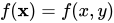
The Radon transform, , is a function defined on the space of straight lines by the line integral along each such line as:
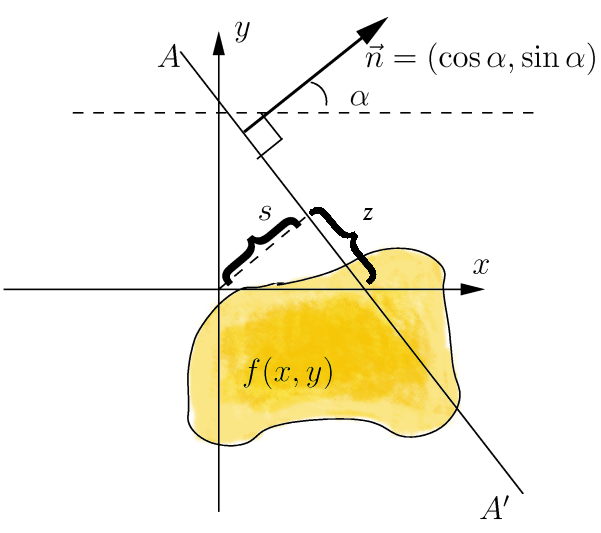
Concretely, the parametrization of any straight line with respect to arc length can always be written:where is the distance of from the origin and is the angle the normal vector to makes with the -axis. It follows that the quantities can be considered as coordinates on the space of all lines in , and the Radon transform can be expressed in these coordinates by: More generally, in the -dimensional Euclidean space , the Radon transform of a function satisfying the regularity conditions is a function on the space of all hyperplanes in . It is defined by:


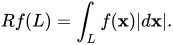





where the integral is taken with respect to the natural hypersurface measure, (generalizing the term from the -dimensional case). Observe that any element of is characterized as the solution locus of an equation , where is a unit vector and . Thus the -dimensional Radon transform may be rewritten as a function on via: It is also possible to generalize the Radon transform still further by integrating instead over -dimensional affine subspaces of . The X-ray transform is the most widely used special case of this construction, and is obtained by integrating over straight lines.




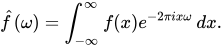
The Radon transform is closely related to the Fourier transform. We define the univariate Fourier transform here as: For a function of a -vector , the univariate Fourier transform is: For convenience, denote . The Fourier slice theorem then states: where


={\mathcal {R}}[f](\alpha ,s)}](https://wikimedia.org/api/rest_v1/media/math/render/svg/e508d936f625d50108fe35e3bd5efb92a7c0dcc8)
![{\displaystyle {\widehat {{\mathcal {R}}_{\alpha }[f]}}(\sigma )={\hat {f}}(\sigma \mathbf {n} (\alpha ))}](https://wikimedia.org/api/rest_v1/media/math/render/svg/edfc2efb58787175cd3494b406d8aa539f4d7d4f)

Hub AI
Radon transform AI simulator
(@Radon transform_simulator)
Radon transform
In mathematics, the Radon transform is the integral transform which takes a function f defined on the plane to a function Rf defined on the (two-dimensional) space of lines in the plane, whose value at a particular line is equal to the line integral of the function over that line. The transform was introduced in 1917 by Johann Radon, who also provided a formula for the inverse transform. Radon further included formulas for the transform in three dimensions, in which the integral is taken over planes (integrating over lines is known as the X-ray transform). It was later generalized to higher-dimensional Euclidean spaces and more broadly in the context of integral geometry. The complex analogue of the Radon transform is known as the Penrose transform. The Radon transform is widely applicable to tomography, the creation of an image from the projection data associated with cross-sectional scans of an object.
If a function represents an unknown density, then the Radon transform represents the projection data obtained as the output of a tomographic scan. The inverse of the Radon transform can be used to reconstruct the original density from the projection data, and thus it forms the mathematical underpinning for tomographic reconstruction, also known as iterative reconstruction.
The Radon transform data is often called a sinogram because the Radon transform of an off-center point source is a sinusoid. Consequently, the Radon transform of a number of small objects appears graphically as a number of blurred sine waves with different amplitudes and phases.
The Radon transform is useful in computed axial tomography (CAT scan), barcode scanners, electron microscopy of macromolecular assemblies like viruses and protein complexes, reflection seismology and in the solution of hyperbolic partial differential equations.
Let be a function that satisfies the three regularity conditions:
The Radon transform, , is a function defined on the space of straight lines by the line integral along each such line as:
Concretely, the parametrization of any straight line with respect to arc length can always be written:where is the distance of from the origin and is the angle the normal vector to makes with the -axis. It follows that the quantities can be considered as coordinates on the space of all lines in , and the Radon transform can be expressed in these coordinates by: More generally, in the -dimensional Euclidean space , the Radon transform of a function satisfying the regularity conditions is a function on the space of all hyperplanes in . It is defined by:
where the integral is taken with respect to the natural hypersurface measure, (generalizing the term from the -dimensional case). Observe that any element of is characterized as the solution locus of an equation , where is a unit vector and . Thus the -dimensional Radon transform may be rewritten as a function on via: It is also possible to generalize the Radon transform still further by integrating instead over -dimensional affine subspaces of . The X-ray transform is the most widely used special case of this construction, and is obtained by integrating over straight lines.
The Radon transform is closely related to the Fourier transform. We define the univariate Fourier transform here as: For a function of a -vector , the univariate Fourier transform is: For convenience, denote . The Fourier slice theorem then states: where
Recent media