Recent from talks
Nothing was collected or created yet.
Finite potential well
View on WikipediaThe finite potential well (also known as the finite square well) is a concept from quantum mechanics. It is an extension of the infinite potential well, in which a particle is confined to a "box", but one which has finite potential "walls". Unlike the infinite potential well, there is a probability associated with the particle being found outside the box. The quantum mechanical interpretation is unlike the classical interpretation, where if the total energy of the particle is less than the potential energy barrier of the walls it cannot be found outside the box. In the quantum interpretation, there is a non-zero probability of the particle being outside the box even when the energy of the particle is less than the potential energy barrier of the walls (cf quantum tunnelling).
Particle in a one-dimensional potential well
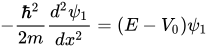
[edit]For the one-dimensional case on the x-axis, the time-independent Schrödinger equation can be written as:
| 1 |
where[1]
- is the reduced Planck constant,
- is the mass of the particle,
- is the potential energy at each point x,
- is the (complex valued) wavefunction, or "eigenfunction", and
- is the energy, a real number, sometimes called eigenenergy.
For the case of the particle in a one-dimensional box of length L, the potential is outside the box, and zero for x between and . The wavefunction is composed of different wavefunctions; depending on whether x is inside or outside of the box, such that:[2]
Inside the box
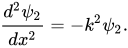
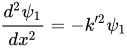
[edit]For the region inside the box, V(x) = 0 and Equation 1 reduces to[3] resembling the time-independent free schrödinger equation, hence Letting the equation becomes with a general solution of where A and B can be any complex numbers, and k can be any real number.
Outside the box
[edit]For the region outside of the box, since the potential is constant, and equation 1 becomes:
There are two possible families of solutions, depending on whether E is less than (the particle is in a bound state) or E is greater than (the particle is in an unbounded state).
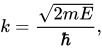
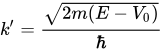
If we solve the time-independent Schrödinger equation for an energy , letting such that then the solution has the same form as the inside-well case: and, hence, will be oscillatory both inside and outside the well. Thus, the solution is never square integrable; that is, it is always a non-normalizable state. This does not mean, however, that it is impossible for a quantum particle to have energy greater than , it merely means that the system has continuous spectrum above , i.e., the non-normalizable states still contribute to the continuous part of the spectrum as generalized eigenfunctions of an unbounded operator.[4]
This analysis will focus on the bound state, where . Letting produces where the general solution is a real exponential:
Similarly, for the other region outside the box:
Now in order to find the specific solution for the problem at hand, we must specify the appropriate boundary conditions and find the values for A, B, F, G, H and I that satisfy those conditions.
Finding wavefunctions for the bound state
[edit]Solutions to the Schrödinger equation must be continuous, and continuously differentiable.[5] These requirements are boundary conditions on the differential equations previously derived, that is, the matching conditions between the solutions inside and outside the well.
In this case, the finite potential well is symmetrical, so symmetry can be exploited to reduce the necessary calculations.
Summarizing the previous sections: where we found , , and to be:
We see that as goes to , the term goes to infinity. Likewise, as goes to , the term goes to infinity. In order for the wave function to be square integrable, we must set , and we have: and
Next, we know that the overall function must be continuous and differentiable. In other words, the values of the functions and their derivatives must match up at the dividing points:
These equations have two sorts of solutions, symmetric, for which and , and antisymmetric, for which and . For the symmetric case we get so taking the ratio gives

Similarly for the antisymmetric case we get
Recall that both and depend on the energy. What we have found is that the continuity conditions cannot be satisfied for an arbitrary value of the energy; because that is a result of the infinite potential well case. Thus, only certain energy values, which are solutions to one or either of these two equations, are allowed. Hence we find that the energy levels of the system below are discrete; the corresponding eigenfunctions are bound states. (By contrast, for the energy levels above are continuous.[6])
The energy equations cannot be solved analytically. Nevertheless, we will see that in the symmetric case, there always exists at least one bound state, even if the well is very shallow.[7] Graphical or numerical solutions to the energy equations are aided by rewriting them a little and it should be mentioned that a nice approximation method has been found by Lima which works for any pair of parameters and .[8] If we introduce the dimensionless variables and , and note from the definitions of and that , where , the master equations read
In the plot to the right, for , solutions exist where the blue semicircle intersects the purple or grey curves ( and ). Each purple or grey curve represents a possible solution, within the range . The total number of solutions, , (i.e., the number of purple/grey curves that are intersected by the blue circle) is therefore determined by dividing the radius of the blue circle, , by the range of each solution and using the floor or ceiling functions:[9]
In this case there are exactly three solutions, since .

and , with the corresponding energies If we want, we can go back and find the values of the constants in the equations now (we also need to impose the normalisation condition). On the right we show the energy levels and wave functions in this case (where ).
We note that however small is (however shallow or narrow the well), there is always at least one bound state.
Two special cases are worth noting. As the height of the potential becomes large, , the radius of the semicircle gets larger and the roots get closer and closer to the values , and we recover the case of the infinite square well.
The other case is that of a very narrow, deep well - specifically the case and with fixed. As it will tend to zero, and so there will only be one bound state. The approximate solution is then , and the energy tends to . But this is just the energy of the bound state of a Delta function potential of strength , as it should be.
A simpler graphical solution for the energy levels can be obtained by normalizing the potential and the energy through multiplication by . The normalized quantities are giving directly the relation between the allowed couples as[10] for the even and odd parity wave functions, respectively. In the previous equations only the positive derivative parts of the functions have to be considered. The chart giving directly the allowed couples is reported in the figure.

Asymmetric well
[edit]Consider a one-dimensional asymmetric potential well given by the potential[11] with . The corresponding solution for the wave function with is found to be and
The energy levels are determined once is solved as a root of the following transcendental equation where Existence of root to above equation is not always guaranteed, for example, one can always find a value of so small, that for given values of and , there exists no discrete energy level. The results of symmetrical well is obtained from above equation by setting .
Particle in a spherical potential well
[edit]Consider the following spherical potential well where is the radius from the origin. The solution for the wavefunction with zero angular momentum () and with an energy is given by[11] satisfying the condition
This equation does not always have a solution indicating that in some cases, there are no bound states. The minimum depth of the potential well for which the bound state first appears at is given by
which increases with decreasing well radius . Thus, bound states are not possible if the well is sufficiently shallow and narrow. For well depth slightly exceeding the minimum value, i.e., for , the ground state energy (since we are considering case) is given by[12]
Spherically symmetric annular well
[edit]The results above can be used to show that, as to the one-dimensional case, there is two bound states in a spherical cavity, as spherical coordinates make equivalent the radius at any direction.
The ground state (n = 1) of a spherically symmetric potential will always have zero orbital angular momentum (ℓ = n−1), and the reduced wave function satisfies the equation where is the radial part of the wave function. Notice that for (n = 1) angular part is constant (ℓ = 0).
This is identical to the one-dimensional equation, except for the boundary conditions. As before,
The energy levels for are determined once is solved as a root of the following transcendental equation where
Existence of root to above equation is always guaranteed. The results are always with spherical symmetry. It fulfils the condition where the wave does not find any potential inside the sphere: .
Different differential equation lay on when ℓ ≠0, so as above titles, here it is:
The solution can be rationalized by some changes of variable and function to rise a Bessel like differential equation, which solution is: where , and are Bessel, Newman and Hankel spherical functions respectively, and could be rewritten as function of standard Bessel function.
The energy levels for are determined once is solved as a root of the following transcendental equation where
Also this two transcendental equations are solutions: and also,
Existence of roots to above equations are always guaranteed. The results are always with spherical symmetry.
See also
[edit]References
[edit]- ^ Hall 2013, p. 110.
- ^ Hall 2013, p. 111.
- ^ Ballentine 1998, pp. 109–112.
- ^ Hall 2013 Section 5.2, 5.5 and Exercise 4 in Chapter 3
- ^ Hall 2013 Proposition 5.1
- ^ Hall 2013 Section 5.5
- ^ Hall 2013 Proposition 5.3
- ^ Lima, Fabio M. S. (2020). "A simpler graphical solution and an approximate formula for energy eigenvalues in finite square quantum wells". Am. J. Phys. 88 (11): 1019. Bibcode:2020AmJPh..88.1019L. doi:10.1119/10.0001694.
- ^ Williams, Floyd (2003). Topics in Quantum Mechanics. Springer Science+Business Media. p. 57. ISBN 978-1-4612-6571-9.
- ^ Chiani, M. (2016). "A chart for the energy levels of the square quantum well". arXiv:1610.04468 [physics.gen-ph].
- ^ a b Landau, L. D., & Lifshitz, E. M. (2013). Quantum mechanics: non-relativistic theory (Vol. 3). Elsevier.
- ^ Perelomov, A. M., & Zeldovich, Ya. B. (1998). Quantum Mechanics, Selected Topics. World Scientific.
Further reading
[edit]- Ballentine, Leslie E (1998). Quantum Mechanics. WORLD SCIENTIFIC. doi:10.1142/3142. ISBN 978-981-02-2707-4.
- Griffiths, David J. (2005). Introduction to Quantum Mechanics (2nd ed.). Prentice-Hall. ISBN 0-13-111892-7.
- Hall, Brian C. (2013), Quantum Theory for Mathematicians, Graduate Texts in Mathematics, vol. 267, Springer
Finite potential well
View on GrokipediaOne-Dimensional Finite Potential Well
Potential Profile and Setup
The one-dimensional finite potential well models a particle confined between two finite barriers, providing a more realistic approximation to quantum confinement compared to idealized infinite walls. The potential energy is defined as zero within the well region and a positive constant outside, specifically for and for , where and is the well width.[3] This creates a rectangular potential profile resembling a "hole" in an otherwise flat landscape at height , allowing the particle to be trapped but with the possibility of tunneling through the barriers.[3] The system's behavior is governed by the time-independent Schrödinger equation in one dimension: where is the reduced Planck's constant, is the particle mass, is the wave function, and is the energy eigenvalue.[3] This equation assumes a time-independent, non-relativistic framework for a single particle, focusing on bound states where to ensure the particle is localized with exponentially decaying probability outside the well.[3] The tunneling phenomenon in finite potentials was notably applied by George Gamow in 1928 to explain alpha decay.[4] Unlike the infinite potential well, where the wave function vanishes abruptly at the boundaries, the finite well permits penetration into the classically forbidden regions beyond , resulting in exponentially decaying tails in .[5] Consequently, the finite well supports fewer bound states and lower energy levels than the corresponding infinite well for the same width, as the effective confinement is weaker due to this spillover effect.[5]Solutions to the Schrödinger Equation
The time-independent Schrödinger equation for a particle in the symmetric one-dimensional finite potential well, defined by for and for , is solved piecewise in the three distinct regions.[6] Inside the well (), where the potential is zero, the equation simplifies to the free-particle form: yielding the general oscillatory solution with wave number . Outside the well, for , the potential is constant at , so the equation becomes with the physically relevant solution being the evanescent (decaying) wave where . Similarly, for , ensuring exponential decay away from the well on both sides.[6] Given the even symmetry of the potential, the wave functions naturally separate into even and odd parity solutions. For even parity, , , and , resulting in . For odd parity, , , and , yielding . The coefficients , , , and are determined up to normalization, requiring This oscillatory form inside the well reflects classical allowed motion, while the exponential tails outside indicate quantum tunneling into the forbidden region.[6]Boundary Conditions and Wave Function Matching
In the finite potential well, the time-independent Schrödinger equation yields solutions that must satisfy specific boundary conditions at the interfaces x = ±a, where the potential changes from 0 (inside, |x| < a) to V₀ (outside, |x| > a). The wave function ψ(x) and its first derivative dψ/dx must both be continuous at these points. This requirement stems from the finite nature of the potential, which imposes no infinite barriers or singular forces; discontinuities in ψ(x) would imply infinite kinetic energy or unphysical probability densities, while discontinuities in dψ/dx would suggest infinite accelerations or delta-function potentials, neither of which apply here.[3][1] For even-parity bound states, the wave function takes the form ψ(x) ∝ cos(kx) inside the well, with k = √(2mE) / ℏ, and ψ(x) ∝ e^{-κ|x|} outside, where κ = √[2m(V₀ - E)] / ℏ > 0 ensures exponential decay in the classically forbidden regions. Applying continuity at x = a, the value matching gives cos(ka) = e^{-κ a} (up to a common normalization constant that scales both regions equally). The derivative continuity at the same boundary yields -k sin(ka) = -κ cos(ka), reflecting the slope alignment between the oscillatory interior and the decaying exterior.[7][1] Dividing the derivative condition by the value from the wave function continuity eliminates the normalization constant, resulting in the ratio κ / k = tan(ka) for even-parity states. This relation connects the interior wave number k (tied to the energy E via the allowed oscillatory behavior) to the exterior decay constant κ (tied to the binding energy below the potential edge). Similarly, for odd-parity states, where ψ(x) ∝ sin(kx) inside and the same exponential form outside, the value matching at x = a is sin(ka) = e^{-κ a}, and the derivative matching is k cos(ka) = -κ sin(ka), leading to -κ / k = cot(ka). These matching conditions enforce the global smoothness of the wave function across the entire domain.[7][3] The parameter 1/κ represents the penetration depth, quantifying how far the wave function tunnels into the forbidden regions beyond x = ±a before decaying significantly; larger depths correspond to shallower wells or energies closer to the potential edge, highlighting the evanescent nature of the tails. This penetration is a direct consequence of the continuity requirements, allowing nonzero probability in the barriers despite classical prohibition.[1]Quantization Condition and Energy Levels
The quantization condition for bound states in the one-dimensional finite potential well arises from matching the wave functions and their derivatives at the boundaries x = ±a, resulting in transcendental equations that determine the discrete energy eigenvalues E_n satisfying 0 < E_n < V_0.[1] For even-parity states, the condition is , where and .[8] For odd-parity states, it is .[8] Defining the dimensionless parameters and , the equations simplify to for even states and for odd states, subject to the constraint , a constant depending on the well parameters.[1] These equations lack closed-form solutions and are typically solved graphically: plot the semicircle (for ) and find its intersections with the periodic branches of (even) or (odd) in the first quadrant.[1] Each intersection corresponds to an allowed , from which .[1] The number of bound states is finite and depends on the well depth and width ; there is always at least one (even-parity ground state) for any , with additional states appearing as or increases, up to a maximum approximately .[1] The energy spectrum consists of discrete levels , alternating in parity, with the ground state and successive levels spaced more closely than in the corresponding infinite well.[1] In the shallow-well limit (small ), only a few bound states exist, and the ground-state energy is small. In the deep-well limit (large ), the spectrum approaches that of the infinite well, with and perturbative corrections for finite penetration into the barriers.[1] Exact solutions require numerical methods to solve the transcendental equations, though approximate analytic expressions are available for weak binding, such as for the ground state where is a constant of order unity, valid near the infinite-well limit.[9]Even and Odd Parity Solutions
In the symmetric one-dimensional finite potential well, where the potential is even, V(x) = V(-x), the bound state solutions to the time-independent Schrödinger equation possess definite parity, allowing classification into even and odd states. The even parity wave functions satisfy ψ_even(-x) = ψ_even(x), while the odd parity ones satisfy ψ_odd(-x) = -ψ_odd(x). These solutions alternate, with the ground state being even and higher excited states alternating in parity. The explicit forms incorporate the wave numbers k = √(2mE)/ℏ inside the well and κ = √[2m(V₀ - E)]/ℏ outside, where E is the bound state energy (0 < E < V₀) determined by the quantization condition.[1] The normalized even parity wave function takes the form where the normalization constant A ensures ∫_{-∞}^∞ |ψ_even(x)|² dx = 1. Due to symmetry, this condition simplifies to 2A² [∫_0^a cos²(kx) dx + cos²(ka) ∫_a^∞ e^{-2κ(x - a)} dx] = 1, yielding The first integral evaluates to (a/2) + sin(2ka)/(4k), and the second to cos²(ka)/(2κ), confirming the expression after doubling for full space. This form maintains continuity of ψ and dψ/dx at x = ±a.[3] Similarly, the normalized odd parity wave function is with the normalization constant derived analogously from ∫_{-∞}^∞ |ψ_odd(x)|² dx = 1, where the inside integral is (a/2) - sin(2ka)/(4k) and the outside contribution is sin²(ka)/(2κ), doubled for symmetry. The sign function ensures odd parity and proper matching at the boundaries.[3] The probability densities |ψ_even(x)|² and |ψ_odd(x)|² highlight key quantum features. For even states, |ψ_even(x)|² peaks at x = 0 and decays toward the edges inside the well, with exponential tails extending into the forbidden regions (|x| > a), indicating quantum tunneling and an effective well width greater than 2a. Odd states exhibit a node at x = 0, where |ψ_odd(0)|² = 0, with symmetric lobes peaking away from the center and similar evanescent tails outside. This penetration is most pronounced for lower-energy states near E ≈ 0, reducing the effective confinement.[1]Asymmetric Potential Well
The asymmetric finite potential well features barriers of unequal heights, breaking the parity symmetry of the symmetric case. The potential is defined as where and is the well width.[10] For bound states with energy , the time-independent Schrödinger equation yields oscillatory solutions inside the well and exponentially decaying solutions outside. Inside (), the wave function is , where . On the left (), , with ; on the right (), , with . These forms ensure the wave function decays in the classically forbidden regions beyond the barriers.[11] The coefficients are determined by requiring continuity of and at the interfaces and . This results in two coupled transcendental equations: Unlike the symmetric well, no closed-form analytic solutions exist for the energy eigenvalues , as the equations cannot be reduced to simple graphical or algebraic conditions.[10] Numerical methods are essential to solve for the discrete energy levels. The shooting method is commonly employed: guess an initial , integrate the Schrödinger equation from the left boundary using the left-region form and initial conditions (e.g., , ), continue into the well with the oscillatory solution, and check the logarithmic derivative against . Adjust iteratively (e.g., via bisection or secant method) until the mismatch is zero, yielding a bound state energy. The transfer matrix method alternatively propagates the wave function coefficients across regions to enforce matching. These approaches confirm a finite number of bound states, typically fewer than in the symmetric case if one barrier (say ) is sufficiently low, as higher energies may exceed the shallower barrier and become unbound.[12][13] A simple pseudocode for root-finding the energy levels using bisection on the mismatch function is:function find_energy(E_min, E_max, tolerance):
while (E_max - E_min > tolerance):
E_mid = (E_min + E_max) / 2
integrate_psi_from_left(E_mid) # Compute ψ and ψ' at x=a from left
f_mid = psi_prime_a / psi_a + kappa_R(E_mid)
if f_mid * f(E_min) > 0:
E_min = E_mid
else:
E_max = E_mid
return (E_min + E_max) / 2
function find_energy(E_min, E_max, tolerance):
while (E_max - E_min > tolerance):
E_mid = (E_min + E_max) / 2
integrate_psi_from_left(E_mid) # Compute ψ and ψ' at x=a from left
f_mid = psi_prime_a / psi_a + kappa_R(E_mid)
if f_mid * f(E_min) > 0:
E_min = E_mid
else:
E_max = E_mid
return (E_min + E_max) / 2