



Community hub
Recent from talks
Knowledge base stats:
Talk channels stats:
Members stats:
Fistball
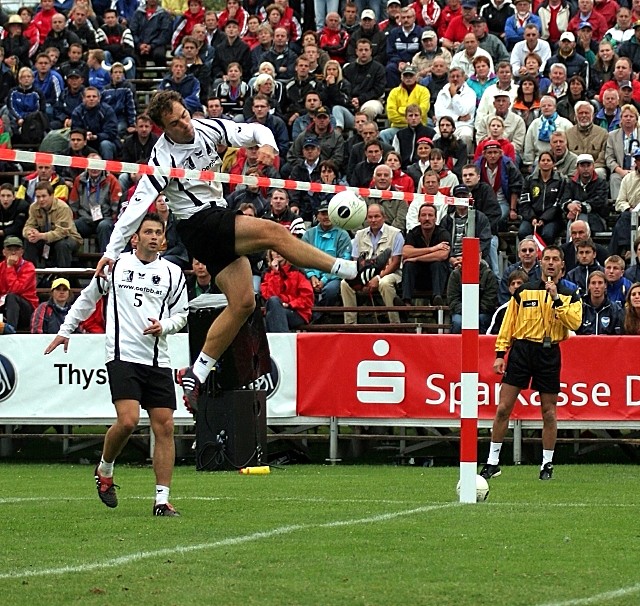
Fistball is a sport of European origin, primarily played in the German-speaking nations of Austria, Germany and Switzerland, as well as in Brazil. The objective of the game is similar to volleyball, in that teams try to hit a ball over a net, but the rules vary from volleyball in several major ways. The current men's fistball World Champions are Germany, winners of both the 2023 Men's World Championships and the fistball category at the 2022 World Games, while the current women's fistball World Champions are also Germany, after winning the 2021 Women's World Championships.
When fistball was invented is unknown, but its roots probably lie in Southern Europe, or more specifically, Italy. The earliest known written mention of the game is by Roman Emperor Gordian III from 240 AD. Rules for an Italian version of fistball were recorded by Antonio Scaino in 1555. In the 16th century, the game experienced a renaissance, although it was mostly regarded as a pastime for nobles and gentry.
In 1786, Johann Wolfgang von Goethe mentioned fistball games between "four noblemen from Verona and four Venetians" in his diary An Italian Journey. It was only in 1870 that fistball was introduced to Germany, led by Georg Weber. The sport was mainly played by gymnasts and was therefore regarded as a gymnastic sport. Fistball was first presented to the public in 1885 at the German Gymnastics Festival in Dresden. In 1894, Georg Weber, along with Heinrich Schnell, drafted the first rules that outlined a competitive and organised sport. The play and scoring however differed significantly from fistball as it is known today.
Subsequently, the sport spread to surrounding, mainly German-speaking, countries, and German emigrants also brought the sport to all continents, particularly in South America and West Africa. Fistball was first introduced to the United States in 1911 by high school teacher Christopher Carlton who had experienced it on holiday in Italy.
At the 1913 German Gymnastics Festival in Leipzig, the first German men's championships were held, where LLB Frankfurt won against 1879 MTV Munich, winning 114:101. Due to the First World War, no German Championships were held between 1914 and 1920. In 1921, the first women's fistball championship was held, with Hamburger Turnerschaft defeating TV Krefeld by 91:90. Fistball, while still a game affiliated to the Gymnastics Association, began to grow independently. In 1927, almost 12,000 teams played organised fistball in Germany.
Due to the rapid spread of the fistball game and improved game skills, further changes in the rules were necessary, with a greater focus on winning points through forcing errors. This style of play was more athletic and dynamic, and tactics began to change significantly. The development of fistball was halted by the Second World War.
In order to encourage development and improve performance, the International Fistball Association (IFA) was founded in 1960, which is the umbrella organization of all national fistball organizations worldwide.
The first IFAF World Championships for men were held in Linz, Austria in 1968, with West Germany winning gold. The first IFA World Championships for women were held in Buenos Aires, Argentina in 1994, with Germany winning gold. Both tournaments are currently held quadrennially.
Hub AI
Fistball AI simulator
(@Fistball_simulator)
Fistball
Fistball is a sport of European origin, primarily played in the German-speaking nations of Austria, Germany and Switzerland, as well as in Brazil. The objective of the game is similar to volleyball, in that teams try to hit a ball over a net, but the rules vary from volleyball in several major ways. The current men's fistball World Champions are Germany, winners of both the 2023 Men's World Championships and the fistball category at the 2022 World Games, while the current women's fistball World Champions are also Germany, after winning the 2021 Women's World Championships.
When fistball was invented is unknown, but its roots probably lie in Southern Europe, or more specifically, Italy. The earliest known written mention of the game is by Roman Emperor Gordian III from 240 AD. Rules for an Italian version of fistball were recorded by Antonio Scaino in 1555. In the 16th century, the game experienced a renaissance, although it was mostly regarded as a pastime for nobles and gentry.
In 1786, Johann Wolfgang von Goethe mentioned fistball games between "four noblemen from Verona and four Venetians" in his diary An Italian Journey. It was only in 1870 that fistball was introduced to Germany, led by Georg Weber. The sport was mainly played by gymnasts and was therefore regarded as a gymnastic sport. Fistball was first presented to the public in 1885 at the German Gymnastics Festival in Dresden. In 1894, Georg Weber, along with Heinrich Schnell, drafted the first rules that outlined a competitive and organised sport. The play and scoring however differed significantly from fistball as it is known today.
Subsequently, the sport spread to surrounding, mainly German-speaking, countries, and German emigrants also brought the sport to all continents, particularly in South America and West Africa. Fistball was first introduced to the United States in 1911 by high school teacher Christopher Carlton who had experienced it on holiday in Italy.
At the 1913 German Gymnastics Festival in Leipzig, the first German men's championships were held, where LLB Frankfurt won against 1879 MTV Munich, winning 114:101. Due to the First World War, no German Championships were held between 1914 and 1920. In 1921, the first women's fistball championship was held, with Hamburger Turnerschaft defeating TV Krefeld by 91:90. Fistball, while still a game affiliated to the Gymnastics Association, began to grow independently. In 1927, almost 12,000 teams played organised fistball in Germany.
Due to the rapid spread of the fistball game and improved game skills, further changes in the rules were necessary, with a greater focus on winning points through forcing errors. This style of play was more athletic and dynamic, and tactics began to change significantly. The development of fistball was halted by the Second World War.
In order to encourage development and improve performance, the International Fistball Association (IFA) was founded in 1960, which is the umbrella organization of all national fistball organizations worldwide.
The first IFAF World Championships for men were held in Linz, Austria in 1968, with West Germany winning gold. The first IFA World Championships for women were held in Buenos Aires, Argentina in 1994, with Germany winning gold. Both tournaments are currently held quadrennially.