Recent from talks
Nothing was collected or created yet.
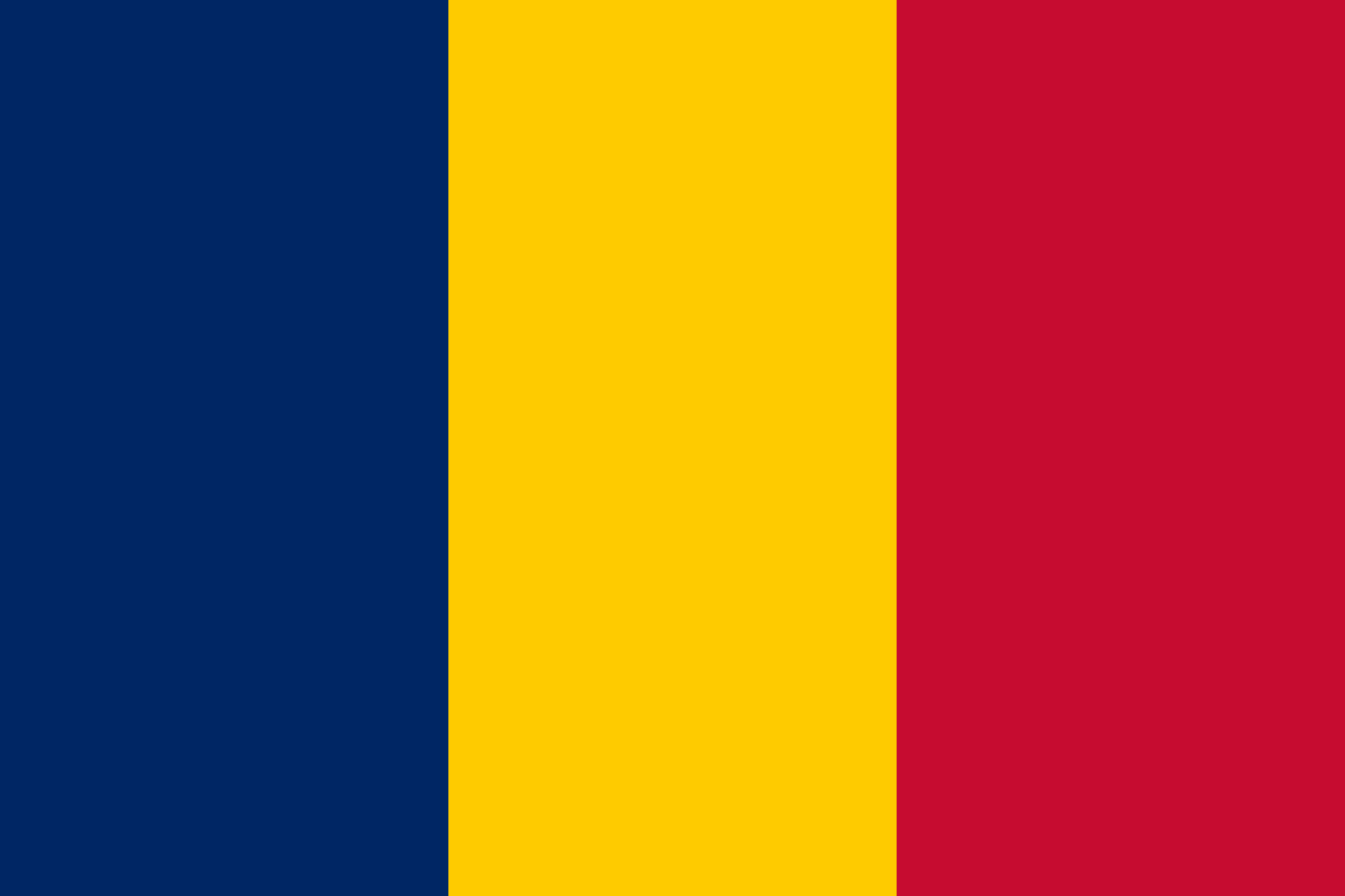
Flag of Chad
View on Wikipedia
| Use | National flag |
|---|---|
| Proportion | 2:3 |
| Adopted | November 6, 1959 |
| Design | A vertical tricolour of indigo, yellow, and red |
| Designed by | Naiyia Amina Goudja |
| Presidential standard of Chad | |
| Use | Presidential standard |
| Proportion | 2:3 |
| Design | A vertical tricolour of indigo, yellow, and red with the national coat of arms in the center |
The national flag of Chad is a vertical tricolour of indigo, yellow, and red.[1] It was adopted on 6 November 1959, almost a year after the founding of the autonomous Republic of Chad.[2] Since the 1990s, its similarity to the flag of Romania has caused international discussion.
Colours
[edit](1959–present) |
Indigo | Yellow | Red |
|---|---|---|---|
| RGB | 0-32-91 | 252-205-0 | 200-16-46 |
| Web colours | #00205B | #FFCD00 | #C8102E |
Description
[edit]The flag of Chad is a vertical tricolour consisting (left to right) of a indigo, a yellow and a red column. The colours of the Chadian flag were intended to be a combination of the colours of blue, white and red as seen on the flag of France with the Pan-African colours of green, yellow and red as seen on the flag of Ethiopia.[3] Furthermore, the indigo represents the lake Chad and the Black African heritage; the yellow represents the sands of the Sahara desert, and the red represents the bloodshed over independence of Chad from France.[4]
The flag was adopted in 1959 for the autonomous republic and retained on independence in 1960, and in the constitution of 1962. Despite many political upheavals within Chad since independence, the flag has not been changed. This may be because the flag is not associated with any of the main power rivals within Chad, which had no sense of national identity before independence, and little after independence.[5]
Similarity with Romanian flag
[edit]The flag of Chad is almost identical to the national flag of Romania, although the colours in Chad flags may vary more than those specified for Romania. Romania has used the flag since 1866, which appeared for the first time in its current form in Wallachia. It was officially in use from 1866 until 1948, when it was superseded by the flag of the Socialist Republic of Romania. Chad began to use its present flag in 1960, after it achieved independence from France. When Chad adopted its flag, Romania's flag also included an emblem in the middle of the flag on top of the tricolour; this was added after World War II during the Communist era of the second half of the 20th century. However, in 1989 Romania's Communist government was overthrown and the insignia was removed, reverting Romania's flag to the prewar version which matched the one which had been adopted by Chad in the meantime.[6]
The crisis between Romania and Chad sharing similar flags has concerned the Chadian government on occasion; they requested in 2004 that the United Nations examine the issue. In response, Romanian President Ion Iliescu stated that no change would occur to the flag, as the existence of Romania's tricolour predates the existence of Chad as a whole: "The tricolour belongs to us. We will not give up the tricolour."[6]
In May 2025, George Simion, the right-wing populist candidate in the 2025 Romanian presidential election, mistakenly used the national flag of Chad instead of the Romanian flag in a post on X claiming he had won prior to the vote count being completed.[7]
Historical flags
[edit]-
Flag of Bornu (Kanem's successor) according to Gabriel de Vallseca (1439) -
Standard of the French Community
See also
[edit]References
[edit]- ^ "Constitution of Chad" (PDF). presidence.td (in French). Chadian government. 31 March 1996. Archived from the original (PDF) on 2 February 2017. Retrieved 31 January 2017.
L'emblème national est le drapeau tricolore, bleu, or, rouge à bandes verticales et à dimensions égales, le bleu étant du côté de la hampe.
- ^ Smith, Whitney (2 February 2001). "Flag of Chad". Encyclopædia Britannica. Encyclopædia Britannica, Inc.
- ^ MacDonald, Ian (20 November 2013). "Chad". Flags of the World. Retrieved 4 November 2016.
- ^ Minahan, James (2010). The complete guide to national symbols and emblems. Santa Barbara, Calif.: Greenwood Press. p. 806. ISBN 978-0-313-34496-1. OCLC 436221284.
- ^ Vagnat, Pascal (2000). Constitutions : what they tell us about national flags and coats of arms. Jos Poels. [Johannesburg, South Africa]: Southern African Vexillological Association (SAVA). ISBN 0-620-27350-X. OCLC 436864297.
- ^ a b "'Identical flag' causes flap in Romania". BBC News. 14 April 2004. Retrieved 4 November 2016.
- ^ Mihaila, Lorena (19 May 2025). "George Simion "a devenit" "președinte al Ciadului". Pagina de Wikipedia a țării a fost modificată". Stirile PRO TV. Retrieved 13 July 2025.
External links
[edit]Flag of Chad
View on GrokipediaThe national flag of Chad is a vertical tricolour featuring three equal bands of blue at the hoist, yellow in the centre, and red at the fly.[1]
It was officially adopted on 6 November 1959, prior to the country's full independence from France on 11 August 1960, and has remained unchanged since.[2][3]
The design draws from the French tricolour by incorporating blue and red, augmented with yellow from Pan-African symbolism, where blue represents the sky over Lake Chad and the nation's hope, yellow denotes the Sahara Desert and sun, and red signifies the blood shed in the struggle for independence and national unity.[1][3]
Notable for its near-identical appearance to the flag of Romania—differing only in a slightly darker shade of blue on Chad's version—the similarity prompted Chad to lodge a formal protest with the United Nations in 2004, asserting prior claim due to Romania's temporary use of a coat of arms in its yellow band from 1948 to 1989, though the issue was resolved by emphasizing contextual distinctions at international events.[1][2]
Design and Specifications
Physical Description
The national flag of Chad is a vertical tricolour featuring three equal-width bands arranged from hoist to fly: blue on the hoist side, followed by yellow (or gold), and red on the outer edge.[3][2][4] The design contains no additional emblems, seals, or charges, maintaining a simple striped composition.[3][5] The flag's standard proportions adhere to a 2:3 aspect ratio, with the height of each vertical band one-third of the flag's width.[5][3] Suggested Pantone Matching System (PMS) equivalents for construction include 281 C for blue, 116 C for yellow, and 186 C for red, though no legally binding specifications are mandated by Chadian law.[3] The vertical orientation distinguishes it from horizontal tricolours, ensuring the blue band remains adjacent to the flagstaff when hoisted.[3]Color Specifications and Proportions
The flag of Chad consists of three equal vertical bands, with blue at the hoist side, followed by yellow, and red at the fly side. Each band occupies one-third of the flag's total width.[3] The overall proportions adhere to a 2:3 ratio of height to width, consistent with standard vexillological practice for such tricolors.[5] No official decree specifies precise color values for the flag, reflecting the adoption process in 1959 without codified chromatic standards.[6] In vexillological documentation, the colors are commonly rendered using Pantone Matching System equivalents: 281C for blue, 116C for yellow, and 186C for red.[3] Corresponding digital representations include RGB values of approximately (0, 37, 105) for blue, (255, 206, 0) for yellow, and (210, 16, 52) for red, with hexadecimal codes #002664, #FECB00, and #C60C30, respectively.[7]| Color | Pantone | RGB | HEX |
|---|---|---|---|
| Blue | 281C | (0, 37, 105) | #002664 |
| Yellow | 116C | (255, 206, 0) | #FECB00 |
| Red | 186C | (210, 16, 52) | #C60C30 |
Symbolism and Interpretation
Official Meanings of Colors
The vertical tricolour design of the Flag of Chad incorporates indigo blue, yellow, and red, with meanings attributed to each color reflecting the nation's geography, resources, and historical struggle for independence, as adopted on 6 November 1959. The hoist-side blue stripe symbolizes the sky and hope, alongside the waters, agriculture, and southern regions of the country, including references to Lake Chad in some interpretations.[3][8] The central yellow stripe represents the sun and the arid Sahara Desert encompassing the northern territories.[3][9] The fly-side red stripe denotes national unity and the blood sacrificed by martyrs during the independence movement against French colonial rule.[3][8] These interpretations draw from Pan-African color symbolism—modified from Ethiopia's green-yellow-red by substituting blue for green to distinguish Chad's flag—combined with French tricolour influences, though Chad's constitution specifies only the colors and layout without explicit symbolism.[3][10]Alternative or Regional Interpretations
The official symbolism of Chad's flag incorporates regional geographical associations, offering interpretations that vary by the country's north-south divide. The blue vertical band, positioned on the hoist side, is linked to the southern regions' agricultural productivity and the waters of Lake Chad, symbolizing hope and fertility in areas dominated by sedentary farming communities such as the Sara ethnic group.[3] In contrast, the central yellow band evokes the arid northern deserts and Sahelian landscapes, representing the sun's endurance and the pastoral heritage of nomadic groups like the Arab and Toubou peoples.[3] These regional emphases provide a localized framing that complements the abstract national narrative, though they remain within the standardized attributions established at adoption. Alternative interpretations occasionally arise from Chad's ethnic fragmentation, with over 200 distinct groups potentially overlaying personal or communal significances onto the colors, such as viewing red not only as martyrs' sacrifice but as emblematic of inter-ethnic bloodshed during civil conflicts like the 1979-1982 wars between northern and southern factions.[11] However, such views lack formal documentation and contrast with the flag's intended role in fostering unity amid diversity, as no ethnic-specific symbolisms have been officially recognized or widely recorded. The substitution of blue for the Pan-African green—chosen in 1959 to avoid confusion with neighboring flags and nod to French colonial tricolors—has led some observers to interpret the design as a hybrid of European legacy and African solidarity, diverging from pure Pan-African orthodoxy.[3] This perspective highlights causal influences of colonial history on post-independence vexillology, rather than endogenous cultural reinterpretations.Historical Development
Pre-Colonial and Colonial Flags
The territory encompassing modern Chad lacked standardized national flags in the pre-colonial era, as polities such as the Kanem Empire (circa 700–1380 AD) and its successor, the Bornu Empire (circa 1380–1900 AD), employed banners, standards, and symbols primarily for military or royal identification rather than territorial sovereignty in the contemporary sense. The earliest surviving European visual record of a Kanem-associated banner appears in the 1339 portolan atlas by Majorcan cartographer Angelino Dulcert, depicting a blue field traversed by a diagonal golden bend, potentially representing a heraldic device observed or inferred during trans-Saharan interactions.[12] Subsequent depictions include the Bornu banner on Gabriel de Vallseca's 1439 portolan chart, illustrated as a golden field bearing a white crescent, which may reflect Islamic influences prevalent in the empire's Sahelian court and military traditions.[13] These representations derive from Mediterranean cartographic traditions reliant on secondhand reports from Arab traders and travelers, rendering their precise usage and colors subject to interpretive variance; no indigenous pre-colonial artifacts confirm the designs, underscoring the anachronistic application of modern flag concepts to pre-19th-century African states.[14] French colonial administration in Chad commenced in 1900 with the establishment of the Military Territory of Chad, under which the national flag of France—the vertical tricolour of blue, white, and red—served as the sole official ensign across administrative, military, and civil contexts.[15] Integrated into French Equatorial Africa in 1910, the territory continued employing the tricolour without territorial variants until autonomy in 1958, reflecting the centralized imperial policy of metropolitan flag usage in sub-Saharan possessions to symbolize undivided sovereignty.[3] During World War II, Chad adhered to the Free French Forces on August 26, 1940, as the first colonial territory to do so under Governor Félix Éboué, with subsequent administrator Pierre-Olivier Lapie (1940–1942) introducing provisional standards incorporating the Cross of Lorraine emblem alongside tricolour elements to denote allegiance to Charles de Gaulle's provisional government. These adaptations, including Lapie's personal gubernatorial flag, persisted briefly until alignment with the restored metropolitan tricolour post-liberation, marking a transitional vexillological phase amid Vichy-Free French rivalries but without supplanting the foundational French ensign.[16] By the late 1950s, as Chad transitioned toward self-rule within the French Community, the tricolour remained dominant until the adoption of a distinct national design in 1959.Adoption Process in 1959
In 1959, as the Republic of Chad transitioned toward greater autonomy within the French Community ahead of full independence, its legislative assembly initiated the process to establish a distinct national flag, replacing colonial symbols such as the French Tricolour used in French Equatorial Africa.[8] A commission was tasked with designing the flag and, on June 30, 1959, recommended a vertical tricolour featuring equal stripes of green, yellow, and red, intended to symbolize the fertile lands of southern Chad (green), the central desert (yellow), and the northern regions inhabited by nomadic peoples (red).[8] [15] This initial proposal aligned with Pan-African color schemes prevalent in the region but drew from local geographic and cultural elements.[3] The green-yellow-red design faced revision due to its close resemblance to the flag of Mali, adopted earlier that year on April 20, 1959, prompting a substitution of dark blue for green to better evoke the northern sky and Lake Chad while maintaining symbolic continuity.[8] [15] The updated tricolour—blue (hoist side) for hope and the northern waters, yellow for the sun and Sahara, and red for unity and the sacrifices of independence fighters—was formalized through Law No. 59/13, passed by the Chadian National Assembly.[3] [8] This law, dated June 11, 1959, outlined the flag's adoption for the autonomous republic, though final approval by acclamation occurred on November 6, 1959, nearly a year after Chad's establishment as an autonomous entity on August 28, 1958.[3] [8] The process reflected France's Loi-cadre reforms of 1956–1958, which devolved powers to territories and encouraged symbolic assertions of sovereignty without immediate rupture from metropolitan oversight.[17] The adopted flag's proportions adhered to a 2:3 ratio, with no emblems or modifications, ensuring simplicity and versatility for official use.[3] This design choice prioritized distinction from both colonial precedents and neighboring states, embedding regional identity into a vexillological framework influenced by French tricolour traditions but adapted to Chadian contexts.[8] The flag's retention post-independence on August 11, 1960, underscores the stability of the 1959 process amid the broader wave of Sahelian decolonization.[17]Post-Independence Retention and Stability
The flag of Chad, adopted by Law No. 59/13 on November 6, 1959, for the autonomous republic within the French Community, was retained without alteration upon full independence from France on August 11, 1960.[9][3] Its design—a vertical tricolor of blue, yellow, and red—was reaffirmed in the 1962 constitution, which established it as the national emblem amid the early presidency of François Tombalbaye.[18] Chad's post-independence era has been marked by profound political turbulence, including the 1965 outbreak of civil war in the north, Tombalbaye's authoritarian rule until his overthrow in a 1975 coup, the subsequent fragmentation into factional warfare during the late 1970s and 1980s, Libyan occupation of the Aouzou Strip from 1973 to 1987, Hissène Habré's dictatorship from 1982 to 1990, and the long tenure of Idriss Déby from 1990 until his death in 2021, followed by a transitional military council.[1] Despite these upheavals, encompassing multiple coups, rebel insurgencies, and shifts in governance from one-party states to multiparty systems, the flag's proportions, colors, and layout have undergone no official modifications.[18][19] This continuity reflects a deliberate choice to preserve national symbols amid instability, with the tricolor serving as a consistent identifier in international contexts, such as UN peacekeeping operations and diplomatic representations, without proposals for redesign gaining traction in legislative or constitutional reforms.[3] The absence of changes underscores the flag's role as a rare element of enduring state identity in a nation prone to internal conflict, though its near-identical resemblance to Romania's has prompted occasional vexillological discussions without influencing domestic retention.[18]Comparisons and Distinctions
Similarity to Romanian Flag
The flags of Chad and Romania are nearly identical in design, both consisting of a vertical tricolor with equal-width stripes of blue (hoist side), yellow (center), and red (fly side) in a 2:3 overall proportion.[3][20] Chad adopted this design on November 6, 1959, as the autonomous republic within the French Community prepared for independence the following year, selecting the colors to evoke the sky, Sahara Desert, and national unity without direct reference to Romanian symbolism.[3][9] Romania's tricolor, rooted in the colors of the 1848 Wallachian revolution and formalized after the 1859 unification of Moldavia and Wallachia, draws from French revolutionary influences with blue representing liberty, yellow justice, and red fraternity.[20] This visual congruence has prompted observations of potential mix-ups during diplomatic or sporting events, where the flags' proximity in displays could lead to errors absent contextual clues like national anthems or emblems.[21] Vexillologists note that while the layouts match precisely, Romania specifies narrower color tolerances in its official palette—yielding a marginally darker blue and paler yellow—compared to Chad's broader, more saturated rendering, though these variances are subtle and not always discernible in practice.[22] No formal diplomatic dispute has arisen over the overlap, as flag designs are not subject to international trademark protections, and Chad's choice reflected pan-African tricolor precedents rather than deliberate imitation. The similarity underscores broader patterns in 20th-century vexillography, where vertical tricolors inspired by Enlightenment ideals proliferated independently across continents.Technical Differences and Vexillological Analysis
The flags of Chad and Romania share identical structural proportions—a 2:3 ratio with three equal vertical bands—but diverge in color specifications, particularly the blue band. Romania's official colors are codified as Pantone 280 C (blue, CMYK 99% cyan, 86% magenta, 1% yellow, 0% black; RGB 0-43-127), Pantone 116 C (yellow), and Pantone 186 C (red).[23] Chad's flag lacks such precise legal definitions in its constitution, resulting in practical implementations that often feature a darker blue, such as Pantone 281 C or 293 C (RGB approximately 0-37-105), with yellow and red approximating Pantone 116 C and 186 C or equivalents like 032 C for red in some standards.[3] This chromatic variance in Chad's blue—typically deeper and less vibrant—arises from production tolerances and historical printing practices rather than deliberate design, allowing greater flexibility in flag manufacture.[3] Vexillologically, these differences manifest in visibility and heraldic contrast: Chad's darker blue enhances depth for distant viewing against equatorial skies, aligning with principles of flag design emphasizing bold, reproducible symbolism under diverse conditions, while Romania's lighter cobalt blue maintains higher luminosity for European contexts.[3] Both adhere to equal band widths (one-third of hoist length), ensuring structural parity, but Chad's color tolerances can lead to near-identical appearances in low-fidelity reproductions, prompting vexillologists to recommend shade fidelity checks for accurate identification. The absence of emblems or additional charges in either flag upholds vexillological ideals of simplicity, with band junctions forming clean vertical divides that avoid complexity in hoisting or printing. No alterations to proportions or orientation have been proposed for Chad since adoption, preserving its technical integrity despite the superficial resemblance.[3]Broader Context with Other Flags
The flag of Chad exemplifies the post-colonial vexillological trend in francophone Africa, where many newly independent states adapted the vertical tricolour format of the French flag—itself a blue-white-red design adopted in 1794—to incorporate local or pan-African elements, often substituting white with yellow to evoke the continent's sun, desert, or mineral wealth.[24] This structural choice facilitated rapid national identification while signaling continuity with metropolitan influences during the transition from French Equatorial Africa, where the French Tricolore flew until 1958.[24] Within West and Central Africa, Chad's blue-yellow-red arrangement distinguishes it from neighboring vertical tricolours like Mali's green-yellow-red flag, adopted in 1960 for the short-lived Mali Federation and retained post-independence to symbolize northern vegetation, Saharan sands, and southern unity or sacrifice.[25] Chad's designers opted for blue in the hoist-side stripe—representing Lake Chad and the northern skies—explicitly to avoid overlap with Mali's green, which had been considered in early proposals but rejected for risking confusion amid regional decolonization movements.[25] Similarly, Guinea's 1958 vertical red-yellow-green tricolour, inspired by pan-African motifs under Sékou Touré's leadership, shares the format and central yellow but reverses the order and hues, highlighting a cluster of Sahelian flags prioritizing bold, equitable stripes for visibility and symbolism over complexity.[26] Globally, Chad's design underscores vexillological challenges in achieving uniqueness with limited color palettes, as vertical tricolours remain scarce post-20th century; France and Ireland (green-white-orange since 1916) persist as primary modern examples, but Chad's color substitution creates an inadvertent parallel to horizontal variants elsewhere, emphasizing how empirical flag evolution favors simplicity—two to three colors, straight lines—for manufacturability and recognition, even at the expense of originality.[26] This approach aligns with first principles of effective symbolism, prioritizing causal legibility over aesthetic novelty, though it has prompted occasional international protocols, such as sequenced display orders at events to mitigate mix-ups with comparably colored ensigns.[27]Legal Framework and Usage
Constitutional and Legal Status
The national flag of Chad is constitutionally defined as the official emblem of the Republic in Article 8 of the 1996 Constitution, which specifies a vertical tricolour consisting of equal-width bands of blue (adjacent to the hoist), yellow (or gold), and red.[28][29] This provision, carried over from earlier legal frameworks including the 1962 Constitution, underscores the flag's role as a symbol of national unity and sovereignty, with no substantive changes to its description despite amendments to the Constitution through 2005 and subsequent political transitions.[3] Legally, the flag's design is protected against unauthorized modification, as any alteration contravenes its entrenched constitutional status and associated national symbols legislation. Desecration or misuse, such as deliberate damage or improper representation, constitutes an offense under Chad's penal code, aimed at safeguarding its representational integrity.[3] While specific protocols for display fall under administrative guidelines, the flag's constitutional designation mandates its precedence in official state functions, reflecting its foundational legal position since adoption on November 6, 1959, prior to full independence.[3]Protocols for Display and Etiquette
The national flag of Chad is displayed on government buildings, public institutions such as schools, and during official ceremonies, national holidays, and international events involving Chadian participation. Private homes may also fly the flag on special occasions, including Independence Day on August 11 and Republic Day on November 28. It is hoisted from sunrise to sunset unless illuminated at night for ceremonial purposes.[30][31] In cases of national mourning, such as the death of the president or other designated periods of grief, the flag is flown at half-mast following a procedure where it is first raised to the peak of the staff and then lowered to approximately half its height; it is similarly raised fully before being lowered at the end of the observance. Such orders are typically issued by presidential decree. Citizens and officials are expected to handle the flag with respect during raising and lowering, including saluting it during the national anthem.[30][32] Prohibitions include defacing the flag, allowing it to touch the ground, or using it as clothing, bedding, or drapery in a manner that disrespects its symbolism. When displayed alongside other flags, the Chadian flag occupies the position of honor—typically at the center or to the viewer's left—and is not subordinated to foreign ensigns except in specific diplomatic contexts governed by international courtesy. No statutory code exclusively detailing these protocols exists in publicly available Chadian law beyond constitutional recognition of the flag as a national emblem, with practices drawing from customary and executive traditions.[33][34]References
- https://commons.wikimedia.org/wiki/File:Flag_of_Chad.svg
- https://commons.wikimedia.org/wiki/File:Kanem_flag_from_dulcerta_1339-pt.svg