


Community hub
Flexural rigidity
View on Wikipedia | This article needs additional citations for verification. (December 2009) |
Flexural rigidity is defined as the force couple required to bend a fixed non-rigid structure by one unit of curvature, or as the resistance offered by a structure while undergoing bending.
Flexural rigidity of a beam
[edit]Although the moment and displacement generally result from external loads and may vary along the length of the beam or rod, the flexural rigidity (defined as ) is a property of the beam itself and is generally constant for prismatic members. However, in cases of non-prismatic members, such as the case of the tapered beams or columns or notched stair stringers, the flexural rigidity will vary along the length of the beam as well. The flexural rigidity, moment, and transverse displacement are related by the following equation along the length of the rod, :


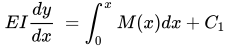
where is the flexural modulus (in Pa), is the second moment of area (in m4), is the transverse displacement of the beam at x, and is the bending moment at x. The flexural rigidity (stiffness) of the beam is therefore related to both , a material property, and , the physical geometry of the beam. If the material exhibits Isotropic behavior then the Flexural Modulus is equal to the Modulus of Elasticity (Young's Modulus).


Flexural rigidity has SI units of Pa·m4 (which also equals N·m2).
Flexural rigidity of a plate (e.g. the lithosphere)
[edit]In the study of geology, lithospheric flexure affects the thin lithospheric plates covering the surface of the Earth when a load or force is applied to them. On a geological timescale, the lithosphere behaves elastically (in first approach) and can therefore bend under loading by mountain chains, volcanoes and other heavy objects. Isostatic depression caused by the weight of ice sheets during the last glacial period is an example of the effects of such loading.
The flexure of the plate depends on:
- The plate elastic thickness (usually referred to as effective elastic thickness of the lithosphere).
- The elastic properties of the plate
- The applied load or force
As flexural rigidity of the plate is determined by the Young's modulus, Poisson's ratio and cube of the plate's elastic thickness, it is a governing factor in both (1) and (2).
Flexural Rigidity[1]
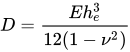
= elastic thickness (~5–100 km)


Flexural rigidity of a plate has units of Pa·m3, i.e. one dimension of length less than the same property for the rod, as it refers to the moment per unit length per unit of curvature, and not the total moment. I is termed as moment of inertia. J is denoted as 2nd moment of inertia/polar moment of inertia.
See also
[edit]References
[edit]- ^ L.D. Landau, E.M. Lifshitz (1986). Theory of Elasticity. Vol. 7 (3rd ed.). Butterworth-Heinemann. p. 42. ISBN 978-0-7506-2633-0.
Flexural rigidity
View on GrokipediaFundamentals
Definition and Physical Interpretation
Flexural rigidity is a fundamental property in structural mechanics that characterizes a material or structure's resistance to deformation under bending loads. For beams, it is defined as the product of the material's Young's modulus $ E $, which measures elastic stiffness, and the second moment of area $ I $ of the cross-section, denoted as $ EI $.[9] In the context of thin isotropic plates, flexural rigidity $ D $ is given by $ D = \frac{E h^3}{12(1 - \nu^2)} $, where $ h $ is the plate thickness and $ \nu $ is Poisson's ratio, accounting for the plate's resistance to out-of-plane bending.[10] Physically, flexural rigidity quantifies how effectively a structure opposes flexural moments that induce curvature, thereby limiting deflection and maintaining structural integrity under transverse loading. This distinguishes it from axial rigidity $ EA $, which governs resistance to longitudinal stretching or compression, and torsional rigidity $ GJ $, which counters twisting about the longitudinal axis, where $ A $ is the cross-sectional area and $ J $ is the polar moment of inertia.[2] Higher flexural rigidity results in smaller curvatures for a given applied moment, as curvature $ \kappa $ relates inversely to it via $ \kappa = \frac{M}{EI} $ for beams, emphasizing its role in controlling bending compliance.[11] The concept originated in the development of beam theory during the 18th century, with key contributions from Leonhard Euler and Daniel Bernoulli, who around 1750 formulated the foundational equations linking bending moments to elastic deflections in slender structures.[12] Their work built on earlier elastic theories, establishing flexural rigidity as a core parameter for predicting structural behavior under load. In SI units, flexural rigidity is expressed as pascal-meters to the fourth power (Pa·m⁴) or equivalently newton-meters squared (N·m²), since $ E $ has units of Pa and $ I $ or $ h^3/12 $ scales with m⁴; for instance, 1 Pa·m⁴ = 1 N·m², facilitating conversions in engineering calculations.[13]Mathematical Derivation
The derivation of flexural rigidity begins with the fundamental principles of linear elasticity applied to bending deformations. Consider a beam subjected to pure bending, where plane sections remain plane after deformation, a key kinematic assumption in classical beam theory. The longitudinal strain ε_x at a distance y from the neutral axis is related to the curvature κ by ε_x = -y κ, where κ = 1/ρ and ρ is the radius of curvature./03:_Development_of_Constitutive_Equations_of_Continuum%2C_Beams_and_Plates/3.04:_Hook%25E2%2580%2599s_Law_in_Generalized_Quantities_for_Beams)[14] Under Hooke's law for linear elastic materials, the normal stress σ_x = E ε_x, where E is Young's modulus. The internal bending moment M about the neutral axis is obtained by integrating the stress distribution over the cross-sectional area A: M = -∫_A σ_x y dA. Substituting the expressions for strain and stress yields M = E ∫_A y² dA ⋅ κ = E I κ, where I = ∫_A y² dA is the second moment of area. Thus, the flexural rigidity E I relates the applied moment directly to the curvature, characterizing the beam's resistance to bending.[15]/03:_Development_of_Constitutive_Equations_of_Continuum%2C_Beams_and_Plates/3.04:_Hook%25E2%2580%2599s_Law_in_Generalized_Quantities_for_Beams) This derivation assumes small deformations (such that strains remain linear and rotations are negligible), linear elasticity (obeying Hooke's law without plasticity), and material isotropy (uniform properties in all directions). These conditions ensure the validity of the plane sections hypothesis and the proportionality between stress and strain. Extensions to anisotropic materials modify the rigidity tensor, replacing scalar E I with a compliance matrix, but the core relation persists in generalized form.[10][14] For plates, the flexural rigidity D extends the beam concept to two dimensions. In thin plate theory, the mid-surface deflection w(x,y) relates to principal curvatures κ_x = -∂²w/∂x² and κ_y = -∂²w/∂y², with twisting curvature κ_xy = -2∂²w/∂x∂y. The moments per unit length are M_x = -D (κ_x + ν κ_y), M_y = -D (κ_y + ν κ_x), and M_xy = -D (1-ν) κ_xy / 2, where ν is Poisson's ratio and D = E h³ / [12(1-ν²)] for plate thickness h. This D incorporates both extensional stiffness E and geometric resistance via h³.[16][17] Equilibrium of forces and moments in the plate leads to the biharmonic equation governing deflection under transverse load q(x,y): D ∇⁴ w = q, where ∇⁴ = (∂²/∂x² + ∂²/∂y²)² is the biharmonic operator. This fourth-order partial differential equation highlights D's role in scaling the load to deflection; larger D implies smaller w for fixed q. The same assumptions of small deformations, linear elasticity, and isotropy apply, with h ≪ lateral dimensions ensuring negligible shear effects.[16][10] Boundary conditions influence the expression of rigidity by determining how D manifests in solutions. For instance, clamped edges enforce zero deflection and slope, maximizing effective stiffness, while simply supported edges allow rotation, reducing it; the general solution to the biharmonic equation incorporates D uniformly but yields deflection profiles modulated by these conditions.[16][17]Beam Applications
Euler-Bernoulli Beam Theory
The Euler–Bernoulli beam theory serves as the classical foundation for understanding flexural rigidity in one-dimensional beam structures, particularly those undergoing small transverse deflections under loading. Developed in the mid-18th century through collaborative efforts by Leonhard Euler and Daniel Bernoulli, the theory integrates principles of elasticity and equilibrium to model beam bending without considering shear deformation.[18] This approach defines flexural rigidity as , where is the Young's modulus of the material and is the second moment of area of the beam's cross-section, emphasizing the beam's resistance to bending based on its material stiffness and geometry.[19] The theory rests on key assumptions that simplify the analysis for slender beams, where the length is significantly greater than the cross-sectional dimensions (typically length-to-depth ratio > 10). Central to these is the kinematic hypothesis that plane cross-sections perpendicular to the beam's neutral axis remain plane and perpendicular after deformation, implying no shear distortion and uniform rotation across the section.[19] Additionally, deformations are assumed small, with slopes limited to small angles (e.g., less than 5° for negligible error), allowing linear approximations for strain and curvature.[20] These assumptions neglect axial loads, torsion, and rotational inertia, focusing solely on pure bending for homogeneous, isotropic materials under transverse distributed loads .[19] The governing differential equation arises from combining the moment-curvature relation with equilibrium conditions. The curvature is related to the bending moment by , where is the transverse deflection.[19] Differentiating twice and applying the load-shear-moment equilibrium () yields the fourth-order equation:Flexural Rigidity in Beam Design
In beam design, flexural rigidity, denoted as or , is calculated as the product of the material's Young's modulus and the second moment of area of the beam's cross-section, which quantifies the beam's resistance to bending deformation under load.[21] For common cross-sections, is determined using standard geometric formulas: for a rectangular section of width and height , ; for a solid circular section of radius , ; and for an I-beam, is approximated by considering the contributions of the flanges and web, such as where is flange width, is total height, is web thickness, and is flange thickness.[22][23] Design considerations for flexural rigidity emphasize material selection, where varies significantly; for instance, structural steel has GPa, enabling high rigidity in compact sections, while wood like oak has GPa, requiring larger cross-sections for equivalent performance.[24][25] Deflection limits in civil structures, such as L/360 for live load on beams supporting brittle finishes, ensure serviceability by comparing calculated deflections under unfactored service loads (using nominal EI) to these code-specified thresholds.[26] Load types influence rigidity requirements: point loads demand higher near supports to limit localized bending, whereas uniform distributed loads prioritize overall stiffness to control mid-span deflection.[27] A practical example is the deflection of a cantilever beam under a point load at the free end, given by , which illustrates the inverse relationship between flexural rigidity and maximum deflection —doubling halves for fixed and length .[27] This formula, derived under Euler-Bernoulli assumptions of small deflections and plane sections remaining plane, guides engineers in selecting to meet deflection criteria.[21] Optimization in beam design often involves trading flexural rigidity for reduced weight, particularly in aerospace applications where high-strength alloys maximize per unit mass for aircraft spars, and in civil engineering where composite steel-concrete sections balance stiffness with cost for bridges.[28][29]Plate and Shell Applications
Kirchhoff-Love Plate Theory
The Kirchhoff-Love plate theory provides the foundational framework for analyzing the bending of thin plates, extending the one-dimensional flexural rigidity concepts from beam theory to two-dimensional structures. Initially formulated by Gustav Robert Kirchhoff in his 1850 paper on the equilibrium and motion of an elastic plate, the theory was later generalized by Augustus Edward Hough Love in 1888 to include vibrations and deformations of thin elastic shells, establishing the classical assumptions for plate behavior under transverse loading.[30][31] This approach is applicable to isotropic, homogeneous plates where the thickness is significantly smaller than the lateral dimensions, typically with a span-to-thickness ratio greater than 20.[32] Central to the theory are Kirchhoff's kinematic hypotheses, which assume that the plate remains in a state of plane stress, with transverse normals to the mid-surface remaining straight, inextensible, and perpendicular to the deformed mid-surface after bending. These assumptions eliminate transverse shear deformation and normal strain through the thickness, simplifying the three-dimensional elasticity problem to a two-dimensional one focused on mid-surface deflection. No transverse shear strains are permitted, making the theory suitable for thin plates where shear effects are negligible compared to bending.[32][33] The flexural rigidity of an isotropic plate, analogous to in beams but adjusted for plate effects, is defined asFlexural Rigidity in Geophysical Contexts
In geophysical modeling, the Earth's lithosphere is treated as an elastic plate that bends under surface or subsurface loads, with flexural rigidity quantifying its resistance to deformation. This approach, building on Kirchhoff-Love plate theory, enables the analysis of isostatic adjustments in large-scale geological structures. Typical effective values of for the lithosphere range from to N·m, corresponding to effective elastic thicknesses () of approximately 10–50 km, though higher values up to N·m occur in cratonic regions.[34][35] These values vary systematically with lithospheric age, increasing as the plate cools and thickens over time, and with temperature, where elevated geothermal gradients weaken the structure by reducing both elastic modulus and yield strength.[34][36] Flexural isostasy models the lithosphere's response to loads such as volcanic edifices or tectonic forces, balancing the plate's bending with buoyant restoration. For one-dimensional profiles across line loads, like those at subduction zones or seamount chains, the governing equation isAdvanced and Specialized Cases
In Composite and Anisotropic Materials
In anisotropic materials, the flexural rigidity extends beyond the scalar form used for isotropic cases to a tensor representation, capturing directional variations in stiffness. For orthotropic materials, which exhibit symmetry about three mutually perpendicular planes, the bending stiffness matrix relates moments to curvatures via , where the components are computed as the integral of the transformed stiffness tensor through the laminate thickness:with denoting the reduced stiffnesses of the -th ply, the distance from the midplane to the ply interface, and the total thickness.[39] This formulation accounts for material orthotropy, where off-diagonal terms like and arise from fiber orientations, leading to shear-bending coupling in non-principal directions.[39] In fiber-reinforced polymer composites, such as carbon or glass fiber laminates, the effective flexural rigidity is determined using classical laminate theory (CLT), which assembles the matrix from individual ply contributions based on their stacking sequence, orientation, and material properties. For unidirectional plies, initial effective stiffnesses can be approximated via the rule of mixtures, where the longitudinal modulus (with and as fiber and matrix volume fractions, and , their moduli) informs the terms before lamination.[40] However, full laminate analysis relies on CLT to predict the overall , enabling tailored rigidity for applications like aircraft wings, where composite skins achieve high out-of-plane bending resistance (e.g., flexural rigidity to N·m² in typical carbon-epoxy panels) while minimizing weight.[41] Similarly, wind turbine blades made from glass-fiber-reinforced polymers exhibit flexural rigidities around 43 kN·m² for E-glass designs, supporting aerodynamic loads over long spans.[42] Challenges in these materials include delamination, which initiates at interfaces under impact or fatigue and significantly reduces effective flexural rigidity by localizing strain energy and promoting out-of-plane ply separation, potentially lowering flexural stiffness by up to 47% in affected regions.[43] In unsymmetric laminates, such as those with mismatched ply orientations (e.g., [0/45]), bending-twisting coupling emerges due to nonzero and terms, causing unintended torsion under pure bending loads and complicating design for stability-critical structures like rotor blades.[39] These effects are mitigated through symmetric stacking sequences, which nullify coupling while preserving directional rigidity.[39]