Hubbry Logo
search
logo

Flight lieutenant

logo
Community Hub0 Subscribers
Read side by side
from Wikipedia

Flight lieutenant (Flt Lt or F/L) is a junior officer rank used by some air forces, with origins from the Royal Air Force.[1] The rank originated in the Royal Naval Air Service (RNAS) in 1914. It fell into abeyance when the RNAS merged with the Royal Flying Corps during the First World War but was revived in 1919 in the post-war RAF. The rank is used by air forces of many countries that have historical British influence.

Flight lieutenant is immediately senior to flying officer and immediately below squadron leader. It is usually equivalent to the rank of lieutenant in the navy and of the rank of captain in other services.

The equivalent rank in the former Women's Auxiliary Air Force (WAAF), Women's Royal Air Force (WRAF) and Princess Mary's Royal Air Force Nursing Service (PMRAFNS) (until 1980) was flight officer.

Canada

[edit]

The rank was used in the Royal Canadian Air Force from 1920 until the 1968 unification of the Canadian Forces, when army-type rank titles were adopted. Canadian flight lieutenants then became captains.[citation needed] In official Canadian French usage, the rank title was capitaine d'aviation.[2]

Denmark

[edit]

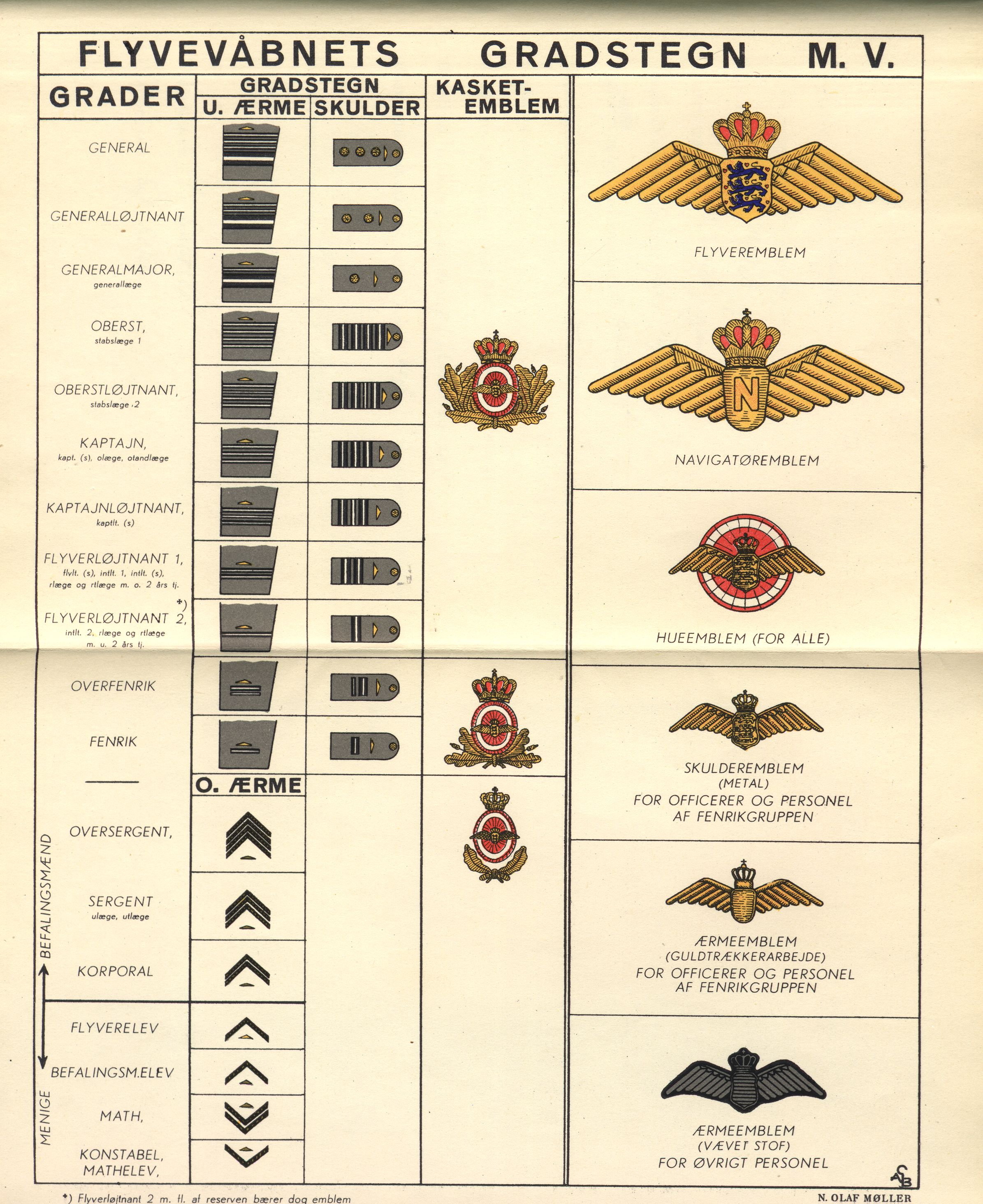
Following the creation of the Royal Danish Air Force, the ranks of flight lieutenant first and second class (Danish: Flyverløjtnant 1. grad and Flyverløjtnant 2. grad) were used.[3] The ranks were used until 1970, when they were replaced by first and second lieutenant (Danish: Premierløjtnant and Sekondløjtnant).[4]

United Kingdom

[edit]
Flight lieutenant
Shoulder and sleeve insignia
CountryUnited Kingdom
Service branch Royal Air Force
AbbreviationFlt Lt / FLTLT
NATO rank codeOF-2
FormationAugust 1919 (1919-08)
Next higher rankSquadron leader
Next lower rankFlying officer
Equivalent ranks
Related articles
HistoryRoyal Naval Air Service

Origins

[edit]
The rank insignia of a Royal Naval Air Service flight lieutenant

The rank originated in the Royal Navy as a rank title for naval lieutenants serving in the Royal Naval Air Service (RNAS).[5] Promotions to the rank were first gazetted on 30 June 1914.[6] It fell into abeyance when the RNAS merged with the Royal Flying Corps during the First World War but was revived in 1919 in the post-war RAF.[7]

On 1 April 1918, the newly created RAF adopted its officer rank titles from the British Army, with Royal Naval Air Service lieutenants (titled as flight lieutenants and flight commanders) and Royal Flying Corps captains becoming captains in the RAF. In response to the proposal that the RAF should use its own rank titles, it was suggested that the RAF might use the Royal Navy's officer ranks, with the word "air" inserted before the naval rank title. For example, the current rank of flight lieutenant would have been "air lieutenant". Although the Admiralty objected to this simple modification of their rank titles, it was agreed that the RAF might base many of its officer rank titles on navy officer ranks with differing pre-modifying terms. It was also suggested that RAF captains might be entitled flight-leaders. However, the rank title flight lieutenant was chosen as flights were typically commanded by RAF captains and the term flight lieutenant had been used in the Royal Naval Air Service. The RAF rank of flight lieutenant was introduced in August 1919[8] and it has been used continuously since then.

Usage in the RAF

[edit]

Although in the early years of the RAF a flight lieutenant commanded an aircraft flight, with the increasing combat power of aircraft and therefore squadrons, command and control has shifted up the rank structure (currently, for instance, most squadron commanders in the RAF are Wing Commanders, a reflection on the comparative combat power between the modern air force and its predecessor).

The RAF's promotion system is automatic up until flight lieutenant. Every officer will attain the rank provided they complete their professional training and do not leave early. For aircrew, flight lieutenant is reached 2.5 years after commissioning, Engineering Branch (AS & CE) entrants with applicable bachelor's/master's degrees reach flight lieutenant at 2.5 and 1.5 years respectively, and for all other ground branch officers, 3.5 years. Aircrew are appointed to an Early Departure Payment Commission upon reaching their Operational Conversion Unit, which is a commission for 20 years or age 40, whichever is later. Promotion to squadron leader thereafter is strictly upon merit; officers promoted beyond flight lieutenant are appointed to a career commission, or service to age 60. Resigning a commission is generally dependent on the needs of the service, although an officer who has completed their return of service (service the RAF requires to justify its expense in originally training the officer) could leave after as little as four years. For aircrew, given the large expense required for training, this return of service is generally the length of their initial commission anyway, unless they re-role to a different branch having failed an element of flying training. Most aircrew reach their squadrons as flight lieutenants due to the length of training time required (up to four years for fast jet pilots) and the significant holds in the training pipeline.[9] The majority of squadron line pilots are flight lieutenants, with some squadron executives or Career Commission aircrew reaching Squadron Leader.

Aside from aircrew, whose work typically does not require active leadership for units of airmen, ground branch officers can expect to operate units that can range in size from a few specialist non-commissioned personnel to 50 or more personnel for engineering or other manpower intensive roles. The role of a flight lieutenant generally involves management of a team of specialist non-commissioned officers and airmen, within their specific branch. In the RAF Regiment, a flight lieutenant generally has the same role and responsibility as a captain in the British Army, in charge of a regiment flight of 30 men, and could be second-in-command of a squadron of up to 120 men.

Flight lieutenant is the most common officer rank in the RAF; in April 2013, for example, there were 8,230 RAF officers, of whom 3,890 (47.3%) were flight lieutenants.[10] In RAF informal usage, a flight lieutenant is sometimes referred to as a "flight lieuy". A Flight Lieutenant's starting salary is £42,008.48 as of 2019.[11]

RAF Air Cadets

[edit]

In the Air Training Corps, a flight lieutenant is usually the officer commanding of a squadron,[citation needed] appointed under a Cadet Forces Commission.[12] Retired flight lieutenants are the first rank that may continue to use their rank after they have left active service.[13]

Insignia

[edit]

The rank insignia consists of two narrow blue bands on slightly wider black bands. This is worn on both the lower sleeves of the tunic or on the shoulders of the flight suit or the casual uniform. The rank insignia on the mess uniform is similar to the naval pattern, being two band of gold running around each cuff but without the Royal Navy's loop. Unlike senior RAF officers, flight lieutenants are not entitled to fly a command flag under any circumstances.

[edit]

Notable flight lieutenants

[edit]
Bir Sreshtho Matiur Rahman, Bangladeshi freedom fighter and recipient of the highest military award in Bangladesh.
Prince William in 2010, in his flight lieutenant's uniform; promoted to squadron leader in 2016

See also

[edit]

References

[edit]
Revisions and contributorsEdit on WikipediaRead on Wikipedia
from Grokipedia
A flight lieutenant is a junior commissioned officer rank in the Royal Air Force (RAF) and other Commonwealth air forces, such as the Royal Australian Air Force and Royal New Zealand Air Force, equivalent to a captain in the British Army or a lieutenant in the Royal Navy, and holding the NATO code OF-2.[1][2] The rank is typically abbreviated as Flt Lt or F/L and is worn on the lower arm of the dress uniform.[3] In the RAF hierarchy, a flight lieutenant ranks immediately above flying officer and below squadron leader, often involving leadership of a flight (a subunit of typically 2 to 6 aircraft) or staff roles in operations, administration, or training.[3] Officers at this rank may serve as flight commanders, deputy squadron commanders, or in specialist positions, with promotion generally requiring several years of service and demonstrated competence.[3] The rank originated as an appointment in the Royal Naval Air Service (RNAS) during the First World War, where it was held by qualified pilots equivalent to a naval lieutenant, and was formally adopted by the newly formed RAF on 1 April 1918 following the merger of the RNAS and the Royal Flying Corps.[4] This aviation-specific nomenclature reflects the RAF's early emphasis on air operations, distinguishing it from traditional army ranks while incorporating naval influences.[4] Today, the rank remains a key mid-level position in modern air forces, supporting tactical command and mission execution.[3]

Overview

Definition and Role

A flight lieutenant is a junior commissioned officer rank in various air forces, most notably the Royal Air Force (RAF), where it holds a position immediately senior to flying officer and junior to squadron leader in the officer hierarchy.[3] This rank denotes an experienced officer capable of assuming leadership responsibilities in operational and administrative contexts within air force units.[5] In terms of inter-service and international equivalency, the flight lieutenant corresponds to the army rank of captain and the naval rank of lieutenant, reflecting its status as a mid-level junior officer role.[6] Under the NATO Standardization Agreement (STANAG) 2116, it is codified as OF-2, facilitating uniform recognition across member nations' air forces for command and interoperability purposes.[6] Flight lieutenants typically command a flight, the smallest tactical sub-unit in an RAF squadron, comprising around 4 to 6 aircraft along with associated aircrew and ground support personnel, often totaling 20 to 35 individuals depending on the squadron's mission.[7][8] Their duties in this capacity include leading flight operations, such as coordinating sorties, ensuring aircraft readiness through maintenance oversight, and briefing aircrew on mission objectives.[9] Beyond flight command, they may serve in staff roles involving operations planning, administrative management, flight instruction at training units, or as executive officers within squadrons to support overall unit efficiency.[10] These responsibilities emphasize tactical leadership, resource allocation, and team welfare to maintain operational effectiveness in diverse air force environments.[11]

Rank Equivalents

The flight lieutenant rank in the Royal Air Force is equivalent to the captain in the British Army and the lieutenant in the Royal Navy, reflecting its position as a junior officer role responsible for command at the flight level.[1] This alignment ensures interoperability across UK armed services under the NATO officer grade code OF-2.[1] In international air forces, the flight lieutenant corresponds to ranks such as Hauptmann in the German Luftwaffe, Capitaine in the French Armée de l'Air, and Capitano in the Italian Aeronautica Militare, all classified under NATO's OF-2 grade for standardized comparison among allied nations.[6] These equivalents facilitate joint operations by aligning seniority and responsibilities in multinational contexts.
NATO CodeUnited Kingdom (RAF)United States (USAF)Germany (Luftwaffe)France (Armée de l'Air)Canada (RCAF)Australia (RAAF)
OF-2Flight LieutenantCaptainHauptmannCapitaineCaptainFlight Lieutenant
This table illustrates equivalents in select major NATO allied air forces, where the OF-2 grade denotes a mid-junior officer typically commanding a flight or equivalent subunit.[12][6] In non-NATO countries, particularly within the Commonwealth, the rank often retains the title "flight lieutenant" with direct equivalence, such as in the Royal New Zealand Air Force and Royal Australian Air Force, promoting seamless integration in coalition efforts.[2] Variations may include translated titles in non-Commonwealth nations, but the functional parity remains tied to OF-2 standards where applicable. Historically, prior to the RAF's formation in 1918, the equivalent in the Royal Flying Corps used British Army ranks, with captains serving as flight commanders and lieutenants as pilots or observers; the specific "observer lieutenant" designation in the RFC denoted a junior warrant or commissioned role for non-pilot aircrew, akin to a flying officer or pilot officer in the later RAF structure.[13] This evolution from Army-derived ranks to aviation-specific titles marked the transition to the independent RAF rank system in 1919.[13]

History

Origins in Pre-RAF Services

The rank of flight lieutenant originated in the Royal Naval Air Service (RNAS), established in July 1914 as the naval branch of British military aviation, separate from the Royal Flying Corps (RFC). Drawing from naval traditions, the RNAS introduced specialized ranks for aircrew officers in 1914, formalized in Admiralty Weekly Order No. 1204/15 effective 1 August 1915, including flight lieutenant, to reflect the unique demands of maritime aviation operations.[14] This rank was positioned between flight sub-lieutenant and flight commander, serving as a designation for experienced officers overseeing flight units.[15] In the RNAS, flight lieutenant denoted senior flight officers responsible for managing air detachments, particularly those embarked on ships such as seaplane carriers during early World War I campaigns. Equivalent to a lieutenant in the Royal Navy, it emphasized command authority in naval contexts, with officers often directing reconnaissance and combat missions from vessels like HMS Ark Royal in the Dardanelles operations of 1915-1916. The rank's insignia featured naval-style sleeve stripes augmented with aviation badges, underscoring the influence of Royal Navy hierarchies on emerging air service structures.[16][17] The RFC, formed by royal warrant on 13 April 1912 with both military and naval wings, initially adopted British Army ranks, using the position of "flight commander"—typically held by a captain—to lead tactical subunits known as flights in aerial reconnaissance and combat. Warrant officer grades in the RFC, established in 1914, included aviation-specific roles like observer or mechanic, but lacked the "lieutenant" nomenclature until naval influences grew amid inter-service coordination. During World War I, formal flight lieutenant appointments occurred in the RNAS, such as that of Redford Henry Mulock in June 1916, who led flights in aerial engagements over the Western Front and North Sea. These officers commanded small formations of aircraft in dogfights and bombing raids, highlighting the rank's role in pioneering air leadership tactics.[13][18][19]

Adoption and Evolution in the RAF

Upon the formation of the Royal Air Force on 1 April 1918 through the amalgamation of the Royal Flying Corps and the Royal Naval Air Service, the rank of flight lieutenant was initially drawn from RNAS nomenclature as a commissioned officer grade equivalent to a lieutenant in the army or navy, standardizing command roles for flight leaders across the unified service.[20][21] In the immediate postwar period, the rank underwent adjustments in 1919 to align with peacetime requirements, including the introduction of distinctive RAF officer titles on 1 August, with flight lieutenant formalized as a permanent commissioned rank above flying officer and below squadron leader; this coincided with a drastic reduction in officer numbers from approximately 30,000 at the Armistice to about 4,000 by late 1919, streamlining the structure for a smaller force.[22][23] During the interwar years, particularly in the 1930s, RAF expansions in response to rising tensions led to increased appointments at the flight lieutenant level to staff the growing bomber and fighter commands, as the service grew from 52 squadrons in 1935 to 135 by 1939, with 74 dedicated to bombing operations.[24][25][26] World War II saw accelerated use of the rank through rapid promotions amid operational demands, notably during the Battle of Britain in 1940, where experienced pilots were elevated to flight lieutenant to lead flights in Fighter Command squadrons defending against Luftwaffe raids.[27] Postwar adaptations during the Cold War included alignment with NATO standardization efforts in 1951, which mapped RAF ranks like flight lieutenant to equivalent OF-2 grades for interoperability among alliance forces, while minor updates in the 1990s supported gender-neutral policies by enabling women's full integration into officer roles, including flight lieutenant positions in flying branches previously restricted to men.[28][29]

Usage in the United Kingdom

Responsibilities in the Royal Air Force

In the Royal Air Force (RAF), flight lieutenants primarily serve as flight commanders within squadrons, leading teams of up to 35 personnel in operational and support roles. Their duties encompass commanding aircraft flights or ground-based units, such as in the RAF Regiment where they evaluate tactical situations, formulate plans, and brief troops on missions.[9] They are also responsible for the training, welfare, and discipline of subordinates, ensuring high standards of performance and readiness.[11] In flying branches, flight lieutenants undertake operational planning, including mission preparation for air-to-air combat, ground attacks, intelligence gathering, surveillance, and logistical support.[30] Career progression to flight lieutenant typically occurs after 3-4 years of service as a flying officer, following initial officer training and substantive promotion based on time served, satisfactory performance reviews, and completion of branch-specific leadership development.[30] Promotion criteria emphasize demonstrated leadership, often through courses like the Junior Officers Development Programme, which prepares officers for increased command responsibilities.[31] Once promoted, flight lieutenants may serve in liaison roles during joint operations with other UK armed services or international partners, coordinating air support and integrating RAF assets into broader military efforts.[32] In modern RAF operations, flight lieutenants hold key positions in advanced aircraft programs, such as commanding flights equipped with Eurofighter Typhoon for quick reaction alert duties or Lockheed Martin F-35 Lightning II for multi-role missions.[30] They also contribute to emerging domains like cyber defense, leading specialist flights that protect air assets from digital threats, or serving in expeditionary air wings for deployed operations in regions like the Middle East or Indo-Pacific. These roles involve ongoing professional training to adapt to evolving threats, including pilot instruction for fast-jet transitions and tactical planning in contested environments.[30] Flight lieutenants are classified under the OF-2 pay scale, with annual salaries for 2025 ranging from £52,815 at the entry level to £62,598 at the highest increment, inclusive of the 14.5% X-factor allowance for full-time regular personnel.[33] Benefits include subsidized accommodation, healthcare, and pension contributions, supporting a structured career path with opportunities for further advancement.[34]

Application in RAF Reserves and Cadets

In the Royal Air Force Reserves, the rank of flight lieutenant is held by part-time commissioned officers who lead reserve flights and squadrons, providing operational support and command capabilities similar to their regular counterparts but on a flexible schedule. Reservists at this rank typically commit to a minimum of 27 days per year, including evenings, weekends, and annual training, allowing them to balance civilian careers with military duties while undergoing the same leadership training at RAF Cranwell.[35] These officers integrate seamlessly with regular forces during joint exercises, such as Exercise Cobra Warrior, a major RAF-led multinational training event focused on air combat and interoperability, where reserve personnel contribute to mission planning and execution alongside full-time units.[36] Unlike regular officers, reserve flight lieutenants experience shorter service commitments and promotions based on voluntary participation and performance rather than full-time tenure, emphasizing their role in augmenting RAF readiness without permanent enlistment.[37] Within the RAF Air Cadets, a youth organization for individuals aged 13 to 18, the flight lieutenant rank serves as an honorary or warrant commission for adult volunteer staff, often assigned to roles such as squadron commanders overseeing local units. These officers, drawn from the RAF Volunteer Reserve (Training Branch), focus on developing leadership, aviation interest, and discipline among cadets through structured programs, without the operational combat duties of regular or reserve service.[38] The Air Training Corps, the primary component of the RAF Air Cadets, was formally established by Royal Warrant on 5 February 1941 to prepare young people for potential wartime service, evolving into a modern leadership training framework that differs from regular RAF paths by prioritizing volunteer-led, non-mandatory progression and community-based activities.[39] Key programs under this rank include Air Experience Flights (AEFs), where flight lieutenant pilots serve as instructors, delivering introductory powered flying training to cadets using aircraft like the Grob Tutor, typically in 30-minute sessions to build aviation skills and confidence.[40] These flights, operated by 13 AEF units across the UK, highlight the rank's emphasis on mentorship in a volunteer context, contrasting with the full-time instructional roles in regular RAF training squadrons by focusing exclusively on youth development rather than professional pilot qualification.

Insignia and Uniform Distinctions

The insignia for a flight lieutenant in the Royal Air Force consists of two medium-width pale blue braids worn on the lower sleeves of the tunic in service dress uniform.[3] These braids are positioned approximately 2 inches above the cuff edge and are set against a dark blue background, distinguishing the rank from the single braid of a flying officer and the three braids of a squadron leader.[41] Historically, prior to the formation of the RAF in 1918, the equivalent rank in the Royal Flying Corps used army-style insignia such as shoulder pips and crown for lieutenants, often accompanied by winged badges indicating aviation roles like pilot or observer.[42] During World War II, flight lieutenant rank braids featured pale blue outer edges with a narrow black central stripe, while embroidered eagle shoulder patches—depicting a stylized bird in flight on a dark blue ground—were worn by all ranks below warrant officer to denote RAF service, placed on both shoulders of the battle dress or service tunic. In the 1950s, the RAF introduced rigid shoulder boards for certain uniforms, incorporating gold-embroidered rank markings aligned with NATO standardization efforts, though the traditional sleeve braids remained standard for dress uniforms.[43] In uniform contexts, flight lieutenant insignia appear on the lower cuffs of No. 1 service dress and No. 2 working dress jackets, with gold-embroidered versions encircling the cuffs of No. 4 mess dress without the naval executive curl.[3] On flying suits, such as the olive drab No. 14 aircrew suit, rank is indicated via Velcro-attached composite slides on the shoulders, allowing quick removal for operational flexibility. Branch-specific additions include the pilot brevet—a winged emblem embroidered in gold or bullion on the left breast pocket above any ribbons—awarded to qualified flying officers and worn across all dress variants to signify aircrew specialization.[44] As of 2025, adaptations for the Multi-Terrain Pattern (MTP) operational uniform incorporate digital camouflage-printed shoulder straps with embroidered or woven flight lieutenant insignia, enhancing concealment in diverse environments during field operations while maintaining visibility for rank identification within units.[41]

Usage in Other Countries

Canada

In the Royal Canadian Air Force (RCAF), the rank of flight lieutenant is identical to its Royal Air Force counterpart, functioning as a junior commissioned officer rank immediately senior to flying officer and junior to squadron leader.[45] Established upon the RCAF's formation on 1 April 1924, the rank has been a core element of the service's structure, reflecting its origins in British military aviation traditions.[46] The rank traces its adoption to the World War I period, when Canadian airmen serving in the Royal Flying Corps and Royal Naval Air Service utilized RAF-style ranks, including flight lieutenant, as formalized in the Canadian Air Force's initial structure in 1920 and carried forward into the permanent RCAF.[46] During the unification of the Canadian Armed Forces (CAF) on 1 February 1968, distinctive air force ranks were abolished in favor of a unified structure, converting flight lieutenants to captains; however, following the 2011 re-designation of the RCAF and a 2013 amendment to the National Defence Act, the traditional air force ranks, including flight lieutenant, were reinstated effective 1 September 2014 to preserve service identity.[46] In contemporary RCAF operations, flight lieutenants typically hold positions of flight command within tactical fighter squadrons, overseeing teams operating aircraft such as the CF-18 Hornet in air defense and combat roles, or participate in North American Aerospace Defense Command (NORAD) missions for continental airspace surveillance. Reflecting Canada's bilingual framework, the rank's official French title is capitaine d'aviation, ensuring equitable use across linguistic communities.[47] Promotions to flight lieutenant follow CAF merit-based criteria, including time in rank as a flying officer (typically two years), performance evaluations, leadership potential, and completion of required professional military education, with selections influenced by operational needs and seniority.[48] Insignia for the rank consists of two half-inch wide braids on the lower sleeve of the uniform, adapted with a superimposed Canadian maple leaf on shoulder slip-ons and other elements to denote RCAF specificity.[49] As of 2025, flight lieutenant pay aligns with the CAF captain scale for air force personnel, starting at $8,861 monthly for pay increment 1 and reaching up to $17,723 for increment 20, inclusive of recent pensionable adjustments retroactive to April 1, 2025.[50]

Australia and New Zealand

The rank of flight lieutenant holds a shared historical foundation in the Royal Australian Air Force (RAAF) and Royal New Zealand Air Force (RNZAF), originating from service in the Royal Flying Corps (RFC) during World War I, where Australian and New Zealand personnel flew in RFC squadrons such as No. 1 Squadron AFC and contributed to reconnaissance and bombing missions.[51][52] During World War II, RAAF and RNZAF flight lieutenants served in integrated Commonwealth commands under British oversight, participating in joint operations across theaters including the Battle of Britain, Pacific island campaigns, and desert warfare with units like No. 75 Squadron RNZAF and No. 10 Squadron RAAF.[53][54] Post-1945, as both air forces achieved greater operational independence, they maintained the flight lieutenant rank with minimal modifications to titles and insignia, preserving alignment with RAF traditions while adapting to national command structures.[55][56] In the RAAF, formed on 31 March 1921, flight lieutenants typically command flights within squadrons, including training elements using Pilatus PC-21 aircraft at No. 4 Squadron or operational missions with F/A-18F Super Hornets at No. 1 Squadron.[57][58] The rank insignia consists of a single full braid with a half-braid above, mirroring the RAF design and worn on shoulder slides or epaulettes.[2] In the RNZAF, the rank dates to the establishment of the New Zealand Permanent Air Force in 1937, which was renamed the RNZAF in 1939; flight lieutenants lead crews in maritime patrol operations aboard the P-8A Poseidon, conducting surveillance and anti-submarine warfare in the South Pacific.[56] Promotions to flight lieutenant follow completion of officer training programs at RNZAF Base Ohakea, which includes air warfare officer courses and multi-engine pilot conversions using King Air aircraft.[59] Insignia follows the RAF pattern with a single narrow braid and half-braid, abbreviated as FLTLT.[60] Contemporary roles emphasize interoperability, as seen in the 2024 Pitch Black exercise where RAAF and RNZAF flight lieutenants supported multinational large-force employment missions from RAAF Bases Darwin and Tindal, involving over 140 aircraft.[61] Pay scales for flight lieutenants are equivalent to those of army captains in both forces, with RAAF officers at O-3 level earning base salaries from approximately AUD 98,090 to 131,391 annually, and RNZAF counterparts aligned under similar NATO OF-2 grading.[62][63][64]

Denmark and Other Nations

In the Royal Danish Air Force (RDAF), the equivalent rank to flight lieutenant is premierløjtnant, a NATO OF-2 grade adopted following Denmark's alignment with NATO standards in the 1950s.[65] This rank structure, influenced by post-World War II British training programs that provided RAF expertise to rebuild Danish aviation capabilities, emphasizes operational roles in fighter squadrons.[66] Premierløjtnants often serve as section leaders or deputy flight commanders, including among F-35A pilots based at Fighter Wing Skrydstrup, where the aircraft support NATO missions such as quick reaction alerts.[67] In 2025, the RDAF deployed F-35As from Skrydstrup for NATO’s Eastern Sentry to enhance regional airspace surveillance amid heightened tensions.[68] The rank's responsibilities include leading patrols and coordinating with allied forces, reflecting Denmark's commitment to collective defense since joining NATO in 1949. Outside Europe, the rank appears in nations with historical British Commonwealth ties. In the Indian Air Force (IAF), established in 1932 under British rule, flight lieutenant has been a standard OF-2 rank since inception, denoting junior officers who command flights in advanced units like Rafale squadrons at Ambala Air Force Station.[69] These officers manage tactical operations, including air superiority missions, with the rank's insignia featuring two braided stripes on the sleeve. The Royal Air Force of Oman (RAFO), formed in 1959 with British advisory support, uses ra'is as the equivalent OF-2 rank, worn by pilots in Eurofighter Typhoon squadrons for strike and reconnaissance duties.[70] This Arabic title, meaning "captain," aligns with RAF traditions and involves leading small formations in Oman's arid operational environment. Variations exist in other influenced air forces, such as Sweden's Flygvapnet, where löjtnant serves as an OF-1 rank but incorporates indirect British-inspired elements through NATO interoperability, focusing on JAS 39 Gripen pilot training without a direct flight lieutenant parallel.[71] In African Commonwealth nations like Kenya, the Kenya Air Force retains flight lieutenant as an OF-2 rank for officers overseeing KDF aviation assets, such as F-7 fighters, in regional peacekeeping roles.[72]

Notable Flight Lieutenants

World War II Figures

During World War II, the rank of flight lieutenant became synonymous with frontline leadership in the Royal Air Force (RAF) and allied air forces, embodying the courage and skill required for critical operations from the Battle of Britain to strategic bombing campaigns. Prominent flight lieutenants contributed decisively to aerial victories, raid executions, and theater commands, earning decorations such as the Distinguished Flying Cross (DFC) and Distinguished Flying Medal (DFM). Their actions elevated the rank's prestige, as thousands of officers at this level served across diverse roles by war's end, supporting the RAF's expansion to over 900,000 personnel.[73] A fictional yet influential figure was James "Biggles" Bigglesworth, created by W.E. Johns in adventure stories that inspired wartime pilots; in early World War II narratives like Biggles Sees It Through (1940), Biggles holds the rank of flight lieutenant while leading daring reconnaissance and combat missions against Axis forces. Among real RAF officers, Douglas Bader, who had rejoined the RAF in 1939 after losing both legs in a 1931 crash, served as acting squadron leader commanding No. 242 Squadron during the Battle of Britain, achieving 22 confirmed aerial victories, including multiple Messerschmitt Bf 109s, through aggressive tactics like the "Big Wing" formation, earning the DSO and DFC for his leadership despite personal challenges.[74] In the Desert Air Force, Australian-born Clive Caldwell, who served as acting flight lieutenant with No. 250 Squadron in 1941 before promotion to squadron leader and command of No. 112 Squadron in 1942, scored 27.5 victories against Italian and German aircraft over North Africa using Tomahawk and Kittyhawk fighters; his bold low-level attacks disrupted Axis supply lines, contributing to the Allied push at El Alamein and earning him the DFC and DFC (US).[75] Allied contributions highlighted the rank's international scope. In Bomber Command, Canadian-born Ian Bazalgette, serving with No. 115 Squadron from late 1942 and promoted through the ranks, piloted approximately 50 bombing missions over Europe, earning the DFC in 1943 for precise operations under fire; as acting squadron leader in 1944, his Victoria Cross action involved steering a burning Lancaster away from civilians during a Pathfinder raid on Trossy St. Maximin, saving his crew at the cost of his life.[76] Similarly, in the Pacific theater, RAAF flight lieutenant William Ellis Newton led Beaufort torpedo-bomber strikes with No. 22 Squadron in New Guinea from 1942–43, completing 52 operations; awarded the VC posthumously for pressing a low-level attack on Japanese shipping at Salamaua despite heavy anti-aircraft fire and wounds, his leadership bolstered Allied advances in the Southwest Pacific.[77] These figures underscored the flight lieutenant's pivotal role in sustaining air superiority and operational tempo, fostering the rank's enduring legacy in wartime aviation.

Post-War and Modern Examples

In the post-World War II era, flight lieutenants in the Royal Air Force (RAF) have played pivotal roles in various conflicts, often demonstrating exceptional leadership and bravery in aerial operations. During the 1982 Falklands War, Flight Lieutenant David Morgan, an RAF Harrier pilot on exchange with the Fleet Air Arm, achieved the highest number of confirmed air-to-air victories for British forces, downing four Argentine aircraft and contributing to the destruction of several ground targets, for which he was awarded the Distinguished Service Cross.[78] His actions underscored the rank's importance in junior command positions during high-intensity combat, where flight lieutenants often led sorties from forward bases. Similarly, Flight Lieutenant Garth Walter Hawkins, attached to 22 SAS, became the sole RAF fatality of the Falklands War when the Sea King helicopter carrying special forces crashed into the South Atlantic on 19 May 1982 during a night insertion mission south of the Falklands.[79] The 1991 Gulf War highlighted the rank's continued relevance in multinational coalitions. Flight Lieutenant John Nichol, a Tornado navigator, was shot down over Iraq on January 17, 1991, during a low-level bombing raid; captured and subjected to propaganda exploitation by Iraqi forces alongside his pilot, Flight Lieutenant John Peters, Nichol's ordeal drew global attention to the risks faced by RAF aircrew in precision strikes against strategic targets.[80] In more recent operations, such as those in Afghanistan, flight lieutenants have exemplified valor in casualty evacuation and close air support. Flight Lieutenant Marc Heal, piloting a Chinook helicopter, conducted multiple extractions under intense enemy fire in Helmand Province in July 2009, rescuing 29 British and Afghan personnel over three days; for this, he received the Distinguished Flying Cross, one of only 22 awarded for Afghan service.[81] Into the modern era, the rank remains prominent in elite units and operational tours. Flight Lieutenant Christopher McCann, a Typhoon pilot, earned the Air Force Cross for gallantry during a classified deployment, later advancing to squadron leader and serving as Red 2 with the Red Arrows aerobatic team in 2024, where he led formations in high-profile displays promoting RAF capabilities.[82] These examples from the Falklands, Gulf War, Afghanistan, and contemporary service illustrate how flight lieutenants continue to bridge tactical execution and leadership in the RAF's evolving mission profile.

References

User Avatar
No comments yet.