


Community hub
Recent from talks
Contribute something
Nothing was collected or created yet.
Quick Reaction Alert
View on WikipediaQuick Reaction Alert (QRA) is the state of readiness and modus operandi of air defence maintained at all hours of the day by NATO air forces. The United States usually refers to Quick Reaction Alert as Airspace Control Alert.
Some non-NATO countries maintain a QRA,[1] either full-time or part-time.[2][3]

Operation
[edit]QRA in the United Kingdom
[edit]There are two QRA stations in the United Kingdom, one at RAF Coningsby in the east of England, and the other at RAF Lossiemouth in Scotland.
Pilots and engineers on QRA duty are at immediate readiness twenty-four hours a day. They are fully dressed in the Crew Ready Room, which are next to the hangars, a hardened aircraft shelter known informally as Q-sheds, which houses the interceptor aircraft, since 2007 the Eurofighter Typhoon. Pilots are on QRA duty around once or twice a month, each a twenty-four-hour shift.
Engineers are on QRA duty three or four times a year, each for a twenty-four-hour a day shift, for seven days at a time. Two Typhoon aircraft are maintained at readiness, along with a Voyager tanker at RAF Brize Norton in Oxfordshire. Before 2014 this task was carried out by a TriStar.

Civilian aircraft in the UK are monitored by NATS Holdings at:
- Swanwick, Hampshire with the London Area Control Centre and London Terminal Control Centre (at RAF West Drayton until 2007), broadly known as the London Air Traffic Control Centre, which covers the London Flight Information Region (EGTT). The RAF have a team at Swanwick.
- Prestwick, which covers the Scotland Flight Information Region (EGPX) which is north of the Solway Firth.

Military radar in the UK is controlled by the UK Air Surveillance and Control System (ASACS),[4] looked after by ASACS Force Command.[5] It has Remote Radar Heads (RRH) at:
- RRH Benbecula in the Outer Hebrides
- RRH Saxa Vord in Shetland (AN/TPS-77 radar moved from RRH Staxton Wold)
- RRH Buchan (former Master Radar Station, or MRS, Buchan) off the A90 south of Peterhead
- RRH Brizlee Wood in Hulne Park, Northumberland (west of RAF Boulmer)
- RRH Staxton Wold off the B1249 in Willerby, North Yorkshire
- RRH Neatishead at Neatishead, Norfolk
- RRH Portreath in Cornwall
From 1997, the radars were the 1.1MW Plessey AR-320 (Type 93), and were replaced by the Lockheed Martin AN/FPS-117 system.
QRA in the United States
[edit]The United States refers to Quick Reaction Alert as Airspace Control Alert.[6]
QRA response
[edit]Air traffic across Europe is controlled by Eurocontrol in Brussels. Military aircraft from Russia can be tracked across Norway, and reported to the Norwegian Joint Headquarters near Bodø, or the Combined Air Operations Centre 2 (CAOC UE) in Uedem, North Rhine-Westphalia close to the border with the Netherlands. Combined Air Operations Centre Finderup (CAOC Finderup),[7] in Denmark, watches Russian aircraft and can alert the UK, and has RAF staff there.
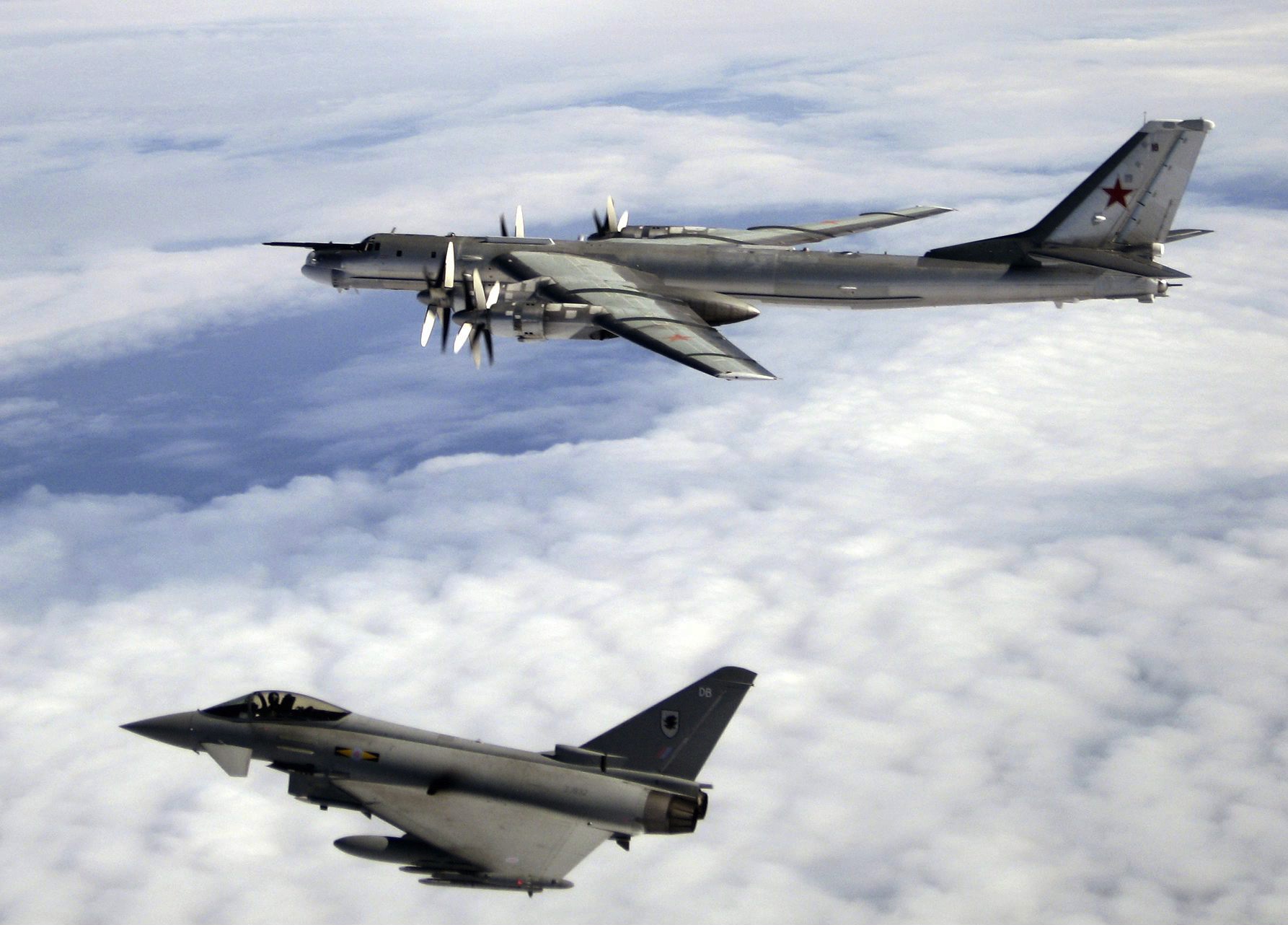
Russian Air Force Tupolev Tu-95 aircraft originate from the Olenya air base on the Kola Peninsula. Tupolev Tu-160 Blackjack aircraft come from the Engels-2 base near Saratov. The Tu-95 aircraft are on 12-14 hour missions, and when tracked across Norway have been colloquially referred to with the codename of zombies.[citation needed]
A QRA response involves the fighter aircraft being scrambled to investigate an infringement of the NATO country's airspace or area of interest.

QRA response in the United Kingdom
[edit]This may also be a civilian aircraft that poses a threat, if not sufficiently responding to air traffic control (ATC). Incidents of this nature in the UK are monitored by the Control and Reporting Centre (CRC) at RAF Boulmer, which builds a 3D Recognised Air Picture. The National Air and Space Operations Centre (NASOC) at RAF Air Command, RAF High Wycombe decides whether to send a QRA response. The Joint Force Air Component Headquarters is also at High Wycombe.
QRA stations
[edit]_Demonstration_(52221995554).jpg)
Austria
[edit]Austria has only daylight QRA readiness. Austrian Air Force Air Surveillance Command is located at Salzburg. Fighter Squadron 1 & 2 with Eurofighter Typhoon are at Zeltweg Air Base.
Baltic States
[edit]Lithuania, Latvia and Estonia, though members of NATO, have no fighters capable of QRA intercepts. Other NATO nations provide periodic air defence at the NATO QRA standard as part of NATO Baltic Air Policing.[6]
Belgium
[edit]Florennes Air Base and Kleine Brogel Air Base.
Bulgaria
[edit]Graf Ignatievo Air Base (3rd Fighter Air Base) of the BuAF has a single MiG-29 squadron, which carry two R-73 missiles. The Bulgarian CRC is at Sofia.
Croatia
[edit]The Croatian Air Force's Air Force and Air Defence Command is located in Zagreb.[8] The 191. Fighter Squadron, flies MiG-21bisD/UMDs from Pleso (Zagreb Airport). The MiG-21 will be replaced with Dassault Rafale.
Czech Republic
[edit]The 261st Control and Reporting Centre (CRC), is in Hlavenec. The Czech Air Force uses JAS-39C/D Gripen at Čáslav AFB.
Denmark
[edit]The Royal Danish Air Force Command is headquartered at Karup Air Base. The Fighter Wing with the Eskadrille 727 and the Eskadrille 730, at Skrydstrup Air Base use F-16AM/BM Falcon, soon to be replaced with F-35A.
Finland
[edit]The Finnish Air Operations Centre is at Jyväskylä–Tikkakoski Air Base. The Finnish Air Force Fighter Squadron 31 (Hävittäjälentolaivue 31, HävLLv 31) uses F-18C/D from Rovaniemi and Kuopio. In addition to the Air Force's main operating bases, QRA aircraft may by rotated between civilian airports and other temporary operating bases.[9]
Germany
[edit]The municipality of Uedem houses NATO's Combined Air Operations Centre (CAOC) Uedem.[10]
Taktisches Luftwaffengeschwader 74 provides cover in the south, and Taktisches Luftwaffengeschwader 71 "Richthofen" in the north. The German Air Force uses Eurofighter Typhoons from Wittmund (QRA North) and Neuburg Air Base (QRA South), with alternate QRA bases in Nörvenich and Rostock-Laage Airport.[11]
Hungary
[edit]The Hungarian Air Command and Control Centre is in Veszprém. The QRA base is at the Kecskemét Air Base. The Fighter Squadron Puma operates JAS-39C/D Gripen fighters. The Hungarian Gripens are responsible for the air police service over Slovenia.[12]
Iceland
[edit]Iceland, though a member of NATO, has no standing armed forces. Other NATO nations provide periodic air defence at the NATO QRA standard as part of NATO Icelandic Air Policing.[13]
Italy
[edit]Italian Air Force squadrons equipped with Typhoon and F-35 jets provide QRA coverage on a rotational basis. These squadrons are based at Grosseto Air Base in Tuscany (IX Gruppo of 4º Stormo), Gioia del Colle Air Base in Apulia (10° Gruppo and 12° Gruppo of 36º Stormo), Trapani Air Base in Sicily (18° Gruppo of 37° Stormo), and Istrana Air Base in Veneto (132° Gruppo of 51° Stormo), all of them operating Typhoons. More recently the F-35As based at Amendola Air Base in Apulia (13° Gruppo of 32° Stormo) have been given QRA tasks as well, and F-35s at Ghedi Air Base in Lombardy will be on QRA too.[14]

Netherlands
[edit]The Royal Netherlands Air Force (RNLAF) have F-35 aircraft at Volkel Air Base or Leeuwarden Air Base on high alert. They intercept once notified by the Air Operations Control Station Nieuw-Milligen, near Apeldoorn in Gelderland. The RNLAF alternates the responsibilities for QRA above Benelux with the Belgian Air Component every four months since 2016/2017.
Norway
[edit]The Royal Norwegian Air Force Quick Reaction Alert force consists of two F-35s on high alert from Evenes Air Station.[15][16][17]
Romania
[edit]The RoAF 71st Air Base (Baza 71 Aeriană) at Câmpia Turzii in central Romania and the RoAF 86th Air Base (Baza 86 Aeriană) at Borcea in south-east Romania are on QRA duty. Romania operates F-16 Fighting Falcons, which carry AIM-9X and AIM-120C missiles. The Romanian CRC is at Balotești in southern Romania.
Slovakia
[edit]The Air Force Command of the Slovak Air Force is in Zvolen.[18] The 1st Tactical Squadron is waiting for delivery of F-16V at Sliač Air Base. Currently the Slovak airspace is guarded by German Air Force, Czech Air Force, Polish Air Force and Hungarian Air Force until the American F-16s are delivered.[19]
Spain
[edit]The Spanish Air Force and Space Force establishes a number of multipurpose fighter units that take turns among themselves. On the one hand, there are four units dependent on the Air Combat Command (MACOM) that are responsible for protecting the airspace.
The QRAs are attended to by different predisposed units, which follow an action plan, in which several Air Force aircraft are prepared to respond to the alert within a maximum time of 15 minutes. A single base is not established as an operations center that is responsible for these activities, but there are several in Spanish territory that are "on duty" to respond to any requirement.

Switzerland
[edit]The main base for the QRA of the Swiss Air Force is Payerne Air Base. The QRA also operates from Emmen Air Base and Meiringen Air Base for several weeks per year. Zurich Airport, Geneva Airport and Sion Airport serve as alternative locations. All QRA operations are guided by the Operations Center (EZ-LUV)/CRC at Dübendorf Air Base. The Swiss QRA are equipped with F/A-18C/D.[20][21]
Turkey
[edit]Merzifon Air Base of the TuAF (Türk Hava Kuvvetleri), in northern Turkey, has one F-16 squadrons (built by TAI) with the 5th Air Wing (5 Ana Jet Üs). Bandırma Air Base has two F-16 squadrons of the 6th Air Wing. The Turkish CRC is at Ahlatlıbel near Ankara.
United Kingdom
[edit]Currently there are two QRA RAF stations, of 1 Group.
- RAF Coningsby in Lincolnshire looks after the southern sector of the UK, known as QRA South, with 3 Sqn and 11 Sqn.
- RAF Lossiemouth in Moray protects the northern sector of the UK, referred to as QRA North,[22] hosted by 1 Sqn, 2 Sqn and 6 Sqn.
History
[edit]Quick Reaction Alert is the current iteration of scrambling, developed by RAF Fighter Command in the Battle of Britain. International boundaries were three miles off the coast.
Austria
[edit]On October 18 2002, a US DC-10 requested to enter Austrian airspace; it was intercepted by two Austrian SAAB fighter aircraft, but the aircraft turned out to be a McDonnell Douglas KC-10 Extender, with two Lockheed F-117 Nighthawk aircraft being refuelled
Germany
[edit]RAF Wildenrath provided air defence cover for Royal Air Force Germany (RAFG), which flew Phantoms with 92 Sqn and 19 Sqn until 1991. The last QRA sortie at RAF Wildenrath was on Wednesday 2 October 1991.[23]
Italy
[edit]The first country to put the Typhoon onto QRA duty was Italy in December 2005, by IX Gruppo of 4º Stormo. 12° Gruppo of 36º Stormo followed in July 2007 and 10° Gruppo in July 2010. Typhoons replaced the F-16A/ADF of 37° Stormo at Trapani from May 2012. From March 2018 the F-35 of 32° Stormo based in Amendola, has implemented the QRA assets.
Spain
[edit]111 Sqn put the first Typhoon on QRA duty in July 2008, followed by 142 Sqn of Ala 14, and later 141 Sqn.
United Kingdom
[edit]


In the 1950s and 1960s, training as a fighter controller in the UK was at MRS Bawdsey (RAF Bawdsey). The main central control was known as ADOC, which monitored the UK Air Defence Region (UK ADR). It was similar to the USA's and Canada's NORAD at Peterson Air Force Base. The ROTOR system was developed in the 1950s.[24]
Before computers arrived in the 1970s, the Russian aircraft were plotted on a map, mainly by WRAF personnel. 11 Group at RAF Bentley Priory from 1968 and RAF High Wycombe from 1972, looked after the UK's air defence until the 1990s. High Wycombe today has the European Air Group. The Ilyushin Il-18 Coot would fly in the 1980s on Ferret missions over the North Sea. The Phantom would be in the air in under two minutes.
43 Sqn, the Fighting Cocks, operated the Phantom from Leuchars from September 1969, along with 23 Sqn, the Red Eagles and 11 Sqn, the Twin Eagles.[25] 56 Sqn, the Firebirds, operated the Phantom in the 1970s from Suffolk.[26] In 1979, an average of 5 Russian aircraft a week entered British airspace.[27] The tankers at Marham were from 55 Sqn and 57 Sqn.
Every QRA alert required a Victor tanker from RAF Marham in Norfolk, with the codename Dragonfly. One fighter squadron would be on QRA for six month shifts. The Phantom had much better range than the Lightning, and had far-better look down radar, but the Lightning had better performance.
The RAF Phantom variant had Spey engines, which were not intentionally designed for the aircraft, and gave lower performance. It had an advanced jam-resistant inertial navigation system but the RAF Phantoms could not take off immediately as this inertial system had to align first. The Lightning left service in 1988 and the Phantom in 1992. When the Tornado F.3 arrived, the RAF QRA duty had an aircraft with complete night-vision capabilities and could connect to the Sentry aircraft.
In the 1960s, Southern Q was maintained by the Lightnings of 5 Sqn at RAF Binbrook and those of 29 Sqn and 111 Squadron at RAF Wattisham. Southern Q was rotated around the three RAF bases. The Lightning left QRA duty on Wednesday 27 April 1988, with last flight in July 1988.[28]
RAF Leeming took over Southern Q from RAF Coningsby in 1988. 11 Sqn left RAF Leeming in October 2005.[29] In June 2007, 3 Sqn at RAF Coningsby took over Southern Q from the Tornados of 25 Sqn at RAF Leeming in North Yorkshire. The Typhoons of 3 Sqn had their first scramble in August 2007 when they intercepted a Russian Bear. 3 Sqn took over all of Southern Q from April 2008.
44 year old Pavel Grachev, the Minister of Defence (Russia) from 1992-96, was shown around RAF Leuchars on Thursday 23 July 1992, being shown the Tornado F3 QRA aircraft of 43 Squadron; he apparently enjoyed the 'hospitality' of the Scottish guests.[30][31]
In August 2007 the Russians had begun to launch long-distance patrols after a 15-year hiatus. Typhoons arrived at RAF Leuchars with 6 Sqn from September 2010, performing their first QRA scramble in January 2011. Typhoons joined 1 Sqn from September 2012. 6 Sqn moved to Lossiemouth in June 2014, with 1 Sqn moving in August 2014. QRA North was moved from RAF Leuchars to RAF Lossiemouth in September 2014. The first QRA sortie from Lossiemouth was on 19 September 2014 with 6 Sqn.
2012 Olympics
[edit]To cover the security for the 2012 Summer Olympics, part of QRA South was briefly deployed from RAF Coningsby to operate from RAF Northolt.
Security incidents
[edit]- 1969 RAF Mildenhall C-130 theft, two French QRA aircraft took off
- Wednesday 7 January 1976, a Lightning 'XP659' collided with a Piper Aztec 'G-BAJX' of Lease Air, travelling from Gothenburg, with pilot Arthur Ramsden, a former wartime bomber pilot, aged 52, and six people, at 600 ft; the Piper landed at Kirmington;[32] the Aztec had been picked up as an unidentified aircraft[33][34][35]
- On 25 September 1979 a light aircraft 'G-BGHR' left at 1pm from Stansted airport; it descended from 31,000ft to 12,000ft, in an exercise at 2.36pm; it flew in circles, after the pilot became ill from hypoxia, and the plane began to make four-mile-wide circular paths for six hours, moving south, and crashed in a French vineyard at Le Tremblay at 8.20pm, 12 miles south-east of Nantes; the aircraft was followed by an RAF Nimrod over the English Channel, and two French Air Force Mirage III and three Mirage F1 followed from 1810 to 2010; French pilots were given orders to shoot the plane down, if it was nearing a town;[36][37][38] on the aircraft were Tom Lampitt, aged 47, from Loom Lane, Radlett in Hertfordshire, a former pilot of Aer Lingus, and Lieutenant-Colonel Fausto Aguiar de Barros Valla, from Sacavém in Portugal, of the Portuguese Army;[39] Tom Lampitt, originally from New Penshaw, had flown in 43 Sqn at Leuchars in an aerobatics team with Peter Bairsto[40]
- 1983 Scotland Learjet 25 crash, on Wednesday 18 May 1983, a pilotless Learjet 25 flew across the North Sea approaching Scotland, crashing 260 miles off Stornoway at around 8.30pm; a Nimrod from RAF Kinloss searched for wreckage;[41] the West German aircraft had taken off from Vienna International Airport at 2.53pm, flying at around 40,000 ft (FL390) across Holland; radio contact had been lost near Fulda in West Germany at 3.49pm; the Learjet had been followed by Dutch QRA pilots, who had likewise seen no-one at the controls; the aircraft 'D-CDPD' was registered by Air Traffic GmbH of Munich; the pilot was believed to be Peter Blangman;[42][43] the Learjet was intercepted by an RAF Phantom over Loch Rannoch, with pilot 23 year old Flying Officer Mark Hanna, the son of Ray Hanna, and navigator 28 year old Flt Lt John Marr, of Portsmouth, from 111 Sqn at Leuchars; the RAF aircrew could see no-one in the cockpit, from a distance of 30 feet; the Learjet flew at around 450mph: the Phantom followed the aircraft to around 150 miles west of Kinloss, as there was no tanker aircraft; from there the Learjet was followed by another QRA RAF Phantom from RAF Coningsby;[44][45][46][47] it crossed the Outer Hebrides at 5.30pm[48][49]
- 1989 Belgium MiG-23 crash, on 4 July 1989, where multiple QRA aircraft were scrambled
- Helios Airways Flight 522, on 14 August 2005, intercepted by two Greek F-16 aircraft from Nea Anchialos National Airport
- 2014 Olsberg mid-air collision, on 23 June 2014, a QRA exercise resulted in a mid-air collision between a Learjet 35 and a German Air Force aircraft from Nörvenich Air Base
- 2018 Horizon Air Bombardier Q400 incident, on 10 August 2018 in the western US
- 2022 Baltic Sea Cessna Citation crash
Non-NATO security incidents
[edit]- Ryanair Flight 4978 in May 2021, ordered to divert from the scheduled route
- 1987 Okinawan Tu-16 airspace violation
- Defection of Viktor Belenko
- 1960 RB-47 shootdown incident
- Violations of Japanese airspace
See also
[edit]- Index of aviation articles
- List of established military terms
- ACCS
- Baltic Air Policing
- Cold War II
- Minimum interval takeoff
- NATO Integrated Air Defense System (NADGE, or NATO Air Defence Ground Environment, in the 1950s)
- Category:Military radars of the United Kingdom
- Category:Telecommunications equipment of the Cold War
- Category:Soviet Long Range Aviation bases
References
[edit]- ^ "Schweizer Luftwaffe: Luftpolizeidienst jetzt rund um die Uhr". www.flugrevue.de. 30 December 2020. Retrieved 22 May 2023.
- ^ Fiona Lombardi; The Swiss Air Power: Wherefrom? Whereto?, vdf Hochschulverlag AG, 2007, Page 95.Swiss Air Power
- ^ Georg Mader; "Austria further reduces QRA capabilities", Air Platforms, Jane's 360, IHS, 21 August 2014.[1]
- ^ "ASACS". Retrieved 22 May 2023.
- ^ "ASACS Force Command". Retrieved 22 May 2023.
- ^ a b Magazine, Smithsonian. "Scramble - Scramble - Air and Space Magazine". Smithsonian Magazine. Retrieved 7 January 2022.
- ^ Finderup history PDF
- ^ "Orbats - Scramble". Scramblemagazine.nl. Archived from the original on 5 November 2013. Retrieved 31 March 2016.
- ^ "Monitoring and Securing of Finland's Territorial Integrity". Archived from the original on 24 June 2016. Retrieved 22 May 2023.
- ^ "Belgium takes over command of NATO's Northern CAOC". NATO. 29 September 2021. Retrieved 28 December 2021.
- ^ "Sicherheit im Luftraum – Der Luftwaffe entgeht nichts!". Archived from the original on 10 April 2022. Retrieved 22 May 2023.
- ^ "Hungarian Gripens police Slovenia". AIRheads↑FLY. Archived from the original on 24 December 2014. Retrieved 23 December 2014.
- ^ "Canadian Department of National Defence". 20 February 2013. Archived from the original on 7 January 2022. Retrieved 7 January 2022.
- ^ "F35: il 32° Stormo svolge il servizio di NATO QRA. aeronautica.difesa.it, 27 January 2022". Retrieved 22 May 2023.
- ^ "At 10:45 today, 2 Norwegian F-35s were scrambled for a #NATO Quick Reaction Alert mission from Evenes, #Norway. The F-35s identified 2 Russian military aircraft in int. airspace outside Norway: a SU-24 ("Fencer") and a MIG-31 ("Foxhound"). Photo: MiG-31 and NOR F-35". X. Norwegian Armed Forces. Retrieved 20 August 2023.
- ^ Nordmo, Sigurd (20 August 2023). "Dette skjer når alarmen går: – Alle som er på vakt slipper det de har i hendene" (in Norwegian). ABC Nyheter. Retrieved 20 August 2023.
- ^ "Royal Norwegian Air Force F-35 Takes Over Quick Reaction Alert Mission from F-16". MilitaryLeak. Retrieved 20 August 2023.
- ^ "Scramble". Archived from the original on 17 April 2019. Retrieved 2 September 2021.
- ^ Teraz.sk (12 June 2023). "Vzdušný priestor SR bude spolu s Poľskom a Českom chrániť aj Maďarsko". TERAZ.sk (in Slovak). Retrieved 17 November 2023.
- ^ Swiss Air Force 24h QRA (German )[permanent dead link]
- ^ "Swiss Air Force finally on call around the clock". SWI swissinfo.ch. 30 December 2020. Retrieved 22 May 2023.
- ^ "QRA North September 2014". Retrieved 22 May 2023.
- ^ Northampton Chronicle and Echo Tuesday 1 October 1991, page 2
- ^ Force V: The history of Britain's airborne deterrent, by Andrew Brookes. Jane's Publishing Co Ltd; First Edition 1 Jan. 1982, ISBN 0710602383, p.130.
- ^ Daily Record Wednesday 8 October 1969, page 19
- ^ Suffolk and Essex Free Press Thursday 15 June 1978, page 3
- ^ Lincolnshire Echo Thursday 26 June 1980, page 7
- ^ Grimsby Evening Telegraph Wednesday 27 April 1988, page 2
- ^ Tornado F3 in Focus: A Navigator's Eye on Britain's Last Interceptor
- ^ Dundee Courier Friday 24 July 1992, page 1
- ^ Scotsman Friday 24 July 1992, page 6
- ^ Times Friday January 9 1976, page 1
- ^ Scunthorpe Evening Telegraph Thursday 8 January 1976, page 1
- ^ Grimsby Evening Telegraph Thursday 8 January 1976, page 1
- ^ Parliament 2 December 1976
- ^ Daily Record Friday 28 September 1979, page 2
- ^ 1979 Incident
- ^ AAIB Report
- ^ Liverpool Echo Thursday 27 September 1979, page 1
- ^ The Scotsman Friday 29 June 1956, page 10
- ^ May 1983 Learjet
- ^ Aberdeen Press and Journal Friday 20 May 1983, page 9
- ^ Times Friday May 20 1983, page 3
- ^ Liverpool Daily Post Friday 20 May 1983, page 5
- ^ Liverpool Echo Thursday 19 May 1983, page 1
- ^ Aberdeen Press and Journal Thursday 19 May 1983, page 1
- ^ 1983 Learjet
- ^ Daily Record Thursday 19 May 1983, page 1
- ^ Daily Record Friday 20 May 1983, page 14
External links
[edit]
- September 2012 MoD document
- "Quick Reaction Alert" (PDF). RAF 2004 (Report). Royal Air Force. 2004. pp. 38–43. Retrieved 3 August 2015.
Quick Reaction Alert
View on GrokipediaPurpose and Strategic Role
Core Definition and Objectives
Quick Reaction Alert (QRA) denotes the continuous state of operational readiness maintained by air forces, particularly those of NATO allies, to launch fighter aircraft with minimal delay in response to unidentified or unauthorized aircraft entering protected airspace. This posture involves armed interceptors held at bases with pilots and support personnel on immediate standby, enabling scrambles typically within 10 to 15 minutes of detection to achieve air superiority and conduct interceptions.[8][9][10] The core objectives of QRA center on preserving air sovereignty by promptly detecting, identifying, and escorting intruding aircraft, thereby preventing unauthorized overflights that could pose risks to national security or civilian aviation. It emphasizes deterrence through visible demonstration of rapid response capabilities, discouraging adversarial probing of defenses, as evidenced by frequent intercepts of Russian aircraft near NATO borders since 2014.[1][11][12] Beyond identification, QRA aims to counter potential threats including air-launched terrorism or hostile incursions, integrating with broader air defense networks for seamless escalation if required, while prioritizing de-escalation in non-combat scenarios to avoid unnecessary confrontation. This framework ensures 24-hour vigilance, with missions fulfilling both national defense mandates and collective NATO air policing commitments.[12][10][13]Deterrence Value Against Airborne Threats
Quick Reaction Alert (QRA) serves a critical deterrence function by ensuring immediate aerial response to potential airborne threats, thereby raising the operational risks for adversaries contemplating airspace violations. The principal role of QRA in air defense is to deter incursions through visible readiness, as rapid intercepts demonstrate a nation's capacity to identify, shadow, and if necessary, neutralize unauthorized aircraft before they pose harm.[7] This posture compels potential aggressors to weigh the certainty of confrontation against any tactical gains, often resulting in self-aborted probes to avoid escalation.[9] In practice, NATO and allied QRA operations have repeatedly intercepted Russian aircraft near alliance airspace, exemplifying deterrence through consistent enforcement. For example, in June 2023, RAF Typhoon jets intercepted 21 Russian aircraft during routine patrols, actions that UK Defence Secretary Ben Wallace described as a "stark reminder of the value of collective defence and deterrence provided by NATO."[14] Similarly, NATO Air Policing forces conducted approximately 400 scrambles in 2024, predominantly in response to Russian planes approaching allied borders without flight plans or transponders active.[15] These interventions, executed within minutes of detection, underscore the high costs of persistent probing, as intercepted aircraft are escorted away, preserving sovereignty without immediate combat.[16] The deterrence value extends beyond immediate intercepts to signaling long-term resolve, as sustained QRA vigilance normalizes defensive responses and discourages graduated escalations toward hostile overflights. Official assessments emphasize that such operations maintain a credible threat of engagement under rules of engagement, deterring not only reconnaissance but also potential strikes by imposing uncertainty on adversary planning.[17] However, the persistence of Russian incursions—such as multiple violations reported in 2025—indicates that while QRA effectively manages routine threats, it may require augmentation with enhanced surveillance or diplomatic measures to fully restore deterrence against bolder provocations.[18]Operational Framework
Readiness Levels and Scramble Procedures
Quick Reaction Alert (QRA) maintains air defense forces in a continuous state of heightened readiness, with fighter aircraft and personnel positioned to respond to potential airborne threats within minutes. This involves two aircraft typically held at immediate readiness, supported by a pyramid of ground crews, maintenance teams, and logistics personnel to ensure rapid launch capability.[19] Standard NATO procedures aim for the first aircraft to become airborne within 10 to 15 minutes of an alert, with the second following shortly thereafter, enabling interception of intruders approaching sovereign airspace.[20][8] Readiness under QRA requires pilots and engineers to be on duty 24 hours a day, often stationed near the aircraft in facilities allowing for swift mobilization. Aircraft are pre-fueled, armed with air-to-air missiles and cannons, and undergo frequent inspections to minimize preparation time.[8] Ground support includes dedicated teams for engine starts, weapons checks, and taxiway clearance, ensuring the full mission cycle from alert to takeoff occurs efficiently. Duty rotations manage fatigue, with crews alternating shifts to sustain this perpetual vigilance without compromising response times.[21] Scramble procedures commence upon detection of an unidentified or non-compliant aircraft by surveillance radars, triggering evaluation by air defense command centers such as the UK's NATO Air Surveillance and Control System (NASOC). If deemed a sufficient threat—such as failure to file a flight plan or deviation from route—the order is relayed to the control and reporting center, which directly notifies QRA pilots via dedicated communication lines.[8] Pilots, already briefed and partially equipped, proceed to their aircraft, where ground crews assist in final checks; engines are started, systems tested, and clearance for takeoff issued in sequence to avoid delays.[22] The intercepting aircraft then vector toward the target under ground-controlled interception guidance until visual range is achieved, prioritizing identification and compliance enforcement over engagement.[10]Aircraft, Armament, and Support Elements
Quick Reaction Alert operations primarily utilize advanced multi-role fighter aircraft optimized for rapid response, high-speed interception, and air-to-air combat, including the Eurofighter Typhoon employed by the Royal Air Force for 24/7 airspace protection.[8] In the United States, NORAD relies on F-16 Fighting Falcons and F-15 Eagles for intercepts in Alaskan and continental defense zones, with F-16s frequently scrambled to monitor Russian aircraft approaching the Air Defense Identification Zone.[23] [24] NATO allies deploy a range of platforms, such as F-35 Lightning IIs in Norway and the Netherlands, Saab JAS 39 Gripens from Sweden for Baltic missions, and legacy F-16s in various rotations, ensuring interoperability across member states.[25] [26] These aircraft are configured with armament focused on air-to-air engagements, typically carrying a mix of beyond-visual-range (BVR) and within-visual-range (WVR) missiles to neutralize threats at varying distances. RAF Typhoons on QRA are equipped with MBDA Meteor ramjet-powered BVR missiles for extended-range engagements, alongside AIM-120 AMRAAM and ASRAAM short-range missiles, often in a loadout of four ASRAAM, four AMRAAM, and fuel tanks for endurance.[27] [28] U.S. fighters employ AIM-120D AMRAAM as the primary BVR weapon, complemented by AIM-9X Sidewinders for close-quarters combat, enabling rules-of-engagement compliant intercepts without escalation. NATO-standard loads emphasize active radar-guided missiles like the Meteor or AMRAAM for all-weather, day-night operations against diverse threats including bombers and reconnaissance aircraft.[29] Support elements include dedicated ground crews trained for sub-minute scrambles, maintaining aircraft in a constant state of combat readiness with pre-loaded weapons and fueled configurations.[30] For Typhoon operations, the Ground Support System provides real-time mission data uplinks and system diagnostics to enhance situational awareness during alerts.[19] Alert pilots, often two per sortie, rotate in 24-hour shifts with rapid egress procedures, backed by weapons technicians, avionics specialists, and logistics teams ensuring turnaround times under 15 minutes for sustained operations.[10] In multinational NATO contexts, support integrates allied refueling assets like U.S. tankers to extend intercept ranges, as demonstrated in Polish airspace exercises.[31]Integration with Surveillance and Command Systems
Quick Reaction Alert (QRA) capabilities are integrated with layered surveillance networks that fuse data from ground-based radars, civilian air traffic feeds, and intelligence sources to maintain a comprehensive Recognised Air Picture (RAP) of airspace. In the United Kingdom, the Air Surveillance and Control System (ASCS), centered at RAF Boulmer's Control and Reporting Centre (CRC), employs radar heads at sites such as Benbecula and Buchan to detect unidentified or non-responsive aircraft in real time, operating 24 hours a day, 365 days a year.[32][8] Upon detection, the RAP is transmitted to the National Air and Space Operations Centre (NASOC) at RAF High Wycombe for threat assessment by Air Operations (Systems) Officers, who determine if a QRA response is required based on factors including airspace violation proximity and flight compliance. If authorized, NASOC issues scramble orders, which the CRC relays directly to on-duty pilots at QRA bases like RAF Lossiemouth or RAF Coningsby, prompting Eurofighter Typhoon launches typically within minutes.[8][10] Command and control coordination extends to civilian infrastructure, where RAF No. 78 Squadron controllers at Swanwick Military collaborate with the National Air Traffic Services (NATS) to provide priority routing and deconfliction for scrambling aircraft, minimizing response delays. In NATO contexts, this integration supports interoperability through shared data links and multinational exercises, incorporating allied assets such as E-3 AWACS for extended surveillance during enhanced Air Policing missions.[8][6] Ongoing modernization, including the introduction of the E-7 Wedgetail Airborne Early Warning and Control aircraft by late 2025 to replace the retiring E-3D Sentry fleet, aims to bolster surveillance fusion and command responsiveness amid evolving threats, as outlined in the UK's Strategic Defence Review of June 2025.[32]Response and Engagement Protocols
Detection to Intercept Sequence
The detection to intercept sequence in Quick Reaction Alert (QRA) operations commences with persistent airspace surveillance conducted by integrated radar networks, including ground-based military sensors and civilian air traffic feeds, which aggregate data to form a Recognized Air Picture (RAP). This RAP, monitored continuously by air operations personnel at control centers such as the UK's Control and Reporting Centre (CRC) at RAF Boulmer, flags anomalous tracks—such as aircraft failing to file flight plans, respond to radio challenges, or adhere to international aviation rules—prompting initial threat evaluation.[8] Assessment escalates the track to command authorities, including the UK's National Air and Space Operations Centre (NASOC) at RAF High Wycombe or, in NATO frameworks, a Combined Air Operations Centre (CAOC), where senior officers determine if the incursion warrants a scramble based on factors like proximity to sovereign airspace, aircraft type, and intent indicators. Authorization for launch is issued rapidly to minimize response lag, with the CRC relaying orders directly to QRA detachments at forward bases, ensuring armed fighters like RAF Typhoons from 1(F) Squadron at RAF Lossiemouth or RAF Coningsby are alerted without delay.[8][33] Pilots, maintained on high alert in ready rooms with pre-flight checks complete, proceed to cockpits where ground crews initiate engine starts and armaments verification; aircraft achieve airborne status within minutes to achieve supersonic dash speeds toward the projected intercept point. En route, interceptors receive real-time vectors from radar controllers, air traffic coordination units like RAF Swanwick, or airborne assets such as E-3 Sentry AWACS, optimizing closure geometry while avoiding civilian traffic.[8][10] The intercept phase prioritizes visual identification (VID) at safe distances, often involving wing rocks, mirror flashes, or radio hails to confirm the target's identity and compliance; QRA pilots maintain parallel formation to monitor and deter deviations, escorting non-hostile intruders out of the area of interest before RTB (return to base), with mid-air refueling available from tankers like the RAF Voyager to extend loiter time if required. This sequence, refined through NATO exercises, emphasizes de-escalation in peacetime while preserving escalation options under predefined rules.[8][34]Rules of Engagement and De-escalation
In Quick Reaction Alert (QRA) operations, rules of engagement (ROE) for peacetime intercepts emphasize non-kinetic measures to identify, deter, and divert unidentified or non-compliant aircraft while minimizing escalation risks. These ROE, often classified at the national level but aligned with international norms, require interceptors to establish visual or radar contact, attempt radio communication on guard frequencies such as 121.5 MHz, and employ standardized visual signals per ICAO Annex 2 procedures, including wing rocking during daylight to signal interception and heading changes to direct the aircraft.[35][36] The approach is typically from the stern to maintain safe separation, with the interceptor matching speed and position for identification without immediate aggressive posturing.[37] De-escalation protocols prioritize compliance through presence and signaling: the intercepted aircraft acknowledges by rocking wings or flashing lights, then follows the interceptor's lead turn toward a designated exit route or alternate airfield, often coordinated with civilian air traffic control for non-hostile cases like lost communications.[35] In NATO contexts, such as Air Policing missions, intercepts are managed via Combined Air Operations Centres (CAOCs) to ensure synchronized responses across allies, focusing on deterrence against airspace violations rather than confrontation.[38] For civil aircraft, the aim is resolution via escort and recovery of control, escalating only if the aircraft ignores signals and poses a persistent security risk.[39] Kinetic engagement, such as warning shots or force, is restricted to scenarios of self-defense or imminent threat—defined as refusal to divert after repeated warnings, potentially endangering critical infrastructure or sovereignty— and requires explicit national authorization, as in UK policy allowing RAF pilots to use proportionate force post-de-escalation failure.[39] This threshold reflects broader principles of proportionality under international law, avoiding shoot-downs in routine violations to prevent unintended conflict, as evidenced by NATO's restraint in Baltic airspace incidents despite repeated Russian incursions.[38][15]Peacetime vs. Combat Scenarios
In peacetime operations, Quick Reaction Alert (QRA) missions prioritize airspace surveillance, identification, and non-kinetic deterrence to maintain sovereignty without escalation. Scrambled aircraft, such as RAF Typhoons or USAF F-15s, approach unidentified intruders—often Russian or Chinese military planes probing NATO borders—conduct visual identification from close range, and escort them away after confirming non-hostile intent. Weapons remain safed unless the intruder ignores radio warnings, visual signals, or maneuvers threateningly, in line with restrictive rules of engagement (ROE) that mandate positive identification before any force. For instance, NATO Air Policing, a continuous peacetime task since 2004, has logged over 1,000 intercepts annually in recent years, with zero shots fired, emphasizing de-escalation to avoid provoking broader conflict.[38] These ROE reflect peacetime constraints under international law, requiring proportional response short of war; pilots must visually verify threats, precluding beyond-visual-range (BVR) missile use to minimize misidentification risks. Armament is limited to short-range air-to-air missiles like ASRAAM for self-defense, with no offensive launches authorized absent clear hostility. Integration with surveillance radars and AWACS ensures intercepts occur within minutes—typically 10-15 from alert to visual range—but prioritizes monitoring over destruction, as seen in routine Baltic Air Policing rotations where allied jets shadow non-compliant flights without engagement.[40] In combat scenarios, QRA transitions to aggressive threat neutralization, with ROE expanding to permit preemptive engagement of confirmed hostiles based on radar tracks, electronic signatures, or intelligence, bypassing visual confirmation for BVR capabilities like AIM-120 AMRAAM. Objectives shift from deterrence to attrition of enemy air assets, coordinating with surface-to-air missiles and allied strikes to deny airspace penetration; for example, during wartime simulations or historical conflicts like the 1982 Falklands campaign, RAF pilots received authority to destroy incoming aircraft without prior warning if deemed threats.[41] Full-spectrum armament, including cannons and multiple missile loads, is employed, with scramble times optimized for high-threat environments—often under 5 minutes—and post-intercept focus on battle damage assessment rather than escort. This mode aligns with NATO's Integrated Air and Missile Defence policy, which escalates from peacetime monitoring to conflict-era destruction of inbound bombers or cruise missiles.[42] The distinction underscores causal differences in risk calculus: peacetime QRA avoids unnecessary force to preserve stability, while combat demands decisive action to ensure survival against peer adversaries, though public details on wartime ROE remain classified to maintain operational security. Historical analyses note that peacetime restraint has prevented escalations, such as during Cold War intercepts, but criticize overly cautious ROE for potentially delaying responses in gray-zone threats.[43]Implementation in Key Nations
United Kingdom Operations
The Royal Air Force (RAF) conducts Quick Reaction Alert (QRA) operations to defend United Kingdom airspace against unauthorized entries, maintaining armed Typhoon FGR4 jets at immediate readiness 24 hours a day, 365 days a year.[8][10] These operations rely on a network of surveillance assets, including ground-based radars monitored by the Control and Reporting Centre (CRC) at RAF Boulmer, which feeds data into the Recognised Air Picture for threat assessment.[10][8] The National Air and Space Operations Centre (NASOC) at RAF High Wycombe authorizes scrambles based on this intelligence, ensuring rapid response times typically within minutes.[10] QRA aircraft are primarily stationed at RAF Coningsby in Lincolnshire for southern coverage and RAF Lossiemouth in Scotland for northern sectors, with Eurofighter Typhoon FGR4s from squadrons such as No. 1 (Fighter) Squadron equipped for air-to-air interception.[10][8] Upon alert, two Typhoons launch to visually identify the intruder, escort it away from controlled airspace, or monitor its path, often supported by RAF Voyager tankers from RAF Brize Norton for extended range if needed.[10][8] Coordination with civilian air traffic control occurs via No. 78 Squadron at Swanwick to deconflict military responses from commercial flights.[10] Responses frequently target Russian long-range aircraft, such as Tu-95 Bears or Il-20 reconnaissance planes, operating near but not penetrating UK airspace, reflecting persistent probing of NATO defenses.[14][16] For instance, on September 30, 2025, two Typhoons from RAF Lossiemouth were scrambled in response to a potential threat, demonstrating routine activation amid heightened Russian activity.[44] In June 2023, RAF jets intercepted 21 Russian aircraft over 21 days during six scrambles, underscoring the operational tempo driven by such incursions.[14] These missions emphasize de-escalation, with pilots establishing radio contact or visual presence to compel compliance without escalation, though armament readiness ensures defensive capability.[10] UK QRA also integrates with NATO air policing, occasionally deploying assets to eastern flanks, but prioritizes sovereign airspace protection.[10]United States NORAD QRA
The United States component of NORAD's Quick Reaction Alert maintains a continuous posture of armed fighter aircraft and support elements at key U.S. Air Force bases to detect, intercept, and deter unauthorized or unidentified aircraft approaching North American airspace.[45] This capability falls under Operation Noble Eagle, launched on September 12, 2001, in response to the 9/11 attacks, focusing on air sovereignty missions including patrols of Air Defense Identification Zones (ADIZ) extending beyond territorial boundaries.[45] U.S. forces, coordinated through the Alaskan NORAD Region (ANR) and Continental U.S. NORAD Region (CONR), provide the bulk of interceptors, with pilots and crews achieving scramble times of 5 to 15 minutes from alert status.[46] Primary alert bases include Joint Base Elmendorf-Richardson in Alaska, headquarters for ANR, which supports rapid response to threats in the northern approaches, particularly Russian incursions into the Alaskan ADIZ.[46] CONR, under the 1st Air Force, divides responsibilities between the Eastern Air Defense Sector (headquartered in Rome, New York) and Western Air Defense Sector (at Joint Base Lewis-McChord, Washington), drawing on active-duty and Air National Guard units for continental coverage.[47] Aircraft on alert typically include F-16 Fighting Falcons for high-frequency missions, supplemented by F-15 Eagles and F-22 Raptors at select sites, armed with air-to-air missiles such as AIM-120 AMRAAM and AIM-9 Sidewinder.[48] [49] Operational examples highlight routine engagements with Russian and occasionally Chinese aircraft. On August 20, 2025, NORAD scrambled two U.S. F-16s, supported by a KC-135 Stratotanker, to positively identify and monitor Russian military planes in the Alaskan ADIZ, ensuring they remained outside sovereign airspace.[48] Three days later, F-16s conducted three intercepts of Russian Il-20 reconnaissance aircraft within the same zone.[23] On September 25, 2025, F-16s intercepted two Russian Tu-95 Bear bombers and two Su-35 Flanker fighters, escorting them while they operated in international airspace but inside the ADIZ.[50] [51] These actions, numbering dozens annually since Russia's 2022 invasion of Ukraine, emphasize visual identification, radio communication attempts, and de-escalatory monitoring without kinetic engagement in peacetime.[52] Integration with NORAD's surveillance relies on ground radars, airborne early warning platforms like E-3 Sentry AWACS, and space-based sensors for track validation before launch orders from command centers such as Cheyenne Mountain Complex.[53] U.S. QRA pilots operate under strict rules of engagement prioritizing threat assessment, with authority escalating only if hostile intent is confirmed, such as weapons lock-on or trajectory toward populated areas.[45] This framework has intercepted diverse threats, including a stolen Q400 airliner on October 29, 2017, using F-15Cs from Portland Air National Guard Base.[54] Recent adaptations include F-16 deployments to forward Arctic sites like Thule Air Base in Greenland for enhanced northern coverage amid rising great-power competition.[55]NATO-Wide Contributions
NATO's peacetime air policing missions, which incorporate Quick Reaction Alert (QRA) capabilities, rely on voluntary rotational contributions from member states equipped with modern fighter aircraft to ensure 24/7 surveillance and rapid response across alliance airspace, particularly in regions lacking indigenous fixed-wing air defense assets.[38] These contributions fulfill collective defense obligations under Article 5 of the North Atlantic Treaty, with deployments coordinated by Allied Air Command (AIRCOM) from Uedem, Germany, and executed through four-to-six-month rotations typically involving four to twelve aircraft, ground support personnel, and integration with NATO's Integrated Air and Missile Defence System.[38] Since Russia's 2014 annexation of Crimea, Enhanced Air Policing (eAP) missions have augmented standard operations with temporary surges of allied assets to deter aggression, as seen in increased intercepts of Russian aircraft near NATO borders.[38] The flagship Baltic Air Policing (BAP) mission, launched on March 29, 2004, following the accession of Estonia, Latvia, and Lithuania to NATO, stations QRA detachments primarily at Šiauliai Air Base in Lithuania and occasionally Ämari Air Base in Estonia to monitor and enforce airspace sovereignty over the Baltic states.[56] Inaugurated by Belgium's four F-16AM fighters from the 10th Tactical Wing, the mission has seen over 100 rotations by 2024, with contributors including Denmark (ongoing since 2004 with F-16s and later F-35s), France (10th rotation by 2023 using Rafales), Germany (Eurofighters from Latvia bases since 2024), Hungary (Gripen deployment in 2025), Italy (frequent Eurofighter contributions), Norway, Poland, Portugal (F-16s in Estonia in 2025), Romania, Spain, the United Kingdom (Typhoons), and the United States (F-15s and F-16s).[56] [57] [58] Complementary missions extend QRA coverage elsewhere: Iceland Air Policing, formalized in 2008 but with roots in post-Cold War rotations to Keflavík Air Base, draws from similar contributors like the United States, Canada, Denmark, and Norway to patrol North Atlantic approaches.[38] Black Sea Air Policing, activated in 2016 for Romania and Bulgaria, integrates QRA from bases like Mihail Kogălniceanu in Romania, with rotations from Italy, Poland, and Turkey enhancing deterrence against Russian incursions.[38] Post-2022 Russian invasion of Ukraine, enhanced vigilance activities like Eastern Sentry (launched September 12, 2025) have mobilized additional QRA assets, including Denmark's F-35s on high alert along the eastern flank, reflecting heightened alliance-wide readiness amid persistent Russian air activity.[59] [38] These rotations foster interoperability through joint exercises, such as multinational QRA drills in 2024 that practiced scramble procedures and de-escalation tactics across allied forces.[6] Contributions vary by nation's capabilities—smaller states like Portugal and Hungary provide niche assets, while larger ones like the US and UK offer high-end platforms—but collectively enable NATO to log thousands of annual flight hours and hundreds of intercepts without relying on host-nation infrastructure in vulnerable areas.[60][38]QRA Stations and Geographic Coverage
United Kingdom Stations
The Royal Air Force maintains two primary Quick Reaction Alert (QRA) stations in the United Kingdom to ensure 24-hour protection of national airspace: RAF Coningsby in Lincolnshire, England, designated as QRA South, and RAF Lossiemouth in Moray, Scotland, as QRA North.[61][62] These bases house Eurofighter Typhoon FGR4 aircraft on constant standby, with pilots and ground crews prepared for rapid scrambles in response to unidentified or unauthorized aircraft detections.[8][10] RAF Coningsby, situated approximately 10 miles south of Lincoln, covers the southern and eastern sectors of UK airspace, including much of the North Sea approaches. The station hosts Typhoon squadrons capable of quick reaction duties, maintaining armed aircraft fueled and ready for takeoff within minutes of an alert.[61][10] This southern base responds to threats originating from continental Europe or the English Channel, integrating with NATO air defense networks for coordinated intercepts.[63] RAF Lossiemouth provides northern coverage, focusing on threats from the North Atlantic, High North, and Scottish approaches, including potential incursions near Iceland or Norway.[64] Equipped with Typhoons from squadrons such as No. 1 (Fighter), the base ensures rapid response to airborne unidentifieds detected by UK air surveillance radar or allied reports.[8][65] Following the closure of RAF Leuchars in 2015, Lossiemouth assumed full northern QRA responsibilities, enhancing geographic redundancy across the UK.[10] Together, these stations enable the RAF to achieve scramble times typically under 15 minutes, supporting peacetime identification missions and scalable escalation in higher-threat environments.[8] The division into north-south operations optimizes response efficiency, minimizing transit times to potential intrusion zones while maintaining overlap for nationwide coverage.[62][64]Germany Stations
The German Air Force (Luftwaffe) maintains two permanent Quick Reaction Alert (QRA) detachments to monitor and defend national airspace, operating under national command while integrated with NATO's peacetime air policing framework. These detachments ensure 24/7 readiness, with armed Eurofighter Typhoon aircraft capable of airborne response within 10-15 minutes of an alert from the Combined Air Operations Centre (CAOC) in Uedem.[66] The northern detachment is based at Wittmundhafen Air Base in Lower Saxony, home to the 71st Tactical Air Wing "Richthofen" (Taktisches Luftwaffengeschwader 71), which equips approximately 30 Eurofighters for air defense missions including intercepts of unidentified aircraft approaching from the North Sea or Baltic Sea regions.[67] The southern detachment operates from Neuburg Air Base in Bavaria, hosted by the 74th Tactical Air Wing (Taktisches Luftwaffengeschwader 74), similarly deploying Eurofighters to cover airspace threats from central Europe southward.[68][66] These stations provide overlapping geographic coverage for Germany's approximately 358,000 square kilometers of airspace, with Wittmund focusing on northern maritime approaches vulnerable to Russian aircraft incursions and Neuburg addressing inland and southern vectors. Each QRA pair consists of two fully armed aircraft, supported by ground crews rotating in 24-hour shifts to sustain continuous alertness; pilots remain on 15-minute standby, often in cockpits during heightened tensions.[66] Alternate bases, such as Laage Air Base in Mecklenburg-Vorpommern (73rd Tactical Air Wing), can surge QRA capabilities during exercises or surges in activity, as demonstrated in March 2025 when Eurofighters from Laage intercepted a Russian Il-20 reconnaissance aircraft off the Baltic coast.[69] This flexibility allows rotation of wings—equipped with around 140 Eurofighters total across four bases—to balance maintenance, training, and operational tempo without compromising readiness.[70] Germany's QRA infrastructure has evolved post-Cold War, reducing from multiple sites to these efficient dual-bases amid budget constraints, but recent geopolitical pressures, including Russia's 2022 invasion of Ukraine, prompted enhancements like doubled detachments in September 2025 and integration with NATO's enhanced Air Policing missions abroad.[71] Intercepts from these stations average 200-300 annually, primarily shadowing Russian surveillance flights, underscoring their role in deterrence without escalation.[66]Baltic and Nordic Stations
NATO's Baltic Air Policing mission, established in 2004 to safeguard the airspace of Estonia, Latvia, and Lithuania following their accession to the Alliance, relies on rotational deployments of allied fighter aircraft to three key stations for Quick Reaction Alert duties. These detachments, typically lasting four months, maintain 24/7 readiness to intercept unidentified or non-compliant aircraft, coordinated through NATO's Combined Air Operations Centre. The mission expanded to include a third base in response to heightened Russian activity after the 2022 invasion of Ukraine.[38][56] Šiauliai Air Base in Lithuania serves as the primary hub, hosting detachments such as Portuguese F-16s in early 2025, equipped for rapid scrambles against incursions near Kaliningrad. Ämari Air Base in Estonia supports secondary operations, with allied jets like Italian or Hungarian Gripens providing coverage over the Gulf of Finland. In March 2024, Lielvārde Air Base in Latvia was activated as the third facility, enabling dispersed operations to enhance resilience against potential saturation attacks and improving response times across the region. These stations collectively field 4-8 fighters on alert, with ground support from approximately 100-150 personnel per rotation.[56][72][73] In the Nordic region, national air forces maintain sovereign QRA postures integrated into NATO's air policing framework, focusing on the High North and Baltic Sea approaches to counter Russian long-range aviation from bases like Murmansk. Norway's Evenes Air Station, operational since 2022 for F-35A QRA missions, succeeded Bodø Main Air Station and handles northern flank intercepts, including a October 2025 scramble of two F-35s against a Russian Il-20 reconnaissance aircraft. Denmark's Skrydstrup Air Base transitioned F-35A QRA duties from F-16s starting April 2025, enabling first-time intercepts of Russian surveillance planes over the Baltic Sea that month.[5][74][75] Finland and Sweden, having joined NATO in 2023 and 2024 respectively, bolster regional coverage through dispersed QRA readiness rather than centralized stations, drawing on F/A-18 Hornets and JAS 39 Gripens from multiple bases including Rovaniemi and Luleå. Finnish jets have supported NATO missions, such as QRA deployments to Romania in 2024 and Icelandic Air Policing in 2025, while Swedish Gripens contributed to enhanced Air Policing in Poland from March 2025. Both nations routinely intercept Russian aircraft in international airspace, as in a July 2024 joint operation over the Baltic Sea, coordinated with NATO's CAOC Uedem; their national operations centers ensure seamless integration. Air forces from Denmark, Finland, Norway, and Sweden formalized a unified Nordic air defense structure in 2025 to optimize tasking and interoperability.[76][77][78]Other European NATO Stations
In Italy, the Aeronautica Militare maintains permanent Quick Reaction Alert (QRA) detachments at Trapani-Birgi Air Base, home to the 37° Stormo equipped with Eurofighter Typhoon aircraft, enabling rapid scrambles to defend NATO's southern Mediterranean approaches. This station supports continuous air policing operations, including intercepts of unauthorized flights near Sicily, as part of Italy's contributions to NATO's southern flank coverage.[79] [80] Spain hosts the Combined Air Operations Centre (CAOC) at Torrejón de Ardoz, which coordinates QRA activities across southern Europe, while the Ejército del Aire y del Espacio operates regular QRA from Albacete Air Base (Los Llanos) using Eurofighter Typhoons for airspace monitoring south of the Alps. These assets have participated in NATO exercises and deployments, such as Baltic Air Policing rotations, underscoring Spain's role in extending QRA coverage to the Iberian Peninsula and Atlantic approaches.[38] [81] In southeastern Europe, Romania's 86th Air Base at Fetești serves as a primary QRA station for the Black Sea region, where F-16 Fighting Falcons from the 53rd Fighter Squadron conduct 24/7 alerts to counter potential incursions along NATO's eastern border. This facility has integrated with allied detachments for enhanced air policing, including joint scrambles against Russian aircraft detected near Ukrainian airspace. Bulgaria, meanwhile, relies on Graf Ignatievo Air Base for its nascent QRA capabilities, transitioning from MiG-29s to F-16 Block 70 jets to achieve full operational independence by reducing dependence on NATO rotations for Black Sea patrols. Greece's Hellenic Air Force maintains QRA units at forward bases like Tanagra and Andravida to safeguard Aegean airspace, frequently engaging in intercepts amid regional tensions, though specific permanent NATO-integrated stations emphasize dispersed readiness across islands and mainland sites.[82] [83] [84]Historical Development
Cold War Origins and Expansion
The Quick Reaction Alert (QRA) system originated in the early 1950s as Western air forces responded to the Soviet Union's acquisition of atomic weapons in 1949 and the development of long-range bombers capable of threatening NATO territory. In the United States Air Forces in Europe (USAFE), the Victor Alert—functioning as the precursor to formalized QRA—began in 1952 with F-84 Thunderjets stationed in England to provide rapid nuclear strike capability in support of NATO's forward defense strategy.[85] This initiative reflected the causal imperative of maintaining immediate air defense readiness amid escalating Cold War tensions, where Soviet incursions into Western airspace necessitated swift intercepts to deter potential preemptive strikes or reconnaissance flights.[30] By the late 1950s, QRA expanded significantly across NATO members, integrating with emerging radar networks and supersonic interceptors to counter advancing Soviet aviation threats, such as the Tu-95 Bear bomber. The Royal Air Force formalized QRA duties with aircraft like the English Electric Lightning, introduced in 1959, which served as the primary interceptor for most of the Cold War, enabling 10-minute scrambles from bases in the UK and Germany—where the equivalent "Battle Flight" required even faster five-minute readiness.[86] In 1962, the RAF's V-bomber force adopted QRA postures, placing one or more Valiant, Victor, or Vulcan aircraft on constant alert per squadron to ensure nuclear deterrence response.[87] Concurrently, NATO's Integrated Air Defense System, operationalized in 1962, coordinated QRA assets Europe-wide, with nations like Norway maintaining alerts since 1961 using F-86 Sabrejets.[2] Expansion continued through the 1960s and 1970s, with USAFE growing Victor Alert forces to over 1,000 aircraft by the late 1970s, including F-4 Phantoms and F-111s dispersed across bases in West Germany, the UK, and beyond, to provide layered defense against Warsaw Pact airpower.[85] This buildup was driven by empirical assessments of Soviet bomber fleet growth and incursions, which prompted frequent QRA scrambles—often multiple times per week—to visually identify and escort intruders, thereby enforcing airspace sovereignty without escalation.[9] RAF Phantoms in Germany similarly upheld QRA commitments, underscoring the system's role in maintaining credible deterrence through persistent readiness.[88]Post-Cold War Restructuring
Following the dissolution of the Warsaw Pact in 1991 and the Soviet Union's collapse later that year, NATO allies initiated defense reviews to capitalize on reduced threats from former adversaries, leading to scaled-back Quick Reaction Alert (QRA) postures across Europe. In the United Kingdom, the Options for Change initiative, announced on 25 July 1990 by Prime Minister Margaret Thatcher and implemented under her successor John Major, mandated cuts to the Royal Air Force's personnel from approximately 88,500 to 75,000 by the mid-1990s, alongside reductions in aircraft inventory and squadron numbers. These changes reflected assumptions of a lower likelihood of peer-state conflict, prioritizing fiscal savings over expansive Cold War-era commitments; RAF squadrons dedicated to air defense, such as several Phantom FGR.2 operators, were disbanded between 1990 and 1993.[89] QRA operations were restructured by consolidating readiness at fewer bases and withdrawing forward elements from continental Europe. RAF Germany (RAFG) facilities, which had hosted QRA detachments for NATO reinforcement roles, faced progressive closures: RAF Wildenrath shut in 1992, followed by RAF Laarbruch in the same year, and RAF Brüggen transitioned away from air defense by 1994 amid Tornado GR1 withdrawals. Domestic QRA shifted primarily to RAF Leuchars (Scotland) and RAF Wattisham (England), where Tornado F3 fighters maintained two-to-four aircraft on 15-minute alert status, down from broader Cold War dispersals across multiple sites including RAF Binbrook and RAF St Mawgan. Intercept frequency dropped sharply in the early 1990s, with fewer than 10 RAF QRA scrambles annually by 1995, enabling reduced manning and maintenance demands.[90] NATO-wide, the alliance's integrated air defense network contracted, with many permanent QRA sites in Germany and the Low Countries deactivated as U.S. and allied forces repatriated assets under the "peace dividend." This reorientation emphasized multi-role capabilities over dedicated interceptors, redirecting resources to emerging crisis-response missions like Operation Deny Flight over Bosnia in 1993–1995, where QRA-trained squadrons enforced no-fly zones from Italian bases. Despite these efficiencies, core QRA protocols endured to safeguard sovereign airspace, informed by lingering uncertainties over residual Russian capabilities and non-state aerial risks.[91]21st-Century Adaptations and Revitalization
Following Russia's annexation of Crimea in 2014, NATO revitalized its Quick Reaction Alert (QRA) capabilities as part of broader assurance measures to counter heightened Russian air activity near Alliance borders.[92] This included expanding the Baltic Air Policing mission, which had been rotational since 2004, by increasing the number of deployed aircraft and enhancing surveillance with additional Airborne Warning and Control System (AWACS) flights.[93] QRA scramble rates surged, with NATO intercepting over 100 Russian aircraft in the Baltic region alone in 2014, compared to far lower pre-2014 averages.[94] Adaptations in the late 2010s and 2020s incorporated advanced multirole fighters such as the Eurofighter Typhoon and F-35 Lightning II into QRA rotations, improving detection, identification, and engagement capabilities against modern threats including stealthy or high-speed intruders.[95] For instance, Norway integrated F-35s into its High North QRA duties by 2025, enabling faster response times and superior sensor fusion for tracking Russian long-range aviation.[96] Procedures emphasized interoperability through multinational exercises, such as those conducted in 2024, which tested joint QRA launches involving fighters from multiple Allies to simulate real-time threat responses.[6] The 2022 Russian invasion of Ukraine prompted further revitalization, with NATO sustaining elevated QRA alertness across northern and eastern flanks, including doubled patrol rotations in the Black Sea region.[38] This era saw procedural shifts toward integrating unmanned aerial system defenses into QRA frameworks, though manned interceptors remained central due to rules of engagement requiring visual identification.[97] By 2023, missions like the UK's Baltic deployment logged over 50 intercepts of Russian aircraft, underscoring the operational tempo's return to Cold War-like levels amid persistent airspace probes.[98] These changes prioritized rapid reinforcement under the NATO Readiness Initiative, ensuring QRA forces could deploy within days to bolster frontline air defense.[99]Notable Incidents and Intercepts
Russian Airspace Violations
Russian military aircraft have repeatedly approached or violated NATO airspace, particularly in the Baltic Sea, North Atlantic, and Black Sea regions, necessitating frequent Quick Reaction Alert (QRA) scrambles by Allied fighter jets to intercept and escort them away. These incursions, often involving long-range bombers like the Tu-95 Bear and fighters such as the Su-27 Flanker, escalated significantly following Russia's annexation of Crimea in 2014, with NATO reporting approximately three times more intercepts in 2014 compared to 2013.[100] QRA responses ensure compliance with international flight rules, including the filing of flight plans and use of transponders, which Russian aircraft frequently omit during these missions.[101] In 2023, NATO air forces scrambled over 300 times to intercept Russian military aircraft nearing Alliance airspace, a figure reflecting sustained high activity levels amid the ongoing Russia-Ukraine conflict.[101] The United Kingdom's Royal Air Force (RAF), operating from bases like RAF Lossiemouth, conducted 136 intercepts of Russian aircraft near UK airspace between 2005 and early 2022, with Typhoon jets frequently tasked.[102] In the Baltic region, under NATO's Air Policing mission, violations have been recurrent; for instance, Russian jets breached Estonian airspace more than 40 times since 2014.[103] These operations test NATO's readiness without typically escalating to direct confrontation, though actual territorial violations prompt diplomatic protests.[18] Notable incidents include multiple RAF Typhoon scrambles against Tu-95 bombers approaching UK airspace, such as in September 2014 when jets from RAF Lossiemouth intercepted Russian Bears for the first time in the post-Cold War era.[104] In June 2023, RAF Typhoons intercepted 21 Russian aircraft—including Su-27M Flankers, Su-30SMs, and transports—over 21 days near NATO airspace.[14] More recently, on October 23, 2025, a Russian Su-30 fighter and Il-78 tanker violated Lithuanian airspace for approximately 700 meters, intercepted by NATO QRA assets.[105] Earlier that month, on September 20, 2025, three Russian MiG-31s breached Estonian airspace for 12 minutes, repelled by NATO F-35s, leading Estonia to invoke NATO's Article 4 consultations.[106] In June 2025, RAF Typhoons scrambled six times in six days to intercept 15 Russian aircraft during enhanced Air Policing missions.[107]| Date | Location | Aircraft Involved | Interceptor | Details |
|---|---|---|---|---|
| September 2014 | North Sea/UK approach | Tu-95 Bears | RAF Typhoon | First post-Cold War RAF Lossiemouth QRA vs. Russian bombers[104] |
| June 2023 | North Atlantic/NATO airspace | Su-27M, Su-30SM, transports | RAF Typhoon | 21 intercepts in 21 days[14] |
| October 23, 2025 | Lithuania | Su-30, Il-78 | NATO QRA | Airspace violation ~700m[105] |
| September 20, 2025 | Estonia | MiG-31s (x3) | NATO F-35 | 12-minute violation, Article 4 invoked[106] |
Non-State and Asymmetric Threats
QRA operations extend to non-state threats, including potential terrorist use of civilian aircraft for attacks or hijackings, providing a rapid national counter-terrorism response through interception and escort. This capability was emphasized in RAF training exercises, where Typhoon aircraft simulate responses to domestic airborne threats distinct from interstate incursions.[12] At RAF Coningsby, QRA readiness prioritizes terrorist scenarios, contrasting with state-focused missions at RAF Lossiemouth, reflecting a division of roles to address diverse airborne risks.[109] Actual intercepts of confirmed non-state threats remain infrequent, as most QRA scrambles involving civilian aircraft stem from communication failures or navigation errors rather than verified terrorism. For example, RAF Typhoons routinely launch against unresponsive private or commercial flights entering UK airspace, a protocol heightened post-9/11 to mitigate hijacking risks, though no public records detail successful thwarting of terrorist plots via QRA since that era. These responses ensure visual identification and, if necessary, forced compliance, underscoring QRA's versatility beyond conventional state adversaries.[7] Asymmetric threats, such as small unmanned aerial vehicles (UAVs) operated by non-state actors, pose challenges to traditional QRA due to their low-altitude, low-observable nature, often better suited to ground-based defenses than high-speed fighters. NATO adaptations include QRA integration into hybrid warfare doctrines, where fighters provide overwatch or rapid engagement against drone swarms in exercises, though real-world non-state UAV intercepts by QRA are undocumented in European theaters. Peer-reviewed analyses highlight vulnerabilities, noting that non-state groups like those in the Middle East have employed commercial drones for attacks, prompting NATO to enhance sensor fusion for early detection without over-relying on kinetic intercepts that risk escalation or inefficiency.[110] Such threats test QRA's limits, as empirical data shows fighters excel against manned incursions but require augmentation for subsonic, disposable UAVs.[111]Special Events and Exercises
NATO member states regularly conduct multinational exercises to test and refine Quick Reaction Alert (QRA) procedures, emphasizing interoperability among air forces. In October 2024, a two-day multinational QRA drill involving fighter and support aircraft from multiple Allies practiced standardized QRA responses, including scrambles, intercepts, and integration with ground-based air defenses to bolster collective readiness.[6] Similarly, during the Global Guardian exercise in June 2024, QRA fast jets from the United Kingdom, Netherlands, Denmark, Sweden, Norway, and Finland executed scrambles, intercepts, and rolling handovers to simulate real-time airspace defense across borders.[112] Other exercises focus on cross-border training and rapid response. In February 2024, NATO jets participated in QRA maneuvers practicing aircraft identification, interception, and handover between nations, demonstrating cohesive operations without predefined scripts.[113] Earlier, in July 2023, NATO pilots in the Baltic region ran daily scramble drills to counter simulated Russian incursions, honing QRA protocols under varying conditions.[114] In July 2021, RAF and German Air Force units integrated for NATO Air Policing training, conducting armed QRA scrambles and intercepts for the first time in a joint format.[115] For special events, QRA assets are often augmented or relocated to ensure swift interception over high-profile gatherings. During the 2012 London Olympics, the RAF shifted QRA Typhoon detachments from eastern bases to RAF Northolt near London, enabling faster response times to potential threats amid heightened terrorism risks.[116] [117] On July 25, 2012, these Northolt-based QRA Typhoons scrambled in a test of Olympic airspace security, intercepting a civilian aircraft that breached restricted zones.[117] The Typhoon force's ongoing 24/7 QRA posture provided a foundational capability, supplemented by temporary forward deployments to cover event-specific vulnerabilities.[118] Such adaptations for VIP summits or major public events may involve airborne QRA patrols using air-to-air refueling to maintain persistent coverage.[119]Effectiveness, Challenges, and Debates
Empirical Measures of Success
Quick Reaction Alert (QRA) operations are evaluated empirically through metrics such as response times from alert to airborne status, the ratio of successful intercepts to total scrambles, and the incidence of escalated threats post-intercept. Response times serve as a core indicator of readiness, with NATO forces in regions like the Baltic achieving launch-to-airborne intervals of approximately 10-15 minutes, while enhanced protocols at select bases enable scrambles within 5 minutes of detection.[120] These timelines are derived from radar detection via ground-based systems integrated with NATO's air command and control, ensuring rapid vectoring to unidentified aircraft.[8] Intercept success rates are quantified by the proportion of scrambles resulting in visual identification, communication establishment, or escort to compliance without airspace violations persisting or kinetic action required. In NATO's Baltic Air Policing mission, over 750 scrambles occurred from 2015 to 2020, with nearly all leading to de-escalation through escort or redirection of Russian aircraft, and zero reported instances of unauthorized penetration beyond monitored zones during these responses.[121] Similarly, a 2023 Royal Air Force deployment to Estonia under the same mission yielded 50 intercepts of Russian aircraft over four months, all concluded peacefully via identification and shadowing, affirming operational reliability amid heightened Russian activity.| Metric | Example Data | Context |
|---|---|---|
| Scrambles (Baltic Air Policing, 2015-2020) | >750 total | Predominantly Russian non-compliant flights; 100% non-kinetic resolution.[121] |
| Intercepts per Deployment | 50 (RAF Estonia, May-Aug 2023) | All identified and escorted without escalation.[123] |
| Response Time | 5-15 minutes to airborne | Standard across NATO QRA sites; tested in exercises and live alerts.[120] |
Operational and Economic Criticisms
Critics of Quick Reaction Alert (QRA) operations argue that the constant state of high readiness imposes significant constraints on training and overall combat preparedness. In the Dutch F-35 program, for instance, unrestricted QRA commitments have been noted to halt operational training activities, disrupting the continuous development of combat-ready units and potentially degrading long-term squadron proficiency.[127] Similarly, NATO analyses highlight that dedicating advanced multirole fighters like the Eurofighter Typhoon to routine air policing diverts resources from high-intensity training, as the platform's maintenance-intensive nature demands sustained personnel focus that competes with skill-building exercises.[128] This trade-off is exacerbated in smaller air forces, where QRA rotations limit surge capacity for broader contingencies beyond peacetime intercepts.[129] Operational challenges also arise from adapting QRA protocols to asymmetric and unmanned threats, where traditional fighter intercepts prove suboptimal. NATO's Joint Air Power Competence Centre has pointed out difficulties in visually identifying and engaging remotely piloted aircraft systems (RPAS) or drones using QRA interceptors, as these threats often lack transponders and require close maneuvering that risks collision or ineffective outcomes without specialized sensors.[97] In hybrid conflict scenarios, fast-jet QRA assets struggle against low-observable or swarming unmanned systems, prompting calls for dedicated interceptors rather than relying on versatile but mismatched platforms designed for peer threats.[110] Frequent Russian airspace probes, while provocative, often involve slow-moving bombers that do not fully test QRA effectiveness against high-speed or stealthy adversaries, raising questions about deterrence value versus escalation risks in pilot-to-pilot encounters.[130] Economically, QRA maintenance burdens advanced fighters with high operational costs relative to the typically low-threat nature of intercepts. Eurofighter Typhoon flying hours are estimated at £70,000 to £90,000 each, with each scramble involving 2-3 hours aloft for identification and escort, accumulating substantial expenses for routine missions against non-hostile incursions.[131] [132] For NATO's Baltic Air Policing, where the RAF conducted 50 intercepts in a four-month 2023 rotation, the cumulative fuel, maintenance, and personnel overhead ties up fleets that could otherwise support wartime readiness or deterrence investments.[133] Analysts from the Royal United Services Institute recommend shifting QRA to lighter, cheaper fighters to alleviate this strain, freeing high-end assets for combat roles and reducing the opportunity cost of peacetime policing on national budgets.[134] This inefficiency is particularly acute for smaller NATO members, where sustaining QRA rotations minimally staffs just four aircraft, curtailing broader force options.[135]Adaptations to Emerging Threats
In response to the escalation of Russian military activities following the February 2022 invasion of Ukraine, Quick Reaction Alert (QRA) operations have undergone operational intensification, including more frequent scrambles and forward deployments to NATO's eastern flank. The Royal Air Force (RAF), for example, conducted six enhanced Air Policing missions over six days in June 2025, intercepting 15 Russian aircraft near NATO airspace, reflecting a broader pattern of heightened alertness driven by persistent airspace probes.[107] Similarly, RAF Typhoon deployments under Operation Eastern Sentry to Poland in September 2025 aimed to bolster air policing amid Russian drone incursions and aircraft activity near the border, integrating QRA with refueling and surveillance assets for extended coverage.[136] These adaptations prioritize rapid response to hybrid threats, combining traditional manned intercepts with networked surveillance to maintain deterrence without direct engagement. Emerging unmanned aerial system (UAS) threats, exemplified by drone incursions over NATO territories and lessons from the Ukraine conflict, have prompted QRA frameworks to evolve toward integrated counter-UAS measures. NATO has expanded its integrated air and missile defense posture to include layered solutions against low-altitude, swarming drones, which challenge conventional radar detection and interceptor kinematics used in QRA.[137] In Baltic Air Policing missions, ground-based systems like the Italian SAMP-T have been employed alongside QRA fighters to neutralize drone threats, as demonstrated in operational tests against unauthorized UAS in September 2025.[138] This hybrid approach augments QRA's aircraft-centric focus by linking fast-jet scrambles with electronic warfare and directed-energy prototypes, addressing the proliferation of commercial-off-the-shelf drones adapted for reconnaissance or attack. Doctrinal shifts are also addressing hypersonic and maneuverable threats, requiring QRA-supported air defenses to enhance sensor fusion and response timelines beyond legacy Cold War paradigms. Hypersonic glide vehicles and advanced drones demand revised training and tactics due to their compressed decision loops and evasion capabilities, with NATO emphasizing adaptive, multi-domain integration to contest such vectors early in flight.[139] The Ukraine war has accelerated these changes, increasing RAF Typhoon sortie rates and incorporating real-time data links for threat identification, though economic constraints limit full-scale procurement of specialized interceptors.[140] Empirical data from intercepts shows sustained effectiveness against non-hypersonic probes, but gaps in countering subsonic drones highlight ongoing needs for AI-assisted classification and non-kinetic options within QRA protocols.References
- https://www.[gov.uk](/page/Gov.uk)/government/news/raf-completes-nato-air-policing-mission-in-the-baltic-after-intercepting-50-russian-aircraft