Hubbry Logo
FloryaFloryaMain
Open search
Florya
Community hub
Florya
logo
8 pages, 0 posts
0 subscribers
Be the first to start a discussion here.
Florya
Florya
from Wikipedia
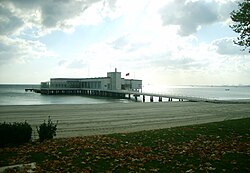
Atatürk marine mansion in Florya

Florya is a quarter (Turkish: semt) belonging to the Bakırköy district of the greater Istanbul, Turkey. It is located along Marmara Sea, and borders to the northeast the neighborhood of Yeşilköy, to the northwest that of Küçükçekmece. Its residents are relatively affluent. Florya has two stations along the Marmaray Commuter Line: Florya and Florya Akvaryum.

Mustafa Kemal Atatürk, the founder and the first president of Turkey, used to spend his free time in his Florya Atatürk Marine Mansion swimming and enjoying the beautiful sandy beach.

Name

[edit]

Florya's name, according to the Byzantine scholar Michael Psellos, who found it cited in an imperial Chrysobull, comes from the Greek word "Phlorion" (Φλώριον).[1] It is possibly derived from a certain Florus, who lived in this neighborhood during the early Byzantine age.[1] Until the 1920s the Ottoman name was "Fülürye".[2]

One part of the neighborhood is also called Şenlikköy.

Facilities

[edit]

The Atatürk Marine Mansion, once summer residence of Mustafa Kemal Atatürk and a museum today, is located at the shore of Marmara Sea.

Famous sports club Galatasaray SK has the club's training facilities in Florya. Also İstanbul Super Amateur League team Bakırköyspor plays its home games in Şenlikköy Stadium, which is located in Florya.

Florya Koleji, İstek Vakfı, İlke Koleji, Bahçeşehir Koleji are some of the local private colleges.

Economy

[edit]

Airlines such as Freebird Airlines have their head office in Florya.[3] Onur Air previously had its head office in Florya.[4]

References

[edit]

Sources

[edit]
  • Janin, Raymond (1964). Constantinople Byzantine (in French) (2 ed.). Paris: Institut Français d'Etudes Byzantines.

40°58′N 28°47′E / 40.97°N 28.79°E / 40.97; 28.79


Revisions and contributorsEdit on WikipediaRead on Wikipedia
from Grokipedia
Florya is a coastal quarter (semt) in the district on the European side of , , located along the approximately 15 kilometers from the city's historic center. Known for its beaches, parks, and modern amenities, it serves as a popular residential, tourist, and recreational area blending natural beauty with urban development. Historically, Florya traces its origins to the Byzantine era and gained prominence in the Republican period as a seaside retreat, particularly with the construction of the Atatürk Marine Mansion in 1935. This wooden pavilion, designed by architect Seyfi Arkan and built on iron pilings extending into the sea, was commissioned by the Istanbul Municipality as a summer residence for to aid his health during his final years; it functioned as a presidential retreat until 1938 and is now preserved as a . The area evolved from quiet coastal dunes into a vibrant neighborhood, featuring landmarks such as Florya Beach—a sandy stretch ideal for swimming and picnics—Florya Coast Park for leisurely walks, the Istanbul Aquarium (one of Europe's largest), and . Florya's significance extends to sports and economy, having long hosted the Florya Metin Oktay Facilities, the training ground and academy for the prominent football club Galatasaray S.K. since the 1980s, until its sale in 2025 to fund club operations, with training relocating to Kemerburgaz. Well-connected by the Marmaray metro line, metrobus, and E-5 highway, it attracts investors through its booming real estate market, luxury hotels like the Crowne Plaza Istanbul - Florya, and diverse dining options, positioning it as a key hub for leisure and commerce in greater Istanbul.

Geography

Location and Borders

Florya is a quarter (semt) and neighborhood (mahalle) within the , a and of the Metropolitan Municipality on the European side of , . Situated along the Marmara Sea coastline, it occupies a strategic position in the city's southwestern expanse, with approximate coordinates of 40.97°N 28.79°E. The area's boundaries are defined by neighboring districts and natural features: to the northeast lies , to the northwest , and to the south the Marmara Sea, providing a direct coastal interface that shapes its urban layout. These borders integrate Florya into the broader metropolitan context, with its administrative oversight falling under the district administration, which manages local services and planning within the greater framework. Florya's connectivity to Istanbul's urban fabric is enhanced by its proximity to key landmarks, including the now-closed Atatürk Airport, located about 10 km away, which historically supported regional access before its decommissioning in 2019. The quarter benefits from robust transport links, such as the Marmaray commuter rail line and major highways like the E-5, ensuring seamless integration with central and surrounding areas.

Physical Features and Climate

Florya occupies a low-lying along the Marmara Sea, characterized by sandy beaches and an average elevation of approximately 30-40 meters above . This gently sloping terrain facilitates easy access to the shoreline, with the district's southern boundary directly abutting the sea, forming a narrow strip of land that extends inland for a few kilometers. The area's includes expansive green spaces, notably Florya Coast Park, a large public park with tree-lined paths, gardens, and recreational areas that preserve pockets of coastal vegetation amid urban development. The climate of Florya is classified as Mediterranean, strongly influenced by its proximity to the Marmara Sea, which moderates temperatures and contributes to higher humidity levels compared to inland areas of . Winters are mild and wet, with average temperatures ranging from 8°C to 10°C between and , often accompanied by frequent rainfall and occasional rolling in from the sea. Summers are hot and dry, featuring average highs of 25°C to 28°C from to , with low during these months. Annual rainfall totals approximately 600-700 mm, concentrated primarily in the cooler seasons, supporting the region's lush green spaces while the sea's thermal regulation prevents extreme heatwaves or frosts. The Marmara Sea plays a crucial role in Florya's environmental dynamics, not only by tempering seasonal temperature swings but also by fostering diverse coastal , including marine species such as , , and seabirds that thrive in the nutrient-rich waters. However, this faces significant challenges from urban encroachment, as rapid residential and commercial expansion along the coast has led to and increased runoff since the late . These pressures have diminished natural buffers like dunes and wetlands, exacerbating vulnerability to and seawater intrusion in the low-elevation plain.

History

Ancient and Byzantine Periods

The region of modern Florya, situated along the Marmara Sea coast within the broader Byzantine suburb of Hebdomon (now ), shows limited evidence of organized settlement during the and Roman periods, likely serving as a peripheral coastal area rather than a prominent urban center. Archaeological investigations in the vicinity have uncovered sparse Roman-era artifacts, such as and structural remains, suggesting occasional use for maritime activities, though no definitive traces of a dedicated have been identified. In the Byzantine era, the locality was documented as Phlorion (Φλώριον), a modest rural settlement or village on the outskirts of , referenced in historical records as part of the extramural territories along the Propontis (Marmara Sea) shore within the suburb of Hebdomon. The name Phlorion is attested in Byzantine sources, such as an imperial chrysobull cited by the scholar . It may derive from the Latin Florus, possibly referring to an early resident or landowner during the initial centuries of Byzantine rule. This etymological link underscores the area's integration into the Greek-speaking Byzantine cultural landscape, where it functioned primarily as an agrarian and coastal outpost, with possible ties to local ecclesiastical properties or imperial estates, though detailed records remain fragmentary. Archaeological finds from the Byzantine period in the broader Hebdomon area are notably limited, consisting mainly of scattered ceramic shards, building foundations, and minor coastal installations that indicate sustained but low-intensity rural habitation and seasonal maritime use, such as small harbors or farmsteads, rather than monumental structures. The suburb of Hebdomon, encompassing Phlorion, served as a ceremonial and residential extension of , hosting imperial processions and suburban villas, but Phlorion itself appears to have been a quieter, peripheral focused on agriculture and fishing-related livelihoods. Byzantine control over the area persisted through the empire's later phases, with the region transitioning to Ottoman administration following the of in 1453, which ended Byzantine dominion and initiated its incorporation into the expanding Ottoman framework.

Ottoman and Republican Eras

During the Ottoman period, Florya was known as Fülürye, a name derived from the greenfinches whose songs attracted visitors to the area. It served primarily as a seaside retreat and along the Marmara , offering public beaches and leisure spots for residents until the early 20th century. The neighborhood's coastal location made it a modest summer , with limited development beyond basic recreational facilities. In the , following the establishment of the Turkish Republic, the area's name was changed to Florya as part of broader efforts to replace Ottoman-era toponyms with Turkish ones. This shift was influenced by White Russian refugees fleeing the 1917 Revolution, who reportedly mispronounced "Fülürye" as "Florya," contributing to its popular adoption. The Republican era brought initial development, including a population influx to after due to migration and the city's reorientation as a cultural hub, which gradually extended to peripheral areas like Florya. A pivotal moment came in 1935 with the construction of the Atatürk Marine Mansion, designed by architect Seyfi Arkan at the request of the Municipality as a summer residence for to aid his health. Built over just two months on pilings extending into the sea, the mansion hosted political meetings, scientific discussions, and notable guests, such as King Edward VIII in 1936, before becoming a in 1988 under the National Palaces Administration. This project marked Florya's transformation into a symbol of modern Republican leisure, integrated into Henri Prost's 1937 master plan for , which emphasized coastal accessibility via new transport links. Post-World War II accelerated Florya's growth, as rural migrants arrived in the , diversifying its population and shifting it from an elite resort to a more inclusive urban extension of . Developments like the Florya Houses in 1952 and expanded beach facilities in the late further embedded the neighborhood in the city's westward expansion, promoting it as a key recreational zone connected by highways and rail.

Etymology

Origins of the Name

The name Florya traces its roots to the Byzantine Greek term Phlorion (Φλώριον), a designation used for a locality along the Marmara Sea coast in the environs of Constantinople during the Byzantine era. This etymon reflects the linguistic evolution of place names in the region, where Greek forms predominated in administrative and topographical records. Scholars propose that Phlorion derives from the Latin personal name Florus, which itself stems from flos, meaning "flower," transmitted through Latin-Greek cultural intermediaries in the Roman and early Byzantine periods. An alternative derivation links it to "Florga," from Florina in Macedonia, possibly introduced via Rum migrations to the area. The connection may indicate a settlement named after an individual bearing that name who lived in the vicinity during the early Byzantine age, though definitive evidence for such a figure remains elusive. Alternatively, the floral root hints at a symbolic connotation tied to the area's natural landscape, including its coastal greenery and vegetation, even if no explicit ancient references link the name directly to blooming flora. While the precise mechanism of the name's adoption lacks robust documentation, Phlorion exemplifies how Latin-derived elements integrated into Byzantine , influencing later Turkish adaptations without altering the core floral undertones. Modern interpretations of Florya as a "flowery" locale are thus indirect, evoking potential historical echoes of the region's verdant setting rather than a literal botanical theme.

Historical Name Variations

During the Byzantine period, Florya was known as "Phlorion" in Greek, a name recorded in imperial documents and possibly referencing a local figure named . This variant reflects the area's integration into the Byzantine urban landscape along the Marmara coast. In the Ottoman era, from the 15th to the early , the neighborhood was primarily called "Fülürye" in , a term derived from the greenfinch birds (Chloris chloris) that were abundant in the region's coastal groves and attracted visitors. The shift to the modern name "Florya" occurred in the early Republican period, solidified around the 1920s amid broader purification efforts that favored phonetic simplifications and adoption. This change was accelerated by White Russian émigrés fleeing the 1917 Revolution, who adapted "Fülürye" into "Florya" due to pronunciation challenges, influencing local usage before official standardization. Nineteenth-century European cartography occasionally rendered the name as "Floria," likely a Latinized or anglicized approximation in travelogues and maps depicting Ottoman coastal sites. Local nicknames persisting into the 20th century, such as those evoking the area's sandy shores and bird-filled wetlands, underscored its recreational identity tied to Marmara Sea features.

Demographics

Population Statistics

As of 2024, the population of Florya (Şenlikköy mahallesi) stands at approximately 28,000 residents, reflecting stability in recent years according to data from the Turkish Statistical Institute (TÜİK). This figure represents a modest evolution from around 26,000 in the late 2000s, when the neighborhood had transitioned from a small coastal village to a more urbanized residential area. Historically, Florya's growth mirrors Istanbul's broader urbanization, with the neighborhood expanding from a modest village of several hundred inhabitants in the early 20th century—to an established urban quarter by the 2000s. The population reached about 27,000 by 2010 and peaked near 29,000 in 2021, driven by Istanbul's metropolitan expansion to over 15.7 million residents in 2024. Covering roughly 3 square kilometers, Florya maintains a population density of approximately 9,200 people per km², higher than the Istanbul average due to its compact coastal layout. The area's demographics feature a relatively young profile, with a significant proportion of families attracted to its residential and seaside appeal, aligning with Istanbul's median age of around 34 years. Post-2020 trends show a slight uptick to 2021 followed by stabilization, influenced by the city's overall growth and Florya's desirability amid remote work shifts, though exact mahalle-level changes remain tied to broader metropolitan dynamics. This ethnic and social composition further shapes the numerical profile, as detailed in related sections.

Ethnic and Social Composition

Florya's population is predominantly ethnic Turkish, reflecting the broader demographic trends in Istanbul where ethnic Turks form the majority, though local neighborhoods like Florya exhibit even higher homogeneity due to historical shifts and selective migration patterns. Small communities of Kurds, the largest ethnic minority in Istanbul, along with Circassians and recent immigrants from the Middle East, such as Syrians and Arabs, contribute to modest diversity, often integrating into the urban fabric without forming distinct enclaves. Historically, Florya and surrounding areas in Bakırköy district hosted significant non-Muslim populations, including Greeks and Armenians, who comprised about 37% of the local residents between 1830 and 1914, centered in villages like Aya Stefanos. These communities declined dramatically following the Ottoman population exchanges of 1923 and earlier events, including the Greco-Turkish War and associated migrations, leading to a Muslim-majority composition that reached 93% by 1965 and persists today with minimal remnants of those groups. The social structure in Florya centers on middle- to upper-middle-class families and professionals, characterized by high education levels, stable incomes, and low housing density, as indicated by a social rank index of 69.65 in recent assessments. Many residents commute to central Istanbul for employment in sectors like business and services, leveraging the area's proximity to transportation hubs while enjoying suburban tranquility. Cultural influences in Florya merge secular urban lifestyles—evident in modern amenities and professional demographics—with longstanding coastal leisure traditions, shaped by its Marmara Sea shoreline and evolution from a 20th-century summer resort to a year-round residential hub. Community dynamics are reinforced through local events like seaside gatherings and festivals at venues such as , which celebrate the area's heritage and promote social cohesion among diverse yet integrated residents.

Economy

Residential and Commercial Development

Florya's residential landscape features a diverse mix of housing types, including mid-rise apartments, traditional villas, and contemporary low- to mid-rise developments along its Marmara Sea coastline. Early summer residences from the mid-20th century evolved into permanent homes, with modern projects like Nivak Florya offering 4- to 5-story buildings containing apartments from 2+1 to 7+1 configurations, emphasizing family-oriented living with amenities such as indoor pools and green courtyards. Villas and second homes persist in areas like the Atatürk Forest vicinity, blending with denser apartment blocks that cater to year-round urban dwellers. Commercial development in Florya centers on prominent retail hubs that integrate shopping with leisure, notably the Aqua Florya Shopping Mall, a seafront complex opened in 2012 with over 145 stores, cinemas, dining options, and an attached aquarium showcasing global marine life. Complementing this are local markets, such as the weekly Florya Bazaar held every Wednesday, where vendors offer fresh produce, spices, textiles, and artisanal crafts, serving as a community-focused retail space that preserves traditional trading practices. These hubs support daily commerce while enhancing Florya's appeal as a balanced urban-residential area. A significant development surge occurred in the early 2000s, particularly around 2004, driven by relaxed building regulations during local elections, which allowed for taller structures up to seven stories and spurred construction of luxury residences. This boom attracted affluent residents seeking proximity to the sea and Atatürk International Airport, transforming Florya from a seasonal resort into a desirable enclave for conservative, high-income families with introverted, upscale homes featuring private gardens and modern facilities. The influx of such projects, including gated complexes, elevated the neighborhood's status as an elite residential zone. Urban planning in Florya has sought to equilibrate expansion with environmental preservation, enforcing height restrictions—initially 7.5 meters near the airport, later adjusted—to mitigate density while protecting coastal aesthetics. Efforts include maintaining green spaces like the 170-acre Florya Atatürk Forest, designated as a protected natural area since the 1930s, though encroachment by second homes and developments has reduced overall lot coverage for gardens from early periods. Initiatives by the Istanbul Metropolitan Municipality, such as green corridors and sustainability strategies, aim to counteract this by integrating eco-friendly designs in new builds, ensuring a portion of land remains for public parks and trails. Property values in Florya remain elevated due to its coveted sea views and coastal location, surpassing Istanbul's citywide average of approximately 63,125 TL per square meter as of mid-2025, with luxury seafront residences often ranging from 80,000 to 120,000 TL per square meter in recent projects. This premium pricing reflects the neighborhood's blend of natural appeal and modern infrastructure, drawing investors and residents despite broader market inflation pressures.

Key Sectors and Businesses

Florya's aviation sector stands out as a major economic driver, anchored by the headquarters of , a Turkish charter airline that operates international flights primarily to European destinations and employs local staff in administrative and operational roles. The neighborhood previously served as the base for , a low-cost carrier that maintained its head office there until its cessation of operations in 2021, supporting ancillary services such as maintenance and logistics that bolstered employment in aviation-related fields. Florya also played a significant role in the sports economy through the Florya Metin Oktay Facilities, the training ground and academy for since the 1980s. This complex contributed to local employment, tourism, and real estate value until its sale in 2025 for approximately €500 million to fund club operations, with training relocating to Kemerburgaz. The sale has potential implications for the area's commercial landscape, including opportunities for redevelopment. Tourism contributes significantly to the local economy through beachfront services and attractions like the Istanbul Aquarium, located within the Aqua Florya complex, which draws about 1.5 million domestic and international visitors each year and sustains seasonal revenue from ticket sales, merchandise, and on-site dining. These visitors support hospitality and retail outlets along the Marmara Sea coast, enhancing economic activity during peak summer months. Small-scale commerce in Florya includes coastal eateries focused on fresh seafood, which trace their roots to the area's traditional practices, though large-scale fishing has diminished in favor of recreational and culinary ventures. This sector provides localized employment and caters to both residents and tourists seeking authentic Marmara cuisine.

Infrastructure

Transportation Networks

Florya benefits from robust rail connectivity through the Marmaray suburban rail line, which operates as an undersea tunnel and surface rail network spanning the European and Asian sides of Istanbul. The line features two key stations in the area: Florya station and Florya Akvaryum station, both serving local commuters and visitors. These stations provide direct links to central Istanbul districts such as Sirkeci and Yenikapı, with services running from Halkalı in the west to Gebze in the east, facilitating efficient travel across the city and connections to broader transit networks, including high-speed rail at Halkalı. Public bus services, operated by the Istanbul Electricity Tramway and Tunnel Administration (İETT), offer extensive intra-city coverage in Florya. Key routes include the 73B line connecting Florya to Bakırköy, the 73F ring line serving Taksim, and others such as 146, 76O, BN1, and BN2, which link to surrounding neighborhoods like Küçükçekmece and Yenibosna. Additionally, Florya is in close proximity to the Metrobüs system, Istanbul's bus rapid transit network, with the Beşyol and Cennet Mahallesi stops accessible within a short walk or minibus ride, enabling quick transfers to major hubs like Kadıköy and Zincirlikuyu for cross-continental travel. Road infrastructure supports seamless vehicular access, with Florya positioned along the D100 state highway (also known as E5), a primary east-west corridor that facilitates connectivity to both European and Asian . The coastal Kennedy Caddesi, running parallel to the Marmara Sea shoreline, provides direct seaside access for local and tourist traffic, enhancing links to nearby beaches and attractions while integrating with the broader urban road grid. Florya lies approximately 41 kilometers from Istanbul Airport, reachable in about 33 minutes by car via the O-7 highway, underscoring its strategic position for air travel. The area is also adjacent to the historical site of Atatürk Airport in neighboring Yeşilköy, roughly 10 kilometers away, which ceased commercial operations in 2019 and now serves limited general aviation while parts are repurposed for urban development. Looking ahead, Florya's transportation network is poised for enhancement through Istanbul's ambitious metro expansion, targeting over 1,000 kilometers of lines by 2030 to alleviate congestion and improve suburban access, potentially including extensions that integrate with existing Marmaray services in the Bakırköy vicinity. As of 2025, construction on the M20 Sefaköy-Beylikdüzü metro line, which will enhance connectivity near Florya with an expected length of 18 km, is underway.

Public Services and Utilities

Florya residents have access to a mix of public and private educational institutions, supporting the 12-year compulsory education system in Turkey. Private schools such as Florya College provide primary education with a focus on modern curricula, including English instruction and international programs. Similarly, FMV Private Florya Işık Kindergarten and Primary School offers early childhood and primary education aligned with national standards and international baccalaureate options. Public primary schools in the Bakırköy district, which encompasses Florya, deliver free education in Turkish through the Ministry of National Education. Higher education is readily available via Istanbul Aydın University, a private institution with its Florya Campus located nearby in the adjacent Küçükçekmece district, known for its diverse programs and high student enrollment. Healthcare services in Florya emphasize both specialized private facilities and proximity to public options. The VM Medical Park Florya Hospital, affiliated with Istanbul Aydın University, operates as a 300-bed multi-specialty center with 13 operating rooms, providing comprehensive care including oncology and emergency services. Florya Hospital serves as another key private provider, focusing on patient satisfaction with modern infrastructure and affordable treatments across various specialties. Local clinics, such as Florya Aesthetic Clinic, offer targeted outpatient care in areas like urology, dentistry, and cosmetic procedures. Residents also benefit from easy access to Bakırköy State Hospital, a public facility within the same district approximately 8 km away, ensuring broader emergency and general medical support. Utilities in Florya are managed through Istanbul's metropolitan systems, ensuring reliable provision for the neighborhood's coastal and urban needs. Water supply and sewage services are handled by the Istanbul Water and Sewerage Administration (İSKİ), which maintains infrastructure for potable water distribution and wastewater treatment across the city, including Florya. Electricity distribution falls under Boğaziçi Elektrik Dağıtım A.Ş., covering the European side of Istanbul and providing consistent power to residential and commercial areas in Florya. İSKİ also addresses coastal flood risks in low-lying areas like Florya through hydrodynamic modeling and early warning systems integrated into broader Istanbul flood management strategies. Waste management and recycling in Florya align with Istanbul Metropolitan Municipality's sustainability initiatives, emphasizing reduction and recovery. The Bakırköy Municipality oversees local collection and disposal, generating approximately 326.5 tons of municipal solid waste daily district-wide, with efforts to separate recyclables like glass and plastics. These programs integrate with the national Zero Waste Project, promoting circular economy practices such as curbside recycling and material recovery to minimize landfill use and support environmental goals. Community centers and social services in Florya support diverse resident needs, including education, recreation, and welfare. The Florya Social Facilities, operated by the Istanbul Metropolitan Municipality, provide multifunctional spaces for up to 4,000 people, hosting events and offering access to libraries and social programs. The Istanbul Provincial Directorate of Family and Social Services delivers targeted assistance, including protection, care, and counseling for vulnerable groups such as families and children in the Bakırköy area. Public libraries in the district function as community hubs, offering free internet, study areas, and cultural activities to foster social cohesion.

Attractions and Culture

Historical Sites

Florya Atatürk Marine Mansion, constructed in 1935 in a modernist style by architect Seyfi Arkan, stands as the district's premier historical landmark. Built over the Sea of Marmara on steel piles connected to the shore by a bridge, the single-story L-shaped structure served as a summer residence and working office for , who first visited in August 1935 and used it regularly until his final stay on May 28, 1938. The mansion features modernist elements like clean white lines and functional interiors, including a reception hall, reading room, bedrooms, and bathrooms, reflecting early Republican architectural ideals. Today, the mansion operates as a historic house museum under the Directorate of National Palaces, affiliated with the Turkish Grand National Assembly (TBMM), preserving its original furnishings, artwork, and personal items from Atatürk's era. Opened to the public in 1993 following restorations, it offers guided tours that highlight Atatürk's time there and the site's role in Republican history, with exhibits including period furniture and photographs. Ottoman-era structures in Florya are modest and integrated into contemporary neighborhoods, such as small mosques and fountains that served community needs during the empire's later periods. For instance, in nearby Şenlikköy—a historical Rum village within the broader Bakırköy district—an early 20th-century church was adapted into a mosque, exemplifying Ottoman practices of reusing religious buildings with added features like timber minarets. Post-2000 cultural preservation efforts in Florya have focused on sustaining these sites amid urban growth and environmental challenges, including studies on the mansion's resilience to marine climates and proposals for adaptive reuse of nearby Ottoman-era buildings to serve as cultural centers. These initiatives, supported by national heritage bodies, aim to balance tourism with conservation, ensuring the district's historical fabric endures.

Recreational and Modern Facilities

Florya has emerged as a hub for modern leisure since the early 2000s, with developments emphasizing coastal access and family-oriented entertainment. The Istanbul Aquarium, located within the Aqua Florya complex, opened in April 2011 and stands as one of Europe's largest public aquariums, housing over 17,000 marine animals representing approximately 1,500 species across 18 themed exhibits that simulate global habitats from the Pacific Ocean to the Amazon rainforest. These exhibits include interactive zones like a penguin enclosure and an underwater tunnel, drawing over a million visitors annually and promoting marine conservation education. Complementing the aquarium, Florya Beach and Coast Park provide expansive public green spaces along the Marmara Sea shoreline, featuring well-maintained promenades ideal for walking and cycling, alongside numerous seaside cafes offering Turkish coffee and light meals. The park's layout supports relaxed picnics and water activities, with seasonal events such as outdoor concerts and family picnics enhancing its appeal as a year-round destination, particularly during summer months when attendance peaks. The Florya Metin Oktay Facilities, serving as the training ground and academy for Galatasaray S.K. since the 1980s, was a key sports attraction until its sale in 2025 to fund club operations, after which training relocated to Kemerburgaz. Shopping options in Florya blend traditional and contemporary elements, with the Florya Bazaar serving as a vibrant market for local crafts, including handmade jewelry, textiles, and artisanal pottery, where visitors can engage in bargaining for authentic Turkish souvenirs. Nearby, the Aqua Florya Mall, a seafront retail center opened in 2012, hosts over 200 stores featuring international brands like Nike, H&M, and Sephora, alongside dining outlets and a cinema, creating a comprehensive entertainment ecosystem. Hospitality in the area caters to leisure seekers through seaside resorts like the Crowne Plaza Istanbul Florya, a modern hotel with direct beach access and multiple dining venues specializing in fresh seafood, such as the Florya Fish House, which highlights Marmara Sea catches in Mediterranean-inspired dishes. These facilities often host informal gatherings, contributing to Florya's reputation for relaxed coastal stays. As of 2025, Florya continues to host annual beachside markets and festivals, including summer pop-up events at the Coast Park that feature local vendors, live music, and cultural performances, fostering community engagement along the promenade.

References

Add your contribution
Related Hubs
User Avatar
No comments yet.