
Hubbry Logo
Radiant exposureRadiant exposureMain
Open search
Radiant exposure
Community hub
Radiant exposure
logo
7 pages, 0 posts
0 subscribers
Be the first to start a discussion here.
Contribute something
Radiant exposure
Radiant exposure
from Wikipedia

In radiometry, radiant exposure or fluence is the radiant energy received by a surface per unit area, or equivalently the irradiance of a surface, integrated over time of irradiation, and spectral exposure is the radiant exposure per unit frequency or wavelength, depending on whether the spectrum is taken as a function of frequency or of wavelength. The SI unit of radiant exposure is the joule per square metre (J/m2), while that of spectral exposure in frequency is the joule per square metre per hertz (J⋅m−2⋅Hz−1) and that of spectral exposure in wavelength is the joule per square metre per metre (J/m3)—commonly the joule per square metre per nanometre (J⋅m−2⋅nm−1).

Mathematical definitions

[edit]

Radiant exposure

[edit]

Radiant exposure of a surface, denoted He ("e" for "energetic", to avoid confusion with photometric quantities), is defined as[1] where
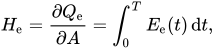
  • ∂ is the partial derivative symbol;
  • Qe is the radiant energy;
  • A is the area;
  • T is the duration of irradiation;
  • Ee is the irradiance.

Spectral exposure

[edit]

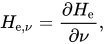
Spectral exposure in frequency of a surface, denoted He,ν, is defined as[1] where ν is the frequency.
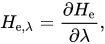
Spectral exposure in wavelength of a surface, denoted He,λ, is defined as[1] where λ is the wavelength.
SI radiometry units

[edit]

Quantity Unit Dimension Notes
Name Symbol[nb 1] Name Symbol
Radiant energy Qe[nb 2] joule J ML2T−2 Energy of electromagnetic radiation.
Radiant energy density we joule per cubic metre J/m3 ML−1T−2 Radiant energy per unit volume.
Radiant flux Φe[nb 2] watt W = J/s ML2T−3 Radiant energy emitted, reflected, transmitted or received, per unit time. This is sometimes also called "radiant power", and called luminosity in astronomy.
Spectral flux Φe,ν[nb 3] watt per hertz W/Hz ML2T −2 Radiant flux per unit frequency or wavelength. The latter is commonly measured in W⋅nm−1.
Φe,λ[nb 4] watt per metre W/m MLT−3
Radiant intensity Ie,Ω[nb 5] watt per steradian W/sr ML2T−3 Radiant flux emitted, reflected, transmitted or received, per unit solid angle. This is a directional quantity.
Spectral intensity Ie,Ω,ν[nb 3] watt per steradian per hertz W⋅sr−1⋅Hz−1 ML2T−2 Radiant intensity per unit frequency or wavelength. The latter is commonly measured in W⋅sr−1⋅nm−1. This is a directional quantity.
Ie,Ω,λ[nb 4] watt per steradian per metre W⋅sr−1⋅m−1 MLT−3
Radiance Le,Ω[nb 5] watt per steradian per square metre W⋅sr−1⋅m−2 MT−3 Radiant flux emitted, reflected, transmitted or received by a surface, per unit solid angle per unit projected area. This is a directional quantity. This is sometimes also confusingly called "intensity".
Spectral radiance
Specific intensity
Le,Ω,ν[nb 3] watt per steradian per square metre per hertz W⋅sr−1⋅m−2⋅Hz−1 MT−2 Radiance of a surface per unit frequency or wavelength. The latter is commonly measured in W⋅sr−1⋅m−2⋅nm−1. This is a directional quantity. This is sometimes also confusingly called "spectral intensity".
Le,Ω,λ[nb 4] watt per steradian per square metre, per metre W⋅sr−1⋅m−3 ML−1T−3
Irradiance
Flux density
Ee[nb 2] watt per square metre W/m2 MT−3 Radiant flux received by a surface per unit area. This is sometimes also confusingly called "intensity".
Spectral irradiance
Spectral flux density
Ee,ν[nb 3] watt per square metre per hertz W⋅m−2⋅Hz−1 MT−2 Irradiance of a surface per unit frequency or wavelength. This is sometimes also confusingly called "spectral intensity". Non-SI units of spectral flux density include jansky (1 Jy = 10−26 W⋅m−2⋅Hz−1) and solar flux unit (1 sfu = 10−22 W⋅m−2⋅Hz−1 = 104 Jy).
Ee,λ[nb 4] watt per square metre, per metre W/m3 ML−1T−3
Radiosity Je[nb 2] watt per square metre W/m2 MT−3 Radiant flux leaving (emitted, reflected and transmitted by) a surface per unit area. This is sometimes also confusingly called "intensity".
Spectral radiosity Je,ν[nb 3] watt per square metre per hertz W⋅m−2⋅Hz−1 MT−2 Radiosity of a surface per unit frequency or wavelength. The latter is commonly measured in W⋅m−2⋅nm−1. This is sometimes also confusingly called "spectral intensity".
Je,λ[nb 4] watt per square metre, per metre W/m3 ML−1T−3
Radiant exitance Me[nb 2] watt per square metre W/m2 MT−3 Radiant flux emitted by a surface per unit area. This is the emitted component of radiosity. "Radiant emittance" is an old term for this quantity. This is sometimes also confusingly called "intensity".
Spectral exitance Me,ν[nb 3] watt per square metre per hertz W⋅m−2⋅Hz−1 MT−2 Radiant exitance of a surface per unit frequency or wavelength. The latter is commonly measured in W⋅m−2⋅nm−1. "Spectral emittance" is an old term for this quantity. This is sometimes also confusingly called "spectral intensity".
Me,λ[nb 4] watt per square metre, per metre W/m3 ML−1T−3
Radiant exposure He joule per square metre J/m2 MT−2 Radiant energy received by a surface per unit area, or equivalently irradiance of a surface integrated over time of irradiation. This is sometimes also called "radiant fluence".
Spectral exposure He,ν[nb 3] joule per square metre per hertz J⋅m−2⋅Hz−1 MT−1 Radiant exposure of a surface per unit frequency or wavelength. The latter is commonly measured in J⋅m−2⋅nm−1. This is sometimes also called "spectral fluence".
He,λ[nb 4] joule per square metre, per metre J/m3 ML−1T−2
See also:
  1. ^ Standards organizations recommend that radiometric quantities should be denoted with suffix "e" (for "energetic") to avoid confusion with photometric or photon quantities.
  2. ^ a b c d e Alternative symbols sometimes seen: W or E for radiant energy, P or F for radiant flux, I for irradiance, W for radiant exitance.
  3. ^ a b c d e f g Spectral quantities given per unit frequency are denoted with suffix "ν" (Greek letter nu, not to be confused with a letter "v", indicating a photometric quantity.)
  4. ^ a b c d e f g Spectral quantities given per unit wavelength are denoted with suffix "λ".
  5. ^ a b Directional quantities are denoted with suffix "Ω".

See also

[edit]

References

[edit]
Revisions and contributorsEdit on WikipediaRead on Wikipedia
from Grokipedia
Radiant exposure, also known as radiant fluence or fluence, is a radiometric quantity that measures the total incident on a surface per unit area. It is defined as the time integral of over the duration of exposure, expressed by the formula H = ∫ E dt, where H is radiant exposure and E is . The standard SI unit is joules per square meter (J/m²), though joules per square centimeter (J/cm²) is commonly used in and biomedical contexts. This quantity plays a central role in assessing the cumulative effects of across the spectrum, from to , without regard to human —distinguishing it from photometric analogs like exposure in . Spectral radiant exposure, denoted H_λ or H_ν, accounts for distribution over or , with units such as J/m²·nm, enabling precise analysis in wavelength-dependent applications. In practice, radiant exposure quantifies energy delivery for pulsed sources, such as lasers, where peak values are calculated as total pulse energy divided by the irradiated area (e.g., for a , H_peak = U / (π w²), with U as and w as beam ). Radiant exposure is essential in standards, where it defines accessible emission limits and maximum permissible exposures to protect against thermal or photochemical damage to eyes and skin. In photobiomodulation and low-level , doses ranging from 0.1 to 50 J/cm² modulate cellular processes like proliferation and inflammation reduction, influencing outcomes in and . Additionally, it determines damage thresholds in and , guiding the design of laser-resistant coatings and gain media by specifying saturation or fluences.

Fundamentals

Definition

Radiant exposure is the total incident on a surface per unit area, representing the accumulation of received over a period of exposure. It quantifies how much energy from sources such as or other forms of impinges upon a given surface. This measure is fundamental in , the science of measuring , where it serves as a key parameter for assessing cumulative energy delivery to a receiver. At its core, radiant exposure builds on the concepts of —the total energy emitted, transmitted, or received by —and surface area, which defines the spatial extent over which the energy is distributed. encompasses all wavelengths of the , from to , while the surface area refers to the specific portion of an object or medium that intercepts the . These foundational elements allow radiant exposure to capture the integrated effect of on a target without regard to immediate power rates. The term "radiant exposure" was introduced in as part of efforts to standardize radiometric , drawing from the photographic concept of "exposure" in photometry and adapting it to broader physics contexts. This formalization occurred amid growing needs in optical sciences for precise terminology, influenced by organizations like the Optical Society of America and the . Earlier ideas in photometry, dating back to the late , laid the groundwork by quantifying light energy on sensitive surfaces, which extended to all . Irradiance, the instantaneous radiant power per unit area incident on a surface, contributes to radiant exposure through its accumulation over time. For example, the radiant exposure from on during a day integrates the varying levels, building up energy that can result in effects like sunburn if thresholds are exceeded.

Physical interpretation

Radiant exposure represents the total energy dose of delivered to a unit area of a surface over time, serving as a measure of the cumulative impact that can induce various physical and biological effects, such as heating, photochemical reactions, or material degradation. This dose determines the extent to which interacts with the target, where absorbed energy can lead to macroscopic changes like surface or microscopic alterations in molecular structures. In thermal contexts, contributes to accumulation that raises the of the exposed , potentially causing phase changes, expansion, or through conduction. For non-thermal effects, particularly with , the dose drives photochemical processes that directly alter biomolecules, such as inducing DNA strand breaks or dimer formation without significant heating. Unlike irradiance, which quantifies instantaneous power density, radiant exposure emphasizes the time-integrated nature of the exposure, allowing equivalent total doses from brief high-intensity pulses or prolonged low-intensity illumination, though biological reciprocity may vary with dose rate in some systems. In biological tissues, threshold radiant exposures define critical limits; for instance, the minimal erythema dose for UVB-induced skin reddening in fair-skinned individuals is typically 200–300 J/m².

Mathematical description

Radiant exposure

Radiant exposure, denoted as HH, is formally defined as the time of irradiance E(t)E(t) over the duration of exposure, expressed mathematically as H=0τE(t)dt,H = \int_{0}^{\tau} E(t) \, dt, where HH has units of joules per square meter (J/m²) and τ\tau is the total exposure time. This definition arises from the fundamental radiometric quantities of and . Radiant energy QQ, the total amount of radiant power accumulated over time, is given by the time of the Φ\Phi: Q=0τΦ(t)dt,Q = \int_{0}^{\tau} \Phi(t) \, dt, where Φ\Phi is the radiant power in watts (W). Radiant exposure then represents this energy density per unit surface area, assuming uniform incidence: H=QA,H = \frac{Q}{A}, with AA as the illuminated area in square meters (m²). Under the condition of normal (perpendicular) incidence on the surface, irradiance is the radiant flux per unit area, E=Φ/AE = \Phi / A. Substituting yields H=1A0τΦ(t)dt=0τE(t)dt.H = \frac{1}{A} \int_{0}^{\tau} \Phi(t) \, dt = \int_{0}^{\tau} E(t) \, dt. These derivations assume a surface oriented perpendicular to the direction of the incident beam and uniform irradiance distribution across the area, without considering surface absorption, reflection, or scattering effects. This formulation captures the broadband accumulation of radiant energy across all wavelengths incident on the surface, motivated by the physical interpretation of radiant exposure as the total energy impinging per unit area over time. For a simple case of constant EE maintained over exposure duration τ\tau, the simplifies to the product H=Eτ.H = E \tau. This linear relationship highlights how exposure scales directly with both intensity and duration under steady conditions.

Spectral radiant exposure

Spectral radiant exposure quantifies the - or -resolved incident on a surface per unit area over time, extending the broadband radiant exposure to account for the distribution across the . It is defined as the time integral of the spectral , expressed as Hλ(λ)=Eλ(λ,t)dtH_\lambda(\lambda) = \int E_\lambda(\lambda, t) \, dt for λ\lambda, or Hν(ν)=Eν(ν,t)dtH_\nu(\nu) = \int E_\nu(\nu, t) \, dt for ν\nu, where the subscripts denote spectral densities per unit or , respectively. In standard notation, wavelength λ\lambda is typically expressed in meters (m), though practical measurements often use nanometers (nm) for optical spectra, while frequency ν\nu is in hertz (Hz). The total (broadband) radiant exposure HH is obtained by integrating the spectral radiant exposure over the entire spectrum: H=0Hλ(λ)dλH = \int_0^\infty H_\lambda(\lambda) \, d\lambda (or equivalently over frequency). This integration links the spectral distribution to the overall energy fluence, enabling the analysis of how specific spectral components contribute to the total exposure. In , spectral radiant exposure is crucial for assessing targeted biological or chemical effects, as certain wavelengths elicit specific responses.

Units and measurement

SI units

The SI unit for broadband radiant exposure HH is the joule per square meter (J/m²), representing the received per unit area on a surface. This unit is formally defined in ISO 80000-7:2019 as the time integral of , ensuring standardized application across in physics and engineering disciplines. For spectral radiant exposure HλH_\lambda, which describes the distribution per unit , the SI unit is joule per square meter per meter (J/m³), though practical measurements often use joule per square meter per nanometer (J/m²·nm⁻¹) for convenience in the visible and ranges. Historically, radiant exposure has been expressed in non-SI units like per square centimeter (cal/cm²) in photobiology and materials testing, where 1 cal/cm² ≈ 4.184 × 10⁴ J/m² based on the thermochemical definition. These conversions facilitate legacy data integration but are discouraged in modern SI-compliant applications to maintain consistency.

Measurement methods

Radiant exposure is quantified experimentally by integrating measurements over the exposure duration, using specialized instruments that capture radiant flux density and accumulate it temporally. Radiometers equipped with photodiodes or bolometers are commonly employed for continuous or steady-state sources, where the sensor output, proportional to , is integrated to yield exposure values in SI units of joules per square meter. These detectors convert incident into electrical signals via photovoltaic or effects, enabling precise quantification across to wavelengths. For pulsed sources, such as lasers, pyroelectric detectors are particularly effective, as they generate a voltage proportional to the absorbed per , facilitating direct computation of radiant exposure when divided by the sensor's effective area. Methods for measurement involve time-resolved recording of irradiance data, typically via data loggers connected to the detector, which perform to compute cumulative exposure. Calibration ensures to primary standards; for instance, detectors are exposed to known radiant fluxes from blackbody sources at controlled temperatures, adjusting factors to minimize uncertainties below 0.1% in many cases. This process verifies , response, and temporal stability, often using cryogenic radiometers as absolute references for high accuracy. Key challenges in these measurements include correcting for angular incidence effects, governed by the cosine law, which requires diffusers or cosine-corrected to ensure the effective accounts for non-normal beam angles and avoid errors up to 4% at 50° incidence. Spectral selectivity poses another issue, addressed by incorporating bandpass filters or monochromators to isolate desired ranges, preventing responses from skewing results in spectrally varying sources.

Relations to other quantities

Comparison with irradiance

Irradiance, denoted EE, quantifies the radiant power incident on a surface per unit area, with SI units of watts per square meter (W/m²). In contrast, radiant exposure, denoted HH, measures the total radiant energy incident on a surface per unit area, expressed in joules per square meter (J/m²), or equivalently W·s/m². The primary distinction lies in their temporal nature: irradiance captures the instantaneous rate of energy delivery at a specific moment, while radiant exposure accumulates energy over an exposure duration, making it essential for evaluating cumulative effects like biological doses. This time-integrated aspect of radiant exposure is critical in scenarios where prolonged or repeated exposures can lead to harm despite moderate instantaneous levels. For example, a brief might produce high but yield low radiant exposure due to its short duration, rendering it relatively safe; conversely, extended exposure to lower can build up to high radiant exposure, posing greater risk. In standards, such as IEC 60825-1, maximum permissible exposure (MPE) limits for are specified using radiant exposure for pulsed sources, derived from thresholds to account for these dynamics.

Relation to radiant energy and fluence

Radiant exposure HH is the total WW incident upon a surface divided by the exposed area AA, expressed as H=WA,H = \frac{W}{A}, where the units are joules per square meter (J/m²). This quantity represents the time-integrated over the duration of exposure. For cases of non-uniform across the surface, HH is computed as the spatial average of the local radiant exposures. In , radiant exposure is frequently synonymous with radiant fluence, serving as the energy-based analog to fluence in other contexts; both describe energy received per unit area. However, in and , fluence Φ\Phi specifically denotes the number of particles (such as photons, electrons, or neutrons) incident on a unit area, with units of inverse square meters (m⁻²). This particle fluence is defined as the quotient of the differential number of particles dNdN by the differential cross-sectional area dada through which they pass. The key distinction lies in their domains: fluence is commonly applied to charged particles or neutral particles in and , whereas radiant exposure pertains exclusively to in radiometric measurements. In , the absorbed dose DD (measured in grays, Gy, where 1 Gy = 1 J/kg) relates to radiant exposure HH via the mass energy-absorption coefficient (μen/ρ)(\mu_{en}/\rho), approximately as DH×(μen/ρ)D \approx H \times (\mu_{en}/\rho) under conditions of equilibrium; notably, HH quantifies the incident energy fluence, distinct from the energy actually absorbed by the medium.

Applications

In photobiology and medicine

In photobiology, radiant exposure quantifies the cumulative ultraviolet (UV) radiation dose delivered to biological tissues, influencing processes such as skin erythema and vitamin D synthesis. The minimal erythemal dose (MED), defined as the smallest radiant exposure causing visible skin reddening 24 hours post-exposure, typically ranges from 200 to 400 J/m² for UVB wavelengths around 300 nm in fair-skinned individuals. This threshold varies by skin phototype, with darker skin requiring higher doses up to 800 J/m² or more. For vitamin D synthesis, suberythemal radiant exposures are sufficient; a threshold of approximately 1 kJ/m² of erythemally weighted UV radiation (primarily 290–315 nm) can initiate cutaneous production of previtamin D3, raising serum 25(OH)D3 levels by 1.6–5.3 nmol/L per 100 J/m² effective exposure depending on body surface area irradiated. Action spectra reveal peak biological sensitivity at specific wavelengths, such as 260 nm for DNA absorption leading to thymine dimer formation, which underpins UV-induced mutagenesis and erythema. Spectral radiant exposure is particularly relevant in these contexts, as weighting functions adjust total exposure for wavelength-specific effects, such as the CIE action spectrum peaking near 300 nm. In medicine, controlled radiant exposure enables therapeutic applications like (PDT) for cancer, where photosensitizers like 5-aminolevulinic acid or temoporfin are activated by red light (630–665 nm) at doses of 20–100 J/cm² to generate that selectively destroy tumor cells in head and neck cancers. These exposures, often 100–150 J/cm² for Photofrin-mediated PDT in oral , balance efficacy with minimizing damage to surrounding healthy tissue. Post-2000 research has refined understanding of non-UV hazards, with studies on blue light (380–550 nm) prompting updates to ICNIRP guidelines in 2013 to address photochemical retinal damage from prolonged exposure, setting radiance limits at 100 W/m² sr⁻¹ for sources larger than 100 mrad (reaffirmed as of 2024). In modern applications, such as LED-based phototherapy for skin conditions like acne or psoriasis, radiant exposures are dosed at 10–60 J/cm² (typically blue or red light) over 10–20 minute sessions, 3–5 times weekly, to stimulate collagen production or reduce inflammation while preventing overexposure that could cause irritation or diminished efficacy. This precise dosing underscores radiant exposure's role in optimizing therapeutic outcomes without exceeding biological tolerance thresholds.

In laser safety and engineering

In laser safety, radiant exposure serves as a key metric for establishing maximum permissible exposure (MPE) limits for sources, where the MPE represents the highest level of radiant exposure (in J/m²) to which the eye or may be exposed without adverse effects. The (ANSI) Z136.1-2022 standard specifies these MPE values through detailed tables accounting for wavelength, pulse duration, and exposure scenario; for visible lasers ( nm), typical MPEs range from approximately 10 J/m² to 2,000 J/m² depending on pulse length, with longer pulses permitting higher exposures due to relaxation and . These MPE limits directly inform practices, such as designing protective barriers and interlocks in systems, ensuring that integrated over durations does not exceed safe thresholds. For repetitive pulses, the standard requires averaging radiant exposure across pulse trains to prevent cumulative damage. In applications like material processing, radiant exposure determines thresholds, beyond which material removal occurs via or plasma ejection. For metals such as aluminum, , and under nanosecond pulsed lasers, these thresholds typically fall in the range of 1–10 J/cm² (equivalent to 10–100 kJ/m²), varying with and material properties; for instance, nanosecond of aluminum at 1064 nm requires approximately 4 J/cm². At higher radiant exposures, nonlinear optical effects emerge, including plasma formation that alters beam absorption and ; plasma ignition thresholds for metals under nanosecond pulses are similarly around 1–10 J/cm², leading to reduced processing efficiency in operations. Safety standards for industrial systems, such as ISO 11553-1, have incorporated explicit calculations for pulsed radiant exposure since post-2010 revisions, addressing hazards in automated environments like robotic where dynamic beam paths increase exposure risks. These updates emphasize integrating radiant exposure assessments with machine motion to maintain safe operational envelopes. In photovoltaic engineering, radiant exposure quantifies cumulative solar loading during of panels; under the AM1.5 global spectrum (standardizing 1000 W/m² ), simulated UV exposures of 15–60 kWh/m² (~54–216 MJ/m²; as of IEC 61215:2021) are applied to evaluate degradation from thermal and photochemical stress.

References

Add your contribution
Related Hubs
Contribute something
User Avatar
No comments yet.