
Hubbry Logo
JanskyJanskyMain
Open search
Jansky
Community hub
Jansky
logo
7 pages, 0 posts
0 subscribers
Be the first to start a discussion here.
Contribute something
Jansky
Jansky
from Wikipedia

jansky
Unit systemnon-SI metric unit
Unit ofspectral flux density
SymbolJy
Named afterKarl Guthe Jansky
Conversions
1 Jy in ...... is equal to ...
   SI units   10−26 W⋅m−2⋅Hz−1
   CGS units   10−23 erg⋅s−1⋅cm−2⋅Hz−1

The jansky (symbol Jy, plural janskys) is a non-SI unit of spectral flux density,[1] or spectral irradiance, used especially in radio astronomy. It is equivalent to 10−26 watts per square metre per hertz.

The spectral flux density or monochromatic flux, S, of a source is the integral of the spectral radiance, B, over the source solid angle:
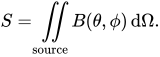
The unit is named after pioneering US radio astronomer Karl Guthe Jansky and is defined as

  • (SI)[2]
  • (CGS).

Since the jansky is obtained by integrating over the whole source solid angle, it is most simply used to describe point sources; for example, the Third Cambridge Catalogue of Radio Sources (3C) reports results in janskys.

  • For extended sources, the surface brightness is often described with units of janskys per solid angle; for example, far-infrared (FIR) maps from the IRAS satellite are in megajanskys per steradian (MJy⋅sr−1).
  • Although extended sources at all wavelengths can be reported with these units, for radio-frequency maps, extended sources have traditionally been described in terms of a brightness temperature; for example the Haslam et al. 408 MHz all-sky continuum survey is reported in terms of a brightness temperature in kelvin.[3]

Unit conversions

[edit]

Jansky units are not a standard SI unit, so it may be necessary to convert the measurements made in the unit to the SI equivalent in terms of watts per square metre per hertz (W·m−2·Hz−1). However, other unit conversions are possible with respect to measuring this unit.

AB magnitude

[edit]

The flux density in janskys can be converted to a magnitude basis, for suitable assumptions about the spectrum. For instance, converting an AB magnitude to a flux density in microjanskys is straightforward:[4]

dBW·m−2·Hz−1

[edit]

The linear flux density in janskys can be converted to a decibel basis, suitable for use in fields of telecommunication and radio engineering.

1 jansky is equal to −260 dBW·m−2·Hz−1, or −230 dBm·m−2·Hz−1:[5]

Temperature units

[edit]

The spectral radiance in janskys per steradian can be converted to a brightness temperature, useful in radio and microwave astronomy.

Starting with Planck's law, we see This can be solved for temperature, giving In the low-frequency, high-temperature regime, when , we can use the asymptotic expression:

A less accurate form is which can be derived from the Rayleigh–Jeans law

Usage

[edit]

The flux to which the jansky refers can be in any form of radiant energy.

It was created for and is still most frequently used in reference to electromagnetic energy, especially in the context of radio astronomy.

The brightest astronomical radio sources have flux densities of the order of 1–100 janskys. For example, the Third Cambridge Catalogue of Radio Sources lists some 300 to 400 radio sources in the Northern Hemisphere brighter than 9 Jy at 159 MHz. This range makes the jansky a suitable unit for radio astronomy.

Gravitational waves also carry energy, so their flux density can also be expressed in terms of janskys. Typical signals on Earth are expected to be 1020 Jy or more.[6] However, because of the poor coupling of gravitational waves to matter, such signals are difficult to detect.

When measuring broadband continuum emissions, where the energy is roughly evenly distributed across the detector bandwidth, the detected signal will increase in proportion to the bandwidth of the detector (as opposed to signals with bandwidth narrower than the detector bandpass). To calculate the flux density in janskys, the total power detected (in watts) is divided by the receiver collecting area (in square meters), and then divided by the detector bandwidth (in hertz). The flux density of astronomical sources is many orders of magnitude below 1 W·m−2·Hz−1, so the result is multiplied by 1026 to get a more appropriate unit for natural astrophysical phenomena.[7]

The millijansky, mJy, was sometimes referred to as a milli-flux unit (mfu) in older astronomical literature.[8]

Orders of magnitude

[edit]
Value (Jy) Source
110000000 Radio-frequency interference from a GSM telephone transmitting 0.5 W at 1.8 GHz at a distance of 1 km (RSSI of −70 dBm)[9]
20000000 Disturbed Sun at 20 MHz (Karl Guthe Jansky's initial discovery, published in 1933)
4000000 Sun at 10 GHz
1600000 Sun at 1.4 GHz
1000000 Milky Way at 20 MHz
10000 1 solar flux unit
2000 Milky Way at 10 GHz
1000 Quiet Sun at 20 MHz

Note: Unless noted, all values are as seen from the Earth's surface.[10]

References

[edit]
Revisions and contributorsEdit on WikipediaRead on Wikipedia
from Grokipedia
The jansky (symbol: Jy) is a non-SI unit of spectral flux density used in radio and infrared astronomy to quantify the power received per unit area per unit frequency interval from astronomical sources. It is defined precisely as 102610^{-26} watts per square metre per hertz (102610^{-26} W m2^{-2} Hz1^{-1}). The unit is named in honor of Karl Guthe Jansky, the American radio engineer who in 1932 detected the first extraterrestrial radio signals from the Milky Way while investigating sources of static interference for transatlantic radio communications. The jansky was formally adopted as the standard unit for flux density in radio astronomy by the International Astronomical Union during its 1973 General Assembly in Sydney, Australia, replacing earlier ad hoc units like the flux unit (f.u.). Karl Guthe Jansky (October 22, 1905 – February 14, 1950) was born in Norman, Oklahoma, to Cyril Jansky, a prominent electrical engineering professor, and grew up in Madison, Wisconsin. After earning a bachelor's degree in physics from the University of Wisconsin in 1927, he joined Bell Laboratories in 1931, where he constructed a large rotatable antenna—often called the "merry-go-round"—on a 100-foot track in Holmdel, New Jersey, to study shortwave radio noise. His systematic observations revealed a third type of static, distinct from local thunderstorms and atmospheric sources, that peaked every 23 hours and 56 minutes, aligning with the Earth's sidereal rotation and originating from the constellation Sagittarius near the galactic center. Jansky announced his findings in a seminal paper, "Directional Studies of Atmospherics at High Frequencies," published in the Proceedings of the Institute of Radio Engineers in 1932, and presented them publicly in Washington, D.C., on April 27, 1933. Despite the groundbreaking nature of his work, Jansky's discovery received limited attention during his lifetime, partly because reassigned him to other projects in , and he conducted no further astronomical research. He continued contributing to radio technology, including advancements in and waveguides, until his death from at age 44 in . Jansky's legacy endures through the field of , which his observations founded; notable early followers like built upon his work to map the radio sky. In practice, the jansky measures flux densities ranging from the faint emissions of distant galaxies (often in microjansky or nanojansky scales) to brighter sources like quasars or pulsars, which can reach thousands of janskys at centimeter wavelengths. For extended sources, is expressed in jansky per (Jy sr1^{-1}), while point sources are directly in Jy; conversions to other systems, such as magnitudes, are common for multi-wavelength studies. The unit's small scale reflects the weak nature of cosmic radio signals, enabling precise quantification in modern observatories like the Karl G. Jansky Very Large Array, named in his honor since 2012.

History

Karl Jansky's contributions

Karl Guthe Jansky (1905–1950) was an American physicist and whose pioneering work at Bell Laboratories laid the groundwork for . Born on October 22, 1905, in , and raised in , Jansky earned a degree in physics from the University of Wisconsin in 1927. He joined Bell Laboratories in 1928, where he focused on improving transatlantic radio-telephone communications by investigating sources of interference, such as atmospheric static. In 1931 and 1932, Jansky constructed a large rotating —a linear of dipoles spanning approximately 100 feet (30 meters) mounted on wheels from a Model T Ford—to study static at a of 20.5 MHz. This meridian transit instrument allowed systematic directional observations by rotating once every 20 minutes. Through months of meticulous measurements, Jansky classified three types of static: local thunderstorms (sharp crackles), distant thunderstorms (steady crashes every few seconds), and a third faint, steady hiss that repeated every 23 hours and 56 minutes, corresponding to the Earth's sidereal rotation period. By plotting the signal's intensity, Jansky determined that the third type of static originated from a fixed direction in space, peaking toward the constellation Sagittarius and aligning with the plane of the . He concluded this was extraterrestrial radio emission from the center of our , beyond the solar system, marking the first detection of cosmic radio waves. Jansky published his findings in two seminal papers: "Directional Studies of Atmospherics at High Frequencies" in the Proceedings of the Institute of Radio Engineers in December 1932, detailing the directional properties, and "Electrical Disturbances Apparently of Extraterrestrial Origin" in October 1933, explicitly identifying the galactic source. He presented his results at the International Union of Radio Science (URSI) meeting on April 27, 1933, which garnered brief media attention, including a New York Times article on May 5, 1933. However, the astronomical community initially overlooked his work, partly due to the era's focus on optical astronomy and economic constraints limiting further research; Jansky himself shifted to defense-related projects during . Despite the muted reception, Jansky's innovations in directional antennas, precise frequency measurements, and systematic sky mapping pioneered techniques, enabling later astronomers to explore the . He also patented a radio direction-finder utilizing solar emissions, which influenced subsequent engineering developments. In recognition of his foundational discoveries, the unit was named the jansky in his honor decades later.

Establishment of the unit

The jansky (Jy) was formally proposed as a unit of in by the (IAU) in 1973 to honor Karl G. Jansky's pioneering detection of cosmic radio emission in 1932. The proposal was adopted during the IAU's General Assembly in , , where the unit was defined as 1Jy=1026Wm2Hz11 \, \mathrm{Jy} = 10^{-26} \, \mathrm{W \, m^{-2} \, Hz^{-1}}, standardizing measurements that had previously relied on informal "flux units" of the same magnitude. Prior to this formal naming, the equivalent unit had been in practical use within the astronomical community, as evidenced by the Third Catalogue of Radio Sources (3C), published in 1959, which reported flux densities in "flux units" explicitly defined as 1026Wm2(c/s)110^{-26} \, \mathrm{W \, m^{-2} \, (c/s)^{-1}}, demonstrating the need for a dedicated measure in radio source surveys. This early application underscored the unit's utility despite lacking an official name, paving the way for its institutional recognition. Although the jansky's non-SI status initially posed challenges for integration with broader scientific measurement systems, it achieved widespread acceptance in astronomical literature by the mid-1970s, becoming the standard for radio flux density reporting. Further institutional acknowledgment came in 2012, when the National Radio Astronomy Observatory (NRAO) renamed its flagship () the Karl G. Jansky Very Large Array to commemorate Jansky's foundational role in the field.

Definition and properties

Formal definition

The jansky (symbol: Jy) is a non-SI unit of , measuring the power received per unit area per unit frequency interval from an astronomical source. It is named after Karl Jansky, the American engineer who pioneered . The formal definition of the unit is 1Jy=1026Wm2Hz11 \, \mathrm{Jy} = 10^{-26} \, \mathrm{W \, m^{-2} \, Hz^{-1}}, where W denotes watts, m , and Hz hertz. In centimeter-gram-second (CGS) units, this is equivalent to 1Jy=1023ergs1cm2Hz11 \, \mathrm{Jy} = 10^{-23} \, \mathrm{erg \, s^{-1} \, cm^{-2} \, Hz^{-1}}. The dimensional formula for the jansky is [Jy]=[energy][time]1[length]2[frequency]1[\mathrm{Jy}] = [\mathrm{energy}] \, [\mathrm{time}]^{-1} \, [\mathrm{length}]^{-2} \, [\mathrm{frequency}]^{-1}, reflecting its role in quantifying energy flux per unit bandwidth. Unlike total flux density, which integrates power over the entire spectrum, the jansky specifically quantifies monochromatic flux at a given frequency, enabling precise spectral analysis.

Relation to flux density

The spectral flux density SνS_\nu quantifies the amount of energy received from an astronomical source per unit time, per unit area, and per unit interval, providing a measure of the source's emission at a specific . In , this quantity is typically expressed in janskys (Jy), where 1 Jy corresponds to 102610^{-26} W m2^{-2} Hz1^{-1}. The jansky unit is especially suitable for characterizing unresolved or point-like sources in , as these appear much smaller than the observing beam, allowing the total integrated to be effectively represented by the flux density at the measurement rather than requiring . For such sources, the total FF across a is given by the F=SνdνF = \int S_\nu \, d\nu, but the jansky directly measures SνS_\nu at discrete frequencies, facilitating precise spectral analysis without needing full bandwidth integration. This unit offers key advantages for detecting weak signals from distant astronomical objects, such as galaxies with flux densities as low as 10610^{-6} Jy (microjansky sources), enabling the study of faint emissions that would be challenging in other units. Additionally, it avoids confusion with surface brightness measures like Jy per (Jy/sr), which are more appropriate for extended sources, by focusing solely on the total density from compact emitters.

Conversions and equivalents

SI and CGS units

The jansky (Jy) is defined in the (SI) as 1Jy=1026Wm2Hz11 \, \mathrm{Jy} = 10^{-26} \, \mathrm{W \, m^{-2} \, Hz^{-1}}, a scale chosen to accommodate the micro-power levels typical in measurements. This equivalence arises from the unit's origins in quantifying , where the factor of 102610^{-26} provides a convenient numerical range for observed signals without excessive scientific notation. In the centimeter-gram-second (CGS) system, the jansky converts to 1Jy=1023ergs1cm2Hz11 \, \mathrm{Jy} = 10^{-23} \, \mathrm{erg \, s^{-1} \, cm^{-2} \, Hz^{-1}}, derived from the relations 1W=107ergs11 \, \mathrm{W} = 10^{7} \, \mathrm{erg \, s^{-1}} and 1m2=104cm21 \, \mathrm{m^{2}} = 10^{4} \, \mathrm{cm^{2}}. Thus, substituting yields 1026Wm2Hz1=1026×107/104=1023ergs1cm2Hz110^{-26} \, \mathrm{W \, m^{-2} \, Hz^{-1}} = 10^{-26} \times 10^{7} / 10^{4} = 10^{-23} \, \mathrm{erg \, s^{-1} \, cm^{-2} \, Hz^{-1}}, maintaining consistency across unit systems for flux density calculations. Expressed in decibels relative to 1 m^{-2} Hz^{-1}, where 0 dB(W m^{-2} Hz^{-1}) corresponds to 1 W m^{-2} Hz^{-1}, the jansky equates to 260dB(Wm2Hz1)-260 \, \mathrm{dB(W \, m^{-2} \, Hz^{-1})}, calculated as 10log10(1026)=26010 \log_{10}(10^{-26}) = -260. This logarithmic form is useful in radio contexts for signal . The choice of the 102610^{-26} factor aligns with typical extraterrestrial radio fluxes, which range from approximately 102410^{-24} to 1030Wm2Hz110^{-30} \, \mathrm{W \, m^{-2} \, Hz^{-1}} for sources like galactic emissions and distant quasars, allowing "bright" objects to register in the order of a few janskys. For fainter detections, prefixes such as milli- (mJy, 103Jy10^{-3} \, \mathrm{Jy}) and micro- (μJy, 106Jy10^{-6} \, \mathrm{Jy}) are commonly employed.

Magnitude systems

The AB magnitude system provides a standardized way to convert flux densities measured in janskys to magnitudes, facilitating comparisons across optical and radio wavelengths. It is defined such that a source with a monochromatic flux density Sν=3631S_\nu = 3631 Jy at the reference frequency corresponds to an AB magnitude of zero:
mAB=2.5log10(Sν3631Jy),m_{\rm AB} = -2.5 \log_{10} \left( \frac{S_\nu}{3631 \, \rm Jy} \right),
where SνS_\nu is the flux density in janskys. This definition assumes a spectrum that is flat in flux density per unit frequency, making it independent of for broadband photometry.
For faint sources common in radio-optical studies, an equivalent expression converts AB magnitudes to flux density in microjansky units, useful for bridging sensitivities between optical surveys and radio :
Sν[μJy]=106×10(23(mAB+48.6)/2.5).S_\nu \, [\mu\rm Jy] = 10^{6} \times 10^{\left(23 - (m_{\rm AB} + 48.6)/2.5\right)}.
This formula derives from the cgs-based zero point of the AB system and approximates the conversion for typical observational contexts.
In contrast to the magnitude system, which calibrates zero magnitude to the spectrum of and varies with wavelength due to the star's non-flat energy distribution, the AB system is frequency-independent and ties directly to absolute flux units like the jansky. This alignment enables consistent cross-wavelength flux comparisons, particularly for sources with power-law . The AB system was developed in the 1970s to support precise and observations, with its formal adoption driven by the need to align optical magnitudes with radio densities in jansky for studying quasars and other extragalactic objects. These conversions primarily to point sources, where the total flux density integrates over the object's angular size; for extended sources, adjustments for (e.g., in jansky per or magnitudes per square arcsecond) are required to avoid underestimating diffuse emission.

Brightness temperature

In radio astronomy, brightness temperature TbT_b serves as a convenient measure to interpret flux densities measured in janskys as equivalent temperatures, facilitating the analysis of thermal and non-thermal emissions from celestial sources. This is particularly relevant in the radio , where emissions often approximate blackbody behavior under certain conditions. The jansky, as a unit of SνS_\nu, is converted to TbT_b by relating it to the specific intensity IνI_\nu, which represents the flux per unit and . The standard conversion relies on the Rayleigh-Jeans (RJ) approximation to the Planck blackbody function, valid at low frequencies where hνkTh\nu \ll kT (with hh , ν\nu , kk , and TT ). In this limit, the specific intensity is given by
Iν=2kTbν2c2,I_\nu = \frac{2 k T_b \nu^2}{c^2},
where cc is the ; solving for TbT_b yields
Tb=c2Iν2kν2.T_b = \frac{c^2 I_\nu}{2 k \nu^2}.
This relation defines TbT_b in for IνI_\nu expressed in consistent units, such as W m2^{-2} Hz1^{-1} sr1^{-1}, derived from the low-frequency tail of the Planck spectral radiance Bν(T)2ν2kTc2B_\nu(T) \approx \frac{2 \nu^2 k T}{c^2}.
To connect this to observed flux density in janskys, note that Sν=IνdΩIνΩS_\nu = \int I_\nu \, d\Omega \approx I_\nu \Omega for a compact source subtending a small Ω\Omega (in steradians) with uniform brightness. Substituting gives
Tb=c2Sν2kν2Ω,T_b = \frac{c^2 S_\nu}{2 k \nu^2 \Omega},
or equivalently in terms of λ=c/ν\lambda = c/\nu,
Tb=λ2Sν2kΩ.T_b = \frac{\lambda^2 S_\nu}{2 k \Omega}.
Here, SνS_\nu is in Jy (with 1 Jy = 102610^{-26} W m2^{-2} Hz1^{-1}), yielding TbT_b in when constants are inserted numerically (e.g., the prefactor c2/(2k)2.02×1023c^2 / (2 k) \approx 2.02 \times 10^{23} K Jy sr Hz2^2 m2^{-2}). This derivation starts from the RJ form of IνI_\nu, equates it to the blackbody radiance, and integrates over the source's projected area on the .
For higher frequencies where the RJ approximation breaks down (typically hν0.1kTh\nu \gtrsim 0.1 kT), the full Planck law is employed:
Iν=2hν3c21ehν/kTb1.I_\nu = \frac{2 h \nu^3}{c^2} \frac{1}{e^{h\nu / k T_b} - 1}.
Here, TbT_b is found by inverting this equation numerically for the observed IνI_\nu, providing a more accurate blackbody-equivalent temperature that accounts for the exponential cutoff in the Planck . This full form ensures proper interpretation of submillimeter or higher-frequency radio , though the RJ limit suffices for most astronomical radio observations below ~100 GHz.
These conversions assume a source of uniform brightness filling the solid angle Ω\Omega, which is often the telescope's beam solid angle for unresolved sources. In practice, this enables size estimation: for a detected flux SνS_\nu, the implied Ω\Omega from an assumed TbT_b (e.g., based on physical models) yields the source angular diameter, or vice versa, with beam-dependent Ω\Omega providing limits for compact objects like quasars. Such applications highlight the utility of brightness temperature in bridging flux measurements to physical source properties without direct imaging.

Applications

Radio astronomy

The jansky (Jy) serves as the fundamental unit for measuring in , enabling precise quantification of radio emissions from celestial objects such as galaxies, quasars, and pulsars. This unit, defined as 10^{-26} W m^{-2} Hz^{-1}, allows astronomers to characterize the intensity of signals across the , facilitating comparisons between sources and instruments. For instance, large-scale surveys like the NRAO Sky Survey (NVSS) at 1.4 GHz catalog thousands of extragalactic radio sources with integrated densities typically in the milliJansky (mJy) range, down to a completeness limit of approximately 3 mJy, providing a census of cosmic radio emitters including active galactic nuclei and star-forming galaxies. In telescope operations, the jansky underpins sensitivity assessments for major facilities. The Karl G. Jansky (VLA) achieves detection limits as low as ~1 μJy (10^{-6} Jy) in its most sensitive configurations and long integrations, allowing it to resolve faint radio structures in nearby galaxies and distant quasars. Similarly, the Atacama Large Millimeter/submillimeter Array (ALMA) employs jansky units to measure continuum and line emissions in the submillimeter regime, with typical sensitivities reaching tens of μJy for point sources, crucial for studying dust-obscured in protostellar disks. Historically, early radio catalogs laid the groundwork for flux measurements that evolved into the standardized jansky system. The Third Cambridge Catalogue (3C) from the 1950s listed 471 discrete radio sources with flux densities measured in arbitrary "flux units," initially calibrated against bright sources like Cygnus A, which equated to about 10^3 flux units or roughly 1000 today. By the 1970s, the formalized the jansky as the standard unit for , replacing scales and enabling consistent global observations, as detailed in absolute calibration efforts using primary standards like . Contemporary research leverages the jansky to probe dynamic astrophysical phenomena. Recent VLA observations from 2023 to 2025 have measured radio emissions from protostars in star-forming regions, such as those in the , with flux densities on the order of a few mJy, revealing outflow structures and accretion processes. Fast radio bursts (FRBs), transient events detected by the , exhibit peak flux densities exceeding 1 Jy in their millisecond-duration pulses, aiding localization and host galaxy identification. In dwarf galaxies, VLA Sky Survey data from 2024 identify active galactic nuclei (AGN) with radio excesses at mJy levels, indicating activity that influences efficiency. The jansky facilitates data analysis through (SNR) calculations, where detection sensitivity improves with the of integration time and bandwidth. For a source with flux density SνS_\nu, the required integration time tt to achieve a desired SNR scales as t1/Sν2t \propto 1 / S_\nu^2, accounting for system and gain, as derived from the radiometer equation; this relationship guides observation planning for faint sources like distant pulsars.

Gravitational wave detection

Gravitational waves carry energy that can be quantified using the jansky unit, which measures spectral flux density in units of 10^{-26} W m^{-2} Hz^{-1}. For events detected by Advanced LIGO, such as binary black hole or neutron star mergers, the equivalent peak flux density of the gravitational wave signal itself reaches approximately 10^{20} Jy at frequencies around 100 Hz, derived from the strain amplitude h \approx 10^{-21} and the relation between strain power and energy flux. This conversion highlights the immense energy output of these events, though direct detection relies on interferometric methods rather than radio telescopes due to the low-frequency nature of the waves (10–1000 Hz). The jansky unit facilitates comparisons between gravitational wave energy fluxes and electromagnetic signals, underscoring the unit's versatility in multimessenger astrophysics. While themselves do not directly produce radio emission, binary neutron star mergers often generate electromagnetic counterparts, including radio s from emission in the merger or jet. Simulations and observations indicate that these afterglows can reach peak es of several mJy in the radio band for events at distances of tens of Mpc. For instance, the binary neutron star merger , detected at 40 Mpc, exhibited a radio afterglow peaking at approximately 1 mJy at 3 GHz around 150 days post-merger, following an initial rise from early detections at ~15 μJy. This emission arises from the deceleration of relativistic in the circumbinary medium, with flux levels scaled to jansky for integration with radio surveys. The relation between gravitational wave h and observable involves the released during the merger, which powers the electromagnetic counterpart. Peak es are estimated from numerical simulations incorporating the merger's , ejecta velocity, and ambient , yielding S_\nu \propto E / d^2, where E is the isotropic-equivalent output and d is the distance; these are then expressed in jansky for direct comparison with radio observations. For , the optical peak was dominant initially, but the radio tail persisted at mJy levels, consistent with structured jet models. Detecting these counterparts poses significant challenges due to their transient nature and faintness. Prompt electromagnetic emission, if present, lasts less than 1 second and spans high frequencies from gamma rays to potentially radio, necessitating wideband arrays capable of rapid follow-up over large sky areas localized by /Virgo/ (typically 10–1000 deg²). Current radio telescopes, such as the Karl G. Jansky Very Large Array, achieve detection limits of ~0.1 mJy for 1-second integrations in prompt searches for events (assuming L-band with ~1 GHz bandwidth), far above typical peaks but sufficient to constrain models of coherent emission. Afterglows evolve over days to months, allowing deeper integrations down to μJy, yet localization uncertainties and variable sky coverage limit detections to nearby events (<100 Mpc). Recent advancements in multimessenger astronomy emphasize the role of next-generation facilities like the (), with studies from 2023–2025 proposing its use for routine detection of radio counterparts to events at nanojansky (nJy) sensitivities. The 's wide-field capabilities and improved point-source sensitivity (~1 nJy for 1-hour integrations at 1 GHz) would enable blind searches over thousands of square degrees, identifying afterglows from off-axis mergers up to 200 Mpc and enhancing measurements via standard sirens. Theoretical frameworks for these fluxes follow S_\nu \propto ()^{-2} \times energy output, scaled to jansky to benchmark against electromagnetic sources like gamma-ray bursts, facilitating joint analyses of merger energetics and environments.

Other uses

In , the jansky is employed to quantify radio emissions from magnetospheric interactions, particularly in observations and simulations of Jupiter's decametric radiation, which arises from electron cyclotron maser instability in its auroral regions and can reach peak flux densities of approximately 10^6 Jy at frequencies around 12–27 MHz when normalized to 1 AU. Simulations of magnetospheres, such as those using tools like the Exoplanetary and Planetary Radio Emissions Simulator (ExPRES), model similar coherent emissions from hypothetical planetary-scale magnetic fields, expressing predicted flux densities in jansky to assess detectability with current radio arrays. In engineering applications, particularly , the jansky calibrates the flux density of planetary radar echoes, enabling precise characterization of near-Earth asteroids; for instance, Arecibo Observatory's S-band system measured system equivalent flux densities around 38 Jy, facilitating the detection and imaging of asteroid surfaces through echo power analysis in jansky units. These calibrations are crucial for determining asteroid sizes, shapes, and rotation states, as radar returns from icy bodies like Europa have been quantified in jansky to study surface properties and subsurface structures. Interdisciplinary uses extend to and communications engineering, where type III solar radio bursts—produced by electron beams streaming along coronal magnetic fields—exhibit flux densities up to 10^12 Jy at 1 MHz, observed with ground-based arrays like the Nançay Radioheliograph to trace particle acceleration during flares. In satellite communications, the jansky models noise from unintended electromagnetic radiation, such as broadband emissions from satellites detected at levels of several jansky in the 110–188 MHz band, informing interference mitigation strategies for protected bands. Emerging applications in cosmology include the jansky's role in cosmic microwave background (CMB) foreground subtraction for next-generation experiments succeeding Planck, where radio point sources at microjansky (μJy) levels—such as those contributing to the —are cataloged and removed from multifrequency maps to isolate primordial signals. Techniques like convolutional neural networks applied to Planck data achieve residual foregrounds below 1 μJy, enhancing precision in polarization measurements for studies. Despite these uses, the jansky remains less common outside astronomy due to its non-SI nature, with engineering contexts often favoring watt per square meter per hertz (W m⁻² Hz⁻¹) for broader compatibility in system design and regulatory standards. This limitation arises from the unit's origin in weak extraterrestrial signals, making direct SI conversions essential for interdisciplinary integration, such as in telecommunication link budgets where flux densities are recast in decibels relative to 1 Jy (dBJy).

Examples and scales

Orders of magnitude

The orders of magnitude of flux densities measured in janskys span a vast range in , from intense terrestrial and at the high end to faint cosmic signals at the low end, illustrating the required for observations. This provides context for the relative strengths of various sources and interferences, influencing design and detection strategies. Representative examples highlight key regimes without exhaustive listings.
log₁₀(Jy)Example Category
10Extreme solar radio bursts at low frequencies (MHz), reaching fluxes of order 10¹⁰ Jy due to coherent plasma emission during flares.
9Intense solar radio bursts at meter wavelengths, up to ~10⁹ Jy in coherent plasma emissions.
8Strong terrestrial interference, such as from signals, with flux densities up to 10⁸ Jy in populated areas.
7Active Sun or planetary radio bursts at decameter wavelengths, around 10⁷ Jy for Jupiter's decametric emissions.
6 at centimeter wavelengths, approximately 10⁶ Jy at 10 GHz from coronal emission.
3Brightest extragalactic radio sources, such as quasars with fluxes up to 10³ Jy at low frequencies, and galactic plane emission from the around 1000 Jy at 10 GHz due to .
1.5Prominent quasars like , with core flux density ~30 Jy at ~1 GHz.
0Typical quasars and radio galaxies, around 1 Jy at GHz frequencies.
-3Typical nearby galaxies, with integrated flux densities ~1 mJy at 1.4 GHz from and AGN activity.
-6Distant galaxies in deep radio surveys, such as microjansky sources at z ~ 1–2 with fluxes ~10 μJy at 1.4 GHz.
-9Faint sources in ultra-deep fields, nanojansky detections of high-redshift galaxies ~10 nJy at 1.4 GHz.
-12 fluctuations, equivalent to ~10⁻¹² Jy in small angular scales after beam dilution.
-26Hypothetical ultra-weak cosmic signals or the fundamental unit scale, defining the baseline sensitivity limit for point sources.
These scales underscore detection challenges, where modern arrays like the achieve sensitivities down to ~10⁻⁶ Jy in moderate integration times, enabling studies of faint populations.

Notable astronomical sources

Cygnus A, cataloged as 3C 405, stands as one of the strongest extragalactic radio sources, with a measured flux density of approximately 8700 Jy at 178 MHz in the Third (3C) catalog. This intense emission, primarily from its radio lobes powered by activity, has made it a cornerstone for early studies, enabling detailed mapping of its structure and spectral properties. The Cassiopeia A exhibits a density of about 2720 Jy at 1 GHz, as measured in the late , originating from in its expanding shell. Over decades, its has faded at a rate of roughly 0.6–0.7% per year due to the cooling of relativistic electrons, a trend confirmed through long-term monitoring that highlights the remnant's evolutionary dynamics. The Sun serves as a prominent solar system source in radio wavelengths, with the quiet disk producing a flux density on the order of 3 × 10^6 Jy at 10 GHz, corresponding to thermal emission from the corona at brightness temperatures around 20,000 K. Active regions, such as sunspots and flares, can elevate this to peaks exceeding 3 × 10^7 Jy through mechanisms like gyrosynchrotron radiation, illustrating the Sun's role in calibrating radio telescopes and studying plasma processes. The PSR B1919+21, the first discovered in 1967, displays a pulsed flux density of approximately 0.25 Jy at 400 MHz, arising from coherent curvature radiation in its . This detection, with its precise 1.337-second periodicity, revolutionized pulsar astronomy and enabled through timing observations. Recent observations include FRB 20220912A, which reached peak flux densities exceeding 600 Jy in 2023 detections at gigahertz frequencies, showcasing its extreme, millisecond-duration emissions likely from a in a distant . Similarly, 2025 Karl G. Jansky (VLA) data on the IRAS 18162-2048 reveal radio continuum emission at the milliJansky (mJy) level with 3–5% , providing insights into magnetic fields near massive sites via processes. Many quasars exhibit significant radio flux variability, with changes by factors of up to 10 or more over months to years, as tracked in Jansky units; for instance, 3C 273's flux at 22–37 GHz fluctuates between 20 and 60 Jy, reflecting instabilities in their relativistic jets. This variability underscores the utility of the Jansky in monitoring and outflow dynamics in active galactic nuclei.

References

Add your contribution
Related Hubs
Contribute something
User Avatar
No comments yet.
