Hubbry Logo
Follo LineFollo LineMain
Open search
Follo Line
Community hub
Follo Line
logo
8 pages, 0 posts
0 subscribers
Be the first to start a discussion here.
Follo Line
Follo Line
from Wikipedia

Follo Line
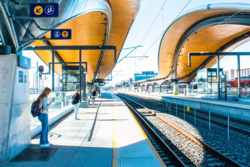
Ski Station serves as the southern terminus of the Follo Line. As part of the project, the Ski Station was rebuilt.
Overview
Native nameFollobanen
OwnerBane NOR
Termini
Service
TypeHigh-speed railway
SystemNorwegian railways
History
Opened11 December 2022 (2022-12-11)
Technical
Line length22 kilometres (14 mi)
Number of tracksDouble
CharacterPassenger
Track gauge1,435 mm (4 ft 8+12 in)
Electrification15 kV  16.7 Hz AC
Operating speed
  • 200 km/h (125 mph)
  • Planned:
  • 250 km/h (155 mph)
Route map

Oslo Central
Blix Tunnel
Ski

The Follo Line (Norwegian: Follobanen) is a 22-kilometre (14 mi) high-speed railway between Oslo and Ski, Norway.

The line runs parallel to the Østfold Line, and is dimensioned for 250 km/h (155 mph). Most of the line, 19 kilometres (12 mi), runs in a twin-tube tunnel named the Blix Tunnel, which is the longest railway tunnel in the country. Construction started in 2015, and the line opened in 2022.[1][2] The Follo Line increased capacity from twelve to forty trains per hour along the South Corridor, and allows express and regional trains to decrease travel time from Ski to Oslo from 22 to 11 minutes. The line was projected to cost over 26 billion Norwegian kroner (NOK) in 2014,[3] but the final cost became 36.8 billion NOK when it was completed.[4][5]

The project was a continuation of the Norwegian National Rail Administration's (now Bane NOR) plan to build four tracks along the three main corridors out of Oslo; the Gardermoen Line was completed in 1998, and the Asker Line was completed in 2011. Between 1989 and 1996, the Østfold Line south of Ski to Moss was upgraded to double track and higher speeds. To take full advantage of this and allow the rest of the Østfold Line to be upgraded for high speeds, it was necessary to increase capacity through the bottleneck from Oslo to Ski.

The Follo Line is hoped to increase rush hour rail ridership by 63%, and increased freight on rail is hoped to remove 750 trucks daily from roads like E6 and E18.

History

[edit]

Background

[edit]

The first railway in the Follo district was the Østfold Line of the Norwegian State Railways (NSB) that opened on 2 January 1879, between Oslo East Station and Halden. Later the same year, the line was extended to the Swedish border, where it connected to the Norway/Vänern Line. The importance of Ski Station increased on 24 November 1882, when it became the station where the Eastern Østfold Line split, and went via Inner Østfold to Sarpsborg, where the two lines reconnected. Electrification of the section from Oslo to Kolbotn was completed on 18 January 1937, and the section to Ski finished in 1939; the whole Østfold line was completed in 1940. Between 1924 and 1939, NSB built double track along the route between Ski and Oslo. From 1989 to 1996, NSB upgraded the track to double track from Ski to Sandbuka, just north of Moss. This section is capable of speeds of 200 km/h (125 mph), however the maximum is 160 km/h (100 mph) due to short distances between stops and limitations of the rolling stock.[6][7]

In 1992, the Norwegian Parliament decided to build the first high-speed railway in Norway, from Oslo via the new Oslo Airport, Gardermoen to Eidsvoll. This line would run parallel to the Hoved Line, increasing the speed and capacity along the route. Fast express and regional trains could run along the new section, while slower commuter trains used the old tracks and could make many stops without disturbing other traffic.[8] Projects were launched during the 1990s to create similar high-speed bypasses from Oslo to Ski, and from Skøyen (west of Oslo) to Asker. Construction of the latter—christened the Asker Line—started in 2001; the first section from Asker to Sandvika opened in 2005[9] , the second section to Lysaker opened in 2011. The Østfold Line between Oslo and Ski remains the largest bottle-neck on the Norwegian railway network. The line restrains the track to twelve trains per hour (six per direction) and hinders freight trains from using it during rush hour. The bottleneck occurs because there are up to four trains each hour making stops at all stations, and these stops delay all express and regional trains that follow. Travel time is 22 minutes for direct trains to Ski, and 31 minutes for commuter trains with a speed limit of 80 km/h (50 mph) along most of the line. Capacity on the upgraded double track from Ski to Moss cannot be fully utilized due to the limitations along the section from Ski to Oslo, and further growth in the number of freight trains along the South Corridor to Sweden and Continental Europe is impossible without reducing the number of passenger trains.[10]

Despite the existing double track all the way from Oslo to Moss, a further upgrade southwards will not be able to increase capacity past the current single train per hour to Fredrikstad, Sarpsborg and Halden. The most optimistic plans involve finishing the first upgrades of track south of Moss simultaneously with the Follo Line. The Rail Administration and Ministry of Transport is working on proposals for a high-speed railway between Oslo and Gothenburg in Sweden. This line would most likely use the Follo Line for the initial distance from Oslo.[11]

Map of the existing Østfold Line on the left, marked with black line, and the Follo Line on the right, marked with red lines. The proposed connection between the Follo and Østfold Line, and the Trunk and Loenga–Alnabru Line, are marked with blue lines.

The first plans for the Follo Line were launched in 1995, and also included an intermediate station at Vevelstad and Kolbotn. The plans also suggested building the line in two phases, first between Ski and Kolbotn, and then from Kolbotn to Oslo. In 2008, the National Rail Administration announced two possible plans for the right-of-way—both predominantly in tunnel. The one proposal included Kolbotn, the other did not. Both excluded Vevelstad as a station on the new line, since the station could not develop as a hub, and would still keep services along the existing commuter line.[12] A report from Det Norske Veritas published in 2008, and ordered by the Rail Administration, concluded that neither a station at Vevelstad or at Kolbotn could support the extra cost of construction. A direct line with no intermediate stops is estimated to cost NOK 11 billion, while a line via Kolbotn would cost 13.5 billion. The report also argued that the intermediate stops would decrease capacity and increase travel time for all passengers departing south of Ski and traveling north. The exclusion of Kolbotn would also increase the importance of Ski as a regional public transport hub.[10] In 2009, the Rail Administration abandoned the plans to build the line via Kolbotn, stating that it was more important to secure a fast connection to Ski. At the same time, they promised to upgrade the existing station at Kolbotn.[13]

The earliest possible construction was 2014, which could allow completion by 2020/21.[14] Ski Station was rebuilt as part of the project, and was expanded to six tracks.[15] Plans to connect the Eastern Østfold Line to the slower line were considered where the Eastern Østfold Line diverges from the Østfold Line at Ski. However this has changed so the local trains from Eastern Østfold can travel to Oslo faster along the new tracks. [16][17]

Just south of Oslo Central Station, each of the two tracks diverge, and follow different routes. The inbound track hooks up with the Østfold Line at Sjursøya, while the outbound track diverges at Loenga.

There is a proposal to have additional connection to the Østfold Line to be made at Nordstrand. The Østfold Line will connect to the Trunk Line and Loenga–Alnabru Line before reaching Oslo Central Station (Oslo S). If the Kolbotn-alternative for the Follo Line is chosen, the Østfold Line will be rebuilt to follow a similar path to the Kolbotn station, which will require a new station building to accommodate the two lines. For this alternate route the two lines will enter the Kolbotn station at two levels, with the Follo Line running in a tunnel below, and the Østfold Line running at-grade above.[10]

Construction

[edit]

The contractors Acciona from Spain, and Ghella from Italy, jointly signed the contract with the Rail Administration to build the Blix Tunnel in March 2015.[18] The main construction started later same year.[19]

The first two tunnel boring machines (TBM), named Queen Eufemia and Queen Ellisiv, started drilling from Åsland towards Oslo on 6 September 2016[20] The third TBM, named Anna, and the fourth TBM, named Magda, started drilling from Åsland towards Ski in 7 November and 4 December 2016 respectively.[21]

The construction site at Ski on 26 February 2019, where the two TBMs were about to break through

The first two TBMs broke through at Oslo on 11 December 2018,[22] and the last two broke through at Ski on 26 February 2019.[23]

The line was originally planned to be opened in December 2021. However, one of the contractors of the project, Condotte, declared bankruptcy, which delayed the opening to December 2022. The bankruptcy of Condotte costed Bane NOR 1.6 billion Norwegian kroner.[24]

The rail line is dimensioned for at least 250 km/h (155 mph). But due to the signalling system FATC, the actual permitted speed is 200 km/h (125 mph). In future, probably before 2040, the new system ERTMS will be installed allowing higher speed than 200.

Opening

[edit]
The inaugural passenger train towards Oslo arrived at Ski at 07:21 local time, before it departed at 07:24 on 11 December 2022

In October 2022, Acciona Ghella handed over most of the tunnel to Bane NOR.[25]

The line opened on 11 December 2022 with the inaugural train to Oslo departed from Ski at 07:24 local time.[1][2] However, a fault in the signalling system occurred later that day, which ordered trains running towards Oslo to run at reduced speed before it was fixed about a quarter-hour later.[26]

On 12 December 2022, the line was formally opened by the King Harald V.[5]

Impact

[edit]

The Follo Line allows the capacity in the South Corridor from Oslo to increase from about twelve to forty trains per hour. Since the opening, local and freight trains use the Østfold Line, while regional and express trains use the Follo Line. Travel time has been reduced from 22 to 11 minutes.[16] With a new line, it is expected to have 11,000 more public transport trips through the corridor; this includes a 67% increase during rush-hour and 43% the rest of the day. This allows a reduction of 5,800 car trips per day and reduces carbon dioxide emissions of 5,474 tonnes. Rush hour capacity would be eight trains per hour to Kolbotn, with four continuing to Ski along the old line. The new line is served by four trains to Moss, two to Mysen and two to Halden. There would be half the frequency during off-peak hours.[10]

The Østfold Line is the railway that connects Norway to Continental Europe, and 80% of all land-based, international freight transport goes through Østfold. Until the Follo Line opened, there could not have a capacity increase on international freight trains to Norway. The Rail Administration has set a goal of tripling the amount of rail freight by 2040, which for the South Corridor is equal to the removal of 750 trucks per day from European Route E18. The Follo Line also allows freight trains to pass during rush hour.[16]

References

[edit]
[edit]
Revisions and contributorsEdit on WikipediaRead on Wikipedia
from Grokipedia
The Follo Line (Norwegian: Follobanen) is a 22-kilometre high-speed railway in connecting directly to , featuring the Nordic region's longest railway tunnel and enabling train speeds of up to 250 km/h. The line forms part of a broader expansion plan to add four tracks along key routes south of , aiming to alleviate congestion on the existing Line by doubling services to four trains per hour during peak times. It reduces travel time between and from 22 minutes to 11 minutes, increasing weekday departures from 71 to 112 and expected to boost rush-hour ridership by 63%. Initiated as Norway's largest transport infrastructure project with a total cost of 36.8 billion (approximately ), the Follo Line addresses growing commuter demand in the Oslo region by providing a dedicated high-capacity corridor separate from the older Østfold Line. Construction began in 2015 under the management of Bane NOR, Norway's state railway infrastructure company, involving international consortia for tunneling, track laying, and station development. The project incorporates advanced engineering to handle challenging geology, including deposits near station that required extensive sheet piling for stability. A defining feature is the 20-kilometre Blix Tunnel, comprising twin bores that together form approximately 36 kilometres of bored underground track, making it the longest bored railway tunnel in the upon completion in 2019. The line features a redeveloped station as a major hub, integrated with local buses and regional services to enhance connectivity. Electrified for both passenger and freight use, it supports Norway's shift toward sustainable by reducing road traffic and emissions in the densely populated Follo region. The Follo Line entered passenger service on December 11, 2022, following an official inauguration by King Harald V the next day, marking a milestone in Norway's rail modernization efforts, though it faced initial technical challenges including closures in 2023 due to tunnel issues that were subsequently resolved. Operated primarily by the state-owned Vy for commuter and regional trains, it has since facilitated smoother integration with Oslo's urban network, contributing to economic growth in southern Akershus and Østfold counties.

Route and Infrastructure

Route Description

The Follo Line is a 22-kilometre railway line connecting in the capital city of to Ski Station in the municipality of Nordre Follo, . It serves as a dedicated high-speed corridor designed to enhance regional connectivity in the southeastern part of the country. The route traverses the Follo region within county, an area historically known for its agricultural landscapes and proximity to , facilitating faster access between the urban center and southern suburbs. For most of its length, the Follo Line runs parallel to the existing Østfold Line, the primary rail corridor serving , but follows an independent alignment to allow for higher speeds and increased capacity. The line diverges from the Østfold Line shortly after departing , heading southeast through urban and semi-rural terrain before entering its primary underground section. Near , the route converges back with the Østfold Line, integrating into the broader network at the Ski public transport hub. This parallel configuration minimizes disruption to legacy infrastructure while providing a straighter path optimized for express services. The route includes approximately 3 km of surface sections, concentrated at the northern and southern endpoints to accommodate station integrations and transitions to the tunnel. In the north, a cut-and-cover segment extends from , navigating beneath Ekeberg Hill before descending into the Blix Tunnel. At the southern end, an open-cut approach spans about 1.5 km from the tunnel portal to Ski Station, incorporating viaducts and embankments to blend with the local topography. These surface portions account for the line's adaptation to surface constraints in densely populated areas, while the majority remains underground to traverse the region's challenging geology efficiently.

Blix Tunnel

The Blix Tunnel constitutes the primary underground element of the Follo Line, comprising a 19.5 km twin-tube structure that accommodates two parallel single-track bores, making it the longest railway tunnel in and the Nordic region. This design enhances safety by separating the tracks into independent tubes, aligning with European standards for evacuation and in long rail tunnels. The tunnel's configuration allows for efficient high-capacity rail operations while minimizing environmental impact along the corridor. Named after Peter Andreas Blix, a prominent 19th-century Norwegian architect who designed numerous stations along the original Østfold Line, the tunnel honors his contributions to early railway development in the country. Blix's work, including standardized station architecture from the 1870s onward, exemplified the integration of functional design with Norway's emerging rail network, influencing infrastructure projects for generations. In terms of engineering, each tube features a bored diameter of approximately 10 m, excavated using tunnel boring machines to create a robust, circular cross-section suitable for rail installation. For safety, 54 cross passages connect the tubes at intervals of 480–500 m, each 25 m long and equipped with smoke-separation doors, emergency facilities, and electrotechnical systems to facilitate rapid evacuation and maintenance access. This layout ensures compliance with stringent inter-European fire and rescue protocols for extended underground routes. The tunnel's design addressed significant geological hurdles, primarily the hard Precambrian gneiss rock formations prevalent along the alignment, characterized by uniaxial compressive strengths of 100–300 MPa and abrasive, folded structures that challenged excavation efficiency. Water ingress posed another key issue, particularly in southern sections with presence; management strategies incorporated pre-grouting over extensive lengths, probe for advance detection, and infiltration wells to limit leakage to strict thresholds, alongside undrained linings and drainage pipes spaced every 80 m for controlled outflow. These measures, informed by detailed geological mapping, ensured structural integrity in urban-proximate areas while treating inflows up to 90 L/s through dedicated plants.

Connections to Existing Lines

The Follo Line connects to the existing Norwegian rail network at , Norway's primary rail hub, where its tracks integrate with the Østfold Line and other national routes as part of a reconfigured four-track layout south of the station. This junction facilitates direct access for high-speed services while allowing the relocation and upgrading of the adjacent Østfold Line tracks to enhance overall capacity and operational flexibility. At the southern end, the line converges with the via a grade-separated junction north of , enabling seamless transfers and continuations eastward toward destinations such as and beyond. This design supports efficient routing for both local and long-distance trains without conflicting with existing operations. The Follo Line is engineered for full bidirectional compatibility with the standard Norwegian rail infrastructure, utilizing the and 15 kV 16.7 Hz AC overhead electrification system prevalent across the national network. This ensures with existing and signaling protocols, minimizing the need for modifications to integrate services. During the 2009 planning phase, authorities decided against including a station at on the Follo Line, citing prohibitive costs estimated at 2.6–3.1 billion for a facility serving both the new line and the parallel Line while meeting updated safety standards. Instead, upgrades to the existing station on the Line were prioritized, with feeder bus connections proposed to maintain accessibility for local passengers.

History

Planning and Background

The Østfold Line, initially known as the Smaalenene Line, opened on 2 January 1879, marking a pivotal development in Norway's rail infrastructure as the first railway to connect with the eastern regions toward . Designed primarily for freight and regional passenger services, the line facilitated economic growth in county but soon faced operational constraints due to its single-track sections and aging infrastructure. By the , surging demand from suburban commuters and freight transport had pushed the line to its capacity limits, with frequent delays and inability to accommodate additional services on the critical Oslo-Ski stretch. To address these bottlenecks, initial planning for the Follo Line commenced in 1995 as an integral component of the Norwegian National Rail Administration's expansion strategy for the South Corridor, aimed at enhancing connectivity between and surrounding municipalities. This initiative sought to quadruple the rail network's capacity in the densely populated southern approaches to , prioritizing high-speed bypass routes to separate express services from local traffic. The South Corridor, encompassing the Østfold Line, had become a chokepoint for regional mobility, underscoring the need for dedicated infrastructure to support Norway's growing urban-rural linkages. In , the Norwegian government proposed the development of a line to bypass the congested Oslo-Ski segment, formalizing the Follo Line as a priority project to alleviate pressure on existing tracks. The economic rationale centered on the segment's role in a mix of passenger, freight, and international services, which contributed to widespread inefficiencies and economic losses estimated in the billions of kroner annually. This proposal aligned with national transport goals to foster sustainable growth, reduce road congestion, and integrate the line into broader plans extending to and beyond.

Construction Phase

The construction of the Follo Line commenced in 2015 under the management of Bane NOR, Norway's state-owned railway infrastructure company, marking the beginning of one of the country's largest rail projects. The main works focused on excavating 20 km of twin-bore tunnels and laying 22 km of double-track railway, with an emphasis on integrating advanced tunneling techniques to minimize surface disruption in the densely populated region. In March 2015, Bane NOR awarded the primary tunneling contract, valued at 8.7 billion NOK (approximately €1 billion), to a between Spanish firm and Italian company Ghella, responsible for the core tunnel excavation and track installation. This (EPC) agreement initiated site preparations, including the establishment of the Åsland launch shaft south of , from which the tunneling operations would proceed northward. The deployed four double-shield tunnel boring machines (TBMs), each 150 meters long and weighing 2,400 tonnes, designed specifically for the project's hard rock conditions; these machines were named Queen Eufemia, Queen Ellisiv, Anna, and Magda. Tunneling operations began on 6 September 2016, with the first two TBMs—Queen Eufemia and Queen Ellisiv—starting from Åsland and advancing toward Oslo, followed by the remaining pair heading south to Ski about a month later. The machines operated simultaneously to excavate parallel 20 km tunnels with an internal diameter of 8.75 meters, installing precast concrete segments to line the bores as they progressed at rates of up to 30 meters per day under optimal conditions. Significant milestones included a double breakthrough on 11 September 2018 near Oslo Central Station by Queen Eufemia and Queen Ellisiv after excavating approximately 9 km each, followed by the final double breakthrough on 26 February 2019 at the Ski end by Anna and Magda, completing the main tunnel excavation ahead of schedule for that phase. The project encountered major challenges from the of Italian subcontractor Condotte in 2018, which was handling approach tunnels at Ekebergåsen and Station; this led to a full halt in those segments, requiring Bane NOR to terminate contracts and re-tender, ultimately costing an additional 1.6 billion in remediation and delays. These issues, compounded by unforeseen ground conditions and disruptions, postponed the overall project timeline by one year, shifting the target opening from December 2021 to December 2022. Cost developments reflected these setbacks, with the initial 2014 budget estimate of 26 billion NOK escalating to a final figure of 36.8 billion NOK upon completion, driven primarily by the Condotte fallout, extended timelines, and adjustments for inflation and additional engineering needs. Despite the overruns, the Acciona-Ghella completed the main tunneling works on time, allowing subsequent phases like track laying, electrification, and station fit-out to proceed, ensuring the line's readiness for high-speed operations by late 2022.

Opening and Initial Operations

The Follo Line began public operations on 11 December 2022, with the inaugural passenger train departing station at 07:24 local time and arriving at S just 12 minutes later, halving previous journey times on the route. This launch integrated the new high-speed infrastructure into the existing Østfold Line network, enabling up to 10,000 daily passengers to benefit from faster and more reliable services between and . The formal inauguration occurred the next day, 12 December 2022, when King Harald V officially opened the line during a ceremony at S, joined by Haakon, Jonas Gahr Støre, and Transport Minister Jon-Ivar Nygård. The event underscored the project's role as Norway's most ambitious rail initiative, featuring the Nordic region's longest railway tunnel and designed to accommodate growing commuter demand in the area. Initial operations faced immediate technical challenges when overheating power cables in the Blix Tunnel were identified, leading to a closure of the line from mid-December 2022 until March 2023 for replacement of approximately 2.5 km of cables. The line reopened on 5 March 2023, after which ridership on the —including the Follo Line—showed uptake, with passenger volumes exceeding 2019 pre-pandemic levels and contributing to an 18% national increase in train journeys to 62 million for 2023. Further issues arose in May 2023 when a corroded detached and was caught by a train, causing a temporary halt and additional repairs. In 2024, Bane NOR replaced power lines supplying electricity to trains in the tunnel to address ongoing concerns.

Technical Specifications

Track and Electrification

The Follo Line features a double-track configuration along its entire 22 km length, enabling bidirectional high-capacity rail operations between and . This design supports the parallel routing to the existing Østfold Line while providing dedicated for express services. The track adheres to the standard gauge of 1,435 mm (4 ft 8½ in), aligning with the Norwegian national railway network to facilitate seamless interoperability. Electrification on the Follo Line employs a 15 kV 16.7 Hz AC overhead system, the prevailing standard for powered rail lines in , which supplies energy to trains via pantographs. This single-phase setup, inherited from early 20th-century European practices and retained for its compatibility with existing , ensures efficient power distribution across the route. The infrastructure includes substations and distribution centers integrated into the tunnel and surface sections for reliable supply. Within the Blix Tunnel, which encompasses approximately 19.5 km of the line, a ballastless slab track system is implemented to enhance stability at elevated speeds and reduce long-term maintenance needs. This fixed-track design eliminates traditional , using slabs with embedded bi-block sleepers, such as the RHEDA 2000 type, to provide a rigid foundation resistant to vibration and settlement in the environment. The choice of slab track minimizes noise, optimizes space in the twin-tube configuration, and supports the line's integration with Line standards.

Signalling and Speed Capabilities

The Follo Line initially employs the conventional Norwegian (ATC) system, classified as a Class B signalling solution, which provides full through Eurobalises for trackside data transmission and axle counters for train detection. This setup ensures safe operations by continuously supervising train speeds and movements, enforcing speed limits based on track conditions and signalling aspects. The system was supplied by Thales as part of a comprehensive awarded in 2015, integrating with the line's at station to replace older relay-based controls. Under the current ATC configuration, the maximum operational speed on the Follo Line is limited to 200 km/h (125 mph), despite the infrastructure being dimensioned for higher velocities. Key safety features include automatic speed enforcement, which prevents overspeeding by intervening if the driver does not respond to restrictions, and integrated controls for tunnel ventilation systems that manage airflow and smoke extraction in the event of incidents to maintain safe conditions within the approximately 19.5 km Blix Tunnel. A planned upgrade to the (ERTMS) Level 2 is scheduled for commissioning between 2032 and 2034 as part of Norway's national signalling rollout, enabling operations at up to 250 km/h (155 mph) while enhancing capacity and interoperability across the network. This transition will replace the legacy ATC with a radio-based communication system (B3R2 baseline 3 release 2), further bolstering safety through continuous movement authority updates and reduced reliance on lineside signals.

Operations and Impact

Passenger Services

The Follo Line forms a key segment of Vy-operated services, enabling direct high-speed connections from to destinations such as , , and beyond to and Mysen along the corridor. These services bypass local stops between and , utilizing the dedicated high-speed alignment to enhance regional connectivity. During peak hours, regional trains operate at a frequency of up to 6 per hour in each direction on the Follo Line, supporting efficient commuter and travel patterns. Off-peak services maintain a reduced but regular schedule to accommodate ongoing demand. The inaugural passenger service on the line commenced shortly after its official opening in December 2022. Passenger trains on the Follo Line consist primarily of electric multiple units, including Class 73 models, compatible with operational speeds of up to 200 km/h through the Blix Tunnel and along the route. These units feature modern amenities such as , , and accessible seating for passengers with reduced mobility. Ticketing for Follo Line services is fully integrated into Norway's system via the Entur app, allowing users to purchase, plan, and manage journeys across Vy-operated routes and other public transport modes in a single platform. The app supports contactless payments, real-time updates, and accessibility options like audio announcements and route adaptations for disabilities.

Capacity and Economic Effects

The Follo Line has significantly enhanced rail capacity in the Oslo-Ski corridor, increasing throughput from 12 trains per hour to 40 trains per hour, thereby accommodating greater passenger volumes and reducing bottlenecks on the Østfold Line. This upgrade supports higher service frequencies, enabling more reliable and efficient operations for both express and regional services. Travel times between and have been halved from 22 minutes to 11 minutes, improving accessibility and encouraging modal shifts from road to . The line's design, featuring high-speed tunnels and advanced , facilitates this reduction while maintaining safety standards. Projections indicate a daily ridership increase of 11,000 trips on the corridor by 2025, driven by the improved connectivity and shorter journeys (as projected pre-opening). Rush-hour usage is expected to grow by 63%, reflecting heightened demand during peak periods as commuters benefit from more frequent services. These enhancements provide substantial economic benefits to the Follo region, home to approximately 150,000 residents, by strengthening links to Oslo's and business hubs. The improved rail access fosters , reduces travel costs for workers, and supports growth in local commerce along the corridor.

Environmental and Freight Benefits

The Follo Line contributes to environmental by facilitating a modal shift from road to , thereby reducing associated with freight and passenger movement. As an electrified , its operations produce zero direct emissions, contrasting sharply with diesel-powered trucks and cars on highways. The line is projected to eliminate approximately 5,500 tonnes of CO₂ emissions annually through the diversion of traffic from roads. This reduction stems primarily from decreased road freight and private vehicle use, aligning with Norway's broader climate objectives to cut transport sector emissions by at least 50% by 2030 compared to 1990 levels. In terms of freight benefits, the Follo Line enhances rail capacity along the Østfold Line corridor, enabling greater diversion of goods from highways to more efficient rail services. By providing dedicated high-speed tracks for passengers, it frees up the existing parallel lines for increased freight operations, with potential to remove up to 750 trucks daily from the European Route E18. This shift supports Norway's national goal, set by the former Norwegian National Rail Administration (Jernbaneverket), to triple rail freight volumes along key corridors like the South Corridor by 2040. Such expansion promotes lower per-tonne emissions for freight—rail transport typically emits about one-tenth the CO₂ of road haulage over comparable distances—while reducing road congestion and accident risks. The project's design and implementation further underscore its environmental alignment, incorporating measures to minimize impacts and integrate with Norway's green transport policies emphasizing and sustainable . These policies aim to accelerate the transition from cars and lorries to low-emission alternatives, positioning the Follo Line as a in achieving long-term decarbonization targets for the transport sector.

Future Developments

Planned Upgrades

The Follo Line, designed for maximum speeds of 250 km/h, currently operates at 200 km/h due to limitations in its existing signalling system. To achieve the full design speed, Bane NOR plans to implement the (ERTMS) Level 2 across the entire Norwegian railway network, including the Follo Line, with completion targeted for 2034. This upgrade will replace the current (ATC) system with ERTMS Baseline 3 Release 2, enabling higher speeds, improved safety, and increased capacity through radio-based communication and continuous train supervision. Post-opening in December 2022, Bane NOR has initiated several retrofits to enhance track reliability and performance. In early 2024, maintenance work addressed issues in the Blix Tunnel by replacing streamlines and adjusting the , ensuring smoother operations and reducing potential disruptions for the high-speed service. These targeted interventions build on initial post-commissioning assessments to optimize the line's 19 km twin-tube tunnel infrastructure for long-term durability. At the southern terminus in , the newly constructed stabling facility supports ongoing operations and light for passenger trains servicing the Follo Line. This facility, integrated into the expanded Ski station with six tracks and modern platforms, allows for efficient train turnaround and routine inspections, minimizing downtime and facilitating the increased service frequency enabled by the line. Further upgrades to processes at are incorporated into Bane NOR's operational strategy to handle the projected 40 trains per hour. Bane NOR has allocated substantial budgets for these enhancements as part of Norway's national investment framework. For 2025, the organization plans to spend approximately 6.6 billion on railway operations and maintenance, nearly double the previous year's amount, alongside an additional 5.5 billion (equivalent to 470 million euros) specifically for network upgrades, including signalling and track improvements on key lines like the Follo Line. These funds underscore the commitment to sustaining the line's performance amid growing demand in the region.

Proposed Extensions

A private proposes extending the Follo Line into a new connection to , , known as the Skagerrakbanan project. This envisioned 256 km double-track electrified line would utilize the Follo Line as the initial segment from to , integrating with the Line southward, and enable non-stop travel times of approximately one hour at speeds up to 400 km/h, or under two hours with intermediate stops at locations such as , , , and . Estimated costs reach SEK 200 billion, with an ambitious target of completion by 2028, though as of 2025, the project awaits funding and official approval, and has not been prioritized in Norway's National Transport Plan 2025-2036. Integration of the Follo Line into a broader pan-Nordic high-speed network has been explored through collaborative studies in the , particularly under the cooperation framework linking Nordic and Baltic capitals. A 2023 by the Norwegian Railway Directorate and Swedish Trafikverket outlines four development concepts for the Oslo-Gothenburg corridor—focusing on regional trains, freight, partial double-tracking, and full double-tracking—emphasizing capacity upgrades and frequency improvements to support regional connectivity as part of the Scandinavian-Mediterranean TEN-T corridor, with more modest travel time reductions compared to full . As of 2025, cross-border rail coordination between and continues. These efforts position the Follo Line as a foundational element for cross-border services, potentially extending northward and eastward within Nordic networks. In the Follo region, the absence of intermediate stations on the current line leaves room for potential new stations or branches should passenger demand continue to grow beyond existing projections. Early planning considered stops at and Vevelstad but opted for a direct route to prioritize speed; future assessments could revisit such additions to serve expanding suburban populations. Environmental assessments for these extensions highlight significant benefits in reducing cross-border road traffic, with the Oslo-Gothenburg upgrades projected to shift freight and passengers to rail, cutting annual CO2 emissions by 289,000 tons through modal shifts from the E6 motorway. The 2020 STRING analysis underscores alignment with the , promoting by minimizing road dependency and enhancing rail's role in low-emission connectivity.

References

Add your contribution
Related Hubs
User Avatar
No comments yet.