



Community hub
Recent from talks
Contribute something
Nothing was collected or created yet.
Headway
View on Wikipedia
Headway is the distance or duration between vehicles in a transportation system. The minimum headway is the shortest such distance or time achievable by a system without a reduction in the speed of vehicles. The precise definition varies depending on the application, but it is most commonly measured as the distance from the tip (front end) of one vehicle to the tip of the next one behind it. It can be expressed as the distance between vehicles, or as time it will take for the trailing vehicle to cover that distance. A "shorter" headway signifies closer spacing between the vehicles. Airplanes operate with headways measured in hours or days, freight trains and commuter rail systems might have headways measured in parts of an hour, metro and light rail systems operate with headways on the order of 90 seconds to 20 minutes, and vehicles on a freeway can have as little as 2 seconds headway between them.
Headway is a key input in calculating the overall route capacity of any transit system. A system that requires large headways has more empty space than passenger capacity, which lowers the total number of passengers or cargo quantity being transported for a given length of line (railroad or highway, for instance). In this case, the capacity has to be improved through the use of larger vehicles. On the other end of the scale, a system with short headways, like cars on a freeway, can offer relatively large capacities even though the vehicles carry few passengers.
The term is most often applied to rail transport and bus transport, where low headways are often needed to move large numbers of people in mass transit railways and bus rapid transit systems. A lower headway requires more infrastructure, making lower headways expensive to achieve. Modern large cities require passenger rail systems with tremendous capacity, and low headways allow passenger demand to be met in all but the busiest cities. Newer signalling systems and moving block controls have significantly reduced headways in modern systems compared to the same lines only a few years ago. In principle, automated personal rapid transit systems and automobile platoons could reduce headways to as little as fractions of a second.
Description
[edit]Different measures
[edit]_-_2022-06-28_-_1.jpg)
There are a number of different ways to measure and express the same concept, the distance between vehicles. The differences are largely due to historical development in different countries or fields.
The term developed from railway use, where the distance between the trains was very great compared to the length of the train itself. Measuring headway from the front of one train to the front of the next was simple and consistent with timetable scheduling of trains, but constraining tip-to-tip headway does not always ensure safety. In the case of a metro system, train lengths are uniformly short and the headway allowed for stopping is much longer, so tip-to-tip headway may be used with a minor safety factor. Where vehicle size varies and may be longer than their stopping distances or spacing, as with freight trains and highway applications, tip-to-tail measurements are more common.
The units of measure also vary. The most common terminology is to use the time of passing from one vehicle to the next, which closely mirrors the way the headways were measured in the past. A timer is started when one train passes a point, and then measures time until the next one passes, giving the tip-to-tip time. This same measure can also be expressed in terms of vehicles-per-hour, which is used on the Moscow Metro for instance.[1] Distance measurements are somewhat common in non-train applications, like vehicles on a road, but time measurements are common here as well.
Railway examples
[edit]
Train movements in most rail systems are tightly controlled by railway signalling systems. In many railways drivers are given instructions on speeds, and routes through the rail network. Trains can only accelerate and decelerate relatively slowly, so stopping from anything but low speeds requires several hundred metres or even more. The track distance required to stop is often much longer than the range of the driver's vision. If the track ahead is obstructed, for example a train is at stop there, then the train behind it will probably see it far too late to avoid a collision.
Signalling systems serve to provide drivers with information on the state of the track ahead, so that a collision may be avoided. A side effect of this important safety function is that the headway of any rail system is effectively determined by the structure of the signalling system, and particularly the spacing between signals and the amount of information that can be provided in the signal. Rail system headways can be calculated from the signalling system. In practice there are a variety of different methods of keeping trains apart, some which are manual such as train order working or systems involving telegraphs, and others which rely entirely on signalling infrastructure to regulate train movements. Manual systems of working trains are common in area with low numbers of train movements, and headways are more often discussed in the context of non-manual systems.
For automatic block signalling (ABS), the headway is measured in minutes, and calculated from the time from the passage of a train to when the signalling system returns to full clear (proceed). It is not normally measured tip to tip. An ABS system divides the track into block sections, into which only one train can enter at a time. Commonly trains are kept two to three block sections apart, depending on how the signalling system is designed, and so the length of the block section will often determine the headway.
To have visual contact as a method to avoid collision (such as during shunting) is done only at low speeds, like 40 km/h. A key safety factor of train operations is to space the trains out by at least this distance, the "brick-wall stop" criterion.[2][3]
In order to signal the trains in time to allow them to stop, early railways placed workmen on the lines who timed the passing of a train, and then signalled any following trains if a certain elapsed time had not passed, although this occasionally lead to accidents when trains broke down or otherwise took more time than expected. As systems allowing communications over longer distances were invented, the workmen were replaced with signal boxes at set locations along the track. This broke the track into a series of block sections. Trains were not allowed to enter a section until the signalman at the other end of the section confirmed the previous train had passed, complete, allowing for the signal to be cleared. This had the side-effect of limiting the maximum speed of the trains to the speed where they could stop in the distance of one block section. This was an important consideration for the Advanced Passenger Train in the United Kingdom, where the lengths of block sections limited speeds and demanded a new braking system be developed.[4]
There is no perfect block-section size for the block-control approach. Longer sections, using as few signals as possible, are advantageous because signals are expensive and are points of failure, and they allow higher speeds because the trains have more room to stop. On the other hand, they also increase the headway, and thus reduce the overall capacity of the line. These needs have to be balanced on a case-by-case basis.[5]
Other examples
[edit]In the case of automobile traffic, the key consideration in braking performance is the user's reaction time.[6] Unlike the train case, the stopping distance is generally much shorter than the spotting distance. That means that the driver will be matching their speed to the vehicle in front before they reach it, eliminating the "brick-wall" effect.
Widely used numbers are that a car traveling at 60 mph will require about 225 feet to stop, a distance it will cover just under 6 seconds. Nevertheless, highway travel often occurs with considerable safety with tip-to-tail headways on the order of 2 seconds. That's because the user's reaction time is about 1.5 seconds so 2 seconds allows for a slight overlap that makes up for any difference in braking performance between the two cars.
Various personal rapid transit systems in the 1970s considerably reduced the headways compared to earlier rail systems. Under computer control, reaction times can be reduced to fractions of a second. Whether traditional headway regulations should apply to PRT and car train technology is debatable. In the case of the Cabinentaxi system developed in Germany, headways were set to 1.9 seconds because the developers were forced to adhere to the brick-wall criterion. In experiments, they demonstrated headways on the order of half of a second.[7]
In 2017, in the UK, 66% of cars and Light Commercial Vehicles, and 60% of motorcycles left the recommended two-second gap between themselves and other vehicles.[8]
 | This graph was using the legacy Graph extension, which is no longer supported. It needs to be converted to the new Chart extension. |
Low-headway systems
[edit]Headway spacing is selected by various safety criteria, but the basic concept remains the same – leave enough time for the vehicle to safely stop behind the vehicle in front of it. The "safely stop" criterion has a non-obvious solution, however; if a vehicle follows immediately behind the one in front, the vehicle in front simply cannot stop quickly enough to damage the vehicle behind it. An example would be a conventional train, where the vehicles are held together and have only a few millimetres of "play" in the couplings. Even when the locomotive applies emergency braking, the cars following do not suffer any damage because they quickly close the gap in the couplings before the speed difference can build up.
There have been many experiments with automated driving systems that follow this logic and greatly decrease headways to tenths or hundredths of a second in order to improve safety. Today, modern CBTC railway signalling systems are able to significantly reduce headway between trains in the operation. Using automated "car follower" cruise control systems, vehicles can be formed into platoons (or flocks) that approximate the capacity of conventional trains. These systems were first employed as part of personal rapid transit research, but later using conventional cars with autopilot-like systems.
Paris Métro Line 14 runs with headways as low as 85 seconds,[9] while several lines of the Moscow Metro have peak hour headways of 90 seconds.[10]
Headway and route capacity
[edit]Route capacity is defined by three figures; the number of passengers (or weight of cargo) per vehicle, the maximum safe speed of the vehicles, and the number of vehicles per unit time. Since the headway factors into two of the three inputs, it is a primary consideration in capacity calculations.[11] The headway, in turn, is defined by the braking performance, or some external factor based on it, like block sizes. Following the methods in Anderson:[12]
Minimum safe headway
[edit]The minimum safe headway measured tip-to-tail is defined by the braking performance:
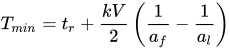
where:
- is the minimum safe headway, in seconds
- is the speed of the vehicles
- is the reaction time, the maximum time it takes for a following vehicle to detect a malfunction in the leader, and to fully apply the emergency brakes.
- is the minimum braking deceleration of the follower.
- is the maximum braking deceleration of the leader. For brick-wall considerations, is infinite and this consideration is eliminated.
- is an arbitrary safety factor, greater than or equal to 1.


The tip-to-tip headway is simply the tip-to-tail headway plus the length of the vehicle, expressed in time:

where:
- time for vehicle and headway to pass a point
- is the vehicle length


Capacity
[edit]The vehicular capacity of a single lane of vehicles is simply the inverse of the tip-to-tip headway. This is most often expressed in vehicles-per-hour:
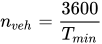
where:
- is the number of vehicles per hour
- is the minimum safe headway, in seconds

The passenger capacity of the lane is simply the product of vehicle capacity and the passenger capacity of the vehicles:
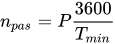
where:
- is the number of passengers per hour
- is the maximum passenger capacity per vehicle
- is the minimum safe headway, in seconds


Headways and ridership
[edit]Headways have an enormous impact on ridership levels above a certain critical waiting time. Following Boyle, the effect of changes in headway are directly proportional to changes in ridership by a simple conversion factor of 1.5. That is, if a headway is reduced from 12 to 10 minutes, the average rider wait time will decrease by 1 minute, the overall trip time by the same one minute, so the ridership increase will be on the order of 1 x 1.5 + 1 or about 2.5%.[13] Also see Ceder for an extensive discussion.[14]
References
[edit]Notes
[edit]- ^ The Metro normally states their best headway as 142 trains per hour, but their english page Archived 21 August 2009 at the Wayback Machine uses the more familiar units.
- ^ Parkinson and Fisher, pg 17
- ^ For a links to a variety of sources on the brick-wall stop in public transit planning, see Richard Gronning, "Brick-Wall Stops and PRT", June 2009
- ^ Leonard Hugh Williams, "Advanced Passenger Train: A Promise Unfulfilled", Ian Allan, 1985, ISBN 0-7110-1474-4
- ^ Parkinson and Fisher, pg 18–19
- ^ Van Winsum, W.; Brouwer, W. (1997). "Time Headway in Car following and Operational Performance during Unexpected Braking". Perceptual and Motor Skills. 84 (3 supplement): 1247–1257. doi:10.2466/pms.1997.84.3c.1247. PMID 9229443. S2CID 6944186.
- ^ Carnegie, Appendix 1
- ^ "Vehicle Speed Compliance Statistics, Great Britain: 2017" (PDF). gov.uk. Retrieved 14 September 2023.
- ^ "Paris Metro Line 14 extended, transforming it into the longest, fastest and best performing line". 23 December 2020.
- ^ "Moscow metro benefits from modernisation".
- ^ "Traffic Analysis Toolbox", US Department of Transit, FHWA-HRT-04-040
- ^ Anderson, pg. 47–48
- ^ Boyle, pg. 13
- ^ Ceder, pg. 537–542
Bibliography
[edit]- John Edward Anderson, "Transit Systems Theory", Lexington Books, 1978
- John Edward Anderson, "The Capacity of a Personal Rapid Transit System", 13 May 1997
- Daniel Boyle, "Fixed Route Transit Ridership Forecasting and Service Planning Methods", Synthesis of Transit Practice, Volume 66 (2006), Transportation Research Board, ISBN 0-309-09772-X
- Jon Carnegie, Alan Voorhees and Paul Hoffman, "Viability of Personal Rapid Transit In New Jersey", February 2007
- Avishai Ceder, "Public transit planning and operation: theory, modelling and practice", Butterworth-Heinemann, 2007, ISBN 0-7506-6166-6
- Tom Parkinson and Ian Fisher, "Rail Transit Capacity", Transportation Research Board, 1996, ISBN 0-309-05718-3
| Bus service | |
|---|---|
| Rail | |
| Vehicles for hire | |
| Carpooling | |
| Ship | |
| Cable | |
| Other transport | |
| Locations | |
| Ticketing and fares |
|
| Routing | |
| Facilities | |
| Scheduling | |
| Politics | |
| Technology and signage | |
| Models | |
| Other topics | |

Headway
View on GrokipediaFundamentals
Definition
Headway is the interval between successive vehicles or services in a transportation system, serving as a key measure of spacing and timing in transit operations. In practice, it is most often defined as the time elapsed between the passage of consecutive vehicles past a fixed point, such as a stop or checkpoint along a route. This temporal measure ensures orderly movement and is fundamental to scheduling in public transport.[2][3] The term originates from nautical usage in the 18th century, where "headway" described a ship's forward progress through water, derived as a shortening of "ahead-way" and first attested around 1748. This evolution extended the concept to broader transportation contexts, emphasizing progress and separation in scheduled services.[4] Headway fundamentally determines service frequency in transit systems, calculated as the inverse of headway time (e.g., a 10-minute headway yields 6 vehicles per hour), which directly impacts passenger waiting times and system accessibility. It also enforces minimum safe separations to prevent collisions, as controllers and signaling rely on headway criteria to maintain braking distances between vehicles. Additionally, headway influences overall system throughput, with capacity expressed as frequency multiplied by vehicle load, enabling higher passenger volumes at shorter headways.[3][5] Headway is quantified in either time-based units, such as seconds or minutes for temporal intervals, or distance-based units, like meters or miles for spatial separations between vehicles. These measures are interconnected via vehicle speed, where spatial headway equals time headway multiplied by average speed, facilitating analysis across varying flow conditions.[6]Measurement Types
Headway can be measured in different ways depending on the reference points of the vehicles involved, with two primary distinctions being tip-to-tip and tip-to-tail headway. Tip-to-tip headway refers to the distance or time between the front (or "tip") of one vehicle and the front of the following vehicle, which is commonly used in scheduling and capacity planning to determine service frequency. In contrast, tip-to-tail headway measures the distance or time from the front of one vehicle to the rear of the preceding vehicle, emphasizing the clear gap for safety considerations such as collision avoidance and braking distances. These measurements are particularly relevant in systems where vehicle length affects operational spacing, with tip-to-tip often incorporating vehicle dimensions into the overall interval. The most common units for quantifying headway are time headway, space headway, and frequency headway, each serving distinct analytical purposes in transportation engineering. Time headway is typically expressed in seconds or minutes as the elapsed time between the passage of successive vehicle fronts at a fixed point, providing a direct measure for operational timing and passenger waiting expectations. Space headway, measured in meters or feet, represents the physical distance between corresponding points on consecutive vehicles (such as front-to-front), which is essential for assessing density and infrastructure utilization. Frequency headway, given in vehicles per hour, is the reciprocal of average time headway and is used to evaluate service levels, such as peak-hour throughput. These units are interrelated through conversion methods that account for vehicle speed, enabling analysis across temporal and spatial dimensions. The fundamental relationship is given by the equation for average space headway: where is the average space headway, is the average (space mean) speed, and is the average time headway. For illustration, if vehicles maintain a time headway of 60 seconds and travel at an average speed of 50 km/h (approximately 13.89 m/s), the space headway calculates to about 833 meters, highlighting how higher speeds amplify spatial requirements for the same temporal interval. Headway measurements must also consider variability, which can be even (consistent intervals) or uneven (fluctuating due to external factors), impacting overall system performance. Even headways promote stable operations with predictable passenger loads, while uneven headways often lead to bunching, where vehicles cluster together, resulting in longer waits for some passengers and overcrowding in others. This variability increases average waiting times beyond theoretical minima and reduces service reliability, as bunching exacerbates deviations from scheduled or planned intervals.Applications Across Transport Modes
Rail and Metro Systems
In rail and metro systems, headway is fundamentally governed by signaling constraints that ensure safe train separation on fixed guideways. Automatic block signaling divides the track into discrete sections, or blocks, where occupancy by one train prevents entry by another to avoid collisions. Typically, systems require trains to maintain separation of at least two to three blocks, corresponding to multiple braking distances, allowing the following train to stop if the leading one halts abruptly.[7] Historically, railway operations relied on manual train-order systems, where dispatchers issued written or telegraphed instructions to conductors and engineers to coordinate movements, particularly on single-track lines. These methods often led to significant delays, with trains held at sidings for extended periods due to human coordination errors or waiting for orders. The transition to modern interlocking systems in the early 20th century marked a key evolution, using mechanical or electrical devices at junctions to prevent conflicting routes while integrating with block signals for continuous protection. A core principle in these advancements is the "brick-wall stop" criterion, which calculates minimum headways based on the worst-case braking distance assuming an instantaneous, full-stop emergency from maximum speed under degraded conditions, often incorporating a safety buffer of at least two such distances.[8][7] Metro systems, as urban rail variants, operate with tighter headways due to higher demand and shorter routes, typically ranging from 90 to 120 seconds during peak hours. Key factors influencing these intervals include platform dwell times, which average 20 to 45 seconds for passenger boarding and alighting, and reduced speeds on curves—often limited to 40-60 km/h—to maintain stability and braking efficiency, thereby extending travel times between signals. Major networks like the Moscow Metro have historically achieved up to 40 trains per hour on select lines. Post-2010 modernizations have pushed these limits further; for instance, Paris Métro Line 14, following its extensions completed in 2020 and 2024, operates at 85-second headways using advanced automated train control, enabling high-frequency service across its expanded 28 km route (as of 2024).[7][9][10][11][12][13]Road Vehicles and Highways
In road vehicles and highways, headway refers to the temporal or spatial separation between successive automobiles, primarily influenced by driver behavior and traffic conditions rather than fixed schedules. The standard guideline for safe following distance is the two-second rule, which recommends maintaining at least two seconds behind the vehicle ahead on faster-moving roads. This time-based measure automatically scales with speed; for instance, at 60 mph (approximately 97 km/h), it equates to about 176 feet (53.6 meters) of space headway. Variations occur based on road conditions, with drivers advised to increase the gap in adverse weather, heavy traffic, or when towing, to account for extended stopping distances. Tip-to-tail measurements, which include the length of the leading vehicle, are used to ensure overall safety spacing in these assessments.[14][15] Empirical data highlights compliance challenges with these guidelines. In 2017, observational studies in Great Britain found that 66% of cars and light commercial vehicles maintained the recommended two-second gap on motorways, while 34% did not, contributing to elevated risks of rear-end collisions and reduced overall safety. Non-compliance often stems from aggressive driving or inattention, exacerbating accident rates in high-speed environments where reaction times are critical.[16] Traffic flow theory further elucidates headway dynamics, distinguishing between free-flow and congested states. In free-flow conditions, headways are larger and more variable, often following an exponential distribution due to minimal vehicle interactions and driver-preferred spacings, allowing for higher speeds and capacities up to around 2,000 vehicles per hour per lane. During congestion, headways shorten and become less random, with distributions shifting toward uniformity as vehicles form platoons—tightly grouped clusters triggered by bottlenecks or upstream disruptions—leading to reduced speeds and shockwave propagation. These platoon effects can amplify instability, as small perturbations in headway propagate backward through the stream.[17] Enforcement of headway guidelines relies on highway codes and driver education, such as the UK's Rule 126, which mandates the two-second gap and penalizes tailgating as careless driving. Human factors introduce real-time variability, with headways fluctuating due to individual reactions, signaling, or merging maneuvers, underscoring the need for adaptive behaviors to maintain flow stability.[14]Buses and Surface Transit
In bus and surface transit systems, headway refers to the time interval between consecutive vehicles on a route, typically measured in minutes for scheduled services operating in urban environments. Standard headways for urban bus routes often range from 5 to 15 minutes during peak and off-peak periods, depending on route demand and city infrastructure. These intervals are influenced by external factors such as traffic signals, which can delay departures and cause deviations from planned timings, and dwell times at stops, where passenger boarding and alighting extend vehicle occupancy and disrupt flow. For instance, studies on transit operations highlight how signal timings and stop dwell durations contribute to headway variability, potentially increasing average delays by 20-30% in congested settings.[18][2][19] Surface transit faces unique challenges in maintaining stable headways due to shared road infrastructure with general traffic, leading to instability from congestion and resulting in bus bunching—where vehicles cluster together, creating irregular gaps. Empirical studies, such as those analyzing GPS-tracked bus data in urban corridors, demonstrate that road congestion amplifies headway variance, with bunching events occurring frequently in peak-hour operations in high-density cities, exacerbating service unreliability. This variability stems from cascading effects: a delayed bus slows following vehicles, while faster ones catch up, often measured through coefficients of variation in inter-arrival times exceeding 0.5 in affected routes. Research on major systems like those in North American cities confirms that such bunching reduces overall route efficiency and passenger satisfaction without dedicated infrastructure.[20][21][22] To address these issues, scheduling practices in bus operations distinguish between fixed timetables, which assign specific departure times for lower-frequency routes to ensure predictability, and flexible headway-based approaches, which prioritize even spacing over strict clocks for higher-frequency services. Fixed schedules are common for routes with headways above 15 minutes, allowing passengers to plan arrivals, but they falter in traffic-prone areas where adherence drops below 70%. In contrast, headway-based scheduling, often implemented via real-time GPS monitoring and holding strategies, dynamically adjusts departures to maintain target intervals, improving regularity by 15-25% in tested scenarios. Bus rapid transit (BRT) systems exemplify advanced applications, targeting 1-2 minute headways during peak hours in high-capacity corridors, as seen in Bogotá's TransMilenio, where multiple lines combine for sub-minute effective frequencies at busy stations.[23][24][25] Even headways in these systems directly benefit ridership by minimizing average passenger wait times, as consistent intervals allow users to arrive randomly without consulting schedules, fostering higher usage in urban networks. For example, maintaining headways below 10 minutes can halve perceived waits compared to bunched services, encouraging mode shifts from private vehicles in surface transit contexts.[2][26]Aviation and Specialized Modes
In aviation, headway primarily manifests as scheduled intervals between flights at airports and spatial or temporal separations enforced by air traffic control to ensure safety. Airport slot allocations, coordinated by bodies like the International Air Transport Association (IATA), govern departure and arrival times in 5- or 10-minute series to manage capacity at congested facilities. These slots enable operational headways of 1 to 2 hours between flights on the same route, such as transatlantic services where multiple airlines space departures to optimize airspace usage without excessive delays.[27] Air traffic control applies standardized separation minima to maintain safe headways en route and in terminal areas. Under International Civil Aviation Organization (ICAO) standards, vertical separation is 1,000 feet (300 meters) below flight level 290 and 2,000 feet (600 meters) above, with reduced vertical separation minima (RVSM) allowing 1,000 feet in approved airspaces. Lateral separation typically requires at least 5 nautical miles between aircraft tracks, achieved through procedural methods like diverging routes or radar monitoring, while wake turbulence categories impose time-based headways of 2 to 5 minutes during approaches.[28] These minima contrast with ground transport by emphasizing three-dimensional spacing over linear following distances. Specialized modes like personal rapid transit (PRT) and waterborne or short-haul shuttles adapt headway concepts to niche demands. The 1970s Cabinentaxi PRT system, an experimental German project, achieved headways of 1.9 seconds between automated vehicles on a 1.9 km test track in Hagen, enabling high throughput with on-demand routing. Ferry services, vital for coastal connectivity, often feature headways of 20 to 60 minutes; for instance, Norwegian routes average 52 minutes between departures to balance passenger loads and vessel availability. Airport shuttles maintain tighter headways of 5 to 15 minutes, as seen in Dallas-Fort Worth operations targeting 7-minute intervals for efficient terminal-to-terminal transfers. Much PRT research dates to these experimental phases, underscoring a gap in contemporary data for scaled deployments.[29][30]Advanced Low-Headway Systems
Automation and Signaling Technologies
Communication-based train control (CBTC) represents a pivotal advancement in rail signaling, enabling dynamic headway adjustments by utilizing continuous, real-time communication between trains and central control systems, in contrast to traditional fixed-block systems that divide tracks into static segments and enforce predetermined separation distances.[31] In fixed-block setups, trains occupy entire blocks regardless of their length, often resulting in conservative headways of 120–180 seconds to ensure safety, whereas CBTC's moving-block approach calculates precise train positions via onboard transponders and wireless links, allowing headways as short as 60 seconds on systems like Vancouver's SkyTrain by optimizing separation based on actual speed and braking performance.[31] This shift enhances line capacity by up to 30 trains per hour without extensive infrastructure overhauls, as demonstrated in upgrades on New York City's Canarsie Line, where CBTC reduced peak headways from 150 to 60–90 seconds while maintaining fail-safe principles through redundant communication channels.[31] Automation levels in rail systems, classified by Grades of Automation (GoA), further support reduced headways by minimizing human intervention and associated variability. GoA4, or unattended train operation, eliminates onboard staff entirely, relying on fully automated systems for acceleration, braking, and routing, which reduces human error and enables consistent, precise control, as exemplified by the Vancouver SkyTrain achieving 60-second headways.[32] The Vancouver SkyTrain exemplifies GoA4 implementation, operating since 1986 with CBTC integration to achieve 60-second headways across its network, serving approximately 149 million annual passengers as of 2024.[31] Such systems incorporate automatic train protection (ATP) and supervision (ATS) to enforce speed limits and collision avoidance dynamically, outperforming lower GoA levels where manual overrides can introduce delays.[32] Beyond rail, vehicle-to-vehicle (V2V) communication technologies facilitate headway reductions in road transport by enabling cooperative adaptive cruise control (CACC), where vehicles exchange position, speed, and intent data via dedicated short-range communications (DSRC) to maintain platoons with gaps as low as 1–2 seconds, compared to 2–3 seconds in human-driven scenarios.[33] This real-time data sharing mitigates reaction time limitations, potentially increasing highway capacity by 2–3 times in mixed traffic environments, as validated in simulations showing stabilized velocities and reduced acceleration fluctuations during perturbations.[33] For buses and surface transit, GPS-based precision positioning integrates with automatic vehicle location (AVL) systems to enable headway-based operations, where real-time tracking adjusts schedules to prevent bunching and achieve even spacing of 5–10 minutes in urban corridors.[34] By estimating arrival times with sub-minute accuracy using GPS and inertial sensors, these systems support holding strategies that regulate headways without fixed timetables, improving reliability on routes like those tested in Jinan, China, where delays were reduced by approximately 7–10%.[35] The evolution of these technologies traces a historical shift from targeted upgrades, such as the 2012 London Olympics preparations that enhanced Docklands Light Railway (DLR) capacity through signaling improvements and three-car train introductions to boost peak-hour throughput by 50%, to broader digital signaling initiatives like the UK's European Train Control System (ETCS) deployments.[36] These Olympic-era modifications laid groundwork for ongoing advancements, including Network Rail's digital in-cab signaling trials that replace lineside signals, aiming for headway optimizations across national networks by 2030.[37]Modern Implementations and Innovations
In recent years, autonomous vehicles (AVs) have advanced platooning techniques, enabling significantly reduced headways through sensor fusion, vehicle-to-vehicle (V2V) communication, and adaptive control systems. Studies on connected AVs demonstrate achievable time headways as low as 0.3 seconds in short-headway configurations for truck platooning, enhancing road capacity while maintaining string stability under noisy conditions.[38][39] Ongoing trials starting in 2023, including those by organizations like FPInnovations, focus on scaling these technologies for freight and passenger applications, with Virginia's Department of Motor Vehicles recommending 2-4 second headways adjusted for speed to balance safety and efficiency.[40][33] Hyperloop systems represent a theoretical leap in low-headway transport within vacuum tubes, where pods can operate at intervals of 30 seconds, allowing for high throughput at speeds up to 1,000 km/h. This headway is feasible under 1g deceleration assumptions, as analyzed in U.S. Department of Transportation feasibility studies supporting the original Hyperloop concept.[41] Virgin Hyperloop's 2020 passenger tests in Nevada validated pod propulsion and levitation technologies, paving the way for concepts that propose 10-30 second headways to achieve capacities rivaling conventional rail, though feasibility studies suggest longer intervals may be more realistic while minimizing energy use in low-pressure environments.[42][43] Urban air mobility (UAM) innovations, particularly for drone delivery, incorporate dedicated airspace corridors to manage headways efficiently, emphasizing detect-and-avoid systems in low-altitude urban routes per FAA and NASA frameworks for beyond-visual-line-of-sight (BVLOS) flights.[44][45] Post-2020 metro upgrades exemplify practical low-headway achievements through automation, such as the Riyadh Metro's implementation of 90-second peak intervals across its 176 km network using communications-based train control (CBTC). Opened in 2024, this driverless system serves up to 3.6 million passengers daily, integrating platform screen doors and high-frequency operations to boost urban capacity in line with Saudi Vision 2030 goals. As of 2025, European ETCS Level 3 trials have demonstrated potential for headways under 2 minutes in mixed traffic environments.[46][47]Operational Impacts
Minimum Safe Headway
The minimum safe headway represents the shortest interval between vehicles or trains that ensures collision avoidance under emergency braking scenarios, determined primarily by human or system reaction time, vehicle dynamics, and safety buffers. Safety criteria focus on the driver's or system's perception-reaction time (), during which the following vehicle continues at constant speed while the leading one decelerates; braking distances for both vehicles, accounting for their deceleration rates; and buffer zones incorporating vehicle lengths, overlaps, and conservative safety factors to prevent contact even in worst-case "brick-wall stop" approximations, where the leading vehicle is assumed to halt abruptly. These elements ensure the following entity can stop without encroaching on the leading one's position, prioritizing physics-based limits over operational signaling.[48] The key equation for the minimum time headway derives from the relative stopping distance divided by the operating speed , incorporating reaction and braking phases. During , the gap closes due to the leading vehicle's initial deceleration, approximated conservatively; subsequent braking assumes constant decelerations for the follower and for the leader, yielding a relative braking distance of . Thus, Here, is the perception-reaction time (typically 1.5–2.5 seconds for human drivers); is the speed; and are the follower's and leader's maximum safe decelerations (e.g., 3–5 m/s² for road vehicles, higher for rail); and is a safety factor (often 1.1–1.5) to account for uncertainties like adhesion variability or sensor delays. This formulation assumes level track/road and dry conditions, with derivation simplifying the leader's motion during reaction (closing gap ) and using kinematic stopping distances, validated in traffic flow models for both road and rail applications.[49][48] Headway requirements increase with speed due to quadratic growth in braking distances, necessitating longer intervals at higher to maintain safety margins; for instance, at 100 km/h, may double compared to 50 km/h under identical decelerations. Weather effects reduce effective and (e.g., by 20–50% in rain or snow via lower friction), extending and requiring operational adjustments like speed reductions. Mode variations reflect differing dynamics: road vehicles typically enforce 2 seconds minimum time headway for cars at highway speeds to cover average s plus buffers, while rail systems achieve sub-2-second headways in absolute braking scenarios but extend to 3–5 seconds with relative braking for high-speed lines.[48][50] Post-2020 advancements in autonomous vehicles (AVs) have enabled significant headway reductions through predictive algorithms that anticipate braking via sensor fusion, minimizing effective (e.g., to 0.1 seconds) and optimizing dynamically without human variability; for example, emergency braking systems using sensor fusion achieve near-instantaneous response, while adaptive control algorithms can reduce traffic delays by up to 23% in mixed fleets, enhancing safety and capacity.[51][52]Route Capacity Calculations
Route capacity in transit systems, particularly for rail, bus, and other fixed-route services, is fundamentally tied to headway, as it governs the frequency at which vehicles can operate along a route. The core mathematical model for calculating route capacity expresses the maximum number of passengers that can be transported per hour, denoted as , using the formula , where represents the vehicle's passenger capacity (adjusted for load factors such as seated and standing passengers), and is the minimum headway in seconds.[53] This equation derives from the vehicle frequency, calculated as vehicles per hour, multiplied by the effective passenger load per vehicle, which accounts for operational constraints like maximum loading standards (e.g., passengers per square meter).[53] The minimum headway serves as a prerequisite input, typically determined from safe separation requirements, signaling systems, and dwell times at stops.[53] To address real-world variability in operations, the formula incorporates adjustments such as using average headway instead of the strict minimum to buffer against delays or inconsistencies in vehicle spacing.[53] The peak hour factor (PHF), ranging from 0.75 to 0.95 depending on the transit mode, further refines the calculation by scaling the 15-minute peak demand to an hourly average, reflecting uneven passenger distribution during rush hours versus off-peak periods.[53] Peak operations often permit higher load factors and shorter headways to maximize throughput, while off-peak scenarios apply more conservative adjustments to ensure reliability and comfort.[53] The theoretical maximum capacity is constrained by the vehicles-per-hour limit of , which represents the upper bound under ideal conditions without external interferences.[53] However, scheduling introduces efficiency losses, primarily through operating margins (typically 10–35 seconds added to each headway) to accommodate recovery from minor delays, signal interactions, or terminal turnaround times, thereby reducing the achievable capacity below the theoretical peak.[53]Capacity Examples
In freeway operations, a 2-second headway between vehicles can achieve a capacity of 1,800 vehicles per hour per lane under ideal conditions.[33] Assuming an average vehicle occupancy of 1.5 passengers, this translates to approximately 2,700 passengers per hour per lane.[54][33] For metro systems, a 120-second headway supports capacities up to 30,000 passengers per hour per direction on trunk lines, as exemplified by historical operations on the New York City Subway using cab-control signaling.[53] Advanced low-headway systems demonstrate even higher potential. Personal Rapid Transit (PRT) with 2-second headways and 3-passenger vehicles can theoretically handle 5,400 passengers per hour per direction.[55] Recent 2024 simulations of fully automated highways with cooperative adaptive cruise control project capacities exceeding 4,000 vehicles per hour per lane.[56] The following table compares headway-driven capacities across modes, highlighting rail's leverage over road in passenger throughput per direction or lane:| Mode | Typical Headway | Capacity Example | Notes/Source |
|---|---|---|---|
| Freeway (Road) | 2 seconds | 2,700 passengers/hour/lane | 1.5 occupancy; illustrates baseline automotive limits.[33][54] |
| Metro (Rail) | 120 seconds | 30,000 passengers/hour/direction | High-volume urban trunk line; cab signaling.[53] |
| PRT (Automated) | 2 seconds | 5,400 passengers/hour/direction | 3-passenger vehicles; theoretical off-line stations.[55] |
| AV Highway | 0.9 seconds | 4,000+ vehicles/hour/lane | Full CACC penetration; 2024 simulation.[56] |