
.jpg/250px-1977_Ford_XC_Falcon_GS_Sedan_(8590803181).jpg)


.jpg/2000px-1977_Ford_XC_Falcon_GS_Sedan_(8590803181).jpg)
Community hub
Recent from talks
Contribute something
Nothing was collected or created yet.
Ford Falcon (XC)
View on Wikipedia
| Ford Falcon (XC) Ford Fairmont (XC) | |
|---|---|
.jpg) Ford Falcon 500 Sedan (XC) with GS Rally Pack | |
| Overview | |
| Manufacturer | Ford Australia |
| Production | July 1976 – March 1979 |
| Body and chassis | |
| Class | Full-size car |
| Body style | 4-door Sedan 4-door Station Wagon 2-door Hardtop 2-door Coupé utility 2-door Panel van |
| Powertrain | |
| Engine | 3.3 L Inline 6 4.1 L Inline 6 4.9 L Cleveland V8 5.8 L Cleveland V8 |
| Transmission | 3spd manual 4spd manual 3spd auto |
| Dimensions | |
| Wheelbase | 2,819 mm (111.0 in) |
| Length | 4,866 mm (191.6 in) |
| Width | 1,900 mm (74.8 in) |
| Height | 1,369 mm (53.9 in) |
| Curb weight | 1,475 kg (3,251.8 lb) |
| Chronology | |
| Predecessor | XB Falcon |
| Successor | XD Falcon |
The Ford Falcon (XC) is a full-size car that was produced by Ford Australia from 1976 to 1979. It was the third and last iteration of the third generation of the Falcon and also included the Ford Fairmont (XC)—the luxury-oriented version of the Falcon.
Overview
[edit]The XC series was a facelift of the XB Falcon, itself an upgrade of the XA Falcon which had entered production in 1972.
Introduced in July 1976, the XC included significant changes to comply with new Australian Design Rules. ADR27A set limits for the emissions of hydrocarbons, carbon monoxide, and oxides of nitrogen.[1] To meet the new requirements, engine compression ratios were dropped, and the engines now featured an exhaust gas recirculation valve and positive crankcase ventilation. In order to offset power losses as a result of implementing emissions controls, Ford upgraded the six-cylinder engines with a new crossflow cylinder head with larger valves, and fitted all V8 engines with four-barrel carburettors. While quoted power outputs were lower than those claimed for the XB Falcon, this reflected a move from SAE gross to DIN methodology, which measured power of the engine as installed in the car with cooling, charging and exhaust systems installed. Ford claimed power outputs for the upgraded engines were around ten per cent higher than those of their XB predecessors.[2][3]
Weight also increased significantly, from 1,385 to 1,478 kilograms (3,053 to 3,258 lb).[3] The increase was in part due to the fitting of much larger, stronger front and rear bumpers, and strengthening of the doors to comply with ADR29, which introduced strength and stiffness requirements for side-impact protection.[4]
Visually, the XC Falcon was given a restyle treatment that softened its appearance from its predecessors. The XC had a less aggressive nose which incorporated two round headlights on Falcon models and two rectangular headlights on Fairmont models. On sedan and wagon models, Ford also addressed the vision problems of the XA and XB by utilising redesigned rear doors, which debuted in May 1976 with the ZH series Fairlane,[5] with a lower window line that had the effect of removing the coke bottle styling of the XA and XB. Visibility was further improved by an all-new, lower dashboard and crash pad,[3] and higher front seats. The XC hardtop was the last of the two-door Australian Falcons.
Total production of the XC range reached 171,082 vehicles[6] prior to the replacement of the XC by the XD Falcon in March 1979.[7]
Model range
[edit]The XC Falcon range of passenger vehicles consisted of nine models:[8]
| Model | Body | 3.3 | 4.1 | 4.9 | 5.8 |
|---|---|---|---|---|---|
| Falcon[9] | Sedan | ● | ● | ● | ● |
| Wagon | ● | ● | ● | ● | |
| Falcon 500[10] | Sedan | ● | ● | ● | ● |
| Wagon | ● | ● | ● | ● | |
| Falcon GS[11] | Hardtop | − | ● | ● | ● |
| Fairmont[12] | Sedan | − | ● | ● | ● |
| Wagon | − | ● | ● | ● | |
| Fairmont (GS)[11] | Hardtop | − | ● | ● | ● |
| Fairmont GXL[12] | Sedan | − | ● | ● | ● |
The Fairmont models were not badged or marketed as Falcons.
The XC Falcon range of commercial vehicles consisted of five models:[13]
| Model | Body | 3.3 | 4.1 | 4.9 | 5.8 |
|---|---|---|---|---|---|
| Falcon | Utility[14] | ● | ● | ● | ● |
| Van[15] | ● | ● | ● | ● | |
| Falcon 500 | Utility[14] | ● | ● | ● | ● |
| Van[15] | ● | ● | ● | ● | |
| Falcon Sundowner | Van[16] | − | ● | ● | ● |
The contemporary Fairlane and LTD models were codenamed ZH, and P6 respectively.
| Model | Body | 3.3 | 4.1 | 4.9 | 5.8 |
|---|---|---|---|---|---|
| ZH Fairlane 500[17] | Sedan LWB | − | − | ● | ● |
| ZH Fairlane Marquis[18][19] | Sedan LWB | − | − | ● | ● |
| P6 LTD[20][21] | Sedan XLWB | − | − | − | ● |
| P6 LTD Silver Monarch[20][21] | Sedan XLWB | − | − | − | ● |
-
 Ford Falcon 500 Sedan (XC)
 -
 Ford Fairmont Sedan (XC)
 -
 Ford Fairmont Wagon (XC) (with GS Rally Pack)
 -
 Ford Fairmont Hardtop (XC) (with optional vinyl roof)
 -
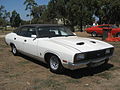 Ford Fairmont GXL (XC) (with optional vinyl roof)
 -
 Ford Falcon Utility (XC)
.jpg)
.jpg)
.jpg)
_(16027826004).jpg)

.jpg)
Fairmont GXL
Unique to the XC model was the GXL version of the Fairmont, Available in 4.1L Straight 6, or 4.9L Cleveland V8. An upgraded engine package, the GT Power Pack, used the larger 5.8L Cleveland v8. The Fairmont GXL was replaced in the following XD range with the Fairmont Ghia model.[22]
GS Rally Pack
A GS Rally Pack was fitted as standard equipment on the Falcon GS Hardtop[13] and was available as an option on Falcon 500 Sedan and Wagon,[13] Fairmont Sedan and Wagon,[13] Falcon Utility and Van[23] and on Falcon 500 Utility and Van.[23] The pack included special paint treatment, bonnet scoops, bumper overriders, slotted steel wheels, enhanced instrumentation, a sports steering wheel and long range driving lights.[13] The driving lights were not included when the pack was fitted to Fairmont models.[13]
Limited edition models
[edit]In December 1977, 12 special-build XC hardtops were released, all with VINs beginning JG65TE. These were based on the GS hardtop but featured an homologation pack of additional parts that Ford persuaded CAMS was now available as standard on GS hardtops, in order to include those parts on their race cars. The pack included front and rear spoilers, twin electric radiator fans, various body and steering braces for durability and stiffness, and a reverse bonnet scoop that supplied cool air to the engine via a circular hole in the bonnet. This homologation pack would also form the basis of the 30 Option 97 "Bathurst Cobras" the following year.
Ford Falcon Cobra
In August 1978, Ford Australia introduced the limited production Falcon Cobra, a high-performance version of the XC Falcon Hardtop. Only 400 were built, including 4.9-litre and 5.8-litre street versions and 30 "Bathurst Specials".[24][25]
Allan Moffat Special
In 1977, a limited number (500) of the Falcon 500 sedan were marketed as Allan Moffat Specials. These cars received XB GT-style blackouts and a sticker on the front doors consisting of Allan Moffat's signature and an Australian flag, as well as other options such as the GS Rally pack and Sports handling suspension as standard. [26]
Sundowner Van
The Falcon Sundowner Van, based on the Falcon 500 Van, was introduced in 1977. It included options from the Falcon GS Hardtop, such as comprehensive instrumentation, bonnet scoops, slotted sports road wheels and driving lights, with side protection moulding's and rear side glass deleted. Side and rear decals were included in the package.
-
 Ford Falcon Cobra (XC)
 -
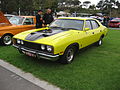 Ford Falcon Allan Moffat Special (XC)
 -
 Ford Falcon Sundowner Panel Van (XC)


Motorsport
[edit].jpg)
At the 1977 Hardie-Ferodo 1000, Allan Moffat and Colin Bond drove Group C specification Hardtops to a "1, 2" formation finish. Moffat later went on to win the 1977 Australian Touring Car Championship driving both an XB Falcon GT Hardtop and XC Falcon GS 500 Hardtop. The GS 500 Hardtop formed the basis for the Ford Falcon Cobra and a customer racing program, with a special "Evolution" (and later Evo II) package to homologate parts.
References
[edit]- ^ "Australian Design Rule 27A for Vehicle Emission Control" (PDF). Commonwealth of Australia. February 1984. Retrieved 10 September 2024.
- ^ "New Fairmont engines". Ford Fairmont. Ford Australia: 6. July 1976.
- ^ a b c "1976 Ford Falcon XC reveal". Wheels. September 1976.
- ^ "Australian Design Rule 29 for Side Door Strength" (PDF). Commonwealth of Australia. February 1984. Retrieved 10 September 2024.
- ^ "Ford Fairlane ZH". Unique Cars and Parts. Retrieved 13 September 2024.
- ^ Tony Davis, Aussie Cars, 1987, page 146
- ^ Tony Davis, Aussie Cars, 1987, page 156
- ^ Ford Cars - All Model Catalogue May 1978, page 64
- ^ Ford Falcon Sedan & Wagon. Ford Motor Company of Australia Limited. November 1976.
- ^ "The Old Car Manual Project Brochure Collection". www.oldcarbrochures.org. Retrieved 9 December 2022.
- ^ a b "The Old Car Manual Project Brochure Collection". www.oldcarbrochures.org. Retrieved 9 December 2022.
- ^ a b "The Old Car Manual Project Brochure Collection". www.oldcarbrochures.org. Retrieved 9 December 2022.
- ^ a b c d e f Ford Cars - All Model Catalogue May 1978, page 48
- ^ a b "The Old Car Manual Project Brochure Collection". www.oldcarbrochures.org. Retrieved 9 December 2022.
- ^ a b "The Old Car Manual Project Brochure Collection". www.oldcarbrochures.org. Retrieved 9 December 2022.
- ^ "The Old Car Manual Project Brochure Collection". www.oldcarbrochures.org. Retrieved 9 December 2022.
- ^ "The Old Car Manual Project Brochure Collection". www.oldcarbrochures.org. Retrieved 9 December 2022.
- ^ "The Old Car Manual Project Brochure Collection". www.oldcarbrochures.org. Retrieved 9 December 2022.
- ^ "The Old Car Manual Project Brochure Collection". www.oldcarbrochures.org. Retrieved 9 December 2022.
- ^ a b "The Old Car Manual Project Brochure Collection". www.oldcarbrochures.org. Retrieved 9 December 2022.
- ^ a b "The Old Car Manual Project Brochure Collection". www.oldcarbrochures.org. Retrieved 9 December 2022.
- ^ "1976 Ford (Australia) XC Fairmont GXL Sedan full range specs".
- ^ a b Ford Cars - All Model Catalogue May 1978, page 37
- ^ Tony Davis, Aussie Cars, 1987, page 153
- ^ "Ford Fairmont XC Fairmont GXL 1976-1979". Archived from the original on 8 October 2009.
- ^ "More Specials".
External links
[edit]Ford Falcon | |||||
|---|---|---|---|---|---|
| North America |  | ||||
| Argentina | |||||
| Australia |
| ||||
| Engines | |||||
Ford Falcon (XC)
View on GrokipediaOverview and history
Introduction
The Ford Falcon (XC) is a full-size car manufactured by Ford Australia from July 1976 to March 1979.[6] It served primarily as a family sedan, station wagon, two-door hardtop coupe, utility (ute), and panel van, offering versatile body styles tailored to Australian consumer needs.[7] As the third and final iteration of the third-generation Falcon—following the XA (1972–1973) and XB (1973–1976) models—the XC represented an evolutionary update to a platform entirely designed and engineered in Australia to suit local road conditions, climate, and driving preferences.[8] Positioned as a direct rival to the Holden Kingswood, the XC emphasized robust construction, spacious interiors, and adaptations like reinforced suspension for rough outback travel, appealing to families and tradespeople alike.[9] The XC achieved a total production of 171,082 units across all variants, marking a commercial high point for the Falcon lineup.[6] In 1977, it became the first Falcon model to outsell Holden in the Australian market, capturing the top sales position amid intensifying competition, though this peak preceded broader declines influenced by the ongoing energy crisis and shifting fuel efficiency demands.[10]Development and launch
The Ford Falcon XC evolved from the preceding XA (introduced in 1972) and XB (launched in 1973) models, which had faced criticism for the XB's aggressive, muscle-car-inspired styling and relatively poor fuel efficiency during the 1970s oil crisis.[1][11] The XB's bold design, while popular among enthusiasts, alienated some mainstream buyers seeking more subdued aesthetics amid rising fuel costs following the 1973 OPEC embargo, which triggered global shortages and higher petrol prices in Australia.[1][12] Redesign motivations for the XC centered on adopting a more restrained aesthetic to broaden market appeal, enhancing fuel economy to address ongoing energy concerns, and responding to the sharp decline in sales of high-performance GT variants due to exorbitant insurance premiums for powerful models.[1][11] Ford Australia aimed to comply with new Australian Design Rules (ADRs), including ADR 27A for emissions effective July 1976, while toning down the XB's upswept beltline and fender bulges for better visibility and safety alignment with ADR 29 side-impact standards.[11][2] This shift reflected a broader industry trend toward efficiency in response to the economic pressures of fuel scarcity, which had diminished demand for large-displacement engines.[1][12] The XC's development followed a two-year program initiated in 1974, culminating in significant engineering updates such as the introduction of crossflow cylinder heads for the 3.3-liter and 4.1-liter inline-six engines, which boosted output by a claimed 12 horsepower while meeting emissions requirements.[1][2] These changes, part of a $16 million investment, rationalized the V8 lineup to 4.9-liter and 5.8-liter options with improved carburetors for better efficiency without sacrificing all performance.[2] The focus on smaller, more efficient engines was directly influenced by the global fuel shortages, prioritizing compliance and economy over raw power.[1][2] The XC Falcon debuted in July 1976 at Ford Australia's Broadmeadows assembly plant in Victoria, marking the first Falcon without the GT badge in the initial lineup, with the GS 500 positioned as the top performance model.[1][2] Sedans and wagons launched first, followed by hardtops in December 1976, amid an economic landscape shaped by persistent fuel price volatility that encouraged the model's emphasis on versatile, efficient powertrains.[11][2] Early sales outperformed rival Holden models, capturing a stable share of the medium-car segment despite the challenges.[1][2]Design and features
Exterior styling
The Ford Falcon (XC) introduced a more subdued exterior aesthetic compared to the aggressive styling of its predecessor, the XB model, which had featured a bolder, more purposeful grille and curvaceous lines inspired by American muscle car influences. The front end was redesigned with a rectangular grille incorporating horizontal slats, paired with slimmer bumpers that contributed to a cleaner, less imposing appearance. Base Falcon and 500 models utilized single round headlights, while higher Fairmont and GXL trims adopted rectangular units for a more modern look, enhancing the overall refined profile adapted for Australian road conditions.[1][11][6] At the rear, the XC Falcon presented a flatter tail light design with black bezels, particularly noticeable on hardtop variants, replacing the chunkier wraparound units of the XB for improved aerodynamics and greater practicality in loading. The upswept rear deck was reduced, resulting in a smoother, less curvaceous "Coke bottle" line that improved rear visibility and aligned with evolving safety standards through redesigned doors borrowed from the ZH Fairlane. This tonal shift emphasized functionality over flair, making the XC better suited to everyday Australian use.[1][6] The XC was offered in multiple body styles, including sedan, wagon, two-door hardtop coupe, ute, and Sundowner panel van, with the hardtop retaining a pillarless design for a sportier silhouette. Its dimensions reflected adaptations for local conditions, with a 2819 mm wheelbase, 4866 mm overall length, and 1900 mm width, providing ample space while maintaining maneuverability on varied terrains.[5][1][6] Trim levels varied in exterior appointments to denote hierarchy: base models came with simple steel wheels and hubcaps for a utilitarian vibe, whereas upscale Fairmont and GXL variants added styled wheel covers, and performance-oriented GS and Cobra editions incorporated alloy wheels along with rear spoilers for enhanced visual aggression. These elements underscored the XC's versatility, blending everyday practicality with optional sporty flair.[1][11]Interior and equipment
The Ford Falcon (XC) introduced a redesigned instrument panel featuring two large circular gauges for speed and engine revolutions directly in front of the steering wheel, complemented by four smaller rectangular gauges for fuel, temperature, ammeter, and oil pressure, angled toward the driver for enhanced readability. This layout, positioned higher than in previous models, included a parcel shelf below the glove box and incorporated an intermittent windscreen wiper control stalk, marking a practical update unique to the XC series. Higher trims such as the Fairmont added chrome accents to the black dashboard for a more refined appearance, while the overall cabin adopted an all-black theme in the GXL variant, except for the headlining, to create a modern, cohesive look.[13][2][14] Seating in the XC Falcon emphasized comfort with vinyl or cloth bench seats as standard in base models like the Falcon 500, providing ample space for five passengers. Bucket seats became standard in mid- and upper-level trims such as the GXL and Fairmont, with reclining front buckets optional across the range for better support during long drives; the GS Hardtop variant offered higher-mounted buckets to improve forward visibility. Cabin comfort was further enhanced by four fan-assisted air vents and built-in door pulls in Fairmont and GXL models, alongside improved sound insulation materials that reduced road and wind noise compared to the XB predecessor.[2][15][14] Safety equipment in the XC aligned with Australian Design Rules (ADR) of the era, including three-point inertia-reel seatbelts for front occupants and a collapsible energy-absorbing steering column to mitigate impact injuries. From January 1977, side guard beams were integrated into the doors for ADR 29 side-impact protection, a feature introduced across the XC lineup to bolster occupant safety without the presence of airbags, which were not yet standard in production vehicles. These measures, combined with a prismatic day/night rearview mirror and dash-mounted map light, provided era-appropriate passive safety focused on crash avoidance and injury reduction.[16][11][15] Luxury-oriented equipment varied by trim, with the Fairmont and GXL models offering power windows, air conditioning, and a soft-rimmed steering wheel as options to elevate the driving experience. A Ford-branded push-button AM radio was standard in mid-level trims like the Falcon 500, with cassette player upgrades available for enhanced audio; heated rear screens and analogue clocks further distinguished higher variants. The GS Hardtop included sportier touches like a two-bar steering wheel, while overall, these features positioned the XC as a step toward greater refinement in Ford's Australian lineup.[17][14][2] In commercial variants such as the XC ute and panel van, interiors prioritized durability with robust vinyl upholstery and carpeted flooring in the Falcon 500 models, complemented by reclining bucket seats for driver comfort during work duties. These adaptations used hard-wearing materials to handle cargo-related wear, while sharing door panels with passenger models for easier maintenance, ensuring practicality without sacrificing basic cabin functionality.[18][17]Engineering specifications
Engines and powertrains
The Ford Falcon (XC) offered a range of inline-six and V8 engines, reflecting adaptations to the 1970s oil crisis while maintaining performance suitable for Australian conditions. All power and torque figures are DIN net ratings to comply with ADR 27A emissions standards. The inline-six options included a base 3.3-litre (3273 cc) engine producing 80 kW (109 PS) at 4200 rpm and 220 Nm of torque at 2000 rpm, paired with a compression ratio of 7.9:1.[19] A larger 4.1-litre (4100 cc) variant delivered 92 kW (125 PS) and 289 Nm of torque, both featuring newly introduced cast-iron crossflow cylinder heads for enhanced breathing and efficiency compared to prior Heron-head designs.[20][2] These six-cylinder engines used a single-barrel carburettor and were tuned for better low-rev response, with power ratings measured under the DIN standard to comply with emerging emission regulations like ADR 27A.[2][21] For higher performance, the XC Falcon utilised Cleveland-series V8s, reduced from three variants in the prior XB model to two for simplification. The 4.9-litre (4942 cc) produced 151 kW (205 PS) at 4600 rpm and 364 Nm at 3000 rpm, while the top 5.8-litre (5735 cc) offered 162 kW (220 PS) at 4600 rpm and 429 Nm at 3000 rpm, both equipped with a four-barrel carburettor.[22][23][24] These V8s emphasised low-end torque for towing and overtaking, with outputs also rated via DIN and designed to run on standard unleaded fuel where possible, though the larger displacement contributed to higher consumption.[2] The engines were mounted longitudinally with rear-wheel drive, prioritising durability over outright power in response to fuel scarcity.| Engine | Displacement | Power | Torque | Configuration |
|---|---|---|---|---|
| Inline-six | 3.3 L (3273 cc) | 80 kW (109 PS) @ 4200 rpm | 220 Nm @ 2000 rpm | OHV, crossflow head, carburetted |
| Inline-six | 4.1 L (4100 cc) | 92 kW (125 PS) @ 3850 rpm | 289 Nm @ 2000 rpm | OHV, crossflow head, carburetted |
| V8 | 4.9 L (4942 cc) | 151 kW (205 PS) @ 4600 rpm | 364 Nm @ 3000 rpm | OHV Cleveland, 4-barrel carburettor |
| V8 | 5.8 L (5735 cc) | 162 kW (220 PS) @ 4600 rpm | 429 Nm @ 3000 rpm | OHV Cleveland, 4-barrel carburettor |