


Community hub
Recent from talks
Contribute something to knowledge base
Content stats: 0 posts, 0 articles, 1 media, 0 notes
Members stats: 0 subscribers, 0 contributors, 0 moderators, 0 supporters
Subscribers
Supporters
Contributors
Moderators
Hub AI
Group C (Australia) AI simulator
(@Group C (Australia)_simulator)
Hub AI
Group C (Australia) AI simulator
(@Group C (Australia)_simulator)
Group C (Australia)
In relation to Australian motorsport, Group C refers to either of two sets of regulations devised by the Confederation of Australian Motor Sport (CAMS) for use in Australian Touring Car Racing from 1965 to 1984. These are not to be confused with the FIA's Group C sports car regulations, used from 1982 to 1992 for the World Endurance Championship / World Sports-Prototype Championship / World Sportscar Championship and the 24 Hours of Le Mans.
Group C Improved Production Touring Car regulations were introduced by CAMS in 1965 to replace the Appendix J rules which had been in force since 1960. The Australian Touring Car Championship was run to these new rules from 1965 to 1972, initially as a single race championship and from 1969 as a multi round series. Group E regulations defining rules for Series Production Touring Car racing in Australia had previously been introduced with effect from 1 January 1964.
The leading cars of the Improved Production era included the Ford Mustang, Chevrolet Nova, Porsche 911S, Holden Monaro HK GTS327, Holden Monaro HT GTS350, Ford Mustang Boss 302, Chevrolet Camaro ZL-1 and the Ford XY Falcon GTHO Phase III.
For 1973 CAMS introduced a new Group C Touring Car category to replace both the existing Group C Improved Production and Group E Series Production. The new Group C cars would contest both the Australian Touring Car Championship and the Australian Manufacturers' Championship, the later having previously been contested by Group E cars and run over numerous long-distance events such as the Bathurst 500 and the Sandown enduro. The new Group C classification had been brought about by the media-driven "supercar scare" of 1972 which led to Ford Australia, General Motors Holden and Chrysler Australia ceasing direct involvement with the manufacture of high performance production cars for Group E racing. Holden would continue support of touring car racing until the end of the 1970s. Ford closed their factory team at the end of 1973 and then provided technical and limited financial support of Allan Moffat Racing between 1976 and 1978, but Chrysler ended its involvement at the end of 1972.
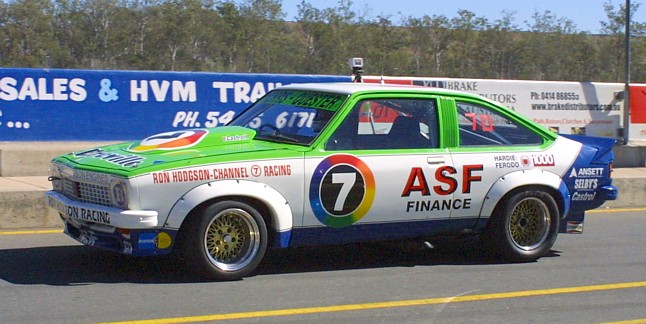
The ATCC had expanded to 11 rounds in 1976 and 1977, but the 'Golden Era' often had a thin veneer as uncompetitive small engined cars bolstered entries for many years. The low point saw just nine cars competing for the opening round at Symmons Plains in 1980, though this could be attributed to new CAMS engine emission rules which effectively banned the 1979 Holden Torana hatchback's and Ford Falcons.
The final three seasons of Group C (1982-1984), while seeing more manufacturer involvement from the Japanese with Nissan and Mazda and German marque BMW, were plagued by parity arguments and leading teams and drivers campaigning with officialdom over technical regulations that were increasingly losing touch with the original intent of the class. In mid-1983 CAMS decided that beginning on 1 January 1985 they would replace Group C with new regulations based on FIA's international Group A rules which had been in place in the European Touring Car Championship since 1982, and in New Zealand since 1984.
In addition to the Australian Touring Car Championship, Group C cars also contested the following national title series:
Group C touring cars also contested the Amaroo Park (Sydney) based AMSCAR series from 1981 to 1984. The series, televised nationally by ATN-7, was restricted to cars with an engine capacity of no more than 3.5 litres in 1981, excluding the outright cars such as the Holden Commodore, Ford Falcon and Chevrolet Camaro and Jaguar XJ-S. After complaints from the mostly Sydney based privateers who ran the outright cars and thus were missing out on potential prize money (with no such series on offer for the outright cars), the restriction was lifted in 1982 and outright cars contested the series to the end of Group C in 1984.
Group C (Australia)
In relation to Australian motorsport, Group C refers to either of two sets of regulations devised by the Confederation of Australian Motor Sport (CAMS) for use in Australian Touring Car Racing from 1965 to 1984. These are not to be confused with the FIA's Group C sports car regulations, used from 1982 to 1992 for the World Endurance Championship / World Sports-Prototype Championship / World Sportscar Championship and the 24 Hours of Le Mans.
Group C Improved Production Touring Car regulations were introduced by CAMS in 1965 to replace the Appendix J rules which had been in force since 1960. The Australian Touring Car Championship was run to these new rules from 1965 to 1972, initially as a single race championship and from 1969 as a multi round series. Group E regulations defining rules for Series Production Touring Car racing in Australia had previously been introduced with effect from 1 January 1964.
The leading cars of the Improved Production era included the Ford Mustang, Chevrolet Nova, Porsche 911S, Holden Monaro HK GTS327, Holden Monaro HT GTS350, Ford Mustang Boss 302, Chevrolet Camaro ZL-1 and the Ford XY Falcon GTHO Phase III.
For 1973 CAMS introduced a new Group C Touring Car category to replace both the existing Group C Improved Production and Group E Series Production. The new Group C cars would contest both the Australian Touring Car Championship and the Australian Manufacturers' Championship, the later having previously been contested by Group E cars and run over numerous long-distance events such as the Bathurst 500 and the Sandown enduro. The new Group C classification had been brought about by the media-driven "supercar scare" of 1972 which led to Ford Australia, General Motors Holden and Chrysler Australia ceasing direct involvement with the manufacture of high performance production cars for Group E racing. Holden would continue support of touring car racing until the end of the 1970s. Ford closed their factory team at the end of 1973 and then provided technical and limited financial support of Allan Moffat Racing between 1976 and 1978, but Chrysler ended its involvement at the end of 1972.
The ATCC had expanded to 11 rounds in 1976 and 1977, but the 'Golden Era' often had a thin veneer as uncompetitive small engined cars bolstered entries for many years. The low point saw just nine cars competing for the opening round at Symmons Plains in 1980, though this could be attributed to new CAMS engine emission rules which effectively banned the 1979 Holden Torana hatchback's and Ford Falcons.
The final three seasons of Group C (1982-1984), while seeing more manufacturer involvement from the Japanese with Nissan and Mazda and German marque BMW, were plagued by parity arguments and leading teams and drivers campaigning with officialdom over technical regulations that were increasingly losing touch with the original intent of the class. In mid-1983 CAMS decided that beginning on 1 January 1985 they would replace Group C with new regulations based on FIA's international Group A rules which had been in place in the European Touring Car Championship since 1982, and in New Zealand since 1984.
In addition to the Australian Touring Car Championship, Group C cars also contested the following national title series:
Group C touring cars also contested the Amaroo Park (Sydney) based AMSCAR series from 1981 to 1984. The series, televised nationally by ATN-7, was restricted to cars with an engine capacity of no more than 3.5 litres in 1981, excluding the outright cars such as the Holden Commodore, Ford Falcon and Chevrolet Camaro and Jaguar XJ-S. After complaints from the mostly Sydney based privateers who ran the outright cars and thus were missing out on potential prize money (with no such series on offer for the outright cars), the restriction was lifted in 1982 and outright cars contested the series to the end of Group C in 1984.
Recent media
Recent media