
Hubbry Logo
Forward priceForward priceMain
Open search
Forward price
Community hub
Forward price
logo
7 pages, 0 posts
0 subscribers
Be the first to start a discussion here.
Forward price
Forward price
from Wikipedia

The forward price (or sometimes forward rate) is the agreed upon price of an asset in a forward contract.[1][2] Using the rational pricing assumption, for a forward contract on an underlying asset that is tradeable, the forward price can be expressed in terms of the spot price and any dividends. For forwards on non-tradeables, pricing the forward may be a complex task.

Forward price formula

[edit]

If the underlying asset is tradable and a dividend exists, the forward price is given by:
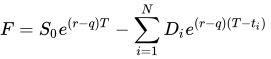
where

is the forward price to be paid at time
is the exponential function (used for calculating continuous compounding interests)
is the risk-free interest rate
is the convenience yield
is the spot price of the asset (i.e. what it would sell for at time 0)
is a dividend that is guaranteed to be paid at time where

Proof of the forward price formula

[edit]

The two questions here are what price the short position (the seller of the asset) should offer to maximize his gain, and what price the long position (the buyer of the asset) should accept to maximize his gain?

At the very least we know that both do not want to lose any money in the deal.

The short position knows as much as the long position knows: the short/long positions are both aware of any schemes that they could partake on to gain a profit given some forward price.

So of course they will have to settle on a fair price or else the transaction cannot occur.

An economic articulation would be:

(fair price + future value of asset's dividends) − spot price of asset = cost of capital
forward price = spot price − cost of carry

The future value of that asset's dividends (this could also be coupons from bonds, monthly rent from a house, fruit from a crop, etc.) is calculated using the risk-free force of interest. This is because we are in a risk-free situation (the whole point of the forward contract is to get rid of risk or to at least reduce it) so why would the owner of the asset take any chances? He would reinvest at the risk-free rate (i.e. U.S. T-bills which are considered risk-free). The spot price of the asset is simply the market value at the instant in time when the forward contract is entered into. So OUT − IN = NET GAIN and his net gain can only come from the opportunity cost of keeping the asset for that time period (he could have sold it and invested the money at the risk-free rate).

let

K = fair price
C = cost of capital
S = spot price of asset
F = future value of asset's dividend
I = present value of F (discounted using r )
r = risk-free interest rate compounded continuously
T = length of time from when the contract was entered into

Solving for fair price and substituting mathematics we get:

where:

(since where j is the effective rate of interest per time period of T )


where ci is the ith dividend paid at time t i.

Doing some reduction we end up with:

Notice that implicit in the above derivation is the assumption that the underlying can be traded. This assumption does not hold for certain kinds of forwards.

Forward versus futures prices

[edit]

There is a difference between forward and futures prices when interest rates are stochastic. This difference disappears when interest rates are deterministic.

In the language of stochastic processes, the forward price is a martingale under the forward measure, whereas the futures price is a martingale under the risk-neutral measure. The forward measure and the risk neutral measure are the same when interest rates are deterministic.

See also

[edit]

References

[edit]
Revisions and contributorsEdit on WikipediaRead on Wikipedia
from Grokipedia
In finance, the forward price is the predetermined price at which an asset, such as a commodity, currency, or security, agrees to be bought or sold on a specific future date through a forward contract, a customized over-the-counter agreement between two parties. This price is established at the contract's inception to ensure neither party has an initial advantage, reflecting the expected cost of holding the asset until delivery, known as the cost of carry. The forward price differs from the spot price—the current market price for immediate delivery—primarily due to adjustments for factors like interest rates, storage costs, dividends, or convenience yields associated with the underlying asset. For non-income-generating assets, it is typically calculated as the spot price compounded at the risk-free rate over the contract's term, using the formula F0=S0×(1+r)TF_0 = S_0 \times (1 + r)^T, where S0S_0 is the spot price, rr is the risk-free interest rate, and TT is the time to maturity in years; in continuous compounding, this becomes F0=S0erTF_0 = S_0 e^{rT}. For assets paying dividends or yields, the formula adjusts to F0=S0e(rq)TF_0 = S_0 e^{(r - q)T}, subtracting the dividend yield qq to account for income foregone by the seller. Forward prices play a critical role in hedging risks, such as price fluctuations in commodities or currencies, and in opportunities when misaligned with theoretical values. Unlike futures contracts traded on exchanges, forward contracts lack and daily settlement, exposing parties to risk but offering flexibility in terms and quantities.

Fundamentals

Definition

The forward price is the predetermined delivery price in a forward contract that ensures the contract has zero value at initiation, meaning neither party pays or receives anything upfront to enter the agreement. A itself is an over-the-counter (OTC) agreement between two parties to buy or sell an underlying asset—such as a , or —at this fixed forward price on a specified future settlement date. Forward contracts date back to ancient civilizations, with evidence from Greek and Roman times, and were widely used in medieval for trading to against price fluctuations in agricultural goods. Key properties include highly customized terms tailored to the specific needs of the counterparties, such as the asset quantity, delivery location, and timing; no initial cash exchange, as the zero-value initiation balances the obligations; and settlement solely at maturity, typically through physical delivery of the asset or cash equivalent based on the difference between the forward price and the prevailing market price. In contrast to price, which represents the current market price for immediate delivery of the asset, the forward price is set for deferred delivery and reflects expectations of future market conditions.

Role in Forward Contracts

A forward contract is a customized, over-the-counter agreement between two parties to buy or sell an underlying asset at a specified future date for a predetermined forward price, creating a binding obligation enforceable by law. These contracts lack the standardization and exchange oversight typical of other derivatives, with no initial margin requirements or daily settlements, allowing negotiations tailored to the parties' needs but increasing exposure to market fluctuations until maturity. The forward price, serving as the agreed delivery price, is set at the contract's inception to ensure its initial value is zero, thereby preventing opportunities that could arise from discrepancies with the current . This no-arbitrage condition facilitates the contract's primary uses: hedging, where participants lock in prices to protect against adverse movements in the underlying asset, or , where parties bet on price changes to generate profits without upfront capital commitment. Settlement occurs at the contract's maturity, either through physical delivery of the asset in exchange for the forward price or cash settlement, in which the parties exchange the monetary difference between the forward price and the spot price at that time. For cash-settled contracts, the long position receives payment if the spot price exceeds the forward price, or pays the shortfall otherwise, effectively transferring the gain or loss without asset transfer. The bilateral structure of forward contracts, without involvement of a clearinghouse, introduces substantial default risk, as one party may fail to fulfill its obligations, leading to potential financial losses for the other. This risk, absent in centrally cleared instruments, necessitates thorough credit evaluation and sometimes collateral arrangements to mitigate exposure.

Pricing Model

Core Formula

The forward price represents the delivery price agreed upon in a that ensures the contract has zero value at initiation, under idealized conditions. The core formula for the forward price FF of an asset with no income or carrying costs is given by F=SerT,F = S e^{rT}, where SS is the current spot price of the asset, rr is the continuously compounded risk-free , and TT is the time to maturity of the . This formula relies on key assumptions: interest rates are compounded continuously, the underlying asset pays no dividends or yields no , there are no storage or other carrying costs associated with the asset, and interest rates are deterministic (non-stochastic). The interprets the forward price as the spot price adjusted forward by the , reflecting the : holding the asset requires forgoing interest that could be earned on cash equivalents. For example, with a spot price S=100S = 100, r=0.05r = 0.05, and maturity T=1T = 1 year, the forward price is F=100×e0.05×1105.13F = 100 \times e^{0.05 \times 1} \approx 105.13.

Derivation

The derivation of the forward price for an asset that provides no relies on the no-arbitrage principle, which ensures that no riskless profits can be made in efficient markets by exploiting price discrepancies between the spot and forward markets. This principle underpins the pricing of forward s, where the forward price is set such that the has zero value at , meaning no upfront payment is required from either party. The derivation assumes frictionless markets with no transaction costs, no storage costs for the asset, and the ability of market participants to borrow and lend unlimited amounts at the continuously compounded risk-free rr. Let S0S_0 denote the current spot price of the asset, and TT the time to maturity of the forward contract. To derive the forward price F0F_0, consider the cash-and-carry , which involves simultaneously buying the asset in the spot market and selling it forward. In the cash-and-carry strategy, an arbitrageur borrows S0S_0 at the to purchase one unit of the asset at the spot price. The asset is held until maturity TT, at which point it is delivered under the forward , yielding F0F_0. The cost of carrying the position to maturity is the repayment of the borrowed amount with , which, under continuous , equals S0erTS_0 e^{rT}. If F0<S0erTF_0 < S_0 e^{rT}, the arbitrageur realizes a riskless profit of S0erTF0S_0 e^{rT} - F_0 at maturity, as the forward sale price exceeds the carry cost. Such an opportunity would attract arbitrageurs, driving up the forward price until equality holds. Conversely, the reverse cash-and-carry strategy applies if F0>S0erTF_0 > S_0 e^{rT}. Here, the arbitrageur shortsells one unit of the asset at S0S_0, lends the proceeds at the to earn S0erTS_0 e^{rT} at maturity, and enters a long forward position to repurchase the asset at F0F_0. This generates a riskless profit of F0S0erTF_0 - S_0 e^{rT} at maturity, prompting arbitrageurs to sell forward contracts and push the forward price down until no profit remains. To eliminate arbitrage opportunities in both directions, the forward price must satisfy F0=S0erTF_0 = S_0 e^{rT}, ensuring the contract's value is zero at initiation. The use of via the reflects the standard assumption in models for precise interest accrual over time.

Asset-Specific Adjustments

Equities and Dividends

When pricing forward contracts on equities that pay dividends, the is adjusted to account for the generated by the underlying asset. Unlike non-dividend-paying , where the forward price equals the spot price compounded at the , dividend payments provide a benefit to the holder of the physical asset but not to the long forward position, thereby lowering the forward price. This adjustment ensures no-arbitrage conditions hold by incorporating the of forgone s. The adjusted forward price formula for an equity with a continuous dividend yield qq is given by F=S×e(rq)T,F = S \times e^{(r - q)T}, where SS is the current spot price, rr is the continuously compounded risk-free interest rate, qq is the continuous dividend yield, and TT is the time to maturity in years. This formula modifies the baseline no-dividend case by subtracting the dividend yield from the interest rate in the exponent, reflecting the net cost of carry. The rationale stems from the fact that dividends reduce the , as the forward contract holder misses out on the income stream during the contract period, which would otherwise offset part of the financing of holding the asset. In a no-arbitrage framework, this is evident in the cash-and-carry strategy: an arbitrageur borrowing at rate rr to buy the receives dividends that can be reinvested at rr, effectively yielding a net carry of rqr - q; the forward price must equal the future value of the spot under this net rate to prevent risk-free profits. Similarly, in reverse cash-and-carry, shorting the incurs a borrowing adjusted for the missed dividends. This extension incorporates dividend reinvestment directly into the replication portfolio, maintaining equilibrium. For example, consider a with spot price S=100S = 100, r=5%r = 5\%, q=2%q = 2\%, and maturity T=1T = 1 year. The forward price is calculated as F=100×e(0.050.02)×1=100×e0.03F = 100 \times e^{(0.05 - 0.02) \times 1} = 100 \times e^{0.03}. To arrive at the solution, first compute the exponent 0.030.03, then e0.031.03045e^{0.03} \approx 1.03045 using the (e.g., via ex1+x+x22e^x \approx 1 + x + \frac{x^2}{2} for small xx, or standard ), yielding F103.04F \approx 103.04. This illustrates how the tempers the growth from interest alone.

Commodities and Carry Costs

In the pricing of forward contracts on commodities, the standard no-arbitrage model is extended to account for the unique characteristics of physical assets, particularly through the cost-of-carry framework. This model incorporates the costs associated with holding the , including financing expenses and storage, as well as any non-monetary benefits derived from possession. The total cost of carry thus comprises the risk-free rr for financing the purchase, the storage cost rate uu (which covers warehousing, , and handling), and offsets from the yy, representing the advantages of holding the physical asset over a financial claim. The captures the intangible benefits accruing to holders, such as the ability to avoid production disruptions or supply shortages during periods of scarcity, which are not replicable through forward contracts. For instance, in markets like or agricultural goods, low inventories can elevate the convenience yield as holders gain flexibility to meet immediate demand without relying on potentially volatile spot purchases. This yield effectively reduces the net cost of carry, often leading to forward prices that are lower than those implied by financing and storage alone, a observed in backwardation market structures. The adjusted forward price formula for commodities is given by: F=S×e(r+uy)TF = S \times e^{(r + u - y)T} where SS is the current spot price, TT is the time to maturity, and the exponential term reflects the continuous compounding of the net carry costs. To illustrate, consider crude oil with a spot price S=80S = 80, risk-free rate r=4%r = 4\%, storage cost rate u=1%u = 1\%, convenience yield y=0.5%y = 0.5\%, and maturity T=0.5T = 0.5 years. The net carry rate is r+uy=0.045r + u - y = 0.045, so the exponent is 0.045×0.5=0.02250.045 \times 0.5 = 0.0225, and e0.02251.0228e^{0.0225} \approx 1.0228. Thus, F80×1.0228=81.82F \approx 80 \times 1.0228 = 81.82, demonstrating a modest premium over the spot price due to the dominant influence of financing and storage costs over the convenience yield in this scenario.

Comparisons

With Futures Prices

Forward contracts are over-the-counter (OTC) agreements tailored to the specific needs of the counterparties, allowing customization in terms of asset , delivery date, and other terms, whereas futures contracts are standardized instruments traded on organized exchanges with fixed specifications for contract size, expiration dates, and settlement procedures. Unlike forwards, which settle only at maturity without interim payments, futures incorporate daily mark-to-market settlements, where gains and losses are realized and adjusted in margin accounts each day, reducing risk through the exchange's clearinghouse guarantee. In pricing, forward prices serve as a baseline calculated to eliminate opportunities based on the spot price, , and any carry costs, but futures prices may diverge from this under rates. When rates are deterministic, forward and futures prices converge exactly, as the daily settlements in futures do not introduce additional variability. However, with uncertain rates, futures prices incorporate a convexity adjustment; if futures prices are positively correlated with rates—as often occurs for equity or assets with positive in returns—futures prices tend to exceed forward prices due to the favorable reinvestment of marking-to-market gains during periods of rising rates. Conversely, negative , common in futures, results in futures prices below forward prices. The daily marking-to-market in futures introduces correlation risk between interim cash flows and prevailing interest rates, amplifying the pricing differential; for assets exhibiting positive , where price movements persist, this mechanism can lead to systematically higher futures prices as long positions benefit from compounding gains in high-rate environments. This effect stems from the nonlinear impact of volatility on the of futures payoffs compared to the linear settlement in forwards. The expansion of futures markets following the introduction of currency futures in 1972 and interest rate futures in 1975, amid the economic volatility including the end of the , provided standardized, liquid alternatives to OTC forwards, thereby diminishing reliance on forward contracts for hedging and speculation by offering reduced credit risk and enhanced tradability. By the mid-1980s, financial futures trading volumes surpassed traditional forwards, further solidifying exchanges as the primary venue for such .

With Spot Prices

The forward price represents the spot price of an underlying asset adjusted for the and associated carry costs, such as financing, storage, and insurance expenses. This adjustment typically results in the forward price exceeding the spot price, a market condition known as , which reflects the net cost of holding the asset until delivery. Conversely, if factors like convenience yields—benefits from immediate possession of the asset—outweigh carry costs, the forward price may fall below the spot price, creating backwardation. In market dynamics, the spot price directly influences price through opportunities that enforce alignment between the two. Traders can exploit discrepancies by buying in the spot market and selling forwards (cash-and-carry arbitrage) or vice versa (reverse cash-and-carry), ensuring the forward price remains tethered to the spot plus carry costs. However, forward prices also incorporate market participants' expectations of future spot prices, serving as indicators of anticipated supply-demand shifts over the contract period. Empirical observations in efficient markets confirm that the differential between forward and spot prices primarily mirrors the , rather than incorporating risk premiums, due to the no-arbitrage constraints that prevent sustained deviations. This relationship holds as long as market frictions like transaction costs remain low, allowing arbitrageurs to maintain pricing discipline.

References

Add your contribution
Related Hubs
User Avatar
No comments yet.