



Community hub
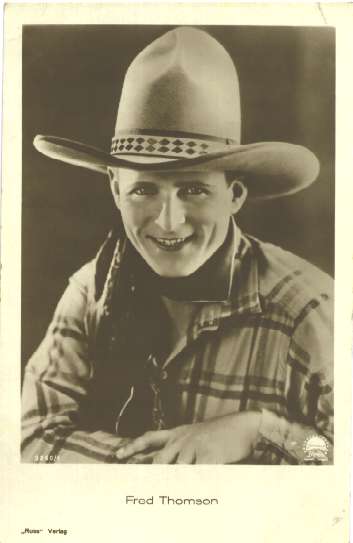
Fred Thomson
View on Wikipedia
Key Information


Frederick Clifton Thomson (February 26, 1890 – December 25, 1928) was an American silent film cowboy[1] who rivaled Tom Mix in popularity before dying at age 38 of tetanus.
Birth and athletic achievement
[edit]Born in Pasadena, California to Clara and Williell Thomson, he was the third of four sons. His father was a Presbyterian minister.[2] His brother Samuel Harrison Thomson also attended Princeton University and won the all-round athlete of America title for 1919.[3]
He attended the Princeton Theological Seminary from 1910–13 and he won the All-Around Champion title given out by the Amateur Athletic Union in 1910, 1911, and 1913.[4][5][6][7]
He married his college sweetheart, Gail Jepson and was ordained by the Presbytery of Los Angeles in September 1913. Three years later, Gail Jepson died of tuberculosis.[citation needed]
During World War I, Thomson served in the 143rd Field Artillery Regiment, known informally at the time as the Mary Pickford Regiment.[8] Thomson joined the 143rd in Arcadia, California as a U. S. Army chaplain. While playing football, he broke his leg. Movie star Mary Pickford visited the patients in the hospital ward with her friend, screenwriter Frances Marion. Thomson and Marion agreed to marry after the war was over.[9] The 143rd were sent to France in August 1918, but did not see any action before the armistice on November 11, 1918.[citation needed]
Movie career
[edit]Thomson and Marion were married on November 2, 1919, at the Memorial Baptist Church in New York City, with Pickford as maid of honor.[citation needed]
Initially interested in directing, he ended up acting in one of Frances' films Just Around the Corner (1921). The movie was a success. Next, he had a co-starring role in another Pickford movie, The Love Light (1921), which was also directed and written by Frances. In 1923, Thomson starred in his own action serial for Universal, The Eagle's Talons, in which he performed his own stunts.
Signed by Joseph P. Kennedy's studio Film Booking Offices of America, he made his debut for FBO in 1924's The Mask of Lopez. Thomson became a superstar at FBO: He was the No. 2 box office star for 1926 and 1927. His April 1925 contract paid him $10,000 a week (equivalent to approximately $183,586 in 2025 dollars[10]) and also gave Thomson his own independent production unit at the studio.[11]
In 1927, Kennedy—sensing that Thomson had reached the peak of his popularity and seeing a financial opportunity for FBO—arranged a four-picture deal with Paramount Pictures, one of the major Hollywood studios. The deal essentially ceded Thomson to the rival studio. For guaranteeing $75,000 in financing, Thomson would star in Paramount productions. In return, Paramount would return the $75,000 in financing plus an additional $100,000 and pay Thomson $15,000 a week, wiping Thomson's salary off of FBO's books.[12]
Paramount's exhibition circuit was more prestigious than FBO's, and its theaters, many located in larger cities, charged a premium for a ticket. In addition, Paramount boosted the price of a Thomson picture to cover the backend deal with FBO and Thomson's hefty salary. The new production arrangement meant that Thomson fans in rural theaters that were the core of FBO's audience often had to wait months for a chance to see a new Thomson picture, if it was even released to backwater theaters, or were forced to go to a larger city where the movie was playing on the Paramount circuit. Some critics found that a Thomson Western, which essentially were "B-pictures", were not suited for the high-end, more expensive theaters they were being shown in. As a result, the Thomson-Paramount Westerns proved not to be as profitable.[12]
Death
[edit]In early December 1928, Thomson stepped on a nail while working in his stables. Contracting tetanus, which his doctors initially misdiagnosed, he died in Los Angeles on Christmas Day 1928.[1] He was survived by his widow, screenwriter Frances Marion, and their children Richard Thomson (adopted) and Frederick C. Thomson.
Thomson was interred in Forest Lawn Memorial Park in Glendale, California (Whispering Pines, L-163 section). Pallbearers at his funeral included Harold Lloyd, Charles Farrell, Douglas Fairbanks, and George W. Hill. Honorary pallbearers included Buster Keaton and movie mogul Joseph M. Schenck.
Silver King
[edit]Silver King was a Palomino horse seventeen hands high. Al Rogell, who directed Thomson's first seven Western films, told about Silver King: "He did all of the work...everything in the early pictures—the mouth work, the jumps, the chases, the falls, quick stops—and could untie knots, lift bars, etc. He could wink one eye, nod his head yes or no, push a person with his head. Thomson trained him to do certain things and expected him to perform them."[13]
After Thomson's death, Silver King appeared in a series of three-reel Westerns from Imperial Studios, starring Wally Wales.[14]
Surviving film legacy
[edit]Thomson never appeared in a sound film lost or otherwise. He made a total of 30 films between 1921 and 1928. But complete prints of only 8 survive. Another 3 survive are partially lost which means 19 are completely lost. The films that survive in full are Just Around the Corner (1921), survives in the collection of the Library of Congress; The Love Light (1921), starring Mary Pickford, has been released on VHS and DVD; A Chapter in Her Life (1923), The Dangerous Coward (1924), Thundering Hoofs (1924) has been released on VHS, A Regular Scout (1926), and Kit Carson (1928). The films that are partially lost are Galloping Gallagher (1924), Lone Hand Saunders (1926), The Two-Gun Man (1926), and Silver Comes Through (1927).
In Thundering Hoofs, Thomson performs a dangerous jump from a moving stagecoach to one of the horses pulling the coach. He fell and suffered a compound fracture of his right thigh. Yakima Canutt completed the stunt. Production of the movie was delayed for weeks while Thomson recovered from his injury.
Filmography
[edit]- Just Around the Corner (1921) directed by Frances Marion
- The Love Light (1921)
- Penrod (1922)
- Oath-Bound (1922)
- The Eagle's Talons (1923)
- A Chapter in Her Life (1923)
- The Mask of Lopez (1924)
- North of Nevada (1924)
- Galloping Gallagher (1924)
- The Silent Stranger (1924)
- The Dangerous Coward (1924)
- The Fighting Sap (1924)
- Thundering Hoofs (1924)
- That Devil Quemado (1925)
- The Bandit's Baby (1925)
- The Wild Bull's Lair (1925)
- Ridin' the Wind (1925)
- All Around Frying Pan (1925)
- The Tough Guy (1926)
- Hands Across the Border (1926)
- The Two-Gun Man (1926)
- Lone Hand Saunders (1926)
- A Regular Scout (1926)
- Don Mike (1927)
- Silver Comes Through (1927)
- Arizona Nights (1927)
- Jesse James (1927)
- The Pioneer Scout (1928)
- The Sunset Legion (1928)
- Kit Carson (1928)
See also
[edit]Notes
[edit]- ^ a b "Fred C. Thomson, Screen Actor, Dies. Rival of Tom Mix in Western Roles. Was a Minister. Star Athlete While at Princeton". The New York Times. Associated Press. December 27, 1928. Retrieved July 24, 2009.
- ^ Zarnowski (2005), p. 134
- ^ "Princeton Athlete, Brother of Former Champion, Scores 6,133 Points". The New York Times. September 21, 1919. Retrieved July 24, 2009.
- ^ Wyatt (1988), p. 23
- ^ "Thomson All-Round Champion Athlete. Defeats Fifteen Picked Men in Amateur Athletic Union Contest at Chicago" (PDF). The New York Times. August 14, 1910. Retrieved July 23, 2009.
- ^ "F. C. Thomson The Leading Amateur". Boston Globe. August 14, 1910. Archived from the original on October 21, 2012. Retrieved July 23, 2009.
- ^ Ellery Harding Clark (1920). Track athletics up to date. Duffield.
June 5, 1913; American Amateur Record, 7499 points, F. C. Thomson
- ^ Wyatt (1988), p. 38
- ^ Wyatt (1988), p. 39
- ^ 1634–1699: McCusker, J. J. (1997). How Much Is That in Real Money? A Historical Price Index for Use as a Deflator of Money Values in the Economy of the United States: Addenda et Corrigenda (PDF). American Antiquarian Society. 1700–1799: McCusker, J. J. (1992). How Much Is That in Real Money? A Historical Price Index for Use as a Deflator of Money Values in the Economy of the United States (PDF). American Antiquarian Society. 1800–present: Federal Reserve Bank of Minneapolis. "Consumer Price Index (estimate) 1800–". Retrieved February 29, 2024.
- ^ Beauchamp (1998), p. 168
- ^ a b Beauchamp (2010), pp. 164–165
- ^ Wyatt (1988), p. 52
- ^ Wyatt (1988), p. 110
References
[edit]- Beauchamp, Cari (1998). Without Lying Down: Frances Marion and the Powerful Women of Early Hollywood. Berkeley, Los Angeles, and London: University of California Press. ISBN 0-520-21492-7.
- Beauchamp, Cari (2010). Joseph P. Kennedy Presents: His Hollywood Years. New York: Knopf. ISBN 978-1400040001.
- Wyatt, Edgar M. (1988). More Than a Cowboy: the Life and Times of Fred Thomson and Silver King. Wyatt Classics.
- Zarnowski, Frank (2005). All-Around Men. Scarecrow Press. ISBN 0-8108-5423-6.
External links
[edit]

- Fred Thomson at IMDb
- Fred Thomson at SilentEra
- Fred Thomson at 'Readers of The Purple Sage'
- "Fred Thomson". Find a Grave. Retrieved 2008-03-19.
- Fred Thomson "Vanity Fair" article at http://www.vanityfair.com/politics/features/2002/04/joekennedy200204
- Fred Thomson at Virtual History
| International | |
|---|---|
| National | |
| Other | |

Fred Thomson
View on GrokipediaEarly Life
Birth and Family Background
Frederick Clifton Thomson was born on February 26, 1890, in Pasadena, Los Angeles County, California.[4][5] He was the third of four sons born to Clara and Williell Thomson; his older brothers were Henry Lyon and Williel II, while his younger brother was Samuel Harrison.[4][5] Williell Thomson served as a Presbyterian minister, and the family settled in Pasadena.[6] Growing up in a ministerial household, Thomson was immersed in an environment that emphasized Presbyterian values, community service, and moral education, with his father's profession providing a direct model of dedicated religious and social commitment.[7] This background profoundly influenced his early development, fostering a strong ethical foundation that later led him to pursue ordination as a Presbyterian minister himself.[7]Education and Athletic Achievements
Thomson initially attended Occidental College in Los Angeles, where he excelled as a multi-sport athlete from 1906 to 1910, earning All-American honors in football while lettering in baseball and track and field.[8] Following his graduation, he enrolled at the Princeton Theological Seminary in 1910 to pursue studies in divinity, completing his coursework there over the next three years. Influenced by his father's career as a Presbyterian minister, Thomson balanced his theological training with continued athletic involvement, including playing football for the seminary's team.[3] During this period, Thomson's athletic prowess reached its peak in amateur competitions, as he captured the Amateur Athletic Union's All-Around Championship title in 1910, 1911, and 1913, defeating top competitors in a grueling multi-event format held in Chicago and other venues. This prestigious award recognized overall excellence across track and field disciplines, such as sprints, high hurdles, pole vault, high jump, shot put, discus throw, javelin, and distance runs, where Thomson amassed scores like 7499 points in the 1913 national meet. His victories underscored a rare versatility, blending speed, strength, and endurance that he developed through rigorous training at Occidental and Princeton.[9] These accomplishments not only established Thomson as one of America's premier amateur athletes but also built the robust physical foundation that foreshadowed his later on-screen athleticism in demanding roles.[3]Personal Life
Marriages and Family
Thomson married his college sweetheart, Gail Dubois Jepson, on September 8, 1913.[10] The couple had no children during their brief marriage. Jepson died of tuberculosis on September 20, 1916, leaving Thomson widowed at age 26 and profoundly impacting his early adulthood with personal tragedy.[10][5] On November 2, 1919, Thomson married Frances Marion, a pioneering screenwriter known for her work on films starring Mary Pickford and other major talents.[2] Marion's expertise in crafting narratives for silent cinema complemented Thomson's transition into acting, fostering a partnership that blended their professional lives; she wrote and directed his acting debut in The Love Light (1921) and later scripted some of his films under the pseudonym Frank M. Clifton.[11] Thomson and Marion had two sons: Richard Gordon Thomson, whom they adopted, and Frederick Clifton Thomson Jr., born in December 1926.[10][2] Their family dynamics centered on this small household, with the couple prioritizing their relationship and raising the boys in a creative environment shaped by their film industry involvement. No additional children were born to the couple.[10]Military Service
Fred Thomson, an ordained Presbyterian minister, enlisted in the U.S. Army shortly after the United States entered World War I in April 1917, volunteering to serve as a chaplain.[4] He was assigned to the 143rd Field Artillery Regiment of the 40th Division, a unit composed primarily of California Army National Guard members, which earned the informal nickname "Mary Pickford Regiment" after the actress became its honorary colonel.[12][13] Thomson's service began with training at Camp Kearny near San Diego, California, where he joined the regiment in Arcadia later in 1917.[14] During this period, he sustained a broken leg while playing football, an injury that sidelined him temporarily but did not end his duties.[15] In August 1918, he was deployed to France as part of the American Expeditionary Forces, arriving after the major Allied offensives had concluded and thus avoiding direct combat exposure.[16] His service extended through the Armistice on November 11, 1918, and into early 1919, during which he remained with the unit in France until its return to the United States.[12] As chaplain, Thomson provided spiritual guidance and moral support to the troops.[15] Although he did not participate in frontline artillery operations due to the timing of his arrival, he contributed to the regiment's cohesion by emphasizing discipline and resilience, drawing on his ministerial background to address the psychological strains of deployment.[15] In the postwar period, Thomson competed in the 1919 Inter-Allied Games in Paris, winning the hand grenade throwing event with a distance of 245 feet 11 inches, showcasing the physical prowess he maintained despite his injury.[15] Upon discharge in 1919, Thomson's military experience profoundly shaped his personal discipline, instilling a structured approach that carried over into his athletic training and later professional endeavors, while he married screenwriter Frances Marion that November, a connection formed during his recovery from the leg injury.[4][15]Film Career
Entry into Film and Early Roles
Thomson, a former Presbyterian minister and accomplished athlete who had earned honors at Occidental College and Princeton Theological Seminary, transitioned to the film industry following his marriage to screenwriter and director Frances Marion in 1919.[17] This union provided the personal stability that facilitated his career shift from religious service and athletics to entertainment, where Marion's connections in Hollywood offered initial opportunities.[16] Prior to his professional debut, Thomson had no documented stage or amateur film experience, though his interest in directing emerged through Marion's projects.[18] Thomson's film debut came in the 1921 silent drama The Love Light, directed by Marion, in which he portrayed Joseph Muller, a German sailor stranded on the Italian coast during World War I and initially suspected as a spy.[19] The role capitalized on his imposing physical presence and allowed him to demonstrate dramatic range opposite Mary Pickford, marking his entry into acting amid the wartime-themed narrative. Later that year, he appeared in Marion's second directorial effort, Just Around the Corner, playing "The Real Man," a benevolent stranger who intervenes to support a struggling widow and her children in a heartwarming family drama.[20] The film received positive critical reception for its emotional depth and Marion's direction, with reviewers praising her ability to craft uplifting stories, and it achieved commercial success as a Paramount release.[21] In his subsequent early roles, such as the adventurous youth in Penrod (1922) and the determined protagonist in the short Oath-Bound (1922), Thomson honed a screen persona rooted in his real-life athletic prowess.[2] These parts often involved physical demands, where his background as a champion sprinter and football player enabled authentic performances in action sequences without relying on stunt doubles, foreshadowing the rugged cowboy archetype he would fully embody in later westerns.[14] This natural athleticism distinguished his early work, emphasizing genuine vigor and reliability in dynamic scenes that appealed to audiences seeking relatable heroism.[16]Rise to Stardom and Major Productions
Thomson's ascent to stardom began with his starring role in the 1923 Universal serial The Eagle's Talons, directed by Duke Worne, where he portrayed the heroic lead in a tale of international intrigue involving Wall Street schemes and global adventures, performing his own demanding stunts.[22] This production highlighted his physical prowess and charisma, serving as a pivotal breakthrough that elevated him from supporting roles to leading man status and directly led to his signing with Film Booking Offices of America (FBO) in 1924.[16] Under his FBO contract, renewed in April 1925 at $10,000 per week—equivalent to one of the highest salaries for a western star at the time—Thomson rapidly became the studio's premier attraction.[3] By 1926 and 1927, he ranked as the number-two box-office draw among all male stars, trailing only top competitors like Tom Mix and Hoot Gibson in popularity among audiences craving authentic cowboy tales.[16] His films consistently drew large crowds, capitalizing on his reputation for genuine athleticism and wholesome heroism, which resonated deeply in the mid-1920s western genre boom. Key productions during this peak era included Thundering Hoofs (1924), directed by Albert S. Rogell, a fast-paced western in which Thomson's character, Dave Taggert, battles border bandits to safeguard a vulnerable family, emphasizing themes of moral justice, daring rescues, and masterful horsemanship through thrilling action sequences.[23] Subsequent FBO releases like The Mask of Lopez (1924) and North of Nevada (1924) built on these motifs, portraying Thomson as an upright frontiersman who triumphs over villains via ingenuity and physical bravery, without relying on excessive violence. These films not only showcased his equestrian skills and stunt work but also reinforced his image as a clean-cut, Presbyterian-influenced hero, contributing to his widespread appeal and box-office dominance.[3]Collaborations and Studio Transitions
Thomson's most significant professional collaboration was with his wife, screenwriter Frances Marion, who contributed extensively to his films by authoring scripts under the pseudonym Frank M. Clifton.[11] Marion's involvement helped shape Thomson's westerns, leveraging her expertise to craft narratives that highlighted his strengths as a leading man and rider.[24] This partnership extended beyond early works like The Love Light (1921), which she also directed, to multiple later productions in the mid-1920s, enhancing the quality and appeal of his output during his peak popularity.[25] In 1927, Thomson secured a lucrative four-picture contract with Paramount Pictures, orchestrated by Joseph P. Kennedy, head of Film Booking Offices of America (FBO), his prior studio.[26] This deal, which paid Thomson $15,000 per week and provided substantial financing, was negotiated using his status as one of Hollywood's top box-office draws, with earnings exceeding $10,000 weekly from prior contracts serving as leverage.[27] Under the arrangement, Paramount advanced $75,000 per film plus an additional $100,000, effectively shifting production costs away from FBO while allowing Kennedy to profit from distribution fees.[3] The transition from FBO to Paramount elevated the scale of Thomson's productions, enabling larger budgets and wider distribution for films such as Jesse James (1927), The Pioneer Scout (1928), and The Sunset Legion (1928).[3] However, it introduced financial tensions, as Kennedy's cut diminished profitability for Paramount and strained relations, leading FBO to prioritize other stars like Tom Mix.[27] Ultimately, the move resulted in only three completed pictures, with the fourth unfulfilled due to production interruptions, limiting the anticipated expansion of Thomson's output at the major studio.[26]Later Years and Legacy
Death and Circumstances
In early December 1928, while working at his stables, Fred Thomson stepped on a rusty nail, which pierced his foot and introduced the Clostridium tetani bacteria responsible for tetanus.[10] The infection initially went unrecognized, as his symptoms—severe pain and muscle stiffness—were misdiagnosed by physicians as complications from gallstones, leading to an unnecessary surgical intervention that further weakened him.[18] Tetanus, often called "lockjaw," causes progressive neuromuscular dysfunction through a potent neurotoxin; by the late 1920s, the primary treatment was equine-derived tetanus antitoxin to neutralize unbound toxin, but administration required early diagnosis, and overall case fatality rates exceeded 50% due to the absence of antibiotics, mechanical ventilation, and modern wound care protocols. Thomson's condition deteriorated rapidly despite these limited interventions, and he died on December 25, 1928, at his Los Angeles home, at the age of 38, during what was the peak of his stardom as a Western film leading man.[10] Thomson's passing on Christmas Day elicited widespread grief in Hollywood and among his devoted fans, who viewed him as an exemplar of clean-living heroism in cinema.[17] His funeral services took place three days later, on December 28, 1928, at the Beverly Hills Universalist Church, attended by a host of industry luminaries. Active pallbearers included prominent actors Harold Lloyd, Charles Farrell, and Douglas Fairbanks, while honorary pallbearers featured Buster Keaton, Joseph Schenck, and other studio executives, underscoring Thomson's respected status within the film community.[28] Thomson's will left his estate to his mother and three-year-old son, Fred Jr., while bequeathing only "love and affection" to his widow at her request.[17] Following the services, Thomson was interred at Forest Lawn Memorial Park in Glendale, California, in the Whispering Pines section (plot L-163), a site chosen for its serene landscape befitting his wholesome public image.[4] The immediate aftermath saw tributes in newspapers highlighting the tragedy of his untimely death, with reports emphasizing the irony of a robust athlete succumbing to a preventable barnyard accident in an era before widespread tetanus toxoid vaccination.[29]Surviving Films and Cultural Impact
Of the approximately thirty silent films starring Fred Thomson, only three are known to have survived the widespread losses typical of the era, when nitrate-based prints deteriorated or were discarded en masse. These include Just Around the Corner (1921), directed by and co-starring his wife Frances Marion, which is preserved in the collection of the Library of Congress. The Love Light (1921), in which Thomson portrayed a German spy opposite Mary Pickford, underwent photochemical restoration in 1988 using original prints and negatives from the Mary Pickford Foundation, followed by a 4K digital scan and restoration in 2021 by the UCLA Film & Television Archive and the Foundation, including color grading and a new orchestral score.[30] Thundering Hoofs (1924), a Western adventure directed by Albert S. Rogell, survives due to its early licensing for 16mm reduction prints, which allowed for later transfers to more stable formats.[31] These surviving works remain accessible primarily through film archives and specialized screenings rather than widespread commercial releases. Just Around the Corner is available for study via the Library of Congress's preservation efforts, though public viewings are limited to archival projections or digital access for researchers. The Love Light's restored version premiered publicly at the UCLA Festival of Preservation and was screened again on October 6, 2024, as part of Silent Movie Day, highlighting ongoing institutional commitment to early cinema beyond the VHS and DVD eras.[30] Thundering Hoofs has been issued on DVD compilations of silent Westerns, making it the most readily available of Thomson's output for modern audiences, often paired with live accompaniment at festivals.[32] The scarcity of these films underscores the broader crisis in silent film preservation, where an estimated 75% of U.S. silent features are lost, exacerbated in Thomson's case by theater owners withdrawing his pictures from circulation after his 1928 death out of deference to his memory.[16] Thomson's cultural impact on the Western genre was significant during his lifetime, as he emerged as a direct rival to Tom Mix, often billed alongside him as one of the era's top cowboy stars for his athletic prowess, moral uprightness, and light comedic touch in action-oriented stories.[17] This rivalry peaked in the mid-1920s, with Thomson's films drawing comparable box-office success through wholesome narratives that emphasized heroism and family values, influencing the archetype of the clean-cut cowboy hero in subsequent silent and early sound Westerns.[12] His emphasis on authentic horsemanship and ethical storytelling contributed to the genre's evolution from raw adventure to more character-driven tales, paving the way for later actors like Buck Jones and Ken Maynard who adopted similar blends of physicality and integrity.[3] In modern recognition, Thomson's legacy endures through renewed scholarly and archival interest in silent Westerns, evidenced by detailed biographies and restorations that position him as a key figure in pre-talkie cinema.[28] As of 2025, efforts like the UCLA restoration of The Love Light reflect growing appreciation for his contributions, with his films occasionally featured in academic discussions of gender dynamics in early Hollywood—such as Marion's directorial role—and the moral underpinnings of the Western form.[30] Despite the preservation gaps, these initiatives ensure Thomson's influence persists in film studies, underscoring his role in shaping the enduring appeal of the cowboy icon.[33]Associates and Assets
Silver King Horse
Silver King was a white Palomino stallion standing 17 hands high, renowned as "the horse with personality" for his expressive behaviors and stunt capabilities in silent Western films.[34] Acquired by Fred Thomson in New York, the horse was personally trained by the actor to perform tricks such as winking, nodding or shaking his head, lifting bars, undoing knots, and jumping from moving railway carriages, often with stunt assistance from Yakima Canutt.[34] These skills enhanced Thomson's portrayal of authentic cowboy roles, drawing on his own athletic background in track and field to develop the horse's performance abilities.[7] In Thomson's films produced by Film Booking Offices (FBO) and later Paramount Pictures, Silver King appeared as a co-star in numerous B-grade Westerns, symbolizing the rugged authenticity of the genre through synchronized riding sequences and dramatic rescues.[35] The horse's intelligence and reliability made him a standout, often billed alongside Thomson in promotional materials as his "remarkable" or "wonderful trick horse."[36][37] Following Thomson's death in 1928, Silver King continued his film career independently, starring in a series of three-reel Westerns for Imperial Pictures through the 1930s, primarily alongside actor Wally Wales (also known as Hal Taliaferro).[35] Notable appearances included West of the Law (1934), The Lone Rider (1934), Pals of the West (1934), and Ridin' the Lone Trail (1937) with Bob Steele, where he reprised his role as a reliable mount in low-budget productions until retiring around 1937.[35] No records indicate significant breeding programs or further historical pursuits for the horse after his screen career.[34]Filmography Overview
Fred Thomson's filmography spans from 1921 to 1928, encompassing approximately 28 credited roles in silent films, predominantly western features and a handful of serials, with no known shorts.[38] His work transitioned across studios, beginning with United Artists and Universal, then FBO (Film Booking Offices of America), Pathé, and finally Paramount, where he starred in high-profile productions that elevated his status as a leading cowboy actor.[10] Notable among these were box-office successes like Lone Hand Saunders (1926) and The Two-Gun Man (1926), which contributed to his ranking as the second most popular male star in 1926–1927.[39] The following table provides a chronological overview of his key credited films, focusing on features and serials, with directors, studios, and roles where documented in film databases. Roles were typically leads as heroic cowboys or ranchers, often alongside his horse Silver King.| Year | Title | Type | Role | Director | Studio |
|---|---|---|---|---|---|
| 1921 | Just Around the Corner | Feature | Bit part | Frances Marion | United Artists |
| 1921 | The Love Light | Feature | Joseph | Frances Marion | United Artists |
| 1922 | Penrod | Feature | Minor role | J. A. Howe | United Artists |
| 1922 | Oath-Bound | Feature | Minor role | Charles Swickard | Universal |
| 1923 | The Eagle's Talons | Serial (15 chapters) | Cal Reynolds | Henry McRae | Universal |
| 1923 | A Chapter in Her Life | Feature | Stephen Ainslee | Frank Borzage | Goldwyn |
| 1923 | The Mask of Lopez | Feature | Jim Mason | Albert Rogell | Universal |
| 1924 | North of Nevada | Feature | Seaton | Harry S. Webb | FBO |
| 1924 | The Lone Hand Texan | Feature | Jim Mason | Albert Rogell | FBO |
| 1924 | Thundering Hoofs | Feature | Dave Marshall | Albert Rogell | FBO |
| 1924 | The Fighting Sap | Feature | Craig Norris | Harry S. Webb | FBO |
| 1924 | The Masked Rider | Serial (10 chapters) | Jim Day | William Craft | Universal |
| 1925 | The Blazing Trail | Feature | Fred | Robert Thornby | FBO |
| 1925 | Ridin' the Wind | Feature | Ben McClure | Del Andrews | FBO |
| 1925 | The Dangerous Coward | Feature | Bob Trent | Albert Rogell | FBO |
| 1925 | The Wild Horse Stampede | Feature | Jim Douglas | J. P. McGowan | FBO |
| 1926 | The Bandit Buster | Feature | Tom Kirby | J. P. McGowan | FBO |
| 1926 | The Two-Gun Man | Feature | Jim Day | J. P. McGowan | FBO |
| 1926 | The Pioneer Trail | Feature | John Sheridan | J. P. McGowan | FBO |
| 1926 | The Fighting Peacemaker | Feature | Jim Craig | J. P. McGowan | FBO |
| 1926 | Hands Across the Border | Feature | Ted Drake | J. P. McGowan | FBO |
| 1926 | A Regular Scout | Feature | Fred Blake | J. P. McGowan | FBO |
| 1926 | Lone Hand Saunders | Feature | Saunders | George B. Seitz | FBO |
| 1927 | Silver Comes Through | Feature | Jim Bailey | Lloyd Ingraham | FBO |
| 1927 | Jesse James | Feature | Jesse James | Lloyd Ingraham | Paramount |
| 1927 | Don Mike | Feature | Don Mike | Lloyd Ingraham | FBO |
| 1927 | Arizona Nights | Feature | Tex | Lloyd Ingraham | FBO |
| 1928 | Kit Carson | Feature | Kit Carson | Lloyd B. Davis | Paramount |
| 1928 | The Sunset Legion | Feature | Jean Rosen / Masked Rider | Alfred L. Werker | Paramount |
| 1928 | The Pioneer Scout | Feature | Ned Rowland | Bert Lytell | Paramount |