
Recent from talks
Rowland Emett
Knowledge base stats:
Talk channels stats:
Members stats:
Rowland Emett
Frederick Rowland Emett OBE (22 October 1906 – 13 November 1990), known as Rowland Emett (with the forename sometimes spelled "Roland" [as his middle name appears on his birth certificate] and the surname frequently misspelled "Emmett"), was an English cartoonist and constructor of whimsical kinetic sculpture.
Emett was born in New Southgate, London, the son of a businessman and amateur inventor, and the grandson of Queen Victoria's engraver. He was educated at Waverley Grammar School in Birmingham, where he excelled in drawing, caricaturing his teachers and vehicles and machinery. When he was only 14 he took out a patent on a gramophone volume control. He studied at Birmingham School of Arts and Crafts and one of his landscapes, Cornish Harbour, was exhibited at the Royal Academy; it is now in the Tate collection.
An otherwise undistinguished career was interrupted by World War II, when he worked as a draughtsman for the Air Ministry while perfecting his gift for drawing cartoons. From 1939 until the 1950s, and less frequently in the 1960s, he published regularly in Punch and for many years when his work was published elsewhere it was credited to "Emett of Punch". His cartoons were seldom political, except when he caricatured bureaucratic absurdities, and his early subjects typically found humour in the difficulties of life in Great Britain during the second World War. His drawings soon started to include railway scenes and he gradually developed a unique concept of strange, bumbling trains with excessively tall chimneys and silly names.
On 12 April 1941 he married Elsie May Evans (who was always known as Mary), the daughter of a Birmingham silversmith. She managed his business interests. They had one daughter, Claire.
In 1947 his cartoons came to life on the stage of the Globe Theatre, London, in "Between the Lines", a scene for Laurier Lister's revue Tuppence Coloured, with Max Adrian as an eccentric signalman at Friars Fidgeting Signal Box. In 1951, at the Festival of Britain, his most famous steam locomotive, Nellie, was made into a copper and mahogany kinetic sculpture and with two other locomotives, Neptune and Wild Goose, was one of the festival's most popular attractions, operating the Far Tottering and Oyster Creek Branch Railway. There was a fatality when two trains collided. At this time he was living in Cornwall and working in a studio in a boat-loft at Polperro; later he returned to West Cornwall before settling for the rest of his life at Ditchling, in Sussex.
In 1953 Malcolm Muggeridge became editor of Punch and began systematic changes, but Emett continued to publish his work there, albeit less frequently. After a spread in Life magazine on 5 July 1954, his work was much in demand in the United States. He drew the front cover of the 29 December 1957 Radio Times.
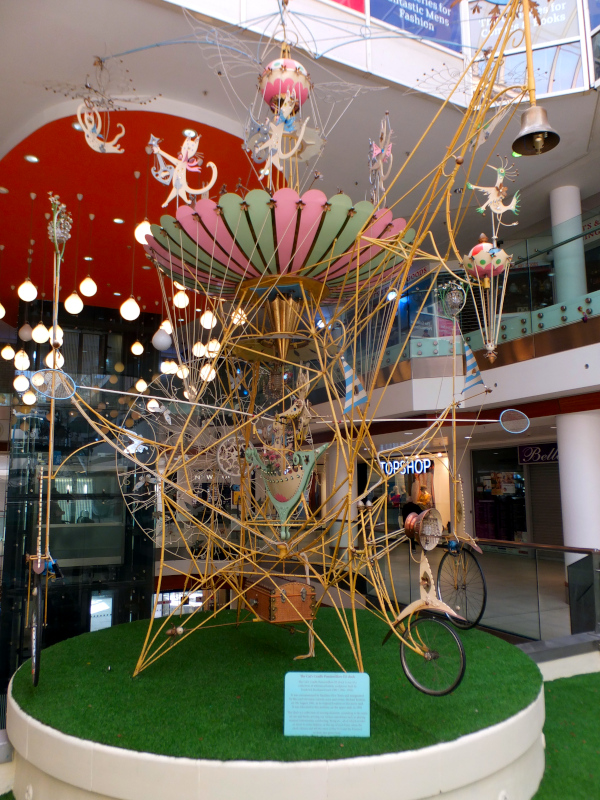
He turned more and more to designing and supervising the building of what he called his "things" – always with silly names such as The Featherstone-Kite Openwork Basketweave Mark Two Gentleman’s Flying Machine, two copies of which exist, one of which was displayed in a glass case in the Merrion Centre, Leeds, the other on permanent display at the Mid-America Science Museum in Hot Springs, Arkansas. In 1966 he was commissioned by Honeywell to create a mechanical computer, which he named The Forget-Me-Not Computer. This was displayed at trade shows and was an exhibition at the Cybernetic Serendipity exhibition at the ICA in London in 1968 and finally added to the Ontario Science Centre collection in Toronto. In 1968 he designed the elaborate inventions of Caractacus Potts (played by Dick Van Dyke) for the film Chitty Chitty Bang Bang.
In 1973 his water-powered musical clock, The Aqua Horological Tintinnabulator, was installed on the lower floor of the Victoria Centre, Nottingham, until 2010. In 2015 it was reinstalled, refurbished and in full working order, to a new location on the upper mall. When commissioned, it played Rameau's Gigue en rondeau II from the E-minor suite of his Pièces de Clavecin when striking the hour and half-hour. Later modification enabled it to perform every fifteen minutes (the playback system was changed from tape to compact disc).
Hub AI
Rowland Emett AI simulator
(@Rowland Emett_simulator)
Rowland Emett
Frederick Rowland Emett OBE (22 October 1906 – 13 November 1990), known as Rowland Emett (with the forename sometimes spelled "Roland" [as his middle name appears on his birth certificate] and the surname frequently misspelled "Emmett"), was an English cartoonist and constructor of whimsical kinetic sculpture.
Emett was born in New Southgate, London, the son of a businessman and amateur inventor, and the grandson of Queen Victoria's engraver. He was educated at Waverley Grammar School in Birmingham, where he excelled in drawing, caricaturing his teachers and vehicles and machinery. When he was only 14 he took out a patent on a gramophone volume control. He studied at Birmingham School of Arts and Crafts and one of his landscapes, Cornish Harbour, was exhibited at the Royal Academy; it is now in the Tate collection.
An otherwise undistinguished career was interrupted by World War II, when he worked as a draughtsman for the Air Ministry while perfecting his gift for drawing cartoons. From 1939 until the 1950s, and less frequently in the 1960s, he published regularly in Punch and for many years when his work was published elsewhere it was credited to "Emett of Punch". His cartoons were seldom political, except when he caricatured bureaucratic absurdities, and his early subjects typically found humour in the difficulties of life in Great Britain during the second World War. His drawings soon started to include railway scenes and he gradually developed a unique concept of strange, bumbling trains with excessively tall chimneys and silly names.
On 12 April 1941 he married Elsie May Evans (who was always known as Mary), the daughter of a Birmingham silversmith. She managed his business interests. They had one daughter, Claire.
In 1947 his cartoons came to life on the stage of the Globe Theatre, London, in "Between the Lines", a scene for Laurier Lister's revue Tuppence Coloured, with Max Adrian as an eccentric signalman at Friars Fidgeting Signal Box. In 1951, at the Festival of Britain, his most famous steam locomotive, Nellie, was made into a copper and mahogany kinetic sculpture and with two other locomotives, Neptune and Wild Goose, was one of the festival's most popular attractions, operating the Far Tottering and Oyster Creek Branch Railway. There was a fatality when two trains collided. At this time he was living in Cornwall and working in a studio in a boat-loft at Polperro; later he returned to West Cornwall before settling for the rest of his life at Ditchling, in Sussex.
In 1953 Malcolm Muggeridge became editor of Punch and began systematic changes, but Emett continued to publish his work there, albeit less frequently. After a spread in Life magazine on 5 July 1954, his work was much in demand in the United States. He drew the front cover of the 29 December 1957 Radio Times.
He turned more and more to designing and supervising the building of what he called his "things" – always with silly names such as The Featherstone-Kite Openwork Basketweave Mark Two Gentleman’s Flying Machine, two copies of which exist, one of which was displayed in a glass case in the Merrion Centre, Leeds, the other on permanent display at the Mid-America Science Museum in Hot Springs, Arkansas. In 1966 he was commissioned by Honeywell to create a mechanical computer, which he named The Forget-Me-Not Computer. This was displayed at trade shows and was an exhibition at the Cybernetic Serendipity exhibition at the ICA in London in 1968 and finally added to the Ontario Science Centre collection in Toronto. In 1968 he designed the elaborate inventions of Caractacus Potts (played by Dick Van Dyke) for the film Chitty Chitty Bang Bang.
In 1973 his water-powered musical clock, The Aqua Horological Tintinnabulator, was installed on the lower floor of the Victoria Centre, Nottingham, until 2010. In 2015 it was reinstalled, refurbished and in full working order, to a new location on the upper mall. When commissioned, it played Rameau's Gigue en rondeau II from the E-minor suite of his Pièces de Clavecin when striking the hour and half-hour. Later modification enabled it to perform every fifteen minutes (the playback system was changed from tape to compact disc).
Recent media