Hubbry Logo
Free spectral rangeFree spectral rangeMain
Open search
Free spectral range
Community hub
Free spectral range
logo
7 pages, 0 posts
0 subscribers
Be the first to start a discussion here.
Free spectral range
Free spectral range
from Wikipedia

Free spectral range (FSR) is the spacing in optical frequency or wavelength between two successive reflected or transmitted optical intensity maxima or minima of an interferometer or diffractive optical element.[1]

The FSR is not always represented by or , but instead is sometimes represented by just the letters FSR. The reason is that these different terms often refer to the bandwidth or linewidth of an emitted source respectively.

In general

[edit]

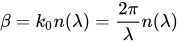
The free spectral range (FSR) of a cavity in general is given by [2]

or, equivalently,

These expressions can be derived from the resonance condition by expanding in Taylor series. Here, is the wavevector of the light inside the cavity, and are the wavevector and wavelength in vacuum, is the refractive index of the cavity and is the round trip length of the cavity (notice that for a standing-wave cavity, is equal to twice the physical length of the cavity).

Given that , the FSR (in wavelength) is given by

being is the group index of the media within the cavity. or, equivalently,

where is the speed of light in vacuum.

If the dispersion of the material is negligible, i.e. , then the two expressions above reduce to

and

A simple intuitive interpretation of the FSR is that it is the inverse of the roundtrip time :

In wavelength, the FSR is given by

where is the vacuum wavelength of light. For a linear cavity, such as the Fabry-Pérot interferometer[3] discussed below, , where is the distance travelled by light in one roundtrip around the closed cavity, and is the length of the cavity.

Diffraction gratings

[edit]

The free spectral range of a diffraction grating is the largest wavelength range for a given order that does not overlap the same range in an adjacent order. If the (m + 1)-th order of and m-th order of lie at the same angle, then

Fabry–Pérot interferometer

[edit]

In a Fabry–Pérot interferometer[3] or etalon, the wavelength separation between adjacent transmission peaks is called the free spectral range of the etalon and is given by

where λ0 is the central wavelength of the nearest transmission peak, n is the index of refraction of the cavity medium, is the angle of incidence, and is the thickness of the cavity. More often FSR is quoted in frequency, rather than wavelength units:

The transmission of an etalon as a function of wavelength. A high-finesse etalon (red line) shows sharper peaks and lower transmission minima than a low-finesse etalon (blue). The free spectral range is Δλ (shown above the graph).

The FSR is related to the full-width half-maximum δλ of any one transmission band by a quantity known as the finesse:

where is the coefficient of finesse, and R is the reflectivity of the mirrors.

This is commonly approximated (for R > 0.5) by

References

[edit]
Revisions and contributorsEdit on WikipediaRead on Wikipedia
from Grokipedia
The free spectral range (FSR), also known as the mode spacing, is the frequency separation between consecutive resonant modes in an or the interval between adjacent interference maxima in a Fabry-Pérot interferometer, representing the range over which the device can uniquely resolve spectral features without ambiguity. In a Fabry-Pérot cavity consisting of two parallel mirrors separated by a distance LL, the FSR in frequency Δν\Delta \nu is given by Δν=c2nL\Delta \nu = \frac{c}{2nL}, where cc is the speed of light in vacuum and nn is the refractive index of the medium between the mirrors (often n=1n=1 for air). For confocal configurations, where the mirror separation equals the radius of curvature, the effective FSR adjusts to Δν=c4L\Delta \nu = \frac{c}{4L} due to the doubled optical path in the round trip. In wavelength terms, the FSR is Δλ=λ22nL\Delta \lambda = \frac{\lambda^2}{2nL}, highlighting its inverse dependence on cavity length. The FSR plays a critical role in determining the performance of optical devices, as it sets the scale for in applications like mode selection, high-precision (e.g., measuring Zeeman shifts), and optical filtering in . It is also integral to the FF of a , defined as F=ΔνδνF = \frac{\Delta \nu}{\delta \nu}, where δν\delta \nu is the of a peak, quantifying the cavity's sharpness and ability to distinguish closely spaced frequencies. In modern contexts, such as microresonators and photonic integrated circuits, tuning the FSR enables compact devices for and sensing.

Fundamentals

Definition

The free spectral range (FSR) is defined as the frequency or wavelength interval between consecutive maxima or minima in the transmission or reflection of periodic optical structures, such as resonators or diffractive elements. This periodic spacing arises from the round-trip phase accumulation in resonant cavities or the periodic nature of , resulting in constructive interference conditions at regular intervals. Physically, the FSR represents the inverse of the round-trip group delay in cavities, determining the separation of supported modes. The FSR is typically expressed in the as Δν (in Hz) for resonators, reflecting the mode spacing, or in the domain as Δλ (in nm) for applications like spectrometers, where it denotes the range before order overlap. For small spectral ranges, the two are related approximately by Δλ ≈ (λ² / ) Δν, where λ is the central and is the in vacuum. The term "free spectral range" originated in the context of during the early , following the development of the Fabry-Pérot interferometer in 1899, with initial applications in high-resolution to measure separations. The FSR holds fundamental significance in , as it sets the operational bandwidth over which devices like spectrometers and optical filters can function without mode overlap or ambiguity, while also imposing limits on that scale inversely with cavity length or grating parameters. In resonant cavities, for instance, a larger FSR enables broader tuning ranges in lasers but requires higher to maintain resolution.

Mathematical Formulation

The free spectral range (FSR) of an optical cavity arises from the condition for constructive interference after a round trip, where the round-trip phase shift is an integer multiple of 2π2\pi. For a cavity with round-trip geometric length LL, the resonance condition is mλ=nLm \lambda = n L, with mm an integer mode number, λ\lambda the wavelength, and nn the phase refractive index of the medium. To derive the frequency spacing, express the resonance in terms of optical ν=c/λ\nu = c / \lambda, yielding νm=mc/(nL)\nu_m = m c / (n L), assuming nn is constant for adjacent modes. For dispersive media where n=n(ν)n = n(\nu), differentiate the phase condition δ=2πνn(ν)L/c=2πm\delta = 2\pi \nu n(\nu) L / c = 2\pi m: dδdν=2πLc(n+νdndν)=2πdmdν1.\frac{d\delta}{d\nu} = 2\pi \frac{L}{c} \left( n + \nu \frac{dn}{d\nu} \right) = 2\pi \frac{dm}{d\nu}^{-1}. The mode spacing ΔνFSR\Delta \nu_\text{FSR} for Δm=1\Delta m = 1 is thus ΔνFSR=cngL,\Delta \nu_\text{FSR} = \frac{c}{n_g L}, where ng=nλdn/dλ=n+νdn/dνn_g = n - \lambda \, dn/d\lambda = n + \nu \, dn/d\nu is the group refractive index, accounting for dispersion. The corresponding wavelength FSR follows from the relation Δλ/λΔν/ν\Delta \lambda / \lambda \approx - \Delta \nu / \nu under the approximation Δν/ν1\Delta \nu / \nu \ll 1, giving ΔλFSR=λ2ngL.\Delta \lambda_\text{FSR} = \frac{\lambda^2}{n_g L}. This expression highlights the inverse scaling with cavity size and group index. Intuitively, the FSR equals the inverse of the round-trip group delay TR=ngL/cT_R = n_g L / c, so ΔνFSR=1/TR\Delta \nu_\text{FSR} = 1 / T_R. This periodicity reflects the cavity's response repeating every time the input frequency advances by one full cycle relative to the round-trip time. In dispersive media, ngn_g typically exceeds the phase index nn under normal dispersion (dn/dλ>0dn/d\lambda > 0), leading to a smaller FSR than predicted by nn alone; this effect is pronounced in applications where mode spacing varies across the spectrum. For units, ΔνFSR\Delta \nu_\text{FSR} is in Hz with c=3×10⁸c = 3 \times 10^8 m/s, ngn_g dimensionless, and LL in meters; ΔλFSR\Delta \lambda_\text{FSR} is in meters (often converted to nm). For a linear cavity with mirror separation d=0.1d = 0.1 mm (so L=2d=0.2L = 2d = 0.2 mm) in GaAs (ng3.6n_g \approx 3.6) at λ=808\lambda = 808 nm, ΔνFSR417\Delta \nu_\text{FSR} \approx 417 GHz and ΔλFSR0.9\Delta \lambda_\text{FSR} \approx 0.9 nm. For a longer air-filled cavity (ng1n_g \approx 1, L=3L = 3 m), ΔνFSR=100\Delta \nu_\text{FSR} = 100 MHz and ΔλFSR0.80\Delta \lambda_\text{FSR} \approx 0.80 pm at 1550 nm.

Resonant Cavities

The consists of two parallel highly reflective mirrors separated by a fixed distance ll, with the space between them filled by a medium of nn, forming a linear resonant cavity that supports standing waves through multiple reflections. incident on the cavity at an angle θ\theta undergoes interference, producing sharp transmission or reflection peaks at resonant frequencies where the round-trip phase shift is an integer multiple of 2π2\pi. This geometry enables high-resolution spectral analysis, with the cavity length ll typically ranging from millimeters to centimeters depending on the desired resolution. The free spectral range (FSR) in frequency for the is given by ΔνFSRc2nlcosθ,\Delta \nu_{\text{FSR}} \approx \frac{c}{2 n l \cos \theta}, where cc is the in and θ\theta is the angle of incidence inside the cavity. This formula adapts the general expression for the FSR of optical cavities, ΔνFSR=c/L\Delta \nu_{\text{FSR}} = c / L, by defining the effective round-trip as L=2nlcosθL = 2 n l \cos \theta, which accounts for the oblique propagation reducing the effective path compared to normal incidence (θ=0\theta = 0). Equivalently, the FSR in wavelength, centered at a reference λ0\lambda_0, is ΔλFSRλ022nlcosθ.\Delta \lambda_{\text{FSR}} \approx \frac{\lambda_0^2}{2 n l \cos \theta}. This wavelength form arises from the relation Δλ(λ2/c)Δν\Delta \lambda \approx (\lambda^2 / c) \Delta \nu, emphasizing how smaller cavities or higher indices yield larger FSR values, limiting the unambiguous spectral range to one FSR without order ambiguity. The finesse FF quantifies the sharpness of the s and is defined as the ratio of the FSR to the (FWHM) of a peak, F=ΔνFSR/ΔνFWHMF = \Delta \nu_{\text{FSR}} / \Delta \nu_{\text{FWHM}}. For mirrors with power reflectivity R>0.5R > 0.5, the finesse is approximated by FπR1R,F \approx \frac{\pi \sqrt{R}}{1 - R},
Add your contribution
Related Hubs
User Avatar
No comments yet.