
Recent from talks
Friedrich Schleiermacher
Knowledge base stats:
Talk channels stats:
Members stats:
Friedrich Schleiermacher
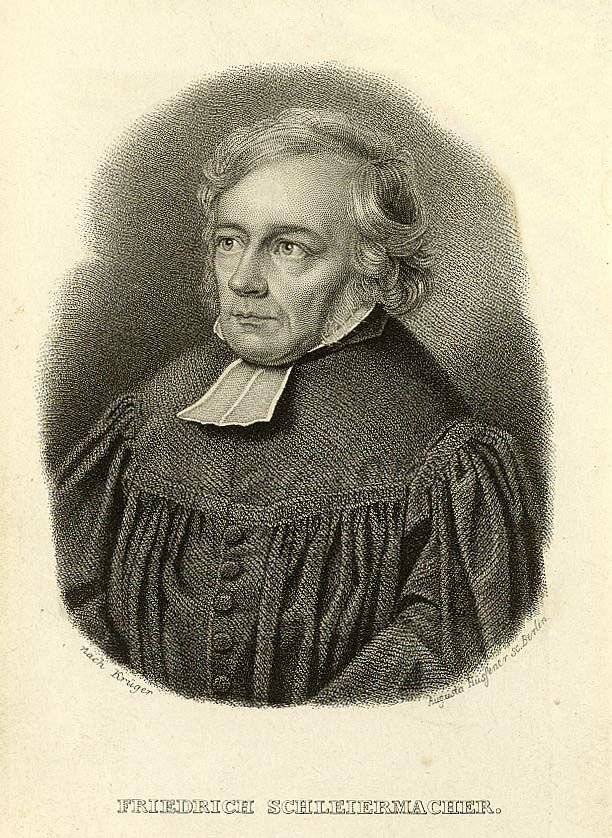
Friedrich Daniel Ernst Schleiermacher (/ˈʃlaɪərmɑːxər/; German: [ˈfʁiːdʁɪç ˈʃlaɪɐˌmaxɐ]; 21 November 1768 – 12 February 1834) was a German Reformed theologian, philosopher, and biblical scholar known for his attempt to reconcile the criticisms of the Enlightenment with traditional Protestant Christianity. He also became influential in the evolution of higher criticism, and his work forms part of the foundation of the modern field of hermeneutics. Because of his profound effect on subsequent Christian thought, he is often called the "Father of Modern Liberal Theology" and is considered an early leader in liberal Christianity. The neo-orthodoxy movement of the twentieth century, typically (though not without challenge) seen to be spearheaded by Karl Barth, was in many ways an attempt to challenge his influence. As a philosopher he was a leader of German Romanticism.
Born in Breslau in Prussian Silesia as the grandson of Daniel Schleiermacher, a pastor at one time associated with the Zionites, and the son of Gottlieb Schleiermacher, a Reformed Church chaplain in the Prussian army, Schleiermacher started his formal education in a Moravian school at Niesky in Upper Lusatia, and at Barby near Magdeburg. However, pietistic Moravian theology failed to satisfy his increasing doubts, and his father reluctantly gave him permission to enter the University of Halle, which had already abandoned pietism and adopted the rationalist spirit of Christian Wolff and Johann Salomo Semler. As a theology student, Schleiermacher pursued an independent course of reading and neglected the study of the Old Testament and of Oriental languages. However, he attended the lectures of Semler and became acquainted with the techniques of historical criticism of the New Testament, and of Johann Augustus Eberhard from whom he acquired a love of the philosophy of Plato and Aristotle. At the same time, he studied the writings of Immanuel Kant and Friedrich Heinrich Jacobi and began to apply ideas from the Greek philosophers to a reconstruction of Kant's system.
Schleiermacher developed a deep-rooted skepticism as a student and soon rejected orthodox Christianity.
Brian Gerrish, a scholar of the works of Schleiermacher, wrote:
In a letter to his father, Schleiermacher drops the mild hint that his teachers fail to deal with those widespread doubts that trouble so many young people of the present day. His father misses the hint. He has himself read some of the skeptical literature, he says, and can assure Schleiermacher that it is not worth wasting time on. For six whole months there is no further word from his son. Then comes the bombshell. In a moving letter of 21 January 1787, Schleiermacher admits that the doubts alluded to are his own. His father has said that faith is the "regalia of the Godhead," that is, God's royal due.
Schleiermacher confessed: "Faith is the regalia of the Godhead, you say. Alas! dearest father, if you believe that without this faith no one can attain to salvation in the next world, nor to tranquility in this—and such, I know, is your belief—oh! then pray to God to grant it to me, for to me it is now lost. I cannot believe that he who called himself the Son of Man was the true, eternal God; I cannot believe that his death was a vicarious atonement."
At the completion of his course at Halle, Schleiermacher became the private tutor to the family of Friedrich Alexander Burggraf und Graf zu Dohna-Schlobitten (1741–1810), developing in a cultivated and aristocratic household his deep love of family and social life. Two years later, in 1796, he became chaplain to the Charité Hospital in Berlin. Lacking scope for the development of his preaching skills, he sought mental and spiritual satisfaction in the city's cultivated society and in intensive philosophical studies, beginning to construct the framework of his philosophical and religious system. Here Schleiermacher became acquainted with art, literature, science and general culture. He was strongly influenced by German Romanticism, as represented by his friend Karl Wilhelm Friedrich von Schlegel. That interest is borne out by his Confidential Letters on Schlegel's Lucinde as well as by his seven-year relationship (1798–1805) with Eleonore Christiane Grunow (née Krüger) (1769/1770–1837), the wife of Berlin clergyman August Christian Wilhelm Grunow (1764–1831).
Though his ultimate principles remained unchanged, he placed more emphasis on human emotion and the imagination. Meanwhile, he studied Spinoza and Plato, both of whom were important influences. He became more indebted to Kant though they differed on fundamental points. He sympathised with some of Jacobi's positions, and took some ideas from Fichte and Schelling. The literary product of that period of rapid development was his influential book, Reden über die Religion (On Religion: Speeches to Its Cultured Despisers), and his "new year's gift" to the new century, the Monologen (Soliloquies).
Hub AI
Friedrich Schleiermacher AI simulator
(@Friedrich Schleiermacher_simulator)
Friedrich Schleiermacher
Friedrich Daniel Ernst Schleiermacher (/ˈʃlaɪərmɑːxər/; German: [ˈfʁiːdʁɪç ˈʃlaɪɐˌmaxɐ]; 21 November 1768 – 12 February 1834) was a German Reformed theologian, philosopher, and biblical scholar known for his attempt to reconcile the criticisms of the Enlightenment with traditional Protestant Christianity. He also became influential in the evolution of higher criticism, and his work forms part of the foundation of the modern field of hermeneutics. Because of his profound effect on subsequent Christian thought, he is often called the "Father of Modern Liberal Theology" and is considered an early leader in liberal Christianity. The neo-orthodoxy movement of the twentieth century, typically (though not without challenge) seen to be spearheaded by Karl Barth, was in many ways an attempt to challenge his influence. As a philosopher he was a leader of German Romanticism.
Born in Breslau in Prussian Silesia as the grandson of Daniel Schleiermacher, a pastor at one time associated with the Zionites, and the son of Gottlieb Schleiermacher, a Reformed Church chaplain in the Prussian army, Schleiermacher started his formal education in a Moravian school at Niesky in Upper Lusatia, and at Barby near Magdeburg. However, pietistic Moravian theology failed to satisfy his increasing doubts, and his father reluctantly gave him permission to enter the University of Halle, which had already abandoned pietism and adopted the rationalist spirit of Christian Wolff and Johann Salomo Semler. As a theology student, Schleiermacher pursued an independent course of reading and neglected the study of the Old Testament and of Oriental languages. However, he attended the lectures of Semler and became acquainted with the techniques of historical criticism of the New Testament, and of Johann Augustus Eberhard from whom he acquired a love of the philosophy of Plato and Aristotle. At the same time, he studied the writings of Immanuel Kant and Friedrich Heinrich Jacobi and began to apply ideas from the Greek philosophers to a reconstruction of Kant's system.
Schleiermacher developed a deep-rooted skepticism as a student and soon rejected orthodox Christianity.
Brian Gerrish, a scholar of the works of Schleiermacher, wrote:
In a letter to his father, Schleiermacher drops the mild hint that his teachers fail to deal with those widespread doubts that trouble so many young people of the present day. His father misses the hint. He has himself read some of the skeptical literature, he says, and can assure Schleiermacher that it is not worth wasting time on. For six whole months there is no further word from his son. Then comes the bombshell. In a moving letter of 21 January 1787, Schleiermacher admits that the doubts alluded to are his own. His father has said that faith is the "regalia of the Godhead," that is, God's royal due.
Schleiermacher confessed: "Faith is the regalia of the Godhead, you say. Alas! dearest father, if you believe that without this faith no one can attain to salvation in the next world, nor to tranquility in this—and such, I know, is your belief—oh! then pray to God to grant it to me, for to me it is now lost. I cannot believe that he who called himself the Son of Man was the true, eternal God; I cannot believe that his death was a vicarious atonement."
At the completion of his course at Halle, Schleiermacher became the private tutor to the family of Friedrich Alexander Burggraf und Graf zu Dohna-Schlobitten (1741–1810), developing in a cultivated and aristocratic household his deep love of family and social life. Two years later, in 1796, he became chaplain to the Charité Hospital in Berlin. Lacking scope for the development of his preaching skills, he sought mental and spiritual satisfaction in the city's cultivated society and in intensive philosophical studies, beginning to construct the framework of his philosophical and religious system. Here Schleiermacher became acquainted with art, literature, science and general culture. He was strongly influenced by German Romanticism, as represented by his friend Karl Wilhelm Friedrich von Schlegel. That interest is borne out by his Confidential Letters on Schlegel's Lucinde as well as by his seven-year relationship (1798–1805) with Eleonore Christiane Grunow (née Krüger) (1769/1770–1837), the wife of Berlin clergyman August Christian Wilhelm Grunow (1764–1831).
Though his ultimate principles remained unchanged, he placed more emphasis on human emotion and the imagination. Meanwhile, he studied Spinoza and Plato, both of whom were important influences. He became more indebted to Kant though they differed on fundamental points. He sympathised with some of Jacobi's positions, and took some ideas from Fichte and Schelling. The literary product of that period of rapid development was his influential book, Reden über die Religion (On Religion: Speeches to Its Cultured Despisers), and his "new year's gift" to the new century, the Monologen (Soliloquies).
Recent media